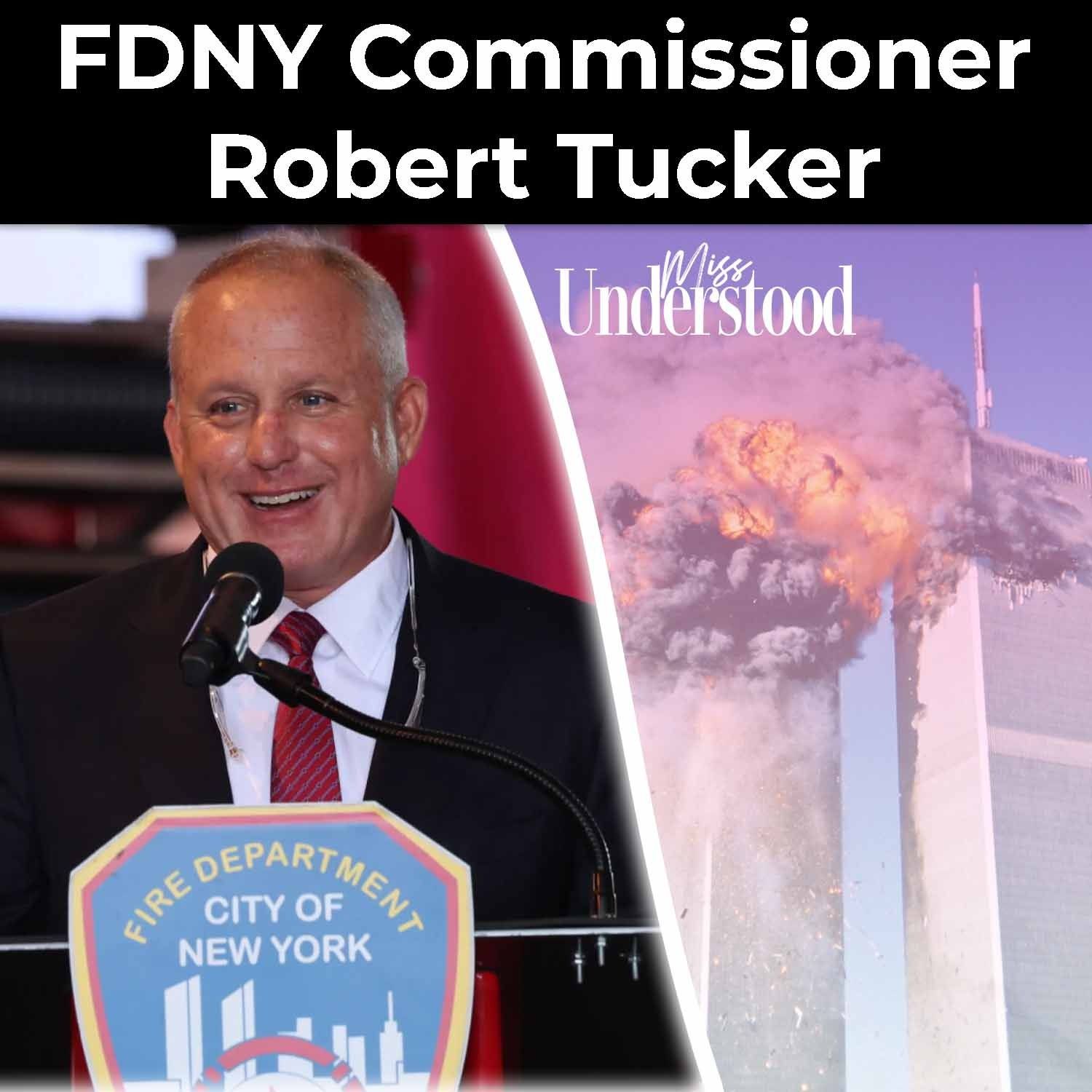
Honoring 9/11 with FDNY Commissioner Robert Tucker
September 11th is a day that forever changed the world — and for me, it is deeply personal. I lost my fiancé on that day, and each year I reflect on the courage, sacrifice, and resilience of the FDNY, who lost 343 of their own in the line of duty.
In this special episode of Miss Understood, I sit down with FDNY Commissioner Robert S. Tucker, the 35th Fire Commissioner of New York City. Commissioner Tucker’s story is unique — he never served as a firefighter, but his lifelong connection to the department and his new role leading the FDNY give him a profound perspective on legacy, culture, and the future of public safety.
Together, we talk about what it means to inherit the weight of the FDNY’s history, the department’s priorities moving forward, and how the legacy of 9/11 continues to shape its mission today. After our conversation, Commissioner Tucker gave me the honor of visiting one of New York’s firehouses — a moment that left me humbled, emotional, and more connected than ever to the sacrifice made by these heroes.
What You’ll Hear in This Episode:
• The personal and professional journey that led Robert Tucker to become Fire Commissioner
• How the FDNY continues to honor and carry forward the legacy of 9/11
• Challenges and changes facing the department under new leadership
• The human side of the FDNY — brotherhood, resilience, and generational service
• My personal reflections on visiting a firehouse where nearly every member was lost on 9/11
This episode is both a tribute and a reminder: remembering isn’t passive — it’s about carrying forward the lessons, courage, and humanity of that day.
If this conversation moved you, please subscribe, rate, and share this episode to honor the memory of 9/11 and the ongoing resilience of the FDNY.
Hosted by Simplecast, an AdsWizz company. See pcm.adswizz.com for information about our collection and use of personal data for advertising.
Available Results
Generated results are saved to the knowledge database for reuse and search.
Extract Knowledge
Pick what you want extracted first. Model, scope, and chapter options appear after a template is selected.
Transcript
[SPEAKER_02]: Today, on misunderstood with Rachel, you could tell.
[SPEAKER_02]: I think it's fascinating that you've done all these different leadership roles.
[SPEAKER_02]: Explain the day-to-day of what the commissioner does.
[SPEAKER_03]: I'm the CEO of the fire department.
[SPEAKER_03]: It's the largest fire department in the country.
[SPEAKER_03]: And then this building started to rumble and come down.
[SPEAKER_03]: And I was in big trouble.
[SPEAKER_03]: I'm banging on the door.
[SPEAKER_03]: I can't breathe.
[SPEAKER_03]: It's completely dark.
[SPEAKER_03]: A police officer I knew opened the door, and by the grace of God, I lived.
[SPEAKER_02]: My fiance at the time had been there for the 93 bombing, and even after the second plane hit, which was his building, I could see that he was above where it hit.
[SPEAKER_03]: We have a counterterrorism center within the fire department.
[SPEAKER_03]: Everything is changed, but we will never forget, and that's the key.
[SPEAKER_03]: Everything we do every single day.
[SPEAKER_03]: We remember those who came before us and who made the ultimate sacrifice.
[SPEAKER_02]: Welcome back to Misunderstood.
[SPEAKER_02]: I'm your host, Rachel, you could tell.
[SPEAKER_02]: Well, September 11th is not just a date on the calendar, as we all know.
[SPEAKER_02]: It is a wound, a memory, and for so many of us, a defining moment we carry in our bones.
[SPEAKER_02]: On this day, we remember the 343 firefighters who ran toward danger when the rest of the world was running away.
[SPEAKER_02]: We honor their courage, their sacrifice, and the families and colleagues who continue to live with that loss every single day.
[SPEAKER_02]: The FDNY is more than a department.
[SPEAKER_02]: It's a symbol of resilience, duty, and service.
[SPEAKER_02]: And today, as we mark another anniversary of 9-11, I wanted to sit down with the one man who now leads that institution.
[SPEAKER_02]: Commissioner Robert Tucker.
[SPEAKER_02]: Commissioner Tucker's path is unusual.
[SPEAKER_02]: He never wore the gear of a firefighter, but he's been connected to the department since his teenage years.
[SPEAKER_02]: From his first internship in Manhattan's Communications Office to his decades in the FDN Y Foundation Board.
[SPEAKER_02]: He's a lawyer, a security executive, and now the 35th fire commissioner of New York City responsible for guiding the department through a new era of challenges.
[SPEAKER_02]: We'll talk about what it means to inherit the weight of this legacy, the controversies and changes that come with leadership, and the vision he's setting for the future, everything from faster emergency response to the wellness of the men and women who serve.
[SPEAKER_02]: But most importantly, we'll reflect on the culture of bravery, brotherhood and sacrifice that was steered into the FDNY's identity on 911 and how that legacy continues to guide the department today.
[SPEAKER_02]: For me, this conversation was deeply personal, as many of you know, I lost my fiancé on September 11th, and this day will always hold a sacred place in my heart.
[SPEAKER_02]: To sit down with Commissioner Tucker, it was not just an interview, it was an honor.
[SPEAKER_02]: And afterward, he invited me in my fiancé, Dan, to visit one of the firehouses, walking through those doors, seeing the pictures of the fallen on the walls, an entire house nearly wiped out in 2001.
[SPEAKER_02]: It was overwhelming.
[SPEAKER_02]: I had to
[SPEAKER_02]: And yet, the house was also live filled with energy and camaraderie, caring for the spirit of those who were lost.
[SPEAKER_02]: In fact, one of the children of a firefighter who died that day now proudly serves in that very firehouse.
[SPEAKER_02]: Remembering isn't passive.
[SPEAKER_02]: It's about caring for the lessons.
[SPEAKER_02]: The heroism and the humanity of that day.
[SPEAKER_02]: And there's no better time and no better voice to help us do that than Commissioner Tucker.
[SPEAKER_02]: Because a lot of people, I don't really think they know what the FDNY commissioner does.
[SPEAKER_02]: What does that even mean?
[SPEAKER_02]: So I really want to get into it.
[SPEAKER_03]: It's hard to work to talk about it.
[SPEAKER_02]: You know what firemen do, but they don't know much about who's running it and paying attention and telling them what to do.
[SPEAKER_02]: So anyway.
[SPEAKER_02]: Let's start if you're okay with Introducing who you are as a person where you came from where you were born kind of family.
[SPEAKER_03]: You were born in yeah So I'm a lifelong New Yorker.
[SPEAKER_03]: I was born at Lennox, Ohio Hospital on 77th Street, which is still there I spent a lot of time
[SPEAKER_03]: in New York City, in private school.
[SPEAKER_03]: I went to Fielston and graduated, went to GW and graduated.
[SPEAKER_03]: I went to Pace University Law School at night while I was working as a prosecutor or as a paralegal specialist assistant to the district attorney, and then became a prosecutor.
[SPEAKER_02]: When you were little, did you plan fire traffic light?
[SPEAKER_03]: Yeah, yeah, yeah, you laugh.
[SPEAKER_03]: It's not so funny.
[SPEAKER_03]: The funny thing is that child who a dream's really can become adult reality, and I used to chase fire engines on my bicycle with a scanner.
[SPEAKER_03]: Oh, no way.
[SPEAKER_03]: And there was a firehouse on 85th street.
[SPEAKER_03]: I grew up on 83rd street, you know, back in the early 1980s when I was riding a bike alone
[SPEAKER_03]: You know, there were no cell phones.
[SPEAKER_03]: My parents didn't know where I was.
[SPEAKER_03]: And I had this little four-channel scanner.
[SPEAKER_03]: But I didn't even need it because I would chase the fire engines out of the fire house and just chase them down, Lexington Avenue, or wherever they were going.
[SPEAKER_03]: And I loved the fire department so much that my mom
[SPEAKER_03]: who was Mayor Koch's assistant got me a summer internship in the FDNY, and most kind of cool during my swearing in as fire commissioner, I had the ID card of 15 year old Robert Tucker.
[SPEAKER_03]: Oh no way.
[SPEAKER_03]: And so it's pretty cool.
[SPEAKER_03]: Interestingly, there are a few people, one in particular, who I knew back then, who's still in the fire department, but I started as an intern and, and along the way, I became a trusty of the FDNY foundation and always had a great interest in FDNY and now I'm the fire commissioner.
[SPEAKER_02]: Why do you think you never became a fireman?
[SPEAKER_03]: Oh, my mom wouldn't let me.
[SPEAKER_03]: She wouldn't just let some.
[SPEAKER_02]: She thought it was too dangerous.
[SPEAKER_03]: Yeah, I think she and my dad had a different idea of sort of the path I was going to take.
[SPEAKER_03]: And they had a lot of influence over me.
[SPEAKER_02]: Right.
[SPEAKER_02]: Now before you took this role, can you just leave people a little bit through all the jobs you had and kind of the path Yeah, I mean, it's actually I wish it was more complicated.
[SPEAKER_03]: When I when I graduated from college, I was hired
[SPEAKER_03]: at the Queen's District Attorney's Office.
[SPEAKER_03]: I was a non-law employee of the office and served as Special Assistant to the late Great Richard A. Brown, the District Attorney of Queen's County.
[SPEAKER_03]: And I went to law school at night, and I became a lawyer in 1996, and I passed the bar.
[SPEAKER_03]: And I was an assistant DA until I had this idea
[SPEAKER_03]: in 1999.
[SPEAKER_02]: And what kind of security company is that?
[SPEAKER_03]: So, so interestingly, you know, you always have a plan and then you, you know, the best smartest brightest people execute perfectly on it.
[SPEAKER_03]: My original idea was that I knew lots and lots of cops because I was an assistant DA, and they were all working moonlighting off duty.
[SPEAKER_03]: And I thought, let me organize that better.
[SPEAKER_03]: It's seen you know, one guy was working at a supermarket.
[SPEAKER_03]: They were, you know, one guy was working as a chauffeur.
[SPEAKER_03]: One guy was working at Tiffany's.
[SPEAKER_03]: Some of it was on the book.
[SPEAKER_03]: Some of it wasn't on the book.
[SPEAKER_03]: Some of them did it with permission from the police department.
[SPEAKER_03]: Other people just took the risk.
[SPEAKER_03]: And I said, you know, I can, I can organize this.
[SPEAKER_03]: I'll be the ADP if you owe the back office.
[SPEAKER_03]: There was no ADP at the time, but I'll be the back office for cops who want to work off duty.
[SPEAKER_03]: I'll do all the paperwork and I'll do exactly what ADP does.
[SPEAKER_03]: It's skim a little fee off of their compensation.
[SPEAKER_03]: That was the original plan.
[SPEAKER_03]: And then I met a detective from the Midtown South Detective Squad named Bob Trada, who is the TNTNM, just celebrated his 80th birthday, and he's a palm-beacher, and he had a very small company called TNM, Trada and Maloy.
[SPEAKER_03]: They were two detectives in the squad.
[SPEAKER_03]: and they were providing off duty cops to the New York Stock Exchange for security.
[SPEAKER_03]: And they had one or two other accounts like that.
[SPEAKER_03]: But nothing, the real company was we hire and employ off duty cops at the New York Stock Exchange.
[SPEAKER_03]: And I thought, you know what, let me, let me talk to him because that sounds interesting.
[SPEAKER_03]: So it's kind of what I want to do, let me, let me get involved with him.
[SPEAKER_03]: And he was great, and he, John Maloy, had already exited the company.
[SPEAKER_03]: And he's like, look, let's make a deal.
[SPEAKER_03]: You buy the company.
[SPEAKER_03]: It was very small at the time, and I will work for three years with you and then it's yours.
[SPEAKER_03]: Do what you want, and that's the setup only only the three years, you know, 99, 2000 and 2001, when 9, 11 happened, everybody in New York City wanted off to decops, and I had them, and that changed the whole.
[SPEAKER_03]: business.
[SPEAKER_02]: Wow.
[SPEAKER_02]: Right.
[SPEAKER_02]: So we'll go back to 911 and 1 second.
[SPEAKER_02]: Two things.
[SPEAKER_02]: It's so interesting, because you bring up your childhood and Manhattan, I was born in Anchorage, Alaska, but I moved here when I was five, and I'm 50.
[SPEAKER_02]: So I remember, similar, you could run around the streets of New York, especially as a female, and there was no fear anything was gonna happen to you.
[SPEAKER_02]: My mom didn't even know where the hell I was.
[SPEAKER_02]: And I had a single, you know, I grew up with a single mother.
[SPEAKER_02]: So like, there was no one really there to watch me.
[SPEAKER_02]: She was working too job.
[SPEAKER_02]: She was getting her MBA, I guess at night,
[SPEAKER_02]: And I was raised by a housekeeper and I don't even know how I got through it.
[SPEAKER_02]: I remember the days flying my dad lived in Alaska flying from New York City to Alaska on an airplane as a child with no cell phone.
[SPEAKER_02]: How did kids even do that about that?
[SPEAKER_02]: I remember.
[SPEAKER_03]: I remember.
[SPEAKER_03]: I remember.
[SPEAKER_03]: I'm a product of it.
[SPEAKER_03]: Yeah.
[SPEAKER_03]: And my sister and I joke about it all the time and you're right.
[SPEAKER_03]: there was a payphone in the lobby of my door man building and occasionally not often but occasionally my mom would call that payphone and say have you seen Robert or have you seen Amy and that would be the extent to which they could keep tabs on us but you know
[SPEAKER_03]: It feels like there was less trouble to get into.
[SPEAKER_03]: Right.
[SPEAKER_03]: And what was the worst thing that might happen?
[SPEAKER_03]: I might come home with a black eye or a bloody nose.
[SPEAKER_03]: Right.
[SPEAKER_03]: And you know, occasionally that happened.
[SPEAKER_03]: But for the most part, we were really good kids.
[SPEAKER_02]: Right.
[SPEAKER_02]: And there weren't that many I do remember I went to Nightingale for it.
[SPEAKER_02]: So I went to a private school.
[SPEAKER_03]: I went down students.
[SPEAKER_02]: Right.
[SPEAKER_02]: Okay.
[SPEAKER_02]: So and, you know, I remember a couple of times hearing about abductions and they became a very big story, but they were, they were a gigantic story.
[SPEAKER_02]: Yeah.
[SPEAKER_03]: You know, it was.
[SPEAKER_02]: It was few and far between.
[SPEAKER_03]: yeah and that you know there was like some trouble makers in my neighborhood on 84th street there was a there was Mimi's pizza on back to internet 84th street there was a place where you could play video games there and there that was a place you could sort of find trouble would find a guy like me
[SPEAKER_03]: But again, you know, you weren't getting shot, right?
[SPEAKER_03]: You weren't getting stabbed.
[SPEAKER_03]: Now, the New York City is a lot safer today than it has been in a long time.
[SPEAKER_03]: And I'm not just saying that because I'm a public official, I'm saying that because it's true.
[SPEAKER_03]: So I don't want people to sample today.
[SPEAKER_03]: You go out and get shot instead.
[SPEAKER_03]: But it just, it felt different.
[SPEAKER_03]: Now,
[SPEAKER_03]: to contrast what I just said, do you remember that you'd wake up in the morning?
[SPEAKER_03]: We had a dog, so I had to walk the dog because my parents didn't want to walk the dog.
[SPEAKER_03]: Of course, I had sex with my family.
[SPEAKER_03]: And every morning there were cars broken into and the radio was being seen.
[SPEAKER_02]: I was just going to say the only thing I remember is the radio and then the commercials for the thing you had the club, they had to put on the car.
[SPEAKER_03]: So you had that?
[SPEAKER_02]: Yeah.
[SPEAKER_03]: And no doubt that was problematic.
[SPEAKER_03]: And remember the radio that started to pull out of the car and everybody was walking around the car radio.
[SPEAKER_03]: So it was just a different time.
[SPEAKER_03]: But nevertheless, I have three children and they're all here in the city now with me this summer and they're working in different ways.
[SPEAKER_03]: And they're on the subway and I'm nervous about it.
[SPEAKER_03]: And I'm not nervous again.
[SPEAKER_03]: Crime is at its all-time low in New York.
[SPEAKER_02]: Which some people don't understand, especially because of what happened a couple days ago.
[SPEAKER_03]: Yeah, and we can talk about that.
[SPEAKER_03]: I was there, and it's obviously, it shook me.
[SPEAKER_03]: And I think it's, it's been very difficult for a lot of people on a lot of levels.
[SPEAKER_03]: me included.
[SPEAKER_03]: But anyway, I worry about them.
[SPEAKER_03]: And I think I worry about them more than my parents worried about me and my sister.
[SPEAKER_03]: And I can access them immediately.
[SPEAKER_03]: Like, as soon as they get off the train, they text me that at work.
[SPEAKER_03]: And that's a feature that our parents or you
[SPEAKER_02]: I just think back then there wasn't a lot of fear like if it happened it didn't seem like it happened to you or anyone You knew you read about it in the post and that was the extent of it kind of back then I think Rudy Giuliani did do a great job of cleaning the city up for a number of years Especially leading up to 9-11 and people did feel safer and today the things that happened are so much more extravagant You could have even come up with back then.
[SPEAKER_02]: I mean a guy walking in with a massive gun like that and just taking people out wasn't even that
[SPEAKER_02]: I don't think there was something people would have thought about that.
[SPEAKER_03]: I mean, you know, unfortunately this type of incident is happening more frequently than then we want to talk about.
[SPEAKER_00]: Yeah.
[SPEAKER_03]: The problem is that it's it's rare.
[SPEAKER_03]: for you and me to have it happen on Park Avenue in 51st Street in 345 Park, that's house, you know, houses blackstone and the NFL and KPMG and other big companies.
[SPEAKER_03]: And, you know, when you shut your eyes, you picture 51st Park, you don't even live in New York City anymore and you can picture for some Park.
[SPEAKER_03]: So there's that part of the the invasiveness of that, that incident,
[SPEAKER_03]: you had a very sort of wide spectrum of victims there.
[SPEAKER_03]: You'd a police officer, which is obviously, you know, remarkably horrible and an assault on the rule of law and all the things that this country can't tolerate.
[SPEAKER_03]: But you had a young Cornell...
[SPEAKER_03]: graduate who went to AAA camp and, you know, some are camp and, you know, mom is a well-known doctor here in New York City and, you know, a lot of people knew her or her sister.
[SPEAKER_03]: Um, you had a fabulous rising star, Blackstone executive young woman, who was the U.J.
[SPEAKER_03]: Honorary and who's just, you know, a complete rock star in probably one of the most important and greatest firms in the world, Blackstone, just wiped out, you know, you, you, you, you, you, you.
[SPEAKER_02]: And by the way, two young kids, and it has been her daughter within my daughter's pocket
[SPEAKER_03]: But then you had a security officer in the lobby of the building, you know, and you have, if there's another victim that was very seriously wounded, the point is that the spectrum is, is, is, is, you know, it is, it is, it is, it is, it is, it is, it is, it is, it is, it is, it is, it is, it is, it is, it is, it is, it is, it is, it is, it is, it is, it is, it is, it is, it is, it is, it is, it is, it is, it is, it is, it is, it is, it is, it is, it is, it is, it is, it is, it is, it is, it is, it is, it is, it is, it is, it is, it is, it is, it is, it is, it is, it is, it is, it is, it is, it is
[SPEAKER_03]: not to in any way take away from a classroom full of kids, but it's just a classroom, you know, it gets lumped as one.
[SPEAKER_03]: Today was the funeral for this young woman just starting her life
[SPEAKER_03]: I'm trying to, you know, in some ways when we talk about my job, I am the consolar and chief of the FDNY as well, but I'm also a dad and I'm trying to console my children.
[SPEAKER_03]: through, through a horrific incident and it's inexplicable, it's, I don't have the vocabulary to explain to anyone a firefighter, an EMT, a paramedic or my daughter.
[SPEAKER_03]: What the heck happened?
[SPEAKER_03]: Yeah.
[SPEAKER_03]: How does a guy drive from Nevada?
[SPEAKER_03]: and just start spraying bullets like what's going on.
[SPEAKER_02]: Yeah, but you know, I have a question because with your security background and obviously what you do now, you know, we started to see this with the United Healthcare assassination.
[SPEAKER_02]: Now something like this.
[SPEAKER_02]: How could they have prevented that?
[SPEAKER_02]: What are the ways that people can even do anything?
[SPEAKER_02]: Because at this point, it's like, I know I've been in that building.
[SPEAKER_02]: I've been in buildings like that, where the security is really tough.
[SPEAKER_02]: You can't go upstairs unless you go through, you show your ID.
[SPEAKER_02]: They tell you what floor you're going to.
[SPEAKER_02]: You have to be on the list.
[SPEAKER_02]: You can't even get to the elevator and go upstairs unless your name is approved.
[SPEAKER_02]: But that's one kind of security.
[SPEAKER_02]: But if someone walks in with a gun, that's forget all of that.
[SPEAKER_02]: That goes up in the air.
[SPEAKER_02]: So how do you prevent something like that?
[SPEAKER_03]: You know, I think if I knew I would just go that quick now and go sell that, I don't know is the answer what I have some thoughts about it first of all.
[SPEAKER_03]: What it shows you is, even when you're doing it really well, like the Ruden Management Company was doing it 345 Park, terrible things can happen.
[SPEAKER_03]: And fire is an interesting thing too when it comes to terrible things can happen because
[SPEAKER_03]: you know, you can do a lot of things well and and just fire can can get away from you so I'm learning that as the fire commissioner, but but that building you know had a lot of of security enhancements in it and and the tenant space was built in a way that seemed to have been thoughtful around security.
[SPEAKER_03]: yet you know you get a guy who blows away everybody in the lobby he walks onto an elevator it's it's goes to 33 33's nowhere near where it now we know he was looking for the NFL right he's nowhere near the NFL 33 and and he kills this young woman
[SPEAKER_03]: Just, you know, with no regard to her life and to what she might have been, and then kills himself, and kills himself thoughtfully because he shoots himself in the chest.
[SPEAKER_03]: So as not to disturb his brain, which is the whole premise of what it appears he was there for, from these football injuries he suffered as a young man.
[SPEAKER_03]: Honestly, I'm still trying to get my arms around the events.
[SPEAKER_03]: I was there.
[SPEAKER_03]: Our firefighters, EMTs, Paramedics, we're all very involved with the NYPD.
[SPEAKER_03]: We have a rescue task force that searches the building.
[SPEAKER_03]: firefighters, EMTs, and paramedics, and full ballistic vests with the cops because if they come upon a victim that needs life saving support, that's the fire department's stop.
[SPEAKER_03]: And so, so we were really working hand in glove with what is our SWAT team in New York, the NYPD Emergency Services Unit, the SRG and CRC, these are especially units in the police
[SPEAKER_03]: And I'm very, very, very, very proud of the first responders.
[SPEAKER_03]: I mean, you know, it didn't save the lives of those who were taken from us that evening, but
[SPEAKER_03]: but they did it the way they practice and train every day.
[SPEAKER_02]: Yeah, yeah, and it's interesting because, you know, in preparing for crisis and security issues like that, you know, the obvious is to think of the terrorist attacks and the people from the outside, but you can't always prepare for the crazy or the people like
[SPEAKER_02]: Um, you know, in the United healthcare issue and this issue where they were trying to make a statement.
[SPEAKER_02]: They were trying to show that, you know, you wanted people to look at his brain, talk, make more awareness about, you know, playing football and what it does to you.
[SPEAKER_02]: And so, I mean, it is interesting because you cannot always prepare and plan ahead for that kind of whether it's crazy or or that kind of mentality.
[SPEAKER_03]: I mean, this is gonna sound like I'm giving advice to the next guy that wants to do this, but if that's really what you want to do, he could have walked on that plaza, killed himself, right there in front of everybody, and probably gotten exactly the same amount of attention for the issue, CTE.
[SPEAKER_03]: That's exactly right.
[SPEAKER_03]: You took the words out of my mouth without killing a police officer and people in the prime of their lives, hard-working security guard in the lobby.
[SPEAKER_03]: I mean, you didn't have to do that to accomplish.
[SPEAKER_03]: and to your point, maybe accomplish more.
[SPEAKER_02]: Right.
[SPEAKER_02]: Yeah.
[SPEAKER_02]: OK, let's get into what you do for a living now.
[SPEAKER_02]: I think it's fascinating that you've done all these different leadership roles.
[SPEAKER_02]: So explain the day-to-day of what the commissioner does.
[SPEAKER_03]: Look, I'm the CEO of the fire department, it's the largest fire department in the country.
[SPEAKER_02]: Are you the only one that's had this job that's never been a fireman?
[SPEAKER_03]: No, no, and in fact, look, I'm not saying it because I am that it's split maybe 50, 50 minutes.
[SPEAKER_03]: You don't have to have that experience.
[SPEAKER_03]: Look, I come from a place where I think the best executive of
[SPEAKER_03]: a big agency like the FDNY could be someone who didn't grow up there.
[SPEAKER_03]: That doesn't mean I'm the best, it just means that the skills that I bring to running and partnering really with the fire chiefs and the number of my deputies, but I bring
[SPEAKER_03]: Not to, in any way, and I know the lanes I belong in, the lanes I don't, but ultimately I'm responsible for the day-to-day operations of the largest fire department and the largest emergency medical service ambulance service in the country.
[SPEAKER_02]: I don't think I knew that they went hand-in-hand.
[SPEAKER_03]: Yeah.
[SPEAKER_03]: Well,
[SPEAKER_03]: They don't always, and they didn't always in New York, but they do now, and that's one of the big challenges I have is because for 25 years they've been under one umbrella agency, FDNY, but I don't think we've ever adequately merged the two, the fire service and the EMS service together.
[SPEAKER_03]: And I think we could, you know, we're going to be forced to do it.
[SPEAKER_03]: I mean, AMS is the biggest crisis in public safety in America that nobody's talking about, because, you know, honestly, nobody wants to be an EMT, because we just don't treat them well.
[SPEAKER_03]: Mm-hmm.
[SPEAKER_03]: And, and, and, and, and, and, and, and, and, and, and, and, and, and, and, and, and, and, and, and, and, and, and, and, and, and, and, and, and, and, and, and, and, and, and, and, and, and, and, and, and, and, and, and, and, and, and, and, and, and, and, and, and, and, and, and, and, and, and, and, and, and, and, and, and, and, and, and, and, and, and, and, and, and,
[SPEAKER_03]: the in New York City, as I said, it's a national problem, but in New York City, we're talking about 1.6 million calls for service a year, almost 5,000 calls a day.
[SPEAKER_03]: And so what that amounts to is you just going from call to call to call all day.
[SPEAKER_03]: And you don't have time to go to the bathroom.
[SPEAKER_03]: You don't have time to eat lunch.
[SPEAKER_03]: And when you take 10, 15, 20 minutes to try to catch your breath,
[SPEAKER_03]: You know, my supervisors are telling you to take it back, we're holding 40 calls, so you gotta get back in the answer them.
[SPEAKER_03]: And so, I think we have to really rethink how pre-hospital care is delivered to
[SPEAKER_03]: everyone in the country.
[SPEAKER_03]: And there are states and cities and villages that are doing it more creatively than we're doing it in New York City.
[SPEAKER_03]: And I'm trying very hard working with anyone who will work with me frankly, but particularly, you know, big companies like Google for AI and
[SPEAKER_03]: and Oracle and lots and lots of big-name companies, but even Amazon, if they can deliver toothpaste to my house in an hour.
[SPEAKER_03]: Then they know something about moving packages around that I could learn from.
[SPEAKER_02]: But do you think it's just that they have more vehicles, more staff?
[SPEAKER_03]: I mean, I think that's relevant, but I think there's an optimization that's going on and an efficiency quotient that's going on that's working better than mine.
[SPEAKER_03]: Right.
[SPEAKER_03]: And, you know,
[SPEAKER_03]: Part of why I really love this job is that I finally have the confidence to say that I know what I know and I know what I don't know and to admit that this is a really hard problem to solve and nobody in my job and I'm the 35th New York City Fire Commissioner.
[SPEAKER_03]: But nobody has tackled it, and nobody has solved it.
[SPEAKER_03]: And I'm trying as hard as I can to sort of set the table, preheat the oven, season the food, get it in the oven.
[SPEAKER_03]: And then if I get to eat it, that'd be wonderful.
[SPEAKER_03]: But if I don't, the next person will have to eat it.
[SPEAKER_02]: Right.
[SPEAKER_02]: So, but do you see the solution?
[SPEAKER_02]: Or is it about you can't figure it out yet?
[SPEAKER_02]: But there's got to be a solution.
[SPEAKER_03]: I think it's a multi-pong solution that's going to involve right-share services like Uber and Lyft.
[SPEAKER_03]: I think that we're going to have to figure out how to better deal with the booboos that we deal with, which is a lot of what 1.6 million calls amount to.
[SPEAKER_03]: many, many, many, many calls a day or just because the person needs a ride to the hospital, because they can't afford to get there themselves.
[SPEAKER_03]: And we've got to, we've got to look at it for what it is and be honest about it and be honest about our capacity to deal with it and also be able to say to you, hey, we're not going to be able to get there fast.
[SPEAKER_03]: We're going to, we're, if you really
[SPEAKER_03]: if we come to you for a spraying ankle or a scrape on your knee and we do that a lot then we miss the cardiac arrest and someone dies and that's heavy and and that keeps me up at night and and I want to try to solve it and and I don't know that we have ever really attacked it.
[SPEAKER_02]: Yeah I mean this is such an ignorant question probably but I have no idea.
[SPEAKER_02]: How does it work when somebody calls 911?
[SPEAKER_02]: Are there ambulances just wait lying and wait like an Uber waiting for their night?
[SPEAKER_02]: We call or do they are they attached to a hospital and they have to bring the person to that hospital?
[SPEAKER_03]: No, no they're just waiting and we want to take them to the closest hospital and that's actually something I have been experimenting with because we always take
[SPEAKER_03]: the sickest patients to the closest appropriate emergency room.
[SPEAKER_03]: If you're having a heart attack, we've got to get you to the hospital fast.
[SPEAKER_03]: So we get you to the closest hospital.
[SPEAKER_03]: And if you were in a very bad car accident and you're a trauma patient, we want to get you to the closest trauma center.
[SPEAKER_03]: But if you're...
[SPEAKER_03]: not seriously injured.
[SPEAKER_03]: We still have to take you.
[SPEAKER_03]: We can't abandon you.
[SPEAKER_03]: And so, but what we have been doing at FDNY for a long time is saying, well, you want to go to Lennox Hill Hospital.
[SPEAKER_03]: We'll take you there.
[SPEAKER_02]: I see.
[SPEAKER_03]: And what I've decided is... And that travel time can just take away from... It is that we're going to try to go within 10 or 15 minutes of where you are and that's it.
[SPEAKER_03]: And because I know an instance where a guy with plenty of means was working on Wall Street and he wanted to go to Mount Sinai Hospital because that's where his doctor was.
[SPEAKER_03]: So on the way up the FDR Drive he passed.
[SPEAKER_03]: Beek bin downtown hospital, he passed Bellevue, he passed NYU Langeon, he passed Lennox Hill, he passed New York Presby, he got off the highway, 96th street metropolitan hospital right there, passed that one right across to Madison and got to Mount Sinai in about 30 minutes, and now that ambulance, which belongs at Wall Street, is now at 100th street in Madison.
[SPEAKER_03]: and they never get back downtown, but also they're it's just we're not we're not a ride chair service.
[SPEAKER_03]: We're not we're not a taxi.
[SPEAKER_03]: You know, if you if you can if you can do that just call an Uber right or let us call one do you do you think that people assume that if they come in an ambulance they're going to get served in the ER quicker.
[SPEAKER_03]: I do but I think they're wrong.
[SPEAKER_03]: And ultimately, I am working very closely with the CEOs of the five big hospitals in New York, and we're going to have to figure out together because this is everybody's problem.
[SPEAKER_03]: It's not just mine.
[SPEAKER_03]: And all the common denominator for the five hospital systems and me is that
[SPEAKER_03]: But there's an economic quotient here too which has to do with getting patients into the emergency department because those hospitals get paid for that and I've got to figure out how to how to how to please a lot of people but ultimately in the job that I'm in currently the most important thing to me is it's just bringing patients to the closest
[SPEAKER_02]: Okay, so you said there's around 5,000 calls a day to 911, right?
[SPEAKER_02]: How many of those are fire related?
[SPEAKER_03]: Yeah, so that doesn't include fire.
[SPEAKER_02]: Okay.
[SPEAKER_03]: However, what we've now started is that our fire engines are supporting our our ambulances.
[SPEAKER_03]: Okay.
[SPEAKER_03]: And so about 50% of what our big beautiful red trucks are doing is going to
[SPEAKER_03]: EMS calls and so that's a whole new thing because they can get their fast.
[SPEAKER_02]: But only if it's deemed important enough.
[SPEAKER_03]: Yes, exactly.
[SPEAKER_03]: They're not going to be better cars.
[SPEAKER_03]: They're not going to boo booze, but they're backing up our ambulances.
[SPEAKER_03]: And that's working pretty well.
[SPEAKER_03]: I think it could work better.
[SPEAKER_03]: I have some ideas around that.
[SPEAKER_03]: I have to deal with the unions that represent the firefighters and the fire officers and the EMTs and the paramedics.
[SPEAKER_03]: Look, unlike in my past life on a home-mine owned business, I now,
[SPEAKER_03]: even though I'm the fire commissioner and I'm the head of this great organization, it's not as easy to get things done as it was at TNM.
[SPEAKER_02]: Right, yeah, there's a lot more people to go to.
[SPEAKER_03]: There's a lot of bureaucracy, and a lot of red tape, and a lot of constituencies to please.
[SPEAKER_03]: And it's very frustrating.
[SPEAKER_03]: And I cannot more highly recommend to my peers.
[SPEAKER_03]: Take us sabbatical from what you're doing and come to government and do something really meaningful.
[SPEAKER_03]: pick an agency, you know, if, if, if they want to do that, they'll how hard is that to get?
[SPEAKER_03]: I think it's, I think it is hard.
[SPEAKER_03]: I think, you know, I've, I'm only the 35th person to run the New York City fire department in 160 years.
[SPEAKER_03]: And so, so it's, it's, it's, it's hard.
[SPEAKER_03]: It's, you know, it's a, you know, it's a select few, but I don't know that we have enough smart people coming to government.
[SPEAKER_01]: Yeah.
[SPEAKER_03]: And we've got a lot of complainers out there who are like, what's going on with
[SPEAKER_03]: all right.
[SPEAKER_02]: You know, so your job is something that is appointed by the mayor.
[SPEAKER_02]: Correct.
[SPEAKER_02]: All right.
[SPEAKER_02]: So it's not like you're running on a platform.
[SPEAKER_03]: No, no, no.
[SPEAKER_03]: I'm not political.
[SPEAKER_02]: Okay.
[SPEAKER_02]: And so what happens then if when when and if the mayor changes, do you get?
[SPEAKER_03]: I serve at the pleasure of the mayor and and I'm it's been the honor of a lifetime to be the New York City fire commissioner and I have Eric Adams to thank for that and and you know my plan is to work for him.
[SPEAKER_03]: Okay.
[SPEAKER_02]: if somebody else becomes mayor, how does it work though?
[SPEAKER_02]: They appoint someone else or you could potentially stay.
[SPEAKER_03]: I could potentially stay, you know, that doesn't, in their certain jobs, like mine and the police department and maybe one or two others that are usually
[SPEAKER_03]: given to people that the mayor knows, and so I think it would be unlikely that the next mayor wants to keep me, but I'm, you know, not going to, to open on whether that will happen or won't happen right now.
[SPEAKER_03]: As I said, I'm honored to work for mayor Adams.
[SPEAKER_02]: And you love your job.
[SPEAKER_03]: This is the greatest job, but I can't imagine there is a better job than New York City Fire Commissioner.
[SPEAKER_03]: The fire service is this brotherhood of the most amazing human beings you've ever met.
[SPEAKER_03]: And they're different than the people who I worked for.
[SPEAKER_03]: at TNM.
[SPEAKER_03]: And they're just, they're just really happy.
[SPEAKER_03]: There's a lot of soulfulness in the
[SPEAKER_03]: Absolutely, and they get to do, I mean, there are firefighters, many, many, with many, many, with well over 30 years on the job.
[SPEAKER_02]: Yeah.
[SPEAKER_02]: And we don't see that in a lot of history.
[SPEAKER_03]: That's the point of making that, you know, they just stay, they just love it.
[SPEAKER_03]: You know, they know each other's families, it's a, it's a, a firehouse is a house.
[SPEAKER_01]: Yeah.
[SPEAKER_03]: they sleep there, they eat there, they sit at the kitchen table and solve the world's problems.
[SPEAKER_03]: And certainly, you know, solve their own problems.
[SPEAKER_03]: The best medical advice comes at the kitchen table, the best divorce advice comes at the kitchen table, the best legal advice, anything you need happens at the kitchen table in a firehouse.
[SPEAKER_02]: How many firehouses are there in Manhattan?
[SPEAKER_03]: Well, there's about 240 in the city.
[SPEAKER_03]: Don't forget it's Manhattan, Brooklyn Queens, Staten Island in the Bronx.
[SPEAKER_03]: So there's about 245 houses.
[SPEAKER_03]: There's another 40 or so EMS stations.
[SPEAKER_03]: it's big.
[SPEAKER_03]: I mean, it's almost 18,000 employees and about a $3 billion budget.
[SPEAKER_02]: And again, maybe another ignorant question.
[SPEAKER_02]: But is it like, you know, a baseball team where you get moved to another house?
[SPEAKER_02]: Yeah.
[SPEAKER_02]: Do you stay with one for three years?
[SPEAKER_03]: Yeah.
[SPEAKER_03]: I mean, I think for the most part, you get to stay where you're assigned.
[SPEAKER_03]: Okay.
[SPEAKER_03]: We detail firefighters from a more rural area to a more urban area, everyone's well for about a year, so that they just learn how to be high-rise firefighters as opposed to house firefighters, but plenty of firefighters are in the same fire company for.
[SPEAKER_03]: years and years, and they become the senior man there, and they, they, is that the goal?
[SPEAKER_03]: Yeah, I mean, I mean, they're, that's not the goal, but it happens and, and, you know, while, and look, you can get promoted to Lieutenant and Captain and Battalion Chief and Deputy Chief, and so, but, but, and that's when you get moved, but, but,
[SPEAKER_03]: But even, you know, you could get a young lieutenant that has a senior man in the firehouse and it's almost like an officer and an enlisted man in the military, you know, the enlisted senior man has has a lot of cloud even though he's not an officer.
[SPEAKER_02]: Is there something that most of these men possess and women possess that come into this field?
[SPEAKER_02]: Is it something that they followed in their parents' footsteps?
[SPEAKER_02]: This is something they didn't want to go overseas and sign up into the military, but they want to fight for their country.
[SPEAKER_03]: Well, I think it's a lot of that.
[SPEAKER_03]: And we get a lot of veterans that come back and come onto the FDNY.
[SPEAKER_03]: We have some absolutely phenomenal women firefighters.
[SPEAKER_03]: absolutely unbelievable just just great and they fit in you know this notion that they're they're ostracized to like one side of the firehouse it's not true at all there's welcome at the kitchen table as anybody in fact they they they bring a whole new element of of conversation and an experience set um
[SPEAKER_03]: One of the most enjoyable parts of my job is the ability to just show up at a far-house.
[SPEAKER_03]: And you know, I don't just show up, but you know, I'll call a few minutes away and say, hey, I'm on my way.
[SPEAKER_03]: Make sure the place looks nice.
[SPEAKER_03]: And I have coffee at the kitchen table with them and we talk and it's just it's so special.
[SPEAKER_03]: There's there's something special going on in the FTNY.
[SPEAKER_03]: that if I could really describe it, I'd write about it because it is worthy of a people of pride and some people have done it very well, but my experience has just been very special.
[SPEAKER_02]: You took this role, I think, correct me if I'm wrong in August last year.
[SPEAKER_02]: So you've already been through a September 11th day.
[SPEAKER_02]: This will be your second one.
[SPEAKER_02]: What is the preparation that goes into the celebration or the moment of love?
[SPEAKER_03]: I mean, September's a very hard month for the FDA and why.
[SPEAKER_03]: As you roll out of August, we know it's coming.
[SPEAKER_03]: there's something in the air that's just not normal, and, you know, when that on that day where 343 New York City firefighters are killed, and it's an extraordinary number of lives lost.
[SPEAKER_03]: but it's not just the number, it's who, the entire leadership team, the most specialized special firefighters, the the the the best of the best of the best and and
[SPEAKER_03]: it hurts.
[SPEAKER_03]: It feels, in fact, it feels different for me now talking about it and it did because I wasn't, I didn't have both my feet on the ground in September.
[SPEAKER_03]: I had just been sworn in of, I was a fire commissioner for a month.
[SPEAKER_03]: But today, it hurts me to even talk about it, and what hurts even more is the astronomical number of firefighters who have died of illnesses that they got in the recovery effort.
[SPEAKER_03]: hundreds, hundreds.
[SPEAKER_03]: And the number of firefighters who are sick.
[SPEAKER_01]: Yeah.
[SPEAKER_03]: They're going to be hundreds and hundreds more.
[SPEAKER_03]: You're going to, we've, we've already passed 343 now, but you're going to get to 567, 800,000 more firefighters who tried to find their brothers under the rubble.
[SPEAKER_03]: Right.
[SPEAKER_03]: We're going to die as a result of it.
[SPEAKER_03]: Right.
[SPEAKER_02]: It's incredible.
[SPEAKER_03]: It's unfathomable.
[SPEAKER_02]: What?
[SPEAKER_02]: So on September 11th, there are it's a full day of events.
[SPEAKER_02]: How much of that are you involved in?
[SPEAKER_03]: Yeah, I mean, I start very early in the morning that there's a firefighter memorial upon Riverside Drive.
[SPEAKER_03]: There's a mass at a firehouse up in up near there.
[SPEAKER_03]: Um, then I come down because I want to be down at the site by about 8.8.15 and we, we bring the bells to, to honor uh, the exact time in which both planes, um,
[SPEAKER_03]: crashed into the buildings.
[SPEAKER_03]: We read the names of those who were killed not just firefighters, but everybody that was in the buildings.
[SPEAKER_03]: Are there for that whole name?
[SPEAKER_02]: How did they, I've always wondered, how did they pick?
[SPEAKER_02]: It's always family members, right?
[SPEAKER_02]: That are reading the name, and they just, every year.
[SPEAKER_02]: It's just good.
[SPEAKER_03]: Yeah, I mean, look, it's almost 25 years since that day.
[SPEAKER_03]: And...
[SPEAKER_03]: you know, some parents aren't alive anymore, some, some, some people only go to the milestone days, 25 years, 20 years, 15 years.
[SPEAKER_03]: You know, time has moved on, and, but it has not moved on for the FDNY, it is a solemn, miserable,
[SPEAKER_03]: heartache, really difficult time for us.
[SPEAKER_03]: And I said it earlier, you know, as in my capacity as the consolar in chief of the FDA and why, which I take very, very seriously, it's very heavy
[SPEAKER_03]: who I don't really know, but who my heart leads for, right?
[SPEAKER_02]: And who there is a sense of knowing and seeing them because of what they went through and you just feel that passion.
[SPEAKER_02]: What I have always thought was amazing and it's always very hard for me anyways, even to talk about, but
[SPEAKER_02]: walking by the firehouses in the month of September or the days before whenever they put out but people the people who died from that firehouse they usually have their pictures out.
[SPEAKER_02]: I don't do I don't know if they still do that.
[SPEAKER_03]: No, no we have memorials of firefighters in every firehouse
[SPEAKER_03]: for those who were working on 9-11, but sadly, we've lost firefighters for other reasons, and in the firehouse where they were, we have big plaques, pictures, some have, you know, their turnout code, so their helmets, it's really, uh,
[SPEAKER_03]: One of the real special parts of the FDNY is exactly is just how much they honor the fallen.
[SPEAKER_03]: And how important those members of our department
[SPEAKER_03]: today to the culture that we still honor.
[SPEAKER_02]: Yeah, it's been incredible to see how many children of those that were last in the 9-11 have become Fireman Fireland.
[SPEAKER_02]: Yeah, it's awesome.
[SPEAKER_02]: It's awesome, right?
[SPEAKER_03]: No, it's incredible.
[SPEAKER_03]: I mean that's that's it's so special, you know, have the honor of of swearing in a new probationary firefighters and of course I always know who they are.
[SPEAKER_03]: and I just, every single person that walks across that stage is very, very special, especially to me, some because they served in our armed forces, some because they, they, you know, have a dad, that's iconic, who, you know, they, they followed or grandpa,
[SPEAKER_03]: but the most special ones are the legacy children of the 9-11 fallen.
[SPEAKER_02]: Yeah, and it must be nice for you to be able to witness what their parents couldn't or what their father.
[SPEAKER_03]: Yeah, I mean it's just it's just it's just it's done so well.
[SPEAKER_02]: Yeah.
[SPEAKER_03]: And so respectfully.
[SPEAKER_03]: I mean, you know,
[SPEAKER_03]: I can't rave enough about what's going on inside FDNY and I'll tell you something that's interesting because I was a trustee of the FDNY foundation, I was an honorary fire commissioner of the City of New York.
[SPEAKER_03]: You think you know what's going on in FDNY.
[SPEAKER_03]: Trust me, I thought I knew what's going on inside this place.
[SPEAKER_03]: You know nothing.
[SPEAKER_03]: until you're part of it and you know even even I had some FDNY sweatshirts like I I wear the the the the garb that I get with such pride now it's it's not just because I'm a firebuff now it's because I'm a part of it and and I wear that patch with pride and with with a dignity
[SPEAKER_03]: There's something really extraordinary happening there and I'm very, very excited to talk about.
[SPEAKER_02]: Can you talk about your own experience with 9-11 and where you were?
[SPEAKER_03]: Yeah, so my 9-11 story really starts on September 10th.
[SPEAKER_03]: I was playing in a golf outing at purchase country club and I got a phone call from a guy named John O'Neill who was an FBI agent who had just taken the job as head of security for the World Trade Center and John and I were friendly.
[SPEAKER_03]: Um, you know, because because of the story, people think, oh, we were best friends.
[SPEAKER_03]: We were not best friends, but we were good, we're friends, and, and, and we saw each other four or five times a year socially, but not more, four times a year.
[SPEAKER_03]: And he called me and he said, hey, look, I have an opportunity for you in your, I was in the security business, and I said, John, I'm playing golf, and I'm, I'm, I'm a call into more.
[SPEAKER_03]: He's like, no, no, it's a today opportunity.
[SPEAKER_03]: So John, didn't skip me.
[SPEAKER_03]: I said, I'm at this really nice place purchase country club.
[SPEAKER_03]: It's, I don't want to hang out with the people after I'm going to shower, I don't have a couple cocktails, I'm going to eat some food, I'm going to go home.
[SPEAKER_03]: He's like, Robert, I'm going to wait for you.
[SPEAKER_03]: Much on this ridiculous but okay.
[SPEAKER_03]: So I shower up.
[SPEAKER_03]: I have a couple drinks.
[SPEAKER_03]: I go down to the world trade center.
[SPEAKER_03]: September 10th.
[SPEAKER_03]: It's pouring rain at this point.
[SPEAKER_03]: I go up to his office.
[SPEAKER_03]: He shows me his office.
[SPEAKER_03]: We talk.
[SPEAKER_03]: He tells me what the problem is.
[SPEAKER_03]: We're hanging out.
[SPEAKER_03]: He said, let's go up to windows on the world for a drink.
[SPEAKER_03]: September 10th.
[SPEAKER_03]: Up we go.
[SPEAKER_03]: It closes, we go back down his cars in the garage, mines on the street, I go out to the car that was driving me.
[SPEAKER_03]: And we were going to go up to a lanes on second Avenue.
[SPEAKER_03]: We go up to a lanes.
[SPEAKER_03]: We have a big dinner.
[SPEAKER_03]: We have a few more drinks.
[SPEAKER_03]: Now John's not driving.
[SPEAKER_03]: He's in the car with me where someone was driving us.
[SPEAKER_03]: And we go out to the China Club.
[SPEAKER_03]: And now we're at China Club and we agree that we're not going to start the job tomorrow and I call it off and we're hanging out and it's now September 11th and I decide it's time to go home and I left John there and the next morning was an election morning and I was voting
[SPEAKER_03]: And I heard about a plane hitting the World Trade Center.
[SPEAKER_03]: And I thought, wow, I bet I that's gonna be cool to see.
[SPEAKER_03]: I wanna go down and see that.
[SPEAKER_03]: I didn't think terrorism, I didn't think, and I thought, wow, you know, I'm a firebuff.
[SPEAKER_03]: I wanna see that.
[SPEAKER_03]: And so I got on the FDR Drive in my little BMW, and I drove down the FDR Drive and fell behind a police car that was going down.
[SPEAKER_03]: As I'm driving down the afternoon drive, just before the Brooklyn Bridge, you could see the world traits enter on fire, and I watched the second plane hit, and I thought, oh my God, this must be something wrong with the radar, the autopilot.
[SPEAKER_03]: I'm still not, I mean, I know I'm supposed to say to you and say, I thought terrorism right away.
[SPEAKER_03]: Nobody, I didn't.
[SPEAKER_03]: And, and I'm not, I'm honest.
[SPEAKER_03]: And I'm like, I literally thought something was wrong with whatever the avionics and it was causing planes to think they're at some altitude and they're not.
[SPEAKER_01]: Right.
[SPEAKER_03]: And so I just continued to go there.
[SPEAKER_03]: And I got out of my car and I walked there and I knew all the fire chiefs and I was saying hi to everyone and and and.
[SPEAKER_02]: And at this point, are they all just congregating downstairs?
[SPEAKER_03]: Yeah, there's massive amounts of firefighters coming in.
[SPEAKER_03]: People are leaving their meeting and I'm there because I can be.
[SPEAKER_03]: And I had been doing the security at the Stock Exchange and I was standing with my guys there and then we walked over and they walked back and walked over.
[SPEAKER_03]: And then this building starts of rumble and come down.
[SPEAKER_03]: and I was in big trouble and I was able to run to a side door of the wall worth building.
[SPEAKER_03]: And by the grace of God, I'm banging on the door.
[SPEAKER_03]: I can't breathe.
[SPEAKER_03]: It's completely dark.
[SPEAKER_03]: I'm with trying to breathe through my jacket.
[SPEAKER_03]: I was wearing a suit.
[SPEAKER_03]: I'm banging on the door and a police officer, I knew Kim Royster.
[SPEAKER_03]: Later, we came up police chief, but open the door.
[SPEAKER_03]: And she goes robber, not a Kim.
[SPEAKER_03]: And she came in the building, we shot the door, and she got some water and poured it on me and I lived.
[SPEAKER_03]: But what was so arbitrary about that day is who lived and who didn't live, because there were other people standing not far away from me, who ran in a different direction.
[SPEAKER_03]: And they're not here.
[SPEAKER_03]: And so that's my September 11th story.
[SPEAKER_03]: And look, I had a business, and a business run with an office by the stock exchange.
[SPEAKER_03]: And now we had no power, and we had no, you know,
[SPEAKER_03]: became a very big challenge to run.
[SPEAKER_03]: We were, I tried to, you know, there was no cloud.
[SPEAKER_03]: Right.
[SPEAKER_03]: If you weren't running your business out of the cloud, so we tried to take as much as we could when a payroll to make.
[SPEAKER_02]: It was a very, very, very, very, very, and it certainly won't happen to the guy that you had been out with the night before.
[SPEAKER_03]: He was killed.
[SPEAKER_03]: He was killed.
[SPEAKER_03]: Yeah.
[SPEAKER_02]: I'm so sorry.
[SPEAKER_03]: Yeah.
[SPEAKER_02]: Um, you know, I was working at Bloomberg at the time and I worked a 5 a.m.
[SPEAKER_02]: shift and I had just gotten back from Greece and I'll never forget waking up that morning and I was on Greece time so I was up even earlier at three in the morning and I said to my fiance or he was watching the weather channel actually when I came out when I was getting ready for work and he said, wow, it's going to be a beautiful day just as beautiful as when we were in Greece and
[SPEAKER_02]: So, going to work that day, you know, we all remember how beautiful and clear the day.
[SPEAKER_02]: It was out of nowhere, kind of, and uncovering the news, you know, working on a newsroom floor, there's hundreds of TVs everywhere, up top on our desks.
[SPEAKER_02]: We all have four TVs, you know, and the first plane hit, and every month, thought it was a little commuter plane.
[SPEAKER_02]: all the guys on air.
[SPEAKER_02]: A guy named Dylan Radigan who I'm still very close with was the anchor at the time caught on air.
[SPEAKER_02]: And most of the people that were in news at the time that we're doing live stuff were stuck on air until noon.
[SPEAKER_02]: So it really defined a lot of people's careers at the time and Dylan and everyone else was reporting.
[SPEAKER_02]: It was a commuter plane or something and it was an accident and
[SPEAKER_02]: You're right, like no one even thought that this could be terrorism.
[SPEAKER_02]: Yeah.
[SPEAKER_03]: And when the second... You didn't even know what terrorism really was.
[SPEAKER_03]: Right.
[SPEAKER_03]: You know, you had to be John O'Neill to who had been... The irony of John dying that morning.
[SPEAKER_03]: It's like he had been trying to tell the world.
[SPEAKER_01]: Yeah.
[SPEAKER_03]: after the coal bombing, and there's a really bad group of people who are trying to hurt us.
[SPEAKER_01]: Yeah.
[SPEAKER_03]: Don't forget we had a 93 bombing there as well.
[SPEAKER_03]: And so, but I don't think terrorism was what it is.
[SPEAKER_02]: Right.
[SPEAKER_02]: And even Andy, my fiance at the time, had been there for the 93 bombing.
[SPEAKER_02]: And he would tell, he told a story about how, you know, they told him not to go anywhere.
[SPEAKER_02]: He played poker with everybody.
[SPEAKER_02]: You worked at San Maronelle.
[SPEAKER_02]: And they played poker until they were allowed to go downstairs.
[SPEAKER_02]: So even after the second plane hit, which was his building,
[SPEAKER_02]: I could see that he was above where it hit.
[SPEAKER_02]: And so I, again, didn't come from a place of fear.
[SPEAKER_02]: I thought, oh, he'll just go up to the roof, you know, it.
[SPEAKER_02]: And none of us had, and this is a terrible word to use, but I believe at the creativity in our heads to think of building so you're going to fall.
[SPEAKER_02]: Yeah.
[SPEAKER_02]: That was not even if I grew.
[SPEAKER_03]: I just never dreamt that those buildings could collapse.
[SPEAKER_02]: So when that rumbling happened and you were down there and then this blackness happened did in your head were you like the building came down or you didn't know that.
[SPEAKER_03]: I was because I was running for my life because I don't know if you if you saw it, but this this this cloud of dirt and dust and
[SPEAKER_03]: the building was chasing me and it came over me.
[SPEAKER_02]: But you knew what it was then, you know.
[SPEAKER_03]: Yeah, I knew and I knew I was in big, big trouble.
[SPEAKER_03]: And I was in in survival mode.
[SPEAKER_03]: But I also have to say that I think I knew I was alive, and I was fairly uningered, and I thought there must be a million dead people behind.
[SPEAKER_03]: Yeah.
[SPEAKER_03]: I mean, look, it's an unacceptable thing to say, it was only... Yeah.
[SPEAKER_02]: But I know what you mean.
[SPEAKER_03]: But I thought there would be... Fifty thousand, hundred thousand dead people I couldn't imagine.
[SPEAKER_02]: Yeah.
[SPEAKER_03]: There wouldn't be.
[SPEAKER_03]: and it wasn't credible how many people did make it out and how many stories there were of it's the greatest rescue operation of all time of the fireman that made it upstairs and we're getting people down and this is the greatest rescue operation ever yeah and and it's it's the cops in the fireman and the port Authority
[SPEAKER_03]: they did it.
[SPEAKER_03]: And yes, they paid a breathtaking toll.
[SPEAKER_03]: But they did it.
[SPEAKER_03]: They really saved a lot of people.
[SPEAKER_03]: And sadly, I know that you suffered a huge loss.
[SPEAKER_03]: And so many people.
[SPEAKER_03]: But
[SPEAKER_03]: You know, I still sit here saying it's the greatest rescue operation of all time.
[SPEAKER_02]: Yeah.
[SPEAKER_02]: No, I agree.
[SPEAKER_02]: And it is interesting because it's like you were talking about before, I feel a kinship with, you know, I can walk by someone and if you hear them telling their story about who they lost on September 11th or they hear me talk about it, it's a closeness, you just can't express with anybody else.
[SPEAKER_03]: No, no, I know so many people whose lives have
[SPEAKER_03]: But who are our deeply scarred by what you, which I suspect you might be?
[SPEAKER_02]: Well, my life is much different now and it always, you know, we can all be healed to a certain extent.
[SPEAKER_02]: It's in my book.
[SPEAKER_02]: It's a deep scar.
[SPEAKER_02]: Just talking about it will, you know, make me very emotional because as a 26-year-old girl, it was terrible.
[SPEAKER_03]: Of course, I mean, uh, but it's, I hope.
[SPEAKER_03]: that it's terrible to talk about for you now because and then think about my role in the FDNY.
[SPEAKER_03]: It hurts me.
[SPEAKER_03]: It hurts me.
[SPEAKER_03]: And then
[SPEAKER_03]: 300 and 40 and we still talk to those families all the time they come to events.
[SPEAKER_03]: We see them.
[SPEAKER_02]: And then that upsetness isn't the tears isn't about necessarily my loss.
[SPEAKER_02]: It's about that feeling that a lot of people really just don't understand that what happened that day was so terrible and it was unexplainable and you know you hear about these things that happen all the time or you hear what happens when like buildings get blown up or people die and unless you're in it you know you can watch it on the news
[SPEAKER_02]: When it really affects your life, you can never recover from that.
[SPEAKER_03]: Part of what shook me so the other night on Park Avenue was that it was the first time, I think, that I felt some of the things I felt on September 11, 2001.
[SPEAKER_02]: I just
[SPEAKER_03]: You know, we initially didn't know how many shooters there were at the beginning.
[SPEAKER_03]: There was a report of multiple shooters in the building and I just thought, oh my God, here we go again on my watch, are you kidding me?
[SPEAKER_02]: Do you remember the building that collapsed a couple years ago in Miami in the middle of the night?
[SPEAKER_02]: Yeah, and that had nothing to do with terrorism, but I remember watching the news of 24 hour cycle.
[SPEAKER_02]: Where are these people are we going to recover?
[SPEAKER_02]: And it sent me back into remembering what that was like.
[SPEAKER_02]: and listening to the reporters talk to the family members that were standing outside waiting and saying, oh, I know that they must be down there somewhere.
[SPEAKER_02]: And that false sense of hope that you really have.
[SPEAKER_02]: And it really brought me back.
[SPEAKER_02]: And I had a daughter now, right?
[SPEAKER_02]: And my daughter's watching it with me.
[SPEAKER_02]: And I'm trying to explain to her, this is what I went through.
[SPEAKER_02]: I sat there and I believed and hoped maybe he would be found somewhere.
[SPEAKER_02]: Maybe he would, there would be someone who remembered what happened because
[SPEAKER_02]: knowing of those that person's last moments is just was the worst thing.
[SPEAKER_03]: I think being a parent also does factor into all.
[SPEAKER_03]: Yes.
[SPEAKER_03]: And what we want for our children and the life we want our children to have at least for me does play a role in this and I know that I think about it a lot in terms of the work I'm doing now and trying to leave the place better than it was when I found it.
[SPEAKER_02]: Well, okay, so speaking of that since 9-11, how has the FDNY changed like operationally prepared nest?
[SPEAKER_03]: Yeah, I mean, it's a really ultra modern sophisticated, all hazards, public safety agency.
[SPEAKER_03]: It's not just a fire department anymore, and so it's really,
[SPEAKER_03]: state of the art, including that we have a counterterrorism center within the fired department, thinking about preparedness and attacks of all types, and just the training, the equipment, the preparation, the thoughtfulness that we
[SPEAKER_03]: It is really something I think all New Yorkers should be very proud of.
[SPEAKER_03]: We learned a lot from September 11th, mistakes were made.
[SPEAKER_02]: If it happened again today, what would be different?
[SPEAKER_02]: What would you have changed?
[SPEAKER_02]: What do you guys prepared for now?
[SPEAKER_03]: I'm remembering that I'm not a firefighter, and I'm not an EMT or a paramedic.
[SPEAKER_03]: The staff of Chiefs that I have working with me today.
[SPEAKER_03]: are so keen to what happened and the lessons learned and so many incidents, you know, as recently as the wildfires in California, I sent a delegation of chiefs out to LA to learn.
[SPEAKER_03]: I mean, we're sending, we send fire department executives all over the world thanks to our
[SPEAKER_03]: to study and learn about what's happening and, you know, we were not going to have forest fires the way California does, but last summer we had some very significant brush fires in in prospect park.
[SPEAKER_03]: in inward park and upper Manhattan, I mean very significant.
[SPEAKER_03]: And so we have to learn and adapt and even even with that, you know, the bunker gear that our firefighters wear is structural fire bunker gear.
[SPEAKER_03]: You know, when we're in the woods fighting a brush fire in a park,
[SPEAKER_03]: Maybe we shouldn't be in 80 pounds of bunker gear.
[SPEAKER_03]: Maybe we shouldn't use the type of hoses we use to bring up into high-rise buildings to fight forest fires.
[SPEAKER_03]: How about apparatus?
[SPEAKER_03]: We need smaller, more nimble apparatus to get into parks where fire trucks just can't drive around.
[SPEAKER_03]: You know, unless it's central park, we can stay on the main road, but as you get through into the
[SPEAKER_03]: into some of the areas it's complicated and so and they're not a lot of fire hydrants in these parks and so we've got to we've got to bring water to it so so everything has changed everything has changed but we will never forget and that's the key.
[SPEAKER_03]: Everything is modern, sophisticated, lots and lots of training,
[SPEAKER_03]: but everything we do every single day, we remember those who came before us and who made the ultimate sacrifice.
[SPEAKER_02]: And I assume when you join the fire department, you have to take some sort of an oath.
[SPEAKER_02]: And do you think just as much these kids or men or women are all ready to step into that fire or that major crisis if it happens again?
[SPEAKER_03]: Absolutely.
[SPEAKER_03]: And you saw at the other night, an active shooter and a high-rise building.
[SPEAKER_03]: And you've got firefighters, EMTs, and paramedics in full ballistic, flat jackets.
[SPEAKER_03]: Tink, let me in there.
[SPEAKER_03]: I want to get in there.
[SPEAKER_02]: Okay, so last two questions, if you could speak directly to the families of those who were lost on 9-11, what's the next generation of firefighters?
[SPEAKER_02]: What would you say?
[SPEAKER_03]: Well, those are those are two different communities, really, and, and I do speak to, I do speak to them, and, and, and,
[SPEAKER_03]: tell them that they are not forgotten, and that there's a, in our fire academy on Randall's island, which is an amazing place, the picture of every single person who died on 9-11 from FDNYs on the wall, and our probies walk by that all the time, and they know it, and they salute it, and they honor it as do I.
[SPEAKER_03]: When I come to the academy, I look at that wall almost every time, and it's a little out of the way, and I go out of the way, because everything that I do as the New York City Fire Commissioner, I do in their honor.
[SPEAKER_03]: Right.
[SPEAKER_03]: As for the future, look, the future is very bright in the FDNY.
[SPEAKER_03]: because of the tradition, because of the culture, because of the job itself.
[SPEAKER_03]: You know, there is a calling to run into a burning building when people are running out.
[SPEAKER_03]: And there's a special type of person that comes down that pole and jumps on that fire truck.
[SPEAKER_03]: And there's a very special person who rides in that ambulance and meets you on your darkest day, in your worst moment, when you're sick, when you're not able to move on your own.
[SPEAKER_03]: And I'm just honored to work side by side with these people.
[SPEAKER_02]: Um, this episode's gonna come out on September 11th or today before, so as we mark another anniversary, what is one thing you hope listeners carry from them from this conversation or at this day that they'll be going through?
[SPEAKER_03]: Look, you know, we, we take September 11th, it's more than a, it's more than an anniversary.
[SPEAKER_03]: It's, it's, it's, it's, it's a day of reflection for us, it's, it's a, it's a, it's
[SPEAKER_03]: a day that we remember some some iconic people who worked in FDNY, really, you know, even our fire department chaplain was killed that morning.
[SPEAKER_03]: It's a it's a day that that that
[SPEAKER_03]: for the next hundred years here, my fire engines, the day, I love it, it's like music, it's a September 11th is special beyond words, and I hope.
[SPEAKER_03]: And this is the message that we honor that day in a way that is meaningful to those who are impacted by it.
[SPEAKER_02]: Yeah.
[SPEAKER_02]: Well, it's been such an honor to get to know you.
[SPEAKER_02]: Thank you.
[SPEAKER_02]: I really appreciate you.
[SPEAKER_02]: I appreciate you being so open and honest.
[SPEAKER_02]: You know, I won't forget your story.
[SPEAKER_02]: And I hope you have an easy day.
[SPEAKER_02]: Thank you.
[SPEAKER_03]: Thank you.
[SPEAKER_03]: Thank you.
[SPEAKER_02]: Thank you so much for listening to Ms.
[SPEAKER_02]: Understood.
[SPEAKER_02]: I'm your host, Rachel, you could tell.
[SPEAKER_02]: Please be sure to subscribe to the show and give us a five-star rating and review.
[SPEAKER_02]: You can support the show by joining our Patreon at patreon.com slash Ms.
[SPEAKER_02]: Understood with Rachel, you could tell.
[SPEAKER_02]: Do you have ideas for the show or want to reach out email us at info, Ms.
[SPEAKER_02]: Understood podcast at gmail.com.
[SPEAKER_02]: That's spelled m-is-s-s-understood.
[SPEAKER_02]: Thank you so much and I'll see you next time.