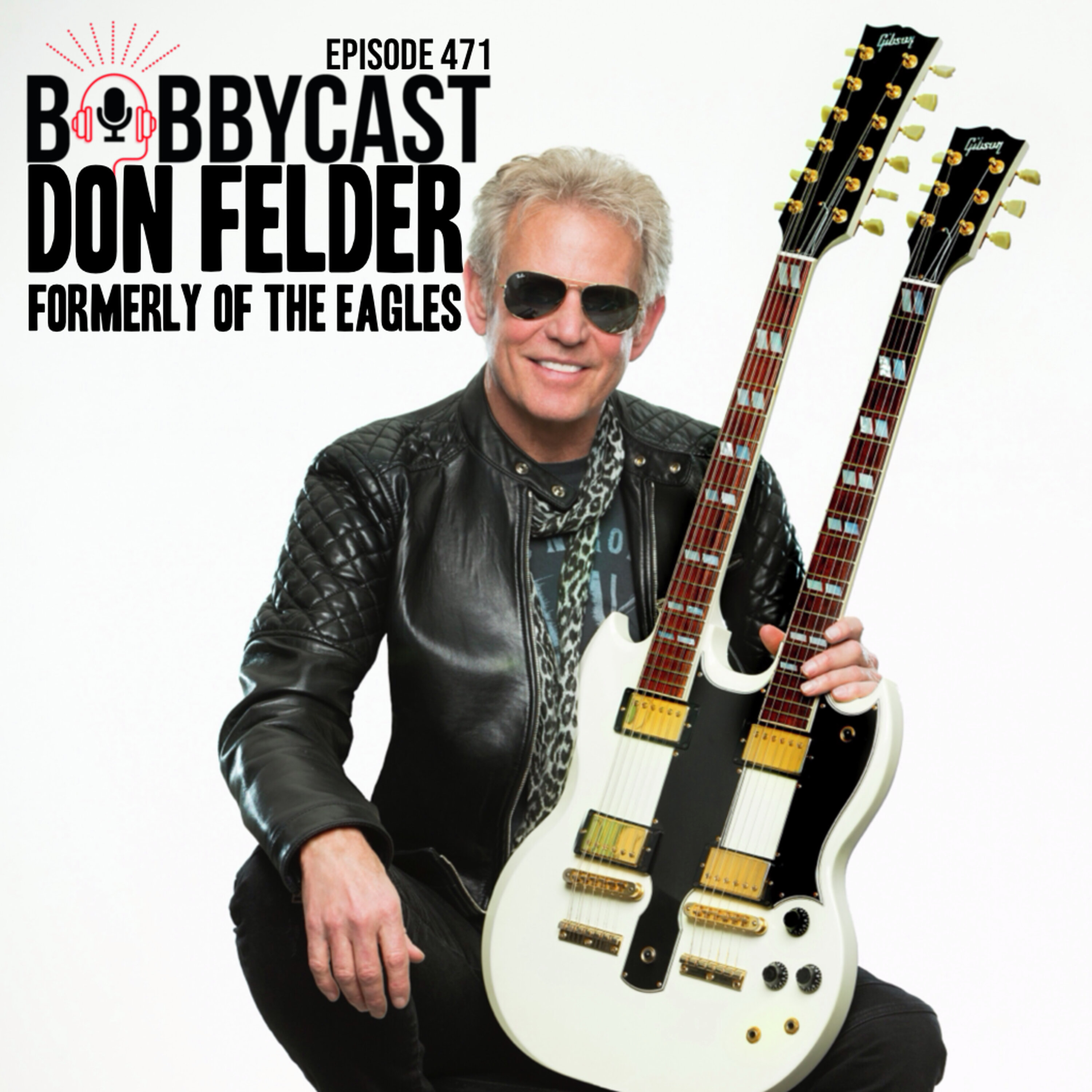
#471 - Don Felder Formerly of The Eagles on Untold Story Behind 'Hotel California'
On this episode of The Bobbycast, Don Felder, formerly of the Eagles, sat down with Bobby Bones to discuss his life after the band. Don shares the story behind their massive hit, "Hotel California," and how he wrote it. He also goes behind some of the band's biggest hits like "One Of These Nights" and "Take It To The Limit." He also tells us if he accepts free guitars, his music and touring plans for next year and more!
Follow on Instagram: @TheBobbyCast
Follow on TikTok: @TheBobbyCast
Watch this Episode on Youtube
See omnystudio.com/listener for privacy information.
Available Results
Generated results are saved to the knowledge database for reuse and search.
Extract Knowledge
Pick what you want extracted first. Model, scope, and chapter options appear after a template is selected.
Transcript
00:00:06
Speaker 1: Actually I saw a trombone player doing the solo for Hotel California, and trombon is like, this guy is a great player, but I can't imagine a sewer pipe players who he's.

00:00:17
Speaker 2: Playing no Hotel. So I watched it.

00:00:23
Speaker 3: Welcome to episode four seventy with Don Felder, formerly of the Eagles. He spent twenty seven years with the Eagles.

00:00:31
Speaker 2: He's the.

00:00:33
Speaker 3: Hotel California. Boom M. I got a text from him after this. Really yeah. So Don Felder, by the way, is like as royalty in the history of rock and roll music. Goes like he's one of those guys. So I got a message. They were like, hey, Don Felder would like to have your cell phone number. And I weigh that out and I go, well, I don't really give anybody a number, but two, I go, but Don Felder's never asked. So I was weighing it and I was like, it's Don Felder. It's not like he's gonna be hitting me up all the time. He's way cooler than I am. So he's and I think he was super cool. So I was like, go ahead and give him a number, and so he texted me and I don't think I am uh, you know, by jumping any boundary. You want to hear what he said. I do want to hear. Hey, Bobby, don Felder here. Been a little slow to text, but came home on Sunday. Leave again very soon. I've done thousands of interviews and I've been asked some of the same questions thousands of times, but your questions were so different and unique. I really enjoyed our chat. Thank you so much for having me on your podcast. Hope to stop it again next year when we're on tour. If you ever want to come to a show, please let me know. We'd love to have you out and your crew as guests. Next time. I'll bring a guitar so we could do a little picking and grinning.

00:01:43
Speaker 2: That's awesome.

00:01:44
Speaker 3: That's awesome that someone's like, I've an interviewed a bunch and you're weird. That's how I, in an unhealthy way, took it at first, But no, it's a compliment. I loved it. It was super cool to have Don Felder in. Check his Instagram out Don Felder music again. He spent twenty seven years with the Eagles. He is on tour until December. He released a record wrote to forever in twenty twenty. I don't know. I mean, he's just out. He's still killing it. He's like funny and with it. And I don't even know. I guess I didn't know how old I thought he would be.

00:02:19
Speaker 2: Is he seventy?

00:02:20
Speaker 3: I think so still looks like a rock star. Yeah, Like he looks cool, Like he's not trying extra hard to look cool because that's how it used to look. He just looks like a cool version of what you think he would look like now, if that makes sense. Yeah, Don Felder here, he is formerly of the Eagles. This was a really cool interview. Dona have about five thousand questions. So I'm glad that you came in. Been a fan for a long time, like just of your individual story and then obviously you're the group story of you with the Eagles and then post as well. It's like three different versions. Do you feel like you've lived three different careers? Because I feel like Eddie and I were talking about it earlier, we feel like it's like three different version of an artist. You feel that way about yourself?

00:03:01
Speaker 2: I do.

00:03:02
Speaker 1: It's actually, you know, growing up in Gainesville and being in an environment that musically doesn't exist. I mean, they had a white radio station that would only play white artists on the radio station growing up, But at night I could dial in WLAC in Nashville, Tennessee, and I could hear Little Richard screaming tooty fruity, and I could hear BB King, and I could hear Albert King. So I'd just beglued that radio. And they had a thing called Randy's Record mart I don't know ifnybody even remembers that. If you heard someone on that radio station that you liked, you could put a dollar or two dollars. I think it was in an envelope with your return address, and you could mail it to Reddy's Record mark. Then every day you'd start checking the mailbox. This is like the way used to download back in those days. That's funny, like super'slow Wi Fi. And finally the record would come with forty five by BB King, and I'd put it on a turntable and record it on a reel to reel tape recorder. It's seven and a half inches per second, and then once it was recorded, I'd slow it down to three and three quarters so I could hear the motions. I can hear the notes and the style of the playing. Yeah, but it's an ocative down, but you can hear the notes as he's going through it. You figure that out and then you can put it back up to speed and try to get your chops.

00:04:22
Speaker 2: Up to play it at the same speed he did.

00:04:24
Speaker 1: So you know, I got a call the other day, all about a year ago from the CEO of Gibson Company and he was at a NAM show down in Dallas and he says, don you got to hear this guy play Hotel California solo. I was like, oh, really, I got to hear it again. I said, okay, put him on. So this person starts playing and it's just amazing. He's got a note for note, vibratos in the right place, the tempos, the harmonies, the whole ending solo is amazing. I said, who is that and he said it's a.

00:04:58
Speaker 2: Ten year old boy.

00:04:59
Speaker 1: I went, no, oh kidding, So I said, put him on the phone. I had him tell me how he learned that. How did you learn that? I didn't even have a guitar until I was ten, and this guy's ripping through hotel he said. I got an iPad and I went on and watched you playing live, and I watched your fingers until I could speed it up to where I could play with He did your version of that. Just with today's technology, that's right, exactly right. But back then that was the only way to learn. We didn't even have a music story Gainsville when we grew up, so the only way you could learn is by your ear.

00:05:30
Speaker 3: So Christapleton's a decent friend of mine, and his song gets covered all the time. A lot of a songs do, but like Tennessee Whiskey, which is not his song but one that he covered and repopular and gets covered all the time. Are people constantly wanting you to hear covers of your songs? Like don listen to this? Does that happen a lot where I's like, listen to this player? Or not so much anymore, it happens a lot.

00:05:51
Speaker 1: Just if I'm going through Instagram or Facebook or something, there's all your TikTok. There's people that want to show me that they can play my solo, which is really flattering. You know, it's not an easy solo by any stretch of the imagination, but it is flattering for that many people to try to attempt there's Actually I saw a trombone player doing the solo for Hotel California on trombone. I was like, this guy is a great player, but I can't imagine a sewer pipe player.

00:06:19
Speaker 2: Who was playing.

00:06:22
Speaker 3: An hotel.

00:06:23
Speaker 2: So I watched it.

00:06:24
Speaker 3: Did you write about like when you wrote that We're on the beach?

00:06:27
Speaker 2: Like?

00:06:28
Speaker 3: Where did that come to you?

00:06:29
Speaker 4: Like that?

00:06:30
Speaker 3: Because it wasn't written as part of the whole song, right, didn't you write the intro to that song just kind of by itself.

00:06:35
Speaker 1: What happened was I had rented a house on a beach in Malibu. I had two little kids, one was about a year old and one was like two and a half.

00:06:43
Speaker 2: And I was sitting on the couch.

00:06:45
Speaker 1: It was just a beautiful sunny California day and the sun was glistening on the surf as it's coming in, and my kids were in the sand on the swing set, and so I have this guitar, acoustic guitar, and I'm just sitting there and I start playing this chord for great and about three or four times through the progression, I said I have to go in the back bedroom and record a little bit of it because if I don't record it tomorrow, I'll go what was that thing that was? So I run in a back bedroom record about I don't know, two or three times through the verse progression and just put it away. It was actually my one year old daughter's bedroom was my recording studio, fact that when she was away playing I could go in and Mike write demos and stuff anyway, So I recorded that, and then we started writing song ideas for the album that was untitled at the time that was going to be Hotel California. So I wound up writing sixteen or seventeen complete basic tracks where I would go in and take an idea like that little progression, and I'd fill it out and write a chorus part to it, and I'd play bass on it. And I had a little rhythm rhythm drum machine called a rhythm ace that you used to see on piano players and bars that they could set it to a chachaar send it to a beat. So I used that, and then I just overdubbed a bunch of stuff on this little four track tape recorder three to one, then fill up two more tracks and bout those three to one, and so it was mono at the time. As a matter of fact, I just I should have brought my laptop because I have a digital copy of it. I could play a little bit of it, and it sounds I played the beginning with a twelve string and then these electrics coming on the solo at the very end is pretty much like it is on the record, with the except exception of some walshisms. When Joe and I played together, we came up with just great, unique stuff. So I put that idea on a cassette with like fifteen or sixteen other song ideas. One became Victim of Love, and Henley liked that one that sounded like a Mexican reggae and so he was off and running writing lyrics to that song and came up with the lyric idea and lyrics for a Hotel California, which was on top of that music bed. So that's kind of how that all came together.

00:08:58
Speaker 3: And I didn't want to get you out right your book. As soon as it came out, Like the week it came out, I devoured it like I'm a literal fan. I knew the story about the beach. I was like, I don't know, I think it's a Beach, But I knew because I as soon as that book came out, I crushed. And it's really one of my favorite like music bio books ever, and I think it represents again we're just talking about back in your childhood, like Gainesville, Florida, what was your environment. What were you surrounded by musically in Gainesville that even created an interest to want to hear music that wasn't the typical white music that you got there, Like where was that coming from? Like that desire to learn and be around different kinds of music. There was nothing else to do. There was no internet.

00:09:38
Speaker 1: Television had three channels, you know, it's ABC, NBCCBS, and then they went off the air shortly after Sunset played The Starspangle by International Anthem.

00:09:47
Speaker 3: I was telling one of our people here like I caught the tail end of that in my life, and they were like, what the channel would go off? I was like, yeah, and then I'm gonna show the screen of his hold. Yeah.

00:09:56
Speaker 1: And there was no really individual entertainment you could do, so I wound up getting a guitar and just trying to figure out how it.

00:10:03
Speaker 3: Worked and how'd you get the guitar?

00:10:05
Speaker 1: What did they There was a kid that lived across the street from me, and up in the top of one of his closets, I saw an acoustic guitar and it had some broken strings on it. And my brother and I had just come back down from South Carolina and my favorite uncle had given us a box of cherry bombs, and we hit him in the trunk from my dad. My dad wouldn't let us play with those things. So when it would rain. We lived on a dirt road that was crowned and there was a ditch on both sides of the road for all the Florida run off, and to get from the road to your house, there was a big metal culvert that the water would run through underneath the driveway. So when it was raining and we would run out with these cherry bombs, light them and throw them upstream and tie them so they would float down into that culvert and then boom, blow up, and everybody would come running out to see what was going on, and we would be back in the house hiding. So this kid comes out doing and he says, oh, it's some of those cherry bombs. And I said, well, I'll give you a handful of these cherry bombs if you can get me that guitar that you have. We'll make a trade. So he runs back to his house, gets his guitar, brings it over. I give him the cherry bombs. Fifteen minutes later, cherry bombs are gone. But I got a guitar. We didn't have any money. That was the only way we could get started.

00:11:21
Speaker 3: Did you have an intro or was it like a natural knack with learning music or hearing music and being able to find the notes, and also you have to learn how to tune a guitar, which is difficult, Like, how did that education happen with you?

00:11:37
Speaker 1: Well, once I had a guitar, I didn't even know how to begin, where to begin. So there was a guy that lived about two or three blocks around the corner from me that I'd ride by his house on my bike and I'd see him sitting on his porch playing guitar. So I went over to his house one day with that guitar and it was missing two or three strings, and he said, well, you got to get some strings for this. I said, well, where do I get strings? He says, you got to go up to the drug store. There was no music store, so the drug store had these black diamond guitar strings, and you could buy one two or I had to buy three. So I had to get enough money mow and lawns and washing my brother's car and stuff to be able to go out and buy some strings. I took the strings and the guitar over to this guy's house. He showed me how to string the guitar and showed me how to tune it, and then he taught me this song called Red River Valley, which is like a real old fashioned country song. And I was off and running. I had three chords, C, F, and G, and that's all I needed learning F. That's a hard part. Well, I was CDG. Yeah, there was no F until later.

00:12:43
Speaker 3: No. I cheated with the four string AF, not the full bar or anything.

00:12:47
Speaker 4: Let's take a quick pause for a message from our sponsor, and we're back on the Bobby Cast.

00:13:01
Speaker 3: Do you start playing in Gainesville for your friends? When was the first time you played and got paid?

00:13:09
Speaker 1: I think shortly after I got I got a year or two. I must have been about fourteen or something, and I think a year or two into those early acoustics, my dad found a family who had bought a guitar, a Fender guitar, and a little tweed amp for the girl. And she complained because she had to cut her nails and it hurt her fingers because it just lived underneath their bed. And so he bought it from this family and brought it home to one day for me, and I was like.

00:13:40
Speaker 2: My god, this is amazing.

00:13:42
Speaker 1: And I was imitating everybody, Buddy Holly, Elvis, Presley, anybody I could get my hands on to learn their records and play a lecture guitar. And then I met this guy named Stephen Stills who was left somewhere in Florida there was a military academy, like a military school high school, who had run away from high school.

00:14:02
Speaker 3: And this is way before he was Steven Stills. Like, you just met that's just as a civilian, regular guy you meet Steven Stills. Yeah, Okay.

00:14:10
Speaker 1: He and I and Tom Petty and Bernie Ledden all went to the same high school. So when we were before we got to high school, he was in Gainesville and he played in this band with me called the Continentals, which a continental That thing was like really cool, you know. So anyway, so we started playing but teen time dances we wouldn't have really didn't get paid. It was just for the fun of being on the stage in a PA and playing and having a good time. But I think the first time we got played Steven paid, Stephen and I got in a car and my mom drove us to this little women's organization tea party where they have those little finger sandwiches and drink tea and stuff, and Steven and I would just play acoustic guitar for these women. I think we got ten dollars or something. We made five bucks apiece, you know, And from there it really wasn't ever about the money, to tell you the truth. It was just the love of playing and figuring out music and how does this work? And how do you write songs? And how do you know? I would get mill Bay guitar books and learn chords from el Bay and just kind of self educated all the way along.

00:15:17
Speaker 3: At what point, because you're talking about three absolute hall of famers, not even just like traditional sense rock and roll hall of fame, but like the greatest ever do anything musically with Steven Stills and Tom Petty and yourself. Do you guys all know you want to do it solo? Why'd you break up the band like that feels like a pretty solid band on.

00:15:38
Speaker 1: Well, Stephen left as soon as he graduated from high school. He was one year ahead of me. He left and moved to California, and I didn't see him until quite a few years later. I think he graduated in sixty four. Was it to do music though?

00:15:52
Speaker 3: When he left? Was he like, I'm going to go do music or was he just moving to California to see what happened with life?

00:15:56
Speaker 1: He knew that was his destiny. He got out to California. It wasn't how happening in the Southeast, it wasn't happening in New York. It was happening in California. So he was magnificently drawn out to California. And the next time I heard him was I was laying in bed one night and the radio was on and I heard for what It's Worth and I went, God, that voice sounds really for me. I know who is that? And they said it was Buffalo's Springfield, And I went and figured out who Buffalo Springfield was. Was released Stephen. And then the next time I actually saw him physically, he was on stage at Woodstock and I was in the crowd, and I went, that's Stephen still side Woodstock.

00:16:39
Speaker 3: So you were there watching, yeah, and you see your friend on stage nineteen sixty nine Woodstock. That's right, that's crazy. Was Woodstock for you as a fan? Was it as like wild and muddy and everything that we see or did you get the good version of it?

00:16:53
Speaker 1: I had enough fourth site to actually have gone to Woodstock with a guy who owned what it's called now travel All. It's like the predecessor to a suburban. It had box doors on the back that open, so we put a mattress in the back because it's out just in the middle of nowhere, right, and we brought an ice chest with drinks and food. And we were got there a day early, and we backed in so we could open those doors towards the stage even if it was pouring rain. We had shelter. We would try a comfy place to sleeve food with it. And then it was just great because I saw some of the most important, I think influential musicians in the history of rock. I saw Jimmy Hendricks, I saw Carlos Santana, saw Crosby Stills, Nash and Young Grateful Dad just on an on Jana's job for three solid days. It was probably the best music event that ever exploded on the planet. It just resonated all over the world. And as a matter of fact, I wrote a song about it on my last record, about how that event went on to influence decades after decades after decades of young people that love rock and roll and wanted to learn to play like that little ten year old in Texas and became famous decade after decade after decade.

00:18:12
Speaker 2: Is called American rock and roll.

00:18:14
Speaker 1: That's the title of my last album, And that song is about being at Woodstock and seeing the beginning of it.

00:18:19
Speaker 3: When you were at Woodstock and you're watching these great artists and you're inspired, but you were in the midst of the early part of your music career at the same time. Did you have a healthy professional jealousy or would you have been like me about like I should.

00:18:31
Speaker 1: Be up there, this sucks? I would say both. It was dependent on how much I was smoking at the time. If I was smoking, it was pretty mellow about it.

00:18:41
Speaker 3: See, I think I would have been completely jealous the whole time. But that's really cool that like you turned out to be really one of America's great musicians, but you were also there as a fan, probably at what was our greatest music event. Yeah, because you have that perspective of being a fan and watching it as well.

00:19:00
Speaker 2: Yeah.

00:19:00
Speaker 3: Man, I just think about how uddy it was. And he was in a freaking suburban. He was covered like he was a d Yeah.

00:19:06
Speaker 2: Don.

00:19:07
Speaker 5: So, you know, I always hear about the California sound. Back then, you talked about that a little bit, and everyone was going to California to make music. But in the sixties, you know, you think about California's Beach Boys. The Beach Boys had the California sound. In the seventies, you guys had the California sound. Did you ever think about that?

00:19:25
Speaker 1: Well, Yeah, because there was nobody except for Bernie Leaden that was in the Eagles that was from California. Don Hinley was from Texas. I was from Florida. Joe Walsh later joined. I think he was from Detroit or so Glenn was from Detroit. There was nobody in the band that had the California sound, but we somehow managed to be given the title of the new California Sound in the seventies.

00:19:50
Speaker 3: Yeah, and you embraced it. You felt like even though you know, not really a band full of Californians, Like, would you guys the word California sound?

00:20:01
Speaker 2: Well, we were making music in California, you know.

00:20:04
Speaker 1: So I do have to say that when the band first, even before I joined at Bernie Leden was a brilliantly gifted country musician. He played unbelievable flat top guitar, the best, one of the best five string banjo players I've ever seen in my life. He played pedal steel, he played mandolin. He was just he loved country music. You listen to those first couple of early records, that's a really heavy influence coming from Bernie and all of those tracks. Right, So there was the birth of what I thought was early country rock music in those tracks. Later, when I joined the band, everybody wanted to move except for Bernie. Wanted to move from country rock to more midstream AM rock and roll radio. And so that's why I was brought in to kind of put a harder edge on everything that led it out of country.

00:20:59
Speaker 3: How was it joined a group that was already a group? What's that dynamic like?

00:21:04
Speaker 1: Well, it was interesting because Bernie and I had been friends since high school. We had Bernie replaced Steven Stills in the Money Quintet when Steve took off, and so I'd known him for a long time and he had given me insights into the dynamics in that band in quite extensive ways about it always felt like a band that was about to break up. So I had no idea how long if I joined this band two weeks from now, somebody's going to quit and take off, And Bernie eventually did quit during the one of these Nights records.

00:21:36
Speaker 3: So do you feel like that helped the creative process or at least made it a like a quirky creative process that there was always some sort of tension, Like was that were you challenging each other creatively because there was tension or was it just like that's kind of it's just tough.

00:21:55
Speaker 1: I think both. I think there were egos involved. I think there were song choices involved. I think there was a battle for who was going to be the front man, which was really a Glenn Fry originally started being the front man from the get go. All the songs on the first record were Glenn Fry songs, big hits, and then Don Hinley just kind of roared out of the background off the drums into singing spectacular song like which he Woman and best of My Love and just great, great songs. His voice was spectacular. So there was always that struggle between those two guys, even though they were writing and collaborating together. I was there not to create friction, but to help divert whatever their goal was musically directly because Don Hilly doesn't write music, and Glenn he used to call himself the claw when he played piano and was like he could get through it, but he really wasn't a pianist. And so between Bernie's influence in earlier on and then when he finally left, and he left for what I thought was a really good reason, to tell you the truth, he really wanted to retain the roots of country in some part of these records, and they were just where over country, we're going to move into rock and pop and all this other stuff. And when Bernie left, they chose to get Joe in which I love Joe to death. I think he and I had some of the best times together any time on the road, And not only that, but the fun we had already been playing together and TV shows and shows that we opened for Elton John at Dodger Stadium as Joe Walsh and Friends, and so he and I had already been doing that stuff. So when that idea for Hotel California came up in that little beach house, I said, I had to make an ending on this that Joe and I could play on so that we could have So I played a solo kind of like what I was going to play, and then i'd play something I thought Joe would try to sound like Joe, and I was like simulating that thing at the very end of the record. It was just always so much fun to work and play with him, and we inspired each other. It was like, Okay, you think you can do this, try this, you know, and okay, Trump, let's put a squeak on this one, and you know, just try to That was a very loving, fun creative process. A lot of times it was over lyrics, and Don Helly is a brilliant lyricist in my opinion. He just you take a song like Hotel, and each little line is like a postcard. It's like a picture of the song on a dark desert highway. You see it cool in my hair, you can feel it in your hair, a warm smell. You can smell khalid As. He just has a way to draw these little pictures that lead you to a great chorus, brilliant. He's an English literature major and it shows and his writing, so I have the utmost respect for Don and his skills. That way, his voice. I used to say he could sing the New York Times telephone book and I love it.

00:25:03
Speaker 2: I'll buy it platinum.

00:25:04
Speaker 6: You know, the Bobby Cast will be right back. This is the Bobby Cast.

00:25:20
Speaker 3: When did you start to get like free guitars? When are they like recognized just being awesome and they're like, we're sending them free stuff? Was it before the Eagles? Was it with the Eagles? Because now if you're an artist and you're halfway decent, I mean I get free guitar sent to me and I'm just we're in a comedy duo. When did that happen where you started to get like free guitars all the time.

00:25:37
Speaker 1: Well, I really don't accept a lot of stuff that people give me because they want the brand, my name sure on their product, so unless I really use the product, like Gibson guitars. I was just over at the shop yesterday and hanging out with Cesar and talking about a few. We're doing a tour next twenty twenty five, and I like to have new looking guitars that just have these monster flames so the guitar players can go, wow, look at that flame on that guitar. It's like flame envy, you know. It's like you want these guys to just drool over their guitar. So I'm going to get a couple of new things from them. But I never really accept stuff that I don't actually use.

00:26:24
Speaker 3: Did they do like endorsement deals back in like the sixties and seventies for instruments? Would they pay you to even though you loved it? I just don't know when that happened, when that culture started. I know the eighties that started happening a little bit, But like, did you just find your guitar pay for and you just travel with it the whole time? That's just it.

00:26:39
Speaker 1: That was a guy down in Texas named Tony Dukes. This is early seventies, seventy three seventy four, and whatever town we were playing in, whether it was Dallas or Houston or Austin, he would show up with a suburban full of classic guitars old fifty nine less Paul's fifty two telecasters, fifty seven sts, Gretch's Elvis Presley acoustic guitars, and just and I'd buy everything he got. And so he came in one day and he had this fifty nine less poe, which is my number one less poe now, and he wanted twelve hundred dollars for it, and I went, geez, twelve hundred bucks, are you kidding me?

00:27:20
Speaker 2: That's a lot of money.

00:27:22
Speaker 1: So I bought it anyway, and I took it back to the soundcheck. I was going to play it that night in the show. Figure back the soundcheck and Glint I opened the cage and Glin went, wow, that's really great.

00:27:31
Speaker 2: Where'd you get that? Said from Tony Dukes? He said, what'd you pay for it? I went twelve hundred dollars?

00:27:36
Speaker 1: He went cheap, Like, you're an idiot to pay that much for it. Now, it's probably worth well over a couple of million dollars just because it's been so documented, and I think Gibson put out a Don Felder Hotel caliversion copy of it. They did three hundred and put it out and sold them. They sold like three days. They were all gone.

00:27:55
Speaker 3: Did you still have the original I do.

00:27:56
Speaker 2: Yeah, that's so cool.

00:27:58
Speaker 3: Yeah, what's is that your number? What's your number? One? Play guitar? That's like, this is the one? Is it that one? But I wouldn't travel with that one. I'm much cost that's too valuable. Like do you have an A plus guitar? That's like, if I'm playing shows, this is my comfortable guitar. I like it. This is it gives you the tone you want.

00:28:15
Speaker 1: It's funny because I was in my studio just cleaning up the other day and I keep finding these Less Paul cases and I opened up there's a ninety four flame top and oh, I didn't know I had that one. And the next thing I know, I have seven Sunbursts Less pauls, all in the nineties and early two thousands, and you can literally pick them up and they're almost identical. That's a good thing about Gibson is they're very just consistent from guitar to guitar guitar and the tones up are fantastic. So I when we do shows, I have five different sets of gear that leap frog and get shipped out to different cities that were going to when we tour, we carry it all on a semi but when we do one off stuff like we do a fair and festival here in a private here at all up in mon talk and we're down in Atlanta two days later.

00:29:03
Speaker 2: You have to use you know, your guitars.

00:29:06
Speaker 1: And stuff and pedals, but to use a lot of backline stuff for drums and keyboards and bass amps and stuff. So I have gone through and picked out what I think are the five my favorite five mess falls and put them in each one of those rigs.

00:29:22
Speaker 3: Were all the tones, because I'm obsessed with guitar tone and trying to find the exact guitar tone. And sometimes it's a tone you can never actually find it is it's the perfect tone doesn't exist for certain things, but you get as close as you can to it. And so I'm obsessed with with the tone. And I was looking at just some of the songs that you had written and just some of the really famous guitar parts and licks, and I'll ask about the song and I wonder was it the original tone that you or did it change as you were recording for example, one of these nights, right, So is that the original tone that you had in mind for that song?

00:29:59
Speaker 2: Yeah?

00:29:59
Speaker 3: And did you mostly stay with the same tone that you would bring it because that was your thing and you got it.

00:30:05
Speaker 1: The thing about one of these nights that's funny is because I was a really huge fan of Dave Samborn, you know, alto sax player, just a fabulous jazz player. And he and I used to go fishing together when he lived out in Bliboo. Had take him out. We'd go fishing and hang out. And so when it came time to write a solo for that, I thought of Dave Samborg, What would Dave Samborg play? What burg? It's a sax solo, It's really what it is. And I played One of my first bands in New York City was a jazz rock fusion band and we had a guy that played soprano sax and his phrasing.

00:30:46
Speaker 2: When you're playing a horn, you have to.

00:30:49
Speaker 1: You have to take a break and put a pause in your phrasing, where like guys that shred, they just you know, they just shred.

00:30:56
Speaker 3: Don't need to breathe through your hands, that's right.

00:30:59
Speaker 1: So I learned to be musically trained from hearing horn players play. I loved Miles Davis. I drove from Gainesville, Florida to New York City so I could see Miles Davis play live with Herbie Hancock, Ron Carter, Wayne Shorter, and Tony Williams. And it was an amazing life changing experience, just like seeing you know, Woodstock and seeing those guys there, it was like another level of respect. He came out, his band's going to.

00:31:28
Speaker 3: Doom Doom, Doom doom.

00:31:32
Speaker 1: He's got his back to the audience right and he stands there and the crowd's just waiting for the first notes to come out of his horn and he.

00:31:43
Speaker 2: Goes ba ba by three notes.

00:31:54
Speaker 1: Kenny g could go play a thousand notes and not have that response, you know.

00:31:59
Speaker 3: Take to the limit. So was there ever an acoustic that turned electric or an electric that turned acoustic from when you wrote it? Or did it always stay with how demoitis would be an example of what happens now, right, Like goy to write a song, they write an acoustic, it's like, man, we don't want to change it because we're so in love with the demo. Did that ever happen? Because that song feels like to me, it could be done multiple, It could be electric, it could be acoustic. Talk to me about that song a little bit. Well, I didn't write Take It to the Limit, none of the guitar part. Oh the guitar, Yeah, I'm talking about the guitar parts. I'm only talking about tone. Like I said, I'm obsessed with tone, all right.

00:32:39
Speaker 1: No, Randy wrote that, and he came in with him acoustic guitar on it, and I think Glenn wound up playing piano on it, if I'm not mistaken. And I picked up a strat, thinking, you know, you can use the straight out without it being a biting, sustaining thing and kind of a clear sound to it, and made up those little guitar approach that are the intro and the solo and stuff to send that. But Randy really that was his baby and to hear him sing. Every night we did a tour and Roy Orbison open for us. Oh that's cool, and you could be backstage and he would sing crying and hit that high note at the end of crying. You go, okay, We're on in seven minutes like clockwork. Every night the crowd would like just roar when he hit that high note. So when Randy came out with take It to the Limit. Sorry, but we did kind of steal that lick from Roy, and it worked every night. Every night that his voice was in good shape, he could sing that high note and the whole place would just explode.

00:33:42
Speaker 3: What Roy Orbison? Like?

00:33:45
Speaker 2: I'm sorry? What was he like?

00:33:46
Speaker 3: Roy Orbison? My grandmother was such a huge fan of Roy, so we listened to him a lot growing up and also like the Glasses too, But like, how long was he with you guys opening up? Did you have any sort of relationship with him?

00:33:56
Speaker 2: Yeah?

00:33:57
Speaker 1: I mean he was their only show. Every night you hung out and talk stuff. As a matter of fact, his son lives right down the street from my daughter now that they grew up together, you know, and our friends did this day and Roy was a really sweet.

00:34:12
Speaker 2: Kind of kind person.

00:34:13
Speaker 1: No eagle ego, no attitude, no rock star stuff, just a really good soul and he made it comfortable and easy to have relationship with.

00:34:24
Speaker 3: So American rock and roll. It was first new record in seven years, but it's also now been five years, so what's so away? I mean, it's about it's a cycle now, Like is another? What are we doing here?

00:34:36
Speaker 2: Anything?

00:34:37
Speaker 3: Were?

00:34:37
Speaker 1: I've got ten tracks finished and mastered.

00:34:41
Speaker 2: I'm probably gonna record.

00:34:43
Speaker 1: At least two more, if not four more between now and next spring release that'll be released just before that twenty twenty five tour that's gonna take place.

00:34:53
Speaker 3: So is that the Rock Legends the Excel twenty five tour? Is that that should? I don't know about that.

00:35:00
Speaker 2: I'm doing that.

00:35:01
Speaker 3: Yeah, yeah, but that's the same. Tours are a different thing that that Rock.

00:35:04
Speaker 1: Legends tours is just a one week cruise. It's me and Alice Cooper. I think, Oh that's cool.

00:35:12
Speaker 3: God, gota gotta Yeah, so you're going and doing a whole tour twenty twenty five. Yeah, what do you start with?

00:35:17
Speaker 2: Like, what do you like?

00:35:18
Speaker 3: What's the first song that you do it? That's so important because everybody's ready to hear those first.

00:35:22
Speaker 2: Notes already gone.

00:35:24
Speaker 3: And then what do you end with? Hotel? For sure that will be awesome. Yeah, listen, don we're massive fans. Like I said when I heard you can buy and I devoured your book. It was so wonderfully written and to get perspective of someone who had a career pre during and post from what a lot of people know you from as the Eagles, but you have all these different lives and all these different versions and you know musically you're you're such a giant. Like for me, it's been super cool to spend a few minutes with you, so we really appreciate it. Oh so glad to be here.

00:35:57
Speaker 2: Thanks for having me, Eddie.

00:35:58
Speaker 3: Any final question for don no, don just thank you and you're awesome. You're awesome. That's our favorite question.

00:36:03
Speaker 2: That's all we want to say.

00:36:04
Speaker 3: You're awesome. There's no question mark on that one. But we are big fans. And thanks And when are you? When are you announcing the tour?

00:36:11
Speaker 1: Like what a lot of people come up to me and say I grew up with your music and I said I did too.

00:36:16
Speaker 3: Yeah right, No, No, no promotion to the tour yet, you don't. You're not saying anything yet the tour five tour, Okay, it won't be long.

00:36:23
Speaker 1: It'd probably be another two weeks maybe a month before we actually release dates and.

00:36:28
Speaker 3: Have someone send it to me and then we'll we'll put we'll talk about it, we'll promote it for you for coming in. That'd be great. Thank you very much. That was awesome. Thanks for listening to a Bobby Cast production