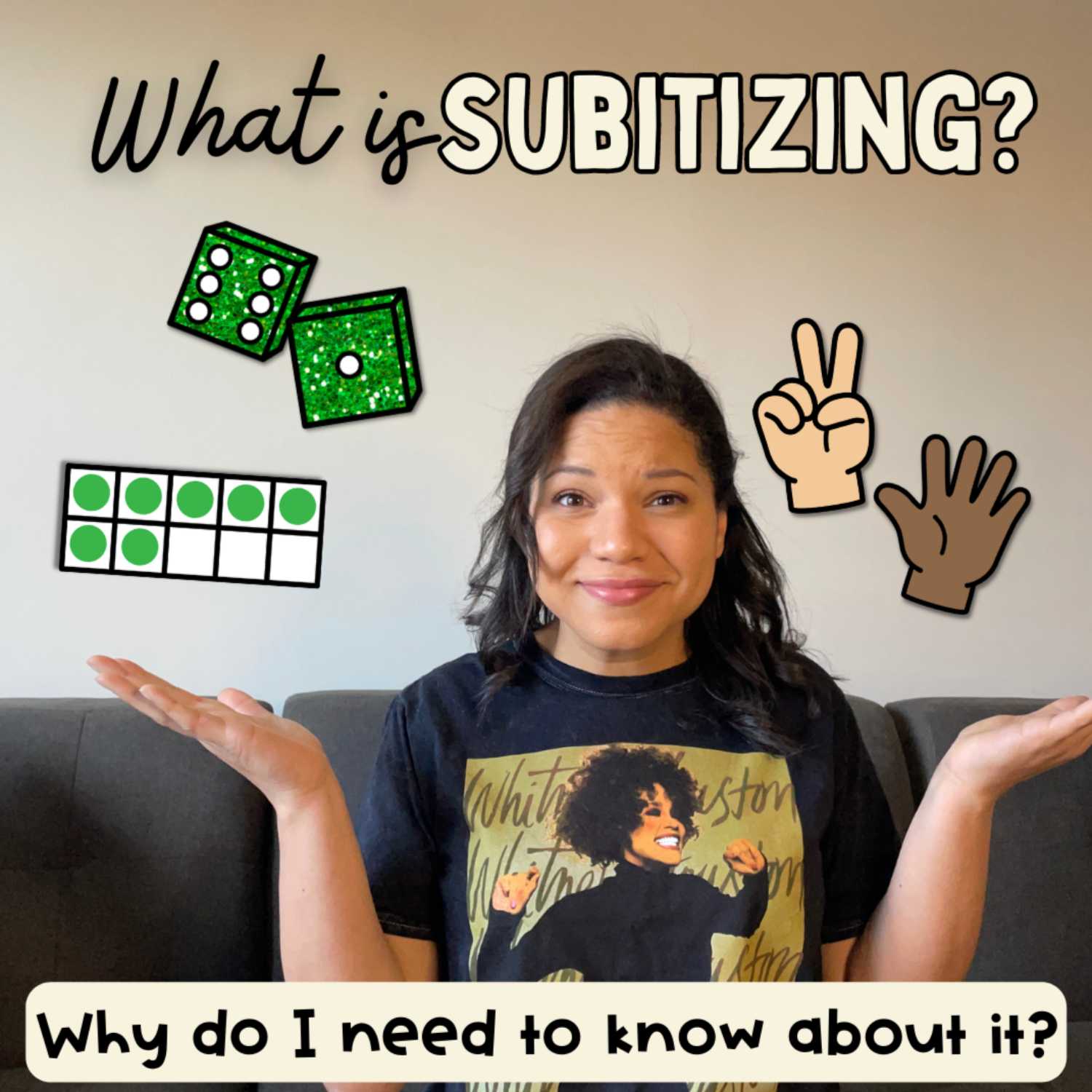
Ep 5. What is Subitizing? Why do I need to know that?!
Making Number Sense Make Sense: A Math Podcast for Early Elementary Teachers
Learn more about subitizing, and get your kids excited about math! Subitizing is a useful skill for young mathematicians to learn and will help them develop number sense! In this episode, you'll learn the definition of subitizing and activities and games to reinforce the concept. With subitizing, you can teach your students how to easily recognize number patterns, and groups of objects they can use as they grow as mathematicians.
Timestamps:
:33 Subitizing is like a turtle covered in flowers 🐢🌺
1:55 Subitizing Definition
2:48 Perceptual VS Conceptual Subitizing
3:38 Why is subitizing important?
4:40 35 +12=?
7: 25 Subitizing in your math block
8:35 Quick Images
9:50 Quick Images Freebie!
10:53 Recap
11:45 Weekly lol break!
Available Results
Generated results are saved to the knowledge database for reuse and search.
Extract Knowledge
Pick what you want extracted first. Model, scope, and chapter options appear after a template is selected.
Transcript
1
00:00:00,000 --> 00:00:12,800
Hello and welcome to Making Number Sense Makes Sense, a podcast for elementary teachers,

2
00:00:12,800 --> 00:00:17,680
specifically early elementary teachers, looking to really make an impact in the number sense

3
00:00:17,680 --> 00:00:23,720
of their students. Welcome back to the Making Number Sense Makes Sense podcast. Today, I'm

4
00:00:23,720 --> 00:00:31,000
going to talk to you about subitizing. When I first started teaching, I had no idea what

5
00:00:31,000 --> 00:00:39,440
subitizing even was. So now I kind of think of subitizing like a turtle covered in flowers.

6
00:00:39,440 --> 00:00:46,200
I know a turtle covered in flowers. I'll explain. So the other day, I was driving, you know,

7
00:00:46,200 --> 00:00:51,400
listening to music, driving, and I turned to the side and I had to do a double take. I

8
00:00:51,400 --> 00:01:00,080
was like, what is that? So I see on my left a giant turtle, probably like a tortoise. And

9
00:01:00,080 --> 00:01:06,200
it's person, I don't know, owner, I guess, we're just strolling along the sidewalk. And

10
00:01:06,200 --> 00:01:12,240
this turtle was covered in pink flowers. And I definitely had to do a double take. I was

11
00:01:12,240 --> 00:01:19,720
like, did I, did I just see that? Is that really just a tortoise covered in flowers, just walking

12
00:01:19,720 --> 00:01:24,320
in the neighborhood? And it sure enough was. I was like, oh man, I wish I could have taken

13
00:01:24,320 --> 00:01:29,120
a picture because I have never seen a turtle covered in flowers before in real life. I

14
00:01:29,120 --> 00:01:36,160
wouldn't even think to do that. So subitizing is a lot like that. When you are subitizing,

15
00:01:36,160 --> 00:01:45,080
your students are seeing an image with some numeral on it or value on it. So when your

16
00:01:45,080 --> 00:01:51,480
students are subitizing, they're looking at an image and trying to figure out how many

17
00:01:51,480 --> 00:01:59,840
things they're seeing without counting by once. So subitizing is the ability to instantly

18
00:01:59,840 --> 00:02:06,440
recognize a number of objects without counting. And some of your students may come in already

19
00:02:06,440 --> 00:02:13,240
being able to subitize small numbers like one, two or three objects, especially in familiar

20
00:02:13,240 --> 00:02:19,000
items like on a dice base. So a lot of times if students play games at home, they know

21
00:02:19,000 --> 00:02:24,920
what the number, the dot arrangement of a dice looks like for numbers one to six, and

22
00:02:24,920 --> 00:02:29,560
they don't need to count it, they just see it and know that is subitizing. And dice is

23
00:02:29,560 --> 00:02:34,400
just my example, but it could be finger patterns like if you ask a student to show you five

24
00:02:34,400 --> 00:02:39,360
fingers, they'll probably just put up their hand with five on it and not have to count

25
00:02:39,360 --> 00:02:44,840
each and every finger, they just know that one full hand is five. That ability to know

26
00:02:44,840 --> 00:02:49,800
your numbers like that is subitizing. Make things just a little complicated. There's

27
00:02:49,800 --> 00:02:55,800
actually two different types of subitizing. There's perceptual subitizing and conceptual

28
00:02:55,800 --> 00:03:04,280
subitizing us as people can really only subitize around five items. When you start to see bigger

29
00:03:04,280 --> 00:03:08,600
items that you're still able to subitize, what's actually happening is you're seeing

30
00:03:08,600 --> 00:03:14,920
its parts. So for example, if you're looking at a dice face and you're looking at the six,

31
00:03:14,920 --> 00:03:21,280
we know it's a six because it's a common arrangement. But you might also see the six as a column

32
00:03:21,280 --> 00:03:29,640
of three and three. You might also see just two three groups of two, so two, two and two.

33
00:03:29,640 --> 00:03:35,440
You might also see four on top and then two extras on the bottom. You can see find those

34
00:03:35,440 --> 00:03:43,360
little numbers inside the bigger number. So why is that an important skill to have? Well,

35
00:03:43,360 --> 00:03:48,600
subitizing on its face may seem like a skill that kids only really need in isolation, but

36
00:03:48,600 --> 00:03:54,240
that's really not the case. It helps your students develop more sophisticated number

37
00:03:54,240 --> 00:04:00,280
strategies and counting strategies than just counting by once. It helps kids really one

38
00:04:00,280 --> 00:04:05,960
number to another number and kind of see the smaller numbers inside bigger numbers that's

39
00:04:05,960 --> 00:04:11,200
composing and decomposing numbers. So if you're thinking of the number five, then kids will

40
00:04:11,200 --> 00:04:16,280
start to learn that five is also the same as three and two is the same as four and one

41
00:04:16,280 --> 00:04:21,320
is the same as five and zero. So really beginning familiar with those number pairs that make

42
00:04:21,320 --> 00:04:26,280
up bigger numbers helps with addition and subtraction as kids move throughout the grade

43
00:04:26,280 --> 00:04:30,640
levels. As of now, I've been using dice face number patterns that only really go up to

44
00:04:30,640 --> 00:04:36,680
10. But when you start being able to subitize and see the bigger numbers and smaller numbers,

45
00:04:36,680 --> 00:04:40,520
you can start to add those to mental math and addition strategies. If I show you the

46
00:04:40,520 --> 00:04:47,760
number sentence 35 plus 12. Now 35 plus 12, some people will just know what the answer

47
00:04:47,760 --> 00:04:52,120
is. But if you're familiar with your number patterns and trying to figure it out in your

48
00:04:52,120 --> 00:04:57,800
head mental math, you might start to break apart those bigger numbers into smaller numbers.

49
00:04:57,800 --> 00:05:04,680
So one way you might do that is if you think of the number 12, 12 is the same as 10 and

50
00:05:04,680 --> 00:05:12,360
two and 10 is an easier number to add on to other numbers than 12 is. So I have 35 plus

51
00:05:12,360 --> 00:05:20,200
12 was my original question. And I broke my 12 into 10 and two. So then I'm thinking 35

52
00:05:20,200 --> 00:05:26,680
plus 10 is 45. And I have that number in my head. And I remember that I have my two other

53
00:05:26,680 --> 00:05:32,920
my two extras, because my original number was 12. So from there, you can do 45 and count

54
00:05:32,920 --> 00:05:39,120
on 454647. Or you might just know that five and two is seven. If you're familiar with

55
00:05:39,120 --> 00:05:43,560
your smaller number pairs, the numbers that make up seven, the numbers that make up eight,

56
00:05:43,560 --> 00:05:48,040
the numbers that make up nine, use that information to get the answer. So from there, you've broken

57
00:05:48,040 --> 00:05:53,160
apart the numbers, you've really been able to manipulate the numbers in your brain to

58
00:05:53,160 --> 00:05:59,480
solve this addition problem. And that's something that I know personally, I never really did.

59
00:05:59,480 --> 00:06:05,040
It wasn't until I took a class as a teacher about developing number sense, did I even

60
00:06:05,040 --> 00:06:10,080
really start to think about that like manipulating numbers in my head to solve questions like

61
00:06:10,080 --> 00:06:17,320
that was never something that I naturally did. And it's so helpful teaching your students,

62
00:06:17,320 --> 00:06:21,440
especially when they're young, to see numbers as things that are flexible things that can

63
00:06:21,440 --> 00:06:28,360
be switched around compensated, it starts to create just a giant world of possibility

64
00:06:28,360 --> 00:06:32,640
around numbers, which is something that a lot of people who are not traditionally in

65
00:06:32,640 --> 00:06:37,600
air quotes math people don't realize that you can do math can seem very rigid. And it

66
00:06:37,600 --> 00:06:42,480
has to be like this, because there's only one right answer. But the creativity comes

67
00:06:42,480 --> 00:06:48,960
in being able to dive into the different ways that you might get to that answer. And growing

68
00:06:48,960 --> 00:06:54,720
up for me, the emphasis was always on did you get the right answer? Not how can you

69
00:06:54,720 --> 00:06:59,440
approach this problem in a way that makes sense to you. So then you can solve it and

70
00:06:59,440 --> 00:07:04,440
get the right answer without having to use a standard algorithm, just really understanding

71
00:07:04,440 --> 00:07:09,600
numbers and understanding math. So I hope that I have convinced you, or at least started

72
00:07:09,600 --> 00:07:15,480
to convince you that subitizing is a very, very important skill for your students to

73
00:07:15,480 --> 00:07:22,360
develop. And it can be a really fun skill to practice throughout your entire math block.

74
00:07:22,360 --> 00:07:27,320
So next, I'm going to give you some ideas of ways that you can include subitizing activities

75
00:07:27,320 --> 00:07:33,360
in your math block that your students might really enjoy. One of my favorite ways to use

76
00:07:33,360 --> 00:07:40,360
subitizing in the classroom is like I said before, just using dice. So using games with

77
00:07:40,360 --> 00:07:45,040
dice, there's so many different things that you can do with dice and not just traditional

78
00:07:45,040 --> 00:07:51,080
one to six dice, you might use a 10 frame dice or five frame dice. That's another way

79
00:07:51,080 --> 00:07:58,720
for kids to really get to know the way that numbers look. And 10 frames, five frames, even

80
00:07:58,720 --> 00:08:04,880
spinners, if you create a spinner that has a five frame on it 10 frame on it. And using

81
00:08:04,880 --> 00:08:09,320
those things over and over in lots of different types of games is a great way to practice

82
00:08:09,320 --> 00:08:15,440
subitizing. I said a 10 frame if you're unfamiliar with a 10 frame, it's basically a rectangle

83
00:08:15,440 --> 00:08:21,240
with 10 squares in it. So it's five squares on top, five squares on bottom, all together

84
00:08:21,240 --> 00:08:27,200
is a 10 frame. And that's another great way for kids to organize numbers organizing counting

85
00:08:27,200 --> 00:08:31,320
into groups of 10, which is really important in our number system that's based in 10. So

86
00:08:31,320 --> 00:08:37,760
10 frames are a great way to practice subitizing as well with numbers higher than six. Something

87
00:08:37,760 --> 00:08:42,600
else that you can do I like to use this as a warm up or a number sense routine is quick

88
00:08:42,600 --> 00:08:49,420
images. So quick images is like it sounds like you show students an image very quickly

89
00:08:49,420 --> 00:08:54,920
like three seconds tops, and then hide it again. And then your students have to figure

90
00:08:54,920 --> 00:09:01,520
out how many things you were showing. So let's say I had a 10 frame with six items in it.

91
00:09:01,520 --> 00:09:06,680
So five on top and one on the bottom, I'll show my kids my 10 frame with six on it and

92
00:09:06,680 --> 00:09:10,760
then hide it really quickly. And so then the kids would have to talk to me about what they

93
00:09:10,760 --> 00:09:16,200
see. So some kids might say, Oh, I know it's six because I saw the top line was full and

94
00:09:16,200 --> 00:09:22,560
had one extra so five and one extra. If I might arrange my six differently for my next

95
00:09:22,560 --> 00:09:29,340
quick image. So instead of having five on top and one on the bottom, I might do three

96
00:09:29,340 --> 00:09:34,520
on the left and three on the right. And then the kids might say, Oh, I know that that is

97
00:09:34,520 --> 00:09:40,920
six because I saw three and three. You could also switch the colors. So maybe I do three

98
00:09:40,920 --> 00:09:46,080
reds and three yellows. And then they could also see three and three is six. He'd like

99
00:09:46,080 --> 00:09:51,640
some more ideas on how to use quick images. I will leave a link in the show notes to my

100
00:09:51,640 --> 00:09:57,320
free quick image kind of sample quick image freebie that you can use in your classroom.

101
00:09:57,320 --> 00:10:01,880
And that's in Google slides. So you can print off your Google slides or just project it and

102
00:10:01,880 --> 00:10:06,200
show your kids really quick and then hide it again. Now quick images doesn't have to just

103
00:10:06,200 --> 00:10:14,040
be 10 frames. It can also be finger patterns. It can be dice. It can be a wreck and wreck.

104
00:10:14,040 --> 00:10:18,160
It can be tile arrangements. There's lots of different ways that quick images can be

105
00:10:18,160 --> 00:10:22,360
used and what kind of images you show your students. So like I said, I will leave a link

106
00:10:22,360 --> 00:10:26,560
to my quick image freebie in the show notes and a blog post that talks all about quick

107
00:10:26,560 --> 00:10:31,960
images and how can you you can use them in your classroom. I mentioned it briefly before,

108
00:10:31,960 --> 00:10:37,720
but using dice in your classroom is a great way to practice subitizing. Again, if you'd

109
00:10:37,720 --> 00:10:43,280
like some more specific examples of games that you can play to practice subitizing,

110
00:10:43,280 --> 00:10:50,120
I'll have pictures and ideas all linked in the blog post that is in the show notes of

111
00:10:50,120 --> 00:10:55,320
this episode. So quick recap.

112
00:10:55,320 --> 00:11:00,200
Subitizing is a amazing skill to help your students develop number sense. You can use

113
00:11:00,200 --> 00:11:06,160
subitizing in your math block as a warm up. You can use it as a kind of wrap up to the

114
00:11:06,160 --> 00:11:13,400
end of your math block or use the thing that some of the tools like 10 frames dice finger

115
00:11:13,400 --> 00:11:19,760
patterns in your math stations or math centers to reinforce the skill. Get your kids familiar

116
00:11:19,760 --> 00:11:27,160
with all different kinds of number patterns and then they can move from the very concrete

117
00:11:27,160 --> 00:11:32,400
to conceptual understanding of numbers as they move throughout the year on your way.

118
00:11:32,400 --> 00:11:37,280
Don't forget to check out the quick images freebie and the accompanying blog post to

119
00:11:37,280 --> 00:11:42,680
see all of this written out as well as pictures of some games that you might like to play

120
00:11:42,680 --> 00:11:48,720
with your students in their centers. I do love talking about math, obviously, but there

121
00:11:48,720 --> 00:11:52,920
are some things I feel like I just need to share because it was just it's just so comical

122
00:11:52,920 --> 00:11:56,760
like some of the things that these kids do you're just like how that even happened. So

123
00:11:56,760 --> 00:12:02,000
one of my students was working on his drawing. He was so happy to show it to me and he kept

124
00:12:02,000 --> 00:12:06,520
talking about his shoes and I'm like why does he keep telling me about his shoes like I

125
00:12:06,520 --> 00:12:11,240
see their shoes I'm glad you added the detail but move away from the shoes. So I look at

126
00:12:11,240 --> 00:12:16,680
him a little bit later and I was like, hmm, he has two different shoes on today. And I

127
00:12:16,680 --> 00:12:20,440
was like, oh, maybe that's why he kept telling me about his shoes because he had two different

128
00:12:20,440 --> 00:12:24,280
shoes on. I was like, oh, wow, well, I mean, there's nothing we can do about that now like

129
00:12:24,280 --> 00:12:27,840
you're at school we can't change your shoes. I look a little closer. How about they're

130
00:12:27,840 --> 00:12:32,600
both the left foot. So not only did you have two different shoes on, but they were both

131
00:12:32,600 --> 00:12:36,400
the left foot. And I was like, well, it makes sense. He was talking about his shoes. They're

132
00:12:36,400 --> 00:12:41,120
probably uncomfortable. Like I don't even I don't even know how that happened. But I

133
00:12:41,120 --> 00:12:45,480
will say, I have walked out the house in slippers before only to have to turn around and be

134
00:12:45,480 --> 00:12:49,960
like, I need to put real shoes on. So I guess it happens to the best of us. If you have

135
00:12:49,960 --> 00:12:54,960
been enjoying the podcast, I would love it if you left a review or sent me a message to

136
00:12:54,960 --> 00:12:59,920
let me know what episodes you'd like to hear in the future. Until then, I will see you

137
00:12:59,920 --> 00:13:25,200
next time and don't forget to get your freebie on the way out.