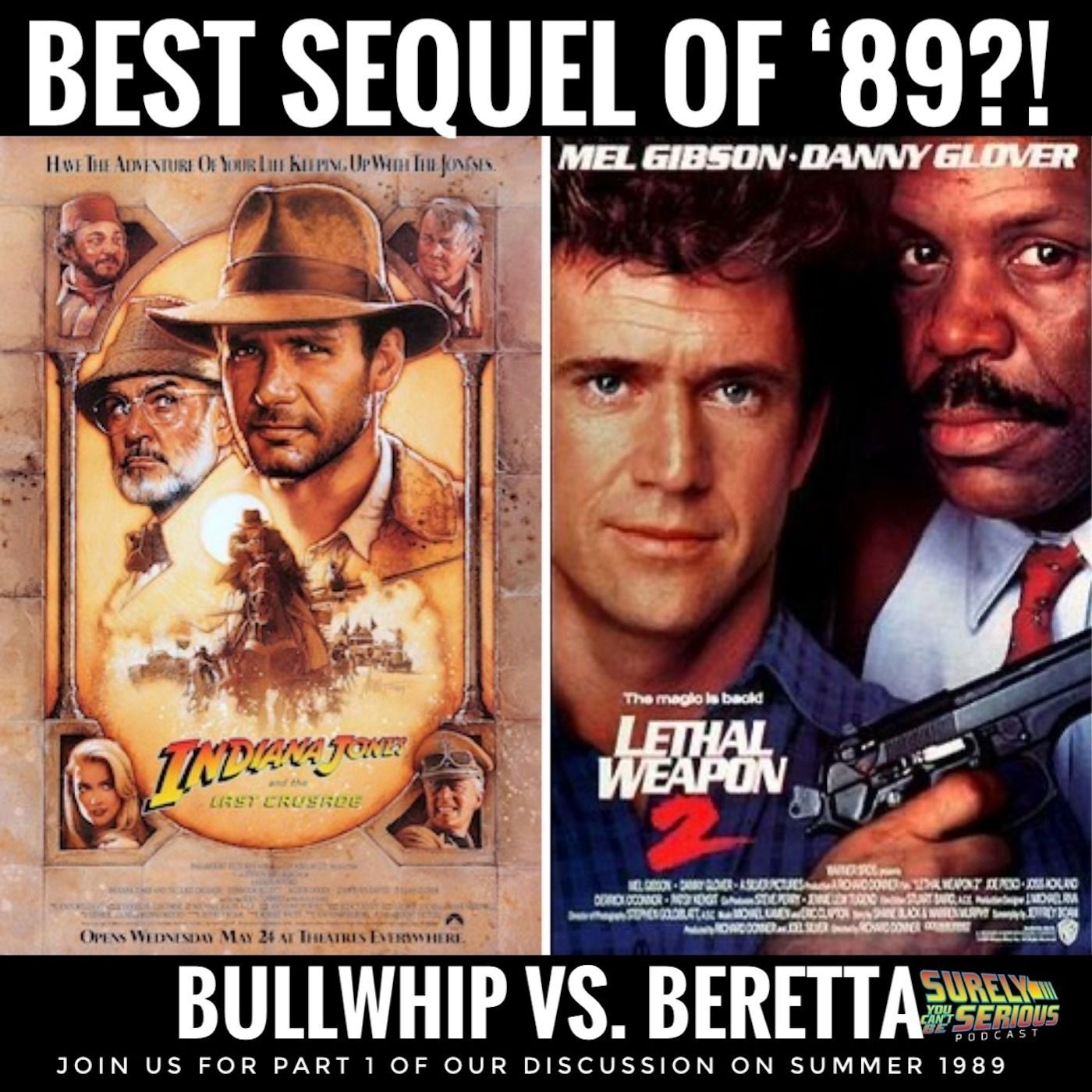
"Indiana Jones and the Last Crusade" (1989) vs "Lethal Weapon 2" (1989): Part 1
Welcome to "Surely You Can't Be Serious," the podcast where hosts Jason and Dee take you on a journey through the most iconic films of the past. In Part 1 of this special episode, they dive into two of the biggest and best sequels of the eighties: "Indiana Jones and the Last Crusade" and "Lethal Weapon 2."Join Jason and Dee as they kick off this epic comparison by exploring the origins of each movie. They'll uncover the stories behind the making of these classics and discuss how they became defining moments in eighties cinema. The hosts also delve into the details of the star-studded casts, sharing insights and little-known facts about the actors who brought these unforgettable characters to life.As they break down the pivotal moments in each film, Jason and Dee will revisit the thrilling action sequences, unforgettable lines, and key scenes that have left a lasting impact on audiences. Dee takes a deep dive into the significant themes and concepts featured in the movies, including the concept of "Diplomatic Immunity" in "Lethal Weapon 2" and the legendary quest for "The Holy Grail" in "Indiana Jones and the Last Crusade."Tune in for a lively discussion filled with fun, comedy, and adventure, as Jason and Dee bring their unique perspectives and passion for these beloved sequels. Whether you're a fan of Indy's daring escapades or the explosive chemistry of Riggs and Murtaugh, Part 1 of this two-part episode is a must-listen!
2024-07-30
58 min
Transcript
Available Results
Generated results are saved to the knowledge database for reuse and search.
No generated results are available for this episode yet.
Extract Knowledge
Pick what you want extracted first. Model, scope, and chapter options appear after a template is selected.
Generated results for public episodes are saved to the knowledge database so they can be reused and searched later.
Transcript
<v Speaker 1>Hey, it's Brett and Harley from the Only Okase Show.
<v Speaker 2>And when I'm not gleaming the cube or justing my swatchwatch,
<v Speaker 2>we're listening to this Syearly you Can't Be Serious Podcast.
<v Speaker 2>Welcome back to the Shurley you Can't Be Serious Podcast.
<v Speaker 2>We have a special song for you that we will
<v Speaker 2>play at the end of the episode that by the
<v Speaker 2>Surely you Can't Be Serious band, little bluesy lethal weapon
<v Speaker 2>sounding number that incorporates a little lethal weapon one and
<v Speaker 2>a lot of lethal weapon two. Because today, boys and girls,
<v Speaker 2>ladies and gentlemen, we are here to talk about the
<v Speaker 2>two best sequels from nineteen eighty nine, Indiana Jones in
<v Speaker 2>the Last Crusade versus Lethal Weapon Twodee.
<v Speaker 1>I've been waiting to talk about the sequels from nineteen
<v Speaker 1>eighty nine with you for over a year. We've been
<v Speaker 1>talking about this matchup for a long time, long time.
<v Speaker 2>We're finally here, Yes, and.
<v Speaker 1>I'm just here to remind you only a penitent man
<v Speaker 1>will pass an ex never.
<v Speaker 2>Ever marks the spot. So you're ready to go.
<v Speaker 1>My soul is prepared. How's yours?
<v Speaker 2>Very good? Very good? Yes, my soul is prepared as
<v Speaker 2>well as are my notes. This was a fun one
<v Speaker 2>to dive into. It's crazy because I mentioned in our
<v Speaker 2>last episode, Hey, I know the tie in between these
<v Speaker 2>two movies, these two incredible sequels from nineteen eighty nine,
<v Speaker 2>and you you called them that. I remember you saying that,
<v Speaker 2>you know, two best sequels of nineteen eighty nine, And
<v Speaker 2>the thought that went through my head was, well, yeah,
<v Speaker 2>but this is the third Indiana Jones. That's right movie.
<v Speaker 2>But then I remembered the second Indiana Jones movie is
<v Speaker 2>not a sequel.
<v Speaker 1>You are correct, And when you told me that, I
<v Speaker 1>was like, oh man, that's awesome.
<v Speaker 2>It's a prequel. Indiana Jones and the Temple of Doom
<v Speaker 2>takes place before the events in Raiders of the Lost.
<v Speaker 2>It is a prequel, And so Indiana Jones and the
<v Speaker 2>Last Crusade is technically the first Indie sequel before we
<v Speaker 2>get out of the gate.
<v Speaker 1>Is Indiana Jones and the Last Crusade the best name
<v Speaker 1>they could come up with for this.
<v Speaker 2>Movie, well, given that they probably thought it was the
<v Speaker 2>last one. It's kind of like you know Ozzy Osbourne's
<v Speaker 2>No More Tours tour, right, which I mean how many
<v Speaker 2>tours ago was that? I mean he spent ting a
<v Speaker 2>bunch of them since then. I think that, you know,
<v Speaker 2>Harrison was probably pretty emphatic that this was going to
<v Speaker 2>be his last movie. But I can also tell you,
<v Speaker 2>going back to what I was saying, the connective tissue
<v Speaker 2>between these two they're both written by the same guy.
<v Speaker 2>Jeffrey Boham wrote both of these just before nineteen eighty nine,
<v Speaker 2>obviously so that they had time to make the movies.
<v Speaker 2>But he even said in nineteen ninety six, saw an
<v Speaker 2>interview he did in nineteen ninety six. At that time
<v Speaker 2>he was working on another Indiana Jones movie script and
<v Speaker 2>he said, Spielberg's for it, Lucas is for it. Our
<v Speaker 2>only hang up is whether Harrison Ford's going to do
<v Speaker 2>it or That was in ninety six.
<v Speaker 1>I heard about one that Frank Dearbond worked on in
<v Speaker 1>the late nineties that could have been awesome. The stories
<v Speaker 1>that we got before this, like the scripts that were
<v Speaker 1>submitted and stuff, are fascinating. Yeah, you know, Spielberg's Jewish,
<v Speaker 1>so doing a movie on the Holy Grail, I don't
<v Speaker 1>know if it is necessarily super comfortable for him. And
<v Speaker 1>there are other continents and places we could have gone.
<v Speaker 1>And obviously we went off the rails after the last Crusade.
<v Speaker 1>But it's super interesting to think about the what ifs
<v Speaker 1>with the Indiana Jones franchise.
<v Speaker 2>Absolutely one percent. I was struggling on this one. We've
<v Speaker 2>talked about Jeffrey Bohm before, right, As a matter of fact,
<v Speaker 2>we've talked about him several times before because we know
<v Speaker 2>that he did Lost Boys, we know that he did
<v Speaker 2>The Dead Zone. He was actually an uncredited script writer
<v Speaker 2>on Lethal Weapon one, which we did in the first
<v Speaker 2>season as well versus Diehard. Yeah, he was called in
<v Speaker 2>to work on Shane Black script because he was a
<v Speaker 2>guy who was a studio guy who they would go
<v Speaker 2>to to change things up on the fly, and so
<v Speaker 2>he did actually work on Lethal Weapon one. So technically
<v Speaker 2>this is the fourth and fifth movies that we've talked
<v Speaker 2>about that are Jeffrey Boem scripts.
<v Speaker 1>That's crazy. I wouldn't have thought about.
<v Speaker 2>That, right, And then you and I were talking and
<v Speaker 2>I was like, his you know, his abilities were incredible,
<v Speaker 2>and You're like, yeah, but he really kind of fell
<v Speaker 2>off the world like two thousand or something. What happened
<v Speaker 2>to him? And I was like, well, he died.
<v Speaker 1>Like I was wonder why his IMDb page wasn't full
<v Speaker 1>of stuff. I did not know that he died.
<v Speaker 2>My gosh, he died at fifty three. Yeah, died very
<v Speaker 2>young man, fifty three years old. It had a lung condition.
<v Speaker 2>I guess that led to a heart failure just suddenly.
<v Speaker 2>So tragic loss. Because obviously he's a very skilled guy.
<v Speaker 2>And I am excited to talk about his history because
<v Speaker 2>even though we've talked talked about the fifth movie that
<v Speaker 2>he's done, but we haven't really talked about him that much,
<v Speaker 2>and so I'm kind of excited to talk about his history.
<v Speaker 2>But before I get there, Yeah, I got to ask
<v Speaker 2>you a question, all right, Yes, yes, So we got
<v Speaker 2>two kind of concepts in these movies that I haven't
<v Speaker 2>really delved into before. Okay, and this is these are
<v Speaker 2>the rabbit holes that I went down. All right, So
<v Speaker 2>which do you think is the older reference? Okay, diplomatic
<v Speaker 2>immunity or the Holy Grail. Well, it's got to be
<v Speaker 2>the Holy Grail, right You would think that, wouldn't you.
<v Speaker 1>Yes? Interesting, Yeah, So let's just let's start.
<v Speaker 2>Let's start talking about it. Okay, diplomatic community. Diplomatic immunity
<v Speaker 2>can be traced back as far as the rama Gyana,
<v Speaker 2>which is an Indian like a holy book that has
<v Speaker 2>a lot of history from Ramayana, rama Yana, Ramayana. This
<v Speaker 2>is an important work in Indian history, right okay, and
<v Speaker 2>it's now. The thing is is that it's had a
<v Speaker 2>lot of different variations over several centuries, but it dates
<v Speaker 2>back to as early as the seventh century, that's the
<v Speaker 2>six hundred's BC. The Ramayana dates back as early as
<v Speaker 2>six hundred years before Christ. And within it is the
<v Speaker 2>concept of diplomatic immunity. Wow, so well before Christ. But
<v Speaker 2>we're going to get into that in a second. If
<v Speaker 2>even that's the earliest reference to the Grail, but we'll
<v Speaker 2>talk about that in a minute. So in the Ramayana,
<v Speaker 2>there is a part where one of the demon kings
<v Speaker 2>is ordering the killing of this this prince, and his
<v Speaker 2>younger brother says, hey, no messengers and diplomats should not
<v Speaker 2>be killed per ancient practices. So it was even an
<v Speaker 2>ancient practice six hundred years before Christ. Wow, diplomatic community.
<v Speaker 2>I would have had no idea. But if you just
<v Speaker 2>give it a little thought, think about the movie three hundred.
<v Speaker 2>Remember when he comes to He's come to give them
<v Speaker 2>a message, right, yeah, yeah, and he and then all
<v Speaker 2>of a sudden they're like surrounding the messengers around that
<v Speaker 2>big old well. Everybody remembers this part right, right, and
<v Speaker 2>he's like this is crazy, and he's like, this is
<v Speaker 2>a sparta, right because he kills the messenger, which was
<v Speaker 2>against custom. You weren't supposed to kill the messenger unless
<v Speaker 2>in some circumstances they made obscenely high demands, which I
<v Speaker 2>guess was the excuse in this one. But also you
<v Speaker 2>think about Brave Heart. Even in Brave Heart, they before
<v Speaker 2>they have the battle, the lords walk, they ride their
<v Speaker 2>horses out to the middle of the battlefield and they
<v Speaker 2>talk with each other, they flip the coin and yeah yeah,
<v Speaker 2>and then and then Braveheart, then mel Gibson's riding around
<v Speaker 2>him in a circle, like causing trouble. And it's all
<v Speaker 2>this idea that in order to have a good relationship
<v Speaker 2>with somebody that you might be at war with, in
<v Speaker 2>order to endeavor to engage in peace, you have to
<v Speaker 2>give those diplomats, those messengers, if you will, immunity. And
<v Speaker 2>what's crazy is it's still exists today.
<v Speaker 1>Our buddy James Buckley spent one day at work on
<v Speaker 1>the Louisiana State payroll writing up specific notes for us
<v Speaker 1>on this very topic under the bus after he helped you,
<v Speaker 1>I am no I scratch that. I'm super thankful that
<v Speaker 1>he did that, but he came up with some interesting stuff.
<v Speaker 1>I'm gonna throw this at you real quickly. So obviously,
<v Speaker 1>diplomatic community still applies in the United States today or
<v Speaker 1>and around the world. So listen to this. In nineteen
<v Speaker 1>ninety seven, this is just one example. There was a
<v Speaker 1>ambassador from the Republic of Georgia who killed a teenage
<v Speaker 1>girl while driving drunk. Georgia, his home country, waived his immunity.
<v Speaker 1>So like the US said, hey, Georgia, this guy drunk driving.
<v Speaker 1>What are we gonna do with him. They're like, no,
<v Speaker 1>he'd wave his immunity. So he was tried and did
<v Speaker 1>time over here. But another example, there was one diplomat's
<v Speaker 1>son who was accused of raping on fifteen separate rape
<v Speaker 1>charges Holy and when they were like, dude, you're going
<v Speaker 1>to jail, they were like, diplomatic community, man, we're not
<v Speaker 1>doing anything.
<v Speaker 2>Huh.
<v Speaker 1>So they what country it doesn't say, oh, doesn't say,
<v Speaker 1>but they kicked him out of the country.
<v Speaker 2>But they didn't prosecute him.
<v Speaker 1>They didn't arrest him, no, but he tried to pull
<v Speaker 1>the diplomatic community thing like, my son, this is not
<v Speaker 1>US soil, right, your laws don't a play here.
<v Speaker 2>And that's that's the accurate reading of the statute. Yeah,
<v Speaker 2>I mean, this is it. We're talking about international law.
<v Speaker 2>This is something that varies from country to country, but
<v Speaker 2>is basically Geneva Convention and well before it. Obviously thousands
<v Speaker 2>of years of this practice. It has been the practice
<v Speaker 2>that the diplomats to a foreign country are not bound
<v Speaker 2>by the laws of that country. Now, as you mentioned
<v Speaker 2>with the drunk driving guy, the home country can say
<v Speaker 2>they do as they call them home, but basically that's
<v Speaker 2>making them a person non grata, which means, hey, you
<v Speaker 2>can do with it what you want to do with them, right.
<v Speaker 2>But obviously there are other situations where the home country
<v Speaker 2>is like, nope, we'll just bring them back here.
<v Speaker 1>Apparently, parking tickets in and around New York City.
<v Speaker 2>It's a big problem.
<v Speaker 1>It's reported that New York City has said that they
<v Speaker 1>are owed sixteen million dollars in unpaid parking tickets from
<v Speaker 1>diplomat sixteen sixteen million dollars ho cow how about that.
<v Speaker 1>I mean, how much is a parking ticket in fifty
<v Speaker 1>bucks or right?
<v Speaker 2>So sixteen million dollars of fifty dollars parking tickets. How
<v Speaker 2>many diplomats are there?
<v Speaker 1>Diplomatic community? Oh my gosh, take this parking ticket and
<v Speaker 1>shove it.
<v Speaker 2>I like, guys, quit patrol on the un parking lot please,
<v Speaker 2>it's a waste of time all right.
<v Speaker 1>By the way, According to the Bayou barrister, mister James Buckley, yeah,
<v Speaker 1>he said that. According to him, the end of lethal
<v Speaker 1>weapon two Arjin Rudd should have been arrested and tried,
<v Speaker 1>and that MYRTA probably would have been arrested as well.
<v Speaker 1>You don't just get to shoot diplomats.
<v Speaker 2>You don't get to revoke their immunity.
<v Speaker 1>No, but it was really boked, really satisfying to watching
<v Speaker 1>shoot it.
<v Speaker 3>It's Jeff been revoked.
<v Speaker 2>But I mean, what a great plan, like if you
<v Speaker 2>think about it from the point of view of the
<v Speaker 2>South African diplomats, like, hey, we can engage in this
<v Speaker 2>drug trade, yeah, and we can claim diplomatic community.
<v Speaker 1>By the way, I had a thought the other day
<v Speaker 1>and I sent you a picture. I text you a
<v Speaker 1>picture at the very beginning which this Lethal Weapon two
<v Speaker 1>starts off with a bang. You get the little Looney
<v Speaker 1>Tunes theme.
<v Speaker 2>Yeah, yes, you do. Right as the WB comes up.
<v Speaker 2>You get just a little taste of Looney Tunes, which
<v Speaker 2>is appropriate for rigs.
<v Speaker 1>On I'm totally fine with. Yeah, and you dive right
<v Speaker 1>into a car chase. That's mid chase.
<v Speaker 2>Mid chase. And I watched this one with Rock and
<v Speaker 2>he was like, I kind of fell asleep and we
<v Speaker 2>watched the first one. Do I really need to know stuff?
<v Speaker 2>I'm like, no, I mean, as long as you know
<v Speaker 2>the relationship exists and that he was crazy and suicidal
<v Speaker 2>before and at the end they're friends and he's not
<v Speaker 2>suicidal anymore, that's all the matter. And we start in
<v Speaker 2>the middle of the car chase and he's like, so,
<v Speaker 2>is this the end of Lethal Weapon? I'm like, no, no, no,
<v Speaker 2>this is like a completely separate story. You don't have
<v Speaker 2>to know the first story to understand the second story
<v Speaker 2>at all. He's like, okay, and then he fell asleep.
<v Speaker 1>Oh man, Well, I love how it starts off with
<v Speaker 1>a bang. You know, Indiana Jones wastes no time to
<v Speaker 1>get started either. You're right in the middle of a
<v Speaker 1>buddying adventure at right beginning right but Letho Weapon two,
<v Speaker 1>you're right in the middle of a car chase and
<v Speaker 1>it's super funn You get the humor right off the
<v Speaker 1>bat where Riggs takes over pushes Murta to the side
<v Speaker 1>and it's like it's a brand new car and he's
<v Speaker 1>gonnase He's gonna try and get up and around and
<v Speaker 1>he's like, there's not enough room, Riggs.
<v Speaker 2>No, you know, I love the eighties, the eighties time
<v Speaker 2>capsule where he's like, oh, yeah, you're already going sixty
<v Speaker 2>five And he's like, oh my gosh, I know right,
<v Speaker 2>my wife's dnew corn. I'm not going any faster.
<v Speaker 3>You're doing sixty five now set the.
<v Speaker 4>Yeah yeah, where.
<v Speaker 1>He's about what that's back when it was illegal to
<v Speaker 1>go over fifty five miles per hour anywhere. Yeah, But
<v Speaker 1>they chase this guy. They're talking South Africa. Helicopters show up,
<v Speaker 1>machine guns. The LA police realize, holy crap, this is
<v Speaker 1>more than just your standard drug bust. The car flip's
<v Speaker 1>over and they hear something kind of shuffle in the back.
<v Speaker 1>When Riggs karate kicks open the trunk, all these gold
<v Speaker 1>coins fall out. Well, those are South African krue grants kruegerrands.
<v Speaker 1>And I'm watching this as an older man now, when
<v Speaker 1>I was sixteen and nothing, I'm like, krue grands. I
<v Speaker 1>don't know what that is. So those were currency from
<v Speaker 1>South Africa which was illegal to use in the United
<v Speaker 1>States because we had this complicated relationship with South Africa
<v Speaker 1>due to apartheid.
<v Speaker 2>Right that suckers worth.
<v Speaker 1>Twenty five hundred dollars wow per one kruwe grant.
<v Speaker 2>Wow.
<v Speaker 1>So you think about how many fell out of the
<v Speaker 1>trunk there in nineteen eighty nine dollars.
<v Speaker 2>Yeah, Oh that's fantastic. Here you go. Okay, So I
<v Speaker 2>told you how old the diplomatic community is. Yes, now
<v Speaker 2>we got to talk about the Holy the question for
<v Speaker 2>the Grail, there's no archeology. It's a race against evil.
<v Speaker 2>If it is captured by.
<v Speaker 5>The Nazis, the armies of darkness will march all over
<v Speaker 5>the face of the earth.
<v Speaker 2>Do you understand me?
<v Speaker 1>I think it's funny, by the way, when you're like,
<v Speaker 1>it's six hundred years before Christ, Well, lucky for us,
<v Speaker 1>we're talking about the Cup of Christ. So we know
<v Speaker 1>exactly how long it is before the Holy Grail.
<v Speaker 2>Right, except not really, because we did a little Bible
<v Speaker 2>research beforehand, right, yeah. And him talking about drinking out
<v Speaker 2>of a cup at the Last Supper, it do it
<v Speaker 2>mentions a cup, and he talks about sharing the cup.
<v Speaker 2>I mean, in Matthew and Mark and Luke, every single
<v Speaker 2>gospel for the first three mentions this. Hey, I'm gonna
<v Speaker 2>drink out of this cup and I'm gonna pass it
<v Speaker 2>to you. But nowhere in there is there anything about
<v Speaker 2>it giving you everlasting life. Nowhere in there is there
<v Speaker 2>anything about Joseph of Arimathea using this same cup to
<v Speaker 2>catch his blood when he's on the cross us right, No, Alexandrada,
<v Speaker 2>Alex right. I mean, now there's there. When I asked
<v Speaker 2>you about it, you were like, well, there's this part
<v Speaker 2>where he's talking about the if you drink from drink
<v Speaker 2>from the well, that gives you eternal life. But I'm like,
<v Speaker 2>where's that? And you said John four, and I'm like,
<v Speaker 2>that's way too early for this supper. That's true, that's
<v Speaker 2>the lady at the well. Right, let me read you.
<v Speaker 1>John four to fourteen.
<v Speaker 2>Reallyeah, they do it.
<v Speaker 1>But whoever drinks the water I give them will never thirst. Indeed,
<v Speaker 1>the water I give them, will become in them a
<v Speaker 1>spring of water welling up to eternal life.
<v Speaker 2>Huh.
<v Speaker 1>Now that's the woman.
<v Speaker 2>At the well. That's that's symbolism talk boys and girls.
<v Speaker 2>That's a parable that is not He is not talking
<v Speaker 2>about a cup that is the fountain of youth or
<v Speaker 2>that gives you eternal life.
<v Speaker 1>Doesn't wash away bullet holes, and it certainly is not
<v Speaker 1>something that you. I mean for you to get immortality,
<v Speaker 1>but you got to stay within a fifty foot radius
<v Speaker 1>of the not.
<v Speaker 2>Very worth while, not very good.
<v Speaker 1>I've like that night stay for nine hundred years.
<v Speaker 2>I texted you a picture. There's the scene at the
<v Speaker 2>end where the earthquake is happening and the night is
<v Speaker 2>just standing there with a look on his face watching
<v Speaker 2>everything crumble. And I'm like, I have been in that
<v Speaker 2>guy's shoes before. Were you like you do all of
<v Speaker 2>this stuff for your kids? You're like, you've built all
<v Speaker 2>of this stuff, and they just zoom in and immediately
<v Speaker 2>destroy everything, and You're just like, well that was worth
<v Speaker 2>six hundred's in a cave by myself.
<v Speaker 1>Waiting here for you guys to come along and screw
<v Speaker 1>everything up in fifteen minutes.
<v Speaker 2>Yeah, yeah, at least I get to die now, Okay,
<v Speaker 2>so Holy Grail. Yes, I'm gonna butcher this name, but
<v Speaker 2>I'm gonna try anyway, because it's a French name. Chritian
<v Speaker 2>de Torres is the author of the Arthurian Legends from
<v Speaker 2>the mid eleven hundreds to eleven ninety and eleven ninety
<v Speaker 2>he wrote Perceval and the Grail, which, if if you
<v Speaker 2>are a ready player one fan, you remember that's why
<v Speaker 2>he gave his avatar that name of Percival is because
<v Speaker 2>Perceval is related to the Holy Grail. Right. But the
<v Speaker 2>thing was is that Troyes didn't finish it. He died. Okay,
<v Speaker 2>So this is an unfinished poem, so many authors since
<v Speaker 2>then have added to it. This is a thousand years
<v Speaker 2>after Christ when this idea of the Grail, not the
<v Speaker 2>Holy Grail, but the Grail comes up because it's only
<v Speaker 2>just a grail. This is like a thousand years after Christ,
<v Speaker 2>a thousand years after Christ talking about the legend of
<v Speaker 2>King Arthur and his knights.
<v Speaker 1>And very nearly a thousand years before Monty Python.
<v Speaker 2>Yes okay, right, yes, So in the eleven nineties, not
<v Speaker 2>too long after the story is written, a guy named
<v Speaker 2>Robert de Baron writes something called Joseph d Arimathea, and
<v Speaker 2>in that one, the grail is portrayed as Jesus's vessel
<v Speaker 2>from the Last Supper, which then Joseph of Arimathea uses
<v Speaker 2>to catch Christ blood at the crucifixion.
<v Speaker 3>OK.
<v Speaker 2>So this idea of the holy Grail, you know, a
<v Speaker 2>lot of people will say in Christian tradition, well, yes,
<v Speaker 2>Christian tradition, that is a thousand years after the fact, right,
<v Speaker 2>it's after that that the grail becomes holy and it
<v Speaker 2>becomes interwoven with this idea of a holy chalice that
<v Speaker 2>he used at the Last Supper, and it gets continued
<v Speaker 2>in the Lancelot grail cycle, and then later much later
<v Speaker 2>in the fifteenth century La Morte de author where we
<v Speaker 2>get most of our King Arthur stories. Now there's just
<v Speaker 2>some interesting facts, right. The grail is supposed to be
<v Speaker 2>guarded by the Fisher King. You've heard of the Fisher
<v Speaker 2>King before. I had no idea that it was related
<v Speaker 2>to the grail. The King Arthur buffs out there will
<v Speaker 2>be like really, yeah, no, I'm sorry, not a King
<v Speaker 2>Arthur buff But he was the last in a long
<v Speaker 2>line of kings that guards the grail. He is both
<v Speaker 2>the protector and physical embodiment of his lands. But he's
<v Speaker 2>got this wound which renders him impotent, and his kingdom's barren,
<v Speaker 2>and so he's unable to walk, he's unable to ride
<v Speaker 2>a horse, and he just.
<v Speaker 1>Not able to do right.
<v Speaker 2>Yes, the queens didn't stick around to see what happened
<v Speaker 2>with the grail, right because there was nothing to stick
<v Speaker 2>around for. So it portrays him as spending his time fishing.
<v Speaker 2>The fisher king. He spends his time fishing while he's
<v Speaker 2>awaiting a chosen one who can heal him of his wound,
<v Speaker 2>and the healing of the wounds are always dependent upon
<v Speaker 2>the completion of a hero's knights quest. Interesting see how
<v Speaker 2>this is all fitting together? Right? Yep, here's another thing.
<v Speaker 2>Most of the versions of the story have both the
<v Speaker 2>Holy Grail and this thing called the Lance of Loginous.
<v Speaker 2>You know, the Lance of Logenus is no nw discovery
<v Speaker 2>for me. This is the holy Lance. It's called the
<v Speaker 2>Lance of Logyenus because it was named after Saint Loginus.
<v Speaker 2>This is the spear of Destiny, or the holy spear
<v Speaker 2>that is alleged to be the one that pierced Jesus's
<v Speaker 2>side as he hung on the cross during the crucifixion. Okay,
<v Speaker 2>there's a mcguffin that's just waiting for a story to
<v Speaker 2>get written about it, right.
<v Speaker 1>Yes, absolutely, Spear of Destiny, yes, yes, I'm on board.
<v Speaker 2>Yes, not the Dial of Destiny. Not the Dial of Destiny,
<v Speaker 2>the Spear of Destiny. Yes. So there you go. That
<v Speaker 2>is the Grail story. And that story is about one
<v Speaker 2>five hundred years after diplomatic community.
<v Speaker 1>That's incredible. Yeah, that's incredible.
<v Speaker 2>You gotta love that. Jeffrey Boehm, at basically the same
<v Speaker 2>time is writing a story about both of these ideas, right, Yeah,
<v Speaker 2>it's great. So what was it our second episode that
<v Speaker 2>we did, Raiders of the Lost Ark Verses back to
<v Speaker 2>the Future.
<v Speaker 1>Yeah, it was.
<v Speaker 2>So we've been talking about this movie for a long time.
<v Speaker 2>Everybody probably knows the story of Steven Spielberg and George
<v Speaker 2>Lucas being on the beach building sand cast Steven Spielberg
<v Speaker 2>saying I think I'm going to try to direct a
<v Speaker 2>James Bond movie. Yes, right, and then George Lucas saying, no,
<v Speaker 2>I got a better idea, and his whole thing is
<v Speaker 2>Indiana Smith, and he has a bull whip and a hat.
<v Speaker 1>That's right, And he talks about the old serials that
<v Speaker 1>used to watch, you know, the Saturday serials.
<v Speaker 2>And Spielberg's like, yes, I'm in let's do it now.
<v Speaker 2>Spielberg says that at that time George told them, hey,
<v Speaker 2>I've got three different stories. You just have to agree
<v Speaker 2>to a direct to direct all three. Well. He then
<v Speaker 2>also says that was a complete lie. He only had
<v Speaker 2>one story and it was a little bit of a story, right,
<v Speaker 2>I mean. And Lawrence Casden later on to write the
<v Speaker 2>fully fleshed out version, but he didn't have any other stories.
<v Speaker 2>They had to come up with those afterwards once Raiders
<v Speaker 2>was successful.
<v Speaker 1>Didn't George Lucas get the arc story from his dentist?
<v Speaker 2>Gosh, I can't remember who it was. Some other person
<v Speaker 2>gave him the arc of the Covenant as the mcguffin
<v Speaker 2>after the idea of Indiana Smith had come about. Yeah,
<v Speaker 2>by the way, Spielberg says, he was the one that
<v Speaker 2>said we can't do Smith.
<v Speaker 1>We have to do John, thank you, thank you.
<v Speaker 2>Yeah, good job, yeah, good job.
<v Speaker 1>Too close to Nevada Smith.
<v Speaker 2>Steve McQueen, Oh okay, yeah, all right, So the next
<v Speaker 2>story that he wants, that George wants to do is
<v Speaker 2>the story of this haunted castle and something called the
<v Speaker 2>Sun King.
<v Speaker 1>The Sun King like the first song off of Coulton
<v Speaker 1>Sonic Temple.
<v Speaker 2>Yet, no, no, that's a different thing. Okay, I said
<v Speaker 2>it wrong, Okay, it is. It is the Monkey King
<v Speaker 2>or Sunday Kong or something like that, which is this
<v Speaker 2>Buddhist character. It is a superhero monkey in Buddhist's literature
<v Speaker 2>from like the sixteenth century that can like talk and
<v Speaker 2>intelligent and and all I can think is, well, thank goodness.
<v Speaker 2>Spielberg said, that's a terrible idea. Let's do something else.
<v Speaker 2>And so what they end up with is Temple of Doom.
<v Speaker 2>Temple of Doom written by Willard Hyuk and Gloria Katz,
<v Speaker 2>and they make it a prequel then once Temple of
<v Speaker 2>Doom's done. So he's got this idea of this character
<v Speaker 2>from Buddhist culture and this haunted castle. But Spielberg has
<v Speaker 2>just finished up with doing Poltergeist, which we've talked about before.
<v Speaker 2>Although it does say it's directed by Toby Hooper, it
<v Speaker 2>was probably Spielberg who.
<v Speaker 1>Really directed to cut his hands all over that one.
<v Speaker 2>Yeah, right, and so he didn't want to do another
<v Speaker 2>haunted mansion, haunted castle thing, and so that's how they
<v Speaker 2>ended up with Temple of Doom. But after Temple of
<v Speaker 2>Doom again the Monkey King and the haunted thing comes
<v Speaker 2>up again, and Spielberg's like, now, I don't want to
<v Speaker 2>do that.
<v Speaker 1>So after Temple of Doom, Remember, Temple of Doom was
<v Speaker 1>really dark. Spielberg has even apologized for how dark it is.
<v Speaker 1>They both were going through divorces, they both had this
<v Speaker 1>sort of bad attitude about life, and so that's why
<v Speaker 1>Temple of Doom when you watch it, there's not a
<v Speaker 1>lot of joy in it. Now, there's some cool action
<v Speaker 1>scenes that it has its moments, but overall you don't
<v Speaker 1>feel real great when you're watching Temple of Doom. So
<v Speaker 1>as early as nineteen eighty four, or Lucas is trying
<v Speaker 1>to convince Spielberg that the third story should be about
<v Speaker 1>the Holy Grail, and Spielberg's like, he didn't think that
<v Speaker 1>mcguffin was strong enough.
<v Speaker 2>At that time, Monty Python had already done it, right.
<v Speaker 1>They had right, right. So Lucas is like, well, okay,
<v Speaker 1>let's flesh out this haunted house thing and that's when
<v Speaker 1>you know Spielberg had just done pulled your guys to whatever.
<v Speaker 1>But Diane Thomas actually wrote a screenplay that contained the
<v Speaker 1>Haunted House story. Now Diane Thomas, if you remember she
<v Speaker 1>wrote Romancing the Stone.
<v Speaker 2>Oh yeah, yeah, she.
<v Speaker 1>Was a waitress. She met Michael Douglass somehow she got
<v Speaker 1>him the script. He loved it. He goes on and
<v Speaker 1>makes Romancing the Stone. That makes her kind of this
<v Speaker 1>screenplay superstar. Well, she's killed from a drunk driving accident.
<v Speaker 1>But because of her death and the fact that they
<v Speaker 1>didn't really like the Haunted House story, they kind of
<v Speaker 1>moved on from that. Then they get Chris Columbus to
<v Speaker 1>write a screenplay. Now, Chris Columbus, he had worked with
<v Speaker 1>Spilberg on Gremlins essentially, Yeah, we talked all about that
<v Speaker 1>in our Gremlins episode.
<v Speaker 2>Yeah.
<v Speaker 1>He writes the story Indiana Jones and then lost City
<v Speaker 1>of these Sun Kung powd King or whatever it is
<v Speaker 1>right there you go, right, which that contains a lot
<v Speaker 1>of like evil spirits and demons and you know, spiritual stuff.
<v Speaker 2>Right.
<v Speaker 1>Well, they didn't really like it, so they rejected Chris
<v Speaker 1>Columbus's script. So then they go back and then that's
<v Speaker 1>when they come up with Indiana Jones and the Monkey King. Okay,
<v Speaker 1>So in my research for that, the only thing I
<v Speaker 1>could really pull out of it other than this weird
<v Speaker 1>thing of superhero monkeys is that there's like Indian Jones
<v Speaker 1>has to play chess and every time he makes a
<v Speaker 1>move that eliminates a character, like somebody evaporates, like a
<v Speaker 1>person dies. Okay, So Spielberg's like, just not, I just
<v Speaker 1>don't really like that, and so Lucas is like, well,
<v Speaker 1>then we're back to the Holy Grail, right, And so
<v Speaker 1>at that point, Spielberg's like, Okay, let's see if we
<v Speaker 1>can make the Holy Grail thing work. But I want
<v Speaker 1>to explore this idea of who could be Indiana Jones's father,
<v Speaker 1>And so Lucas is like, yeah, but we're going for
<v Speaker 1>the Grail, and spill Work's like, yeah, but the hunt
<v Speaker 1>for the Grail is the search for the father. It's
<v Speaker 1>a father and son's story.
<v Speaker 2>You got to love how this is so beat by
<v Speaker 2>beat Raiders of the Lost Ark, Right, Yeah, You've got
<v Speaker 2>Indy on a big quest, then you have Indy teaching
<v Speaker 2>a class, then you have a new assignment, and Brody
<v Speaker 2>is in Indy's house, trying to convince him to take
<v Speaker 2>the assignment right beat by beat for Raiders, Right, sure,
<v Speaker 2>But then they're talking about the Grail and he says,
<v Speaker 2>Indy says, do you believe? And then there's this nice,
<v Speaker 2>pregnant pause, do you believe the Grail actually exists? And
<v Speaker 2>Brody says, the search for the Cup of Christ is
<v Speaker 2>the search for the divine in all of us. But
<v Speaker 2>if you want fact, Cindy, I have none to give you.
<v Speaker 2>At my age, I'm prepared to take a few things
<v Speaker 2>on faith. I said to you, Okay, the mcguffin in
<v Speaker 2>this thing is not actually the whole The mcguffin is
<v Speaker 2>the diary.
<v Speaker 1>Right, Sure, we chase it around the whole movie.
<v Speaker 2>We do. It goes from good guy to bad guy,
<v Speaker 2>to good guy to bad guy and all over the place.
<v Speaker 1>Right, But I should have mailed it to the Marx Brothers.
<v Speaker 2>For the first half of the movie before the diary
<v Speaker 2>is the mcguffin. The father is the mcguffin. It's him
<v Speaker 2>that they're trying to find. It's him that's leading all
<v Speaker 2>of the action to where it's going, and it's they're
<v Speaker 2>just using his diary to help find him again.
<v Speaker 1>Very similar to Raiders in the fact that they have
<v Speaker 1>to find the headpiece to the staff of Raw, then
<v Speaker 1>they got to find the map room, and then they
<v Speaker 1>gotta find the arc.
<v Speaker 2>You know, so an X never ever marks the spot.
<v Speaker 2>I love it, love it.
<v Speaker 1>So, Spielberg says, I know this guy named Jeffrey Boham,
<v Speaker 1>he worked with me on Innerspace. Let's give him a
<v Speaker 1>shot at this thing.
<v Speaker 2>Okay. So, like I said before, we haven't talked about
<v Speaker 2>Jeffrey Boham's history before, but I feel like I got
<v Speaker 2>to give I mean, the guy did some incredible stuff,
<v Speaker 2>including these two movies coming out in the same year.
<v Speaker 2>So he grew up in He grew up in New
<v Speaker 2>Jersey and eventually moved out to California. Was inspired. He
<v Speaker 2>can remember being inspired by the movie Tom Jones Albert
<v Speaker 2>Fenny movie from sixty four, and he was so impressed
<v Speaker 2>by it, Like he was like, this is nineteen sixty four.
<v Speaker 2>You couldn't just go to scriptorama dot com. Right. He
<v Speaker 2>actually sent away as a kid, sent away to have
<v Speaker 2>the script given to him. Wow. And when he got it,
<v Speaker 2>he was like, I couldn't believe it. How empty the
<v Speaker 2>pages were. Like he was expecting to be just packed
<v Speaker 2>full of words and it's all this empty space. So
<v Speaker 2>that was a big lesson for him. But he was
<v Speaker 2>an artist, like he was. He was a good artist,
<v Speaker 2>and so he thought, well, I'll get into film and
<v Speaker 2>I'll do stuff like set design and artistic design. But
<v Speaker 2>then he started thinking about it and he's like, I
<v Speaker 2>don't really want to be the guy in the background
<v Speaker 2>doing all this stuff. And he learned about the film
<v Speaker 2>program at UCLA and he's like, I'll go in and
<v Speaker 2>I'll study directing, and that was what he wanted to do.
<v Speaker 2>He's like, I'm going to be a director, and so
<v Speaker 2>he goes graduate program at UCLA. He has a teacher
<v Speaker 2>who's a mentor for him over there that he only
<v Speaker 2>ends up with because he can't afford to produce his
<v Speaker 2>own movie. Apparently, even in the in film school, you
<v Speaker 2>have to fund your own student film project.
<v Speaker 1>Right, And so he's like, well, crap, I don't have
<v Speaker 1>the money to do that.
<v Speaker 2>I'll take a script writing class and I'll just write
<v Speaker 2>a script and see how that does. Right. Well, the
<v Speaker 2>teacher tells him on his first few projects, you suck,
<v Speaker 2>and he's and his reaction is not like, well, I
<v Speaker 2>picked the wrong field. His reaction is, well, I'm going
<v Speaker 2>to keep doing this until I get good, and he
<v Speaker 2>basically bugged the teacher into becoming a mentor for him. Well,
<v Speaker 2>then he graduates and his teacher gives him a call
<v Speaker 2>and he says, hey, I know a producer who is
<v Speaker 2>looking for some scripts, and I think he might be
<v Speaker 2>interested in a couple that you've given me. Is it
<v Speaker 2>okay if I give him your scripts? And he's like, well,
<v Speaker 2>of course, heck yeah. The producer calls him and he says, well, well,
<v Speaker 2>these aren't really what I want to do, but I
<v Speaker 2>can tell that you've really got some talent. And he says,
<v Speaker 2>my girlfriend just becoming an agent and she's looking for clients.
<v Speaker 2>Would you want her to be your agent? And he's like, well,
<v Speaker 2>heck yeah, I would love to have an agent. Sure,
<v Speaker 2>And so she is his first agent and he is
<v Speaker 2>her first client. Huh. But she's also I think they're
<v Speaker 2>ultimately married. She's married to this producer and so she
<v Speaker 2>has some connections and he immediately starts getting work. So
<v Speaker 2>he has never been a spec script guy. He's never
<v Speaker 2>been the guy like Chris Columbus that's writing in his
<v Speaker 2>rat invested basement apartment, sending scripts off hoping that somebody
<v Speaker 2>will read them. It was he just started immediately getting
<v Speaker 2>work working on other people's stuff. Good for him. Yeah,
<v Speaker 2>So he's always been a working writer. So one of
<v Speaker 2>his first big assignments that he got we talked about
<v Speaker 2>in her Halloween episodes last year is the Dead Zone. Right.
<v Speaker 2>Remember we said Stephen King but had a bunch of
<v Speaker 2>people trying to write a script for the sing including
<v Speaker 2>Stephen King.
<v Speaker 1>That's right.
<v Speaker 2>Like they were like, Steven, why don't you try it
<v Speaker 2>because nobody else can do it, And they got Stephen
<v Speaker 2>Kings and they're like, well this sucks too.
<v Speaker 1>Yeah.
<v Speaker 2>Yeah, So he had he had worked with Stanley donnon.
<v Speaker 2>You remember Stanley Donnan. He had, he had done like
<v Speaker 2>Singing in the Rain, like he was the original director
<v Speaker 2>attached the Singing in the Rain director was the original
<v Speaker 2>director attached to the Dead Zone. Wow, And so that's
<v Speaker 2>who Jeffrey Broehm wrote the script for. Well, then director's change.
<v Speaker 2>He goes on with his life and later when David
<v Speaker 2>Cronenberg gets attached, he called Jeffrey Bohm back up and
<v Speaker 2>he's like, hey, I like your script. That's right.
<v Speaker 1>Was he went like reverted back to him.
<v Speaker 2>Yes, one of the original scripts. He goes back and
<v Speaker 2>which is It's interesting because Cronenberg had written all of
<v Speaker 2>the other stuff that he had directed, but this one
<v Speaker 2>he liked Jeffrey Boum's stuff enough that he was like,
<v Speaker 2>I'm keeping what you had. That was eighty three ish,
<v Speaker 2>right yep. In eighty seven he gets inter Space and
<v Speaker 2>the Lost Boys, right, which the Lost Boys another big
<v Speaker 2>complete change. Remember the Lost Boys was supposed to be
<v Speaker 2>like Cooney's and Peter Paan, right yep, And they completely
<v Speaker 2>changed that to make it rock and roll and cool.
<v Speaker 2>That was Joel Schumacher's idea. But he's like, Jeffrey Boehm
<v Speaker 2>can take this this script and make it a completely
<v Speaker 2>different script. And that's how we get the Lost Boys.
<v Speaker 1>You remember who was in charge of the Lost Boys.
<v Speaker 1>That was a Richard Donner property.
<v Speaker 2>Yes, yeah, that's right.
<v Speaker 1>Yes, Richard Donner is over the Lethal Weapon movies.
<v Speaker 2>So there you go. So then you get a successive Interspace,
<v Speaker 2>you get a success of the Lost Boys, and Richard
<v Speaker 2>Donner has a Lethal Weapon two script that Shane Black
<v Speaker 2>has written. We talked about that one in our Lethal
<v Speaker 2>Weapon one episode about it being a much darker the
<v Speaker 2>way sequels go with writers, a much darker take, and
<v Speaker 2>Riggs ends up dead at the end, and we even
<v Speaker 2>we pull the script and the opening scene is an
<v Speaker 2>action scene, but it's an action on an airplane. It's
<v Speaker 2>not a car chase, so very little. I think Shane
<v Speaker 2>Black still gets a story credit on this, but I
<v Speaker 2>think it was a major overhaul by Jeffrey Ball, right,
<v Speaker 2>So Shane Black, I mean his version, Like you said,
<v Speaker 2>it's called play dirty.
<v Speaker 1>That was the name of the script. So Leith Weapon,
<v Speaker 1>play dirty, much darker. I told you there's an action
<v Speaker 1>scene where an airplane carrying a bunch of cocaine over
<v Speaker 1>Los Angeles explodes and there's like a thin layer of
<v Speaker 1>cocaine over the entire.
<v Speaker 2>City in the nineteen eighties, that's right.
<v Speaker 1>And then like you said, at the end of it,
<v Speaker 1>Riggs sacrifices himself for Merta. He gets killed. If you
<v Speaker 1>even go back to the original Lethal Weapons story, they
<v Speaker 1>even filmed this scene.
<v Speaker 2>Riggs leaves, he gets the heck out.
<v Speaker 1>Riggs is like, We're out of here. This that was
<v Speaker 1>fun and good to see it.
<v Speaker 2>I'm out here, not going to be a cop anymore, right,
<v Speaker 2>not a cop tonight, Roger.
<v Speaker 1>This is personal, that's right, and so thank goodness they
<v Speaker 1>decided not to take that road, but so you go back.
<v Speaker 1>They film that scene. They also filmed a scene for
<v Speaker 1>Leath Weapon two where Riggs actually is killed and they
<v Speaker 1>had had some alternatives, right right. They filmed a scene
<v Speaker 1>where they're celebrating Thanksgiving dinner and Patsy Kinsey's character Rikavan
<v Speaker 1>hagendas Brian hagandas yep.
<v Speaker 4>No Vanden has it's Dutch.
<v Speaker 2>Is they're eating Thanksgiving, eating Thanksgiving to floating with her
<v Speaker 2>lifeless eyes in the bottom of the lake.
<v Speaker 1>Huh, that's right? Which that man that from theater? Oh,
<v Speaker 1>stunning and from heartbreaking.
<v Speaker 2>Yeah. So when he was doing when Jeffrey Bohm was
<v Speaker 2>doing Leath a Weapon, he's what he said. He says,
<v Speaker 2>you do a lot of changes on the Lethal Weapon
<v Speaker 2>movies because Donner is very spontaneous and he always wants
<v Speaker 2>something new the day he shoots the scene. So he
<v Speaker 2>would call him up around seven in the morning and go,
<v Speaker 2>we're about to shoot the scene. I have an idea.
<v Speaker 2>What you think can you fax it to me? And
<v Speaker 2>so it was like he was the guy who could
<v Speaker 2>do stuff quick on the fly and was available to
<v Speaker 2>do it.
<v Speaker 1>And so, by the way, something on the Shane Black script. Yeah,
<v Speaker 1>Shane Black has said that that Leath the Weapon two
<v Speaker 1>script is the best thing he's ever written.
<v Speaker 2>Yeah.
<v Speaker 1>He was so upset that they rejected it that he
<v Speaker 1>offered to give the money back and they were like, no, dude,
<v Speaker 1>you did the work. And then he's like, yeah, I
<v Speaker 1>screw you, guys, I'm taking the money. But I mean
<v Speaker 1>just really hurt his feelings that they didn't like it
<v Speaker 1>enough for him to do it right. When they eventually
<v Speaker 1>offered it to Jeffrey Boham, he wrote two different versions
<v Speaker 1>of it. One was more action, one was more comedy,
<v Speaker 1>and Donner said, combine them and that's what we get
<v Speaker 1>at least the web and two it's super funny.
<v Speaker 2>Yeah, and it's loaded with action. It's it's great. And
<v Speaker 2>that's and going back to Indiana Jones, that third movie
<v Speaker 2>becomes more light hearted. They had gone dark with Temple
<v Speaker 2>of Doom, and it becomes more lighthearted, more fun, more comedy,
<v Speaker 2>more action. And I said this, I sent this to you.
<v Speaker 2>I was like, okay, I've just blown my own mind.
<v Speaker 2>I said, are are you ready for this? Movie? One?
<v Speaker 2>An action adventure quest introducing the hero. Movie two, darker,
<v Speaker 2>more ominous hero discovers the darkness within himself. Movie three
<v Speaker 2>much more light hearted Ensure, where the hero is reconciled
<v Speaker 2>with his estranged father. Did I just describe the Indiana
<v Speaker 2>Jones trilogy or Star Wars?
<v Speaker 1>You nailed it. I mean there's a formula.
<v Speaker 2>It's the same deal, right, It's the same.
<v Speaker 1>By the way, our man, Robert Mark Cayman, actually also
<v Speaker 1>worked on Lethal Weapon two. Remember him from the Karate
<v Speaker 1>Kid episode? Yes, did some work on leth a Weapon two.
<v Speaker 2>Trying to think what he would have done.
<v Speaker 1>I don't know exactly, rights, yeah, okay, dialogue maybe.
<v Speaker 2>So after after he's done with Lethal Weapon two, he
<v Speaker 2>gets a call from Steven Spielberg and he says, hey, oh,
<v Speaker 2>we're going to do a movie. Actually, actually what he
<v Speaker 2>says is he says something like, you want to get
<v Speaker 2>real rich?
<v Speaker 1>You want to get really rich?
<v Speaker 2>And I was like, yeah, why, yes, please? Then Spielberg says,
<v Speaker 2>I think you should do the next Indiana Jones movie.
<v Speaker 2>It's something to do with the Holy Grail. He said
<v Speaker 2>he had to talk to George because George didn't know
<v Speaker 2>who Jeffrey Bohm was, right, And so a long time
<v Speaker 2>goes by and he just kind of forgot about it.
<v Speaker 2>And then Spielberg calls him again after something for some
<v Speaker 2>other reason, and he goes by the way, anything going
<v Speaker 2>to go on for that Indiana Jones idea, and he said,
<v Speaker 2>I think George is going to call you soon. Got
<v Speaker 2>a call from George. He wanted to meet at Amblin.
<v Speaker 2>They went over there, they got a long next step
<v Speaker 2>was spending about two weeks with George working on the story.
<v Speaker 2>George already had the ideas for the Vienna scenes and
<v Speaker 2>the boats and the propellers and all of that stuff.
<v Speaker 2>And I'm going to throw back to our Phantom Menace episode.
<v Speaker 2>We've talked several things now about where George is like, Hey,
<v Speaker 2>I want to do this, and somebody was like, I
<v Speaker 2>don't think that's a good idea, right, terrible idea, George. Yeah,
<v Speaker 2>And that is why when you had the Phantom Menace,
<v Speaker 2>where George is writer, director, and producer and financier, there's
<v Speaker 2>nobody there to go George, I don't think that's a
<v Speaker 2>good idea. All right, you're fined. Yeah. Yeah, So fortunately
<v Speaker 2>in this situation, people were still able to tell George, eh,
<v Speaker 2>maybe not the Monkey King.
<v Speaker 1>You know, we talked about that's a great, great point.
<v Speaker 1>When George is strictly in charge, you run into problems,
<v Speaker 1>but you've got Lawrence Casten to push back, or you've
<v Speaker 1>got Marcia Lucas to push back. You know, he needs
<v Speaker 1>somebody to keep him in check.
<v Speaker 2>Filmmaking is a collaborative process. You cannot have a dictator
<v Speaker 2>in the mix.
<v Speaker 1>I've got something interesting for you on Spielberg during this time. Okay,
<v Speaker 1>So Spielberg, you think about it. He had kind of
<v Speaker 1>gone dark a little bit after Et, you know. So
<v Speaker 1>he does Poldergeist, he does Empire the Sun's He's wandering
<v Speaker 1>in the wilderness just a little bit. So Spielberg said
<v Speaker 1>that nineteen eighty eight was one of the worst years
<v Speaker 1>in cinematic history.
<v Speaker 2>Okay, And he said, I'm watching.
<v Speaker 1>These movies that were not what they could have been,
<v Speaker 1>and a lot of them were done by my friends.
<v Speaker 2>Ouch. Yeah, because he's.
<v Speaker 1>Involved in Indiana Jones in the Last Crusade, he turns down.
<v Speaker 2>Big and rain Man. Yeah, and I'm wondering if.
<v Speaker 1>That's a little bit accusatory of those two movies.
<v Speaker 2>I mean, I don't know, because we talked. We talked
<v Speaker 2>about Big and his reasons for not being involved with
<v Speaker 2>that because his sister's involved with that, right, Yeah, she
<v Speaker 2>wrote the script, she did, right, Yeah. And Penny Marshall,
<v Speaker 2>I mean, obviously she took that one and sailed with it.
<v Speaker 2>But I see other reasons on Big and then rain Man.
<v Speaker 2>I don't know how you're not going to say that's
<v Speaker 2>a great script, but it's it's not big and flashy
<v Speaker 2>like all of Spielberg's other stuff is either.
<v Speaker 1>So he did make a comment about rain Man how
<v Speaker 1>he thought he could have pulled more emotion out of it.
<v Speaker 2>Huh.
<v Speaker 1>So I wonder if that's the one he's got pegged.
<v Speaker 2>I wonder. Okay, all right, so there we go. We've
<v Speaker 2>we've got the history, we've got the stories behind the scripts.
<v Speaker 2>Let's talk about casting.
<v Speaker 1>Yes, all right, let's fly back to leath a weapon too.
<v Speaker 2>Yeah. I'm surprised you haven't heard about me. You know,
<v Speaker 2>I got a bad reputation, and sometimes I just go
<v Speaker 2>on nuts, like.
<v Speaker 1>Now, okay, so number one, you've got mel Gibson movie
<v Speaker 1>star extraordinari at this time, Yeah, we had just seen
<v Speaker 1>him in Lethal Weapon one in nineteen eighty seven. You
<v Speaker 1>and I both agreed. Man, this guy's awesome. He got
<v Speaker 1>his start in Australia and became a star in the
<v Speaker 1>mad Max movies.
<v Speaker 2>Yep.
<v Speaker 1>Riggs is when he starts to take hold of the
<v Speaker 1>American audience.
<v Speaker 2>Yep. Okay.
<v Speaker 1>So he's thirty three at the time of filming Lethal
<v Speaker 1>Weapon two.
<v Speaker 2>Okay, He's on the.
<v Speaker 1>Cover of People magazine. He's the heart throb of America,
<v Speaker 1>sexiest man in America. It was all about that butt
<v Speaker 1>scene in Legal Lethal Weapon too, right. It didn't hurt,
<v Speaker 1>that's for sure. But this is way before any of
<v Speaker 1>his crazy antics that happened later on in his life.
<v Speaker 2>Yeah. I mean, as you pointed out, every girl wanted
<v Speaker 2>to be with him and every guy wanted to be him.
<v Speaker 1>It's true. Yeah, you know, we talked about how in
<v Speaker 1>Lethal Weapon he was drinking two pints of beer every
<v Speaker 1>morning for breakfast and still showing up on time. You
<v Speaker 1>got a hydrate and then you got Danny Glover back.
<v Speaker 4>I'm black.
<v Speaker 3>That's why I want to go to South Africa to
<v Speaker 3>join up with my oppressed brothers, to take up the
<v Speaker 3>struggle against the tyranny of the racist, fascist, white minority regime,
<v Speaker 3>fascist white regime. One man, one vote, one man, one vote,
<v Speaker 3>Free South Africa. You're dumb son of a bitch.
<v Speaker 1>Your dumb son of a bitch. I've just about as
<v Speaker 1>much as I want. Yeah, we talked about how he
<v Speaker 1>was hired from his role in The Color Purple Right,
<v Speaker 1>which is a Spielberg movie.
<v Speaker 2>Yep, got a little bit of.
<v Speaker 1>A connection there. These guys have such great chemistry on screen.
<v Speaker 2>I think they're really great friends too. Even off screen,
<v Speaker 2>I think that they they just got along very well.
<v Speaker 1>I don't want to overstate this, but as far as
<v Speaker 1>on screen chemistry, these two characters work incredibly well together.
<v Speaker 2>Absolutely.
<v Speaker 1>You believe that Riggs has been adopted by this family.
<v Speaker 2>The thing is is that what you have from lethal
<v Speaker 2>weapon one to lethal weapon two is a completely different dynamic, right,
<v Speaker 2>because lethal weapon one, they're at odds, like Martas just
<v Speaker 2>trying to get through is last year being a police.
<v Speaker 2>He just wants to retire. He's just too old for this,
<v Speaker 2>you know, years old, and he wants to be done
<v Speaker 2>and cool and quiet. And he gets partnered up with
<v Speaker 2>this rogue cop who is suicidal and doesn't seem to
<v Speaker 2>have any concern for his own life for the lives
<v Speaker 2>of people around him. Right, So it's the perfect oppositional story.
<v Speaker 2>But what you have by the end of the movie
<v Speaker 2>is the crazy cop has become saying and is no
<v Speaker 2>longer suicidal, and the enemies have become friends. So what
<v Speaker 2>do you do for part two? Right? Because are they
<v Speaker 2>going to fight about something again? Because what the point
<v Speaker 2>that you made was these guys work together so well. Well,
<v Speaker 2>they work together as guys who are fighting with each other,
<v Speaker 2>and if you look at Lethal Weapon two, they work
<v Speaker 2>together as best friends because that's what they are in
<v Speaker 2>Lethal Weapon. Do they don't give us these guys fighting again.
<v Speaker 2>They're a different relationship where their best buds looking out
<v Speaker 2>for each other, have each other back, you know, finishing
<v Speaker 2>each other's sandwiches. You know, it's it's that that relationship
<v Speaker 2>that these two actors must have. Really, it's them worked
<v Speaker 2>well together regardless of what the character's relationships are.
<v Speaker 1>Absolutely one hundred percent. You know, I heard Mel Gibson
<v Speaker 1>talking about how they as actors, they creatively came up
<v Speaker 1>with the idea they would spoon the spaghetti out of
<v Speaker 1>the same dish without getting plates, because that's who they
<v Speaker 1>are right.
<v Speaker 2>And Joe Peshi is just like, what what you know?
<v Speaker 2>I don't don't have any plates.
<v Speaker 1>Now listen, you drop in Joe Peshi. We need to
<v Speaker 1>have a conversation about who adds more to the franchise.
<v Speaker 1>Is it Sean Conry is doctor Henry John Senior? Or
<v Speaker 1>is it Joe Peshi? As Leo gets because they both,
<v Speaker 1>I think when you drop them in, it levels up.
<v Speaker 2>Yes, Okay, okay, okay, bed cop bed cock.
<v Speaker 3>I got it.
<v Speaker 5>I know all those.
<v Speaker 2>Routine Leo gets. Yes, sir, you said, it's me.
<v Speaker 1>Leo gets whatever you need. Leo gets, you get it.
<v Speaker 1>I use that all the time to break the ice
<v Speaker 1>when I meet people.
<v Speaker 2>You know, it's good.
<v Speaker 1>So Riggs and MYRTA are standing side by side, and
<v Speaker 1>now they're new they're joint pain in.
<v Speaker 2>The butt is Leo gets Yeah?
<v Speaker 1>But I think he's like us, like we get to
<v Speaker 1>ride along in the cop car with Riggs and MYRTA.
<v Speaker 1>He is the audience representation. Oh my gosh, what kind
<v Speaker 1>of gun do you have? Because it's awesome you get
<v Speaker 1>to shoot people right right? Can I turn on the siriren?
<v Speaker 2>You know one of the texts I sent during the
<v Speaker 2>movie was like Riggs worst witness protection cop ever. Like
<v Speaker 2>what you immediately take him on an assignment where there's
<v Speaker 2>gun play and as it turns out, gun play with
<v Speaker 2>the people he's supposed to be protected from.
<v Speaker 1>And he gets him kidnapped and beaten up.
<v Speaker 2>Little little convenient, little plot point there.
<v Speaker 1>I told you stop being a killjoy, but listen to this.
<v Speaker 1>So I have found this really fascinating. So Joe Peshi
<v Speaker 1>is the third guy. Leo gets whatever.
<v Speaker 2>You want Leo gets.
<v Speaker 1>He had been in Raging Bowl with de Niro. He
<v Speaker 1>had a really good, strong start to his career. He
<v Speaker 1>does Easy Money with Rodney Dangerfield in eighty.
<v Speaker 2>Three Needle Scratch. That movie is terrible.
<v Speaker 1>Yeah, and then he kind of goes through a dry
<v Speaker 1>spell where he does not a lot of anything. He
<v Speaker 1>does Lethal Weapon two, which gives him rocket fuel. But
<v Speaker 1>then listen to what he does over the next six years. Okay,
<v Speaker 1>Betsy's wedding, good Fellas, Home Alone, JFK, my cousin, Vinnie Leith,
<v Speaker 1>A Weapon three, Casino.
<v Speaker 2>I don't know what Betsy's wedding is, but the rest
<v Speaker 2>of those are definitely all major, major movies, right.
<v Speaker 1>Yeah, and he's so funny and you believe him as
<v Speaker 1>the Pip squeak, but he's having the time of his life.
<v Speaker 2>Yeah.
<v Speaker 1>I love it when he says they're talking to the
<v Speaker 1>captain's chewing him out or whatever, and he's like, yes, sir,
<v Speaker 1>you know they're like, He's like, these guys are good cops.
<v Speaker 1>They usually make me stay in the car.
<v Speaker 2>He's like, usually usually doesn't matter if he's dirty, rigs.
<v Speaker 3>He's a diplomat, he's got immunity, he's beyond the law.
<v Speaker 1>We can't touch him, arrest him, prosecute him.
<v Speaker 3>Is that clear?
<v Speaker 2>Does that spell it out for you? Yes, sir? Okay,
<v Speaker 2>the hell is this guy?
<v Speaker 1>Leo gets nice to meet you, sir? Gets jeez, you
<v Speaker 1>took a civilian on a bust, a civilian.
<v Speaker 2>You're supposed to be protectedly alive.
<v Speaker 1>It's okay, it's okay. I signed to wait.
<v Speaker 5>Besides, I usually wait.
<v Speaker 1>In the car usually usually that's right. Hey, they're very
<v Speaker 1>adamant about that.
<v Speaker 2>So obviously we've seen him in some pretty scary characters, right, Like,
<v Speaker 2>I mean.
<v Speaker 1>They're just horrifying and good Fellas and Casino both.
<v Speaker 2>For sure, right, But he's so lovable in this, like
<v Speaker 2>he's a lovable teddy bear in this like ewok yeah,
<v Speaker 2>So I saw him talking about how he came up
<v Speaker 2>with the character and he's like, okay, so we're gonna
<v Speaker 2>dress him like Joel Silver. Yes, Joel Silver is the
<v Speaker 2>producer of Lethal Weapon and of Diehard. I mean he
<v Speaker 2>and Predator and a bajillion other things in the eighties,
<v Speaker 2>right right right, But he's a very flamboyant guy. By
<v Speaker 2>the way, side note, go check out our who for
<v Speaker 2>Roger Rabbit episode with the Docking Bay seventy seven podcast
<v Speaker 2>with Dayton Johnson because we talk about how that's an
<v Speaker 2>acting moment for Joel Silver. He's the director of the
<v Speaker 2>opening cartoon. God yeah, Roger, Yeah, that's it. That's droll Silver. Anyway,
<v Speaker 2>they take his clothes because he's got this big, flamboyant
<v Speaker 2>style of dressing. And then he says he takes the
<v Speaker 2>he takes his inspiration from the people who work at Disneyland,
<v Speaker 2>and he's like, you'll go you'll go into Disneyland and
<v Speaker 2>be like, excuse me, can you tell me where the
<v Speaker 2>Magic Kingdom is? And they'll be like okay, okay, okay,
<v Speaker 2>so the Magic Kingdom, I wait, yes, okay, so okay,
<v Speaker 2>the Magic Kingdom is this way, and they're always just
<v Speaker 2>bubbly and full of smiles. And so that was how
<v Speaker 2>he creates the character of Leo Getz. I love it, man,
<v Speaker 2>that's great. I love it. It is great. Okay.
<v Speaker 1>So let's talk briefly about Joss Auckland. He plays Argent Rudd. Okay,
<v Speaker 1>he's the bad guy.
<v Speaker 2>The bad guy, diplomatic immunity.
<v Speaker 1>That guy had a community, my dear officer who could
<v Speaker 1>not even give me a bucking ticket. He plays the
<v Speaker 1>bad guy the next year in the Hunt for October.
<v Speaker 2>Oh, that's right.
<v Speaker 1>He's the bad guy in Bill and Ted's bogus journey
<v Speaker 1>that we covered in season one, I believe. Okay, but
<v Speaker 1>he had had some roles. He had been in the
<v Speaker 1>Three Musketeers movies, and I mean he was a you know,
<v Speaker 1>stage actor. This guy's a big British.
<v Speaker 2>British guy, rischh guy. Yeah. None of these guys were
<v Speaker 2>actually South.
<v Speaker 1>African South African. No, No, they were British. Okay. Now
<v Speaker 1>I want to talk about the lovely Patsy Kinsett. You know,
<v Speaker 1>she's got a interesting surely you can't be serious connection
<v Speaker 1>that I want to drop on you.
<v Speaker 2>Okay, Okay, we're talking. We're talking about Missus hogandhass.
<v Speaker 1>Rika venden Huss Yes, yeah, which I'm curious. She was
<v Speaker 1>twenty one when she did Luth the Weapon two. Alison
<v Speaker 1>Duty was twenty one when she did Indiana Jones in
<v Speaker 1>the Last Crusade.
<v Speaker 2>She was twenty one and she auditioned for it. I
<v Speaker 2>think she's about twenty three when they actually shut them.
<v Speaker 1>Okay, your early twenties. Yeah, who you taking in nineteen
<v Speaker 1>eighty nine.
<v Speaker 2>I don't care. Blindfold me and send me in with
<v Speaker 2>something to pin the tail on, and I'm good to go.
<v Speaker 1>No.
<v Speaker 2>They're both phenomenally beautiful.
<v Speaker 1>Matris incredibly beautiful women. Okay, all right, So here's the
<v Speaker 1>interesting thing about patsy Kins. There's an interesting connection to.
<v Speaker 2>Interest in case pat patsy Kins that is listening to
<v Speaker 2>this episode and you're like, oh, you had a chance,
<v Speaker 2>but then you said that forget it, Patsy, I'll smoke here.
<v Speaker 1>Okay. She plays a young girl in the movie Hanover Street,
<v Speaker 1>which I've never seen. I've always wanted to see. Okay,
<v Speaker 1>I'm not sure how she's related to the main character.
<v Speaker 1>I think maybe a step daughter or something.
<v Speaker 2>Like that. Okay.
<v Speaker 1>The starring role in that one goes to mister Harrison
<v Speaker 1>Ford Hanover Street. Interesting, and she's a little girl in that.
<v Speaker 2>So this is missus Hogendas. Okay, because the reason that
<v Speaker 2>River Phoenix got picked to be the young Indie was
<v Speaker 2>because he had been in a movie Mosquito Coast with
<v Speaker 2>Harrison Ford. Harrison was the one that suggested him, and
<v Speaker 2>he fantastic he was. He had watched Harrison and his
<v Speaker 2>behaviors and knew how to do it good Harrison impression
<v Speaker 2>when he wasn't looking.
<v Speaker 1>Let's say that for the Indiana Jones cast. Okay, all right,
<v Speaker 1>all right, but here's the interesting surely you can't be
<v Speaker 1>serious podcast connection to Patsy Kinset Okay. Her first husband's
<v Speaker 1>name is Dan Donovan. Okay. He was in the band
<v Speaker 1>Big Audio Dynamite. Okay, famous song called the Globe from
<v Speaker 1>nineteen ninety one.
<v Speaker 2>You would know it here. It is right here.
<v Speaker 1>Oh bless you, bless you well, go away beauty.
<v Speaker 2>Okay.
<v Speaker 1>Okay, that's her first husband.
<v Speaker 2>Okay.
<v Speaker 1>So apparently she's really easy to marry to have to
<v Speaker 1>stay married too, because she's been divorced four times. But
<v Speaker 1>her second husband is Jim Kerr. Does that name Ring
<v Speaker 1>a Bell to you like Kerr McGee Kerr? Yeah, Jim Kerr.
<v Speaker 2>Okay, is he related to Kermagee? Nope, okay, no, I
<v Speaker 2>got I got nothing with Jim Kerr.
<v Speaker 1>Jim Kerr sings this song.
<v Speaker 2>Jim Kerr from Simple Minds.
<v Speaker 1>Yes, you're exactly right.
<v Speaker 2>Oh wow, okay, good job Jim Kerr.
<v Speaker 1>Now get this.
<v Speaker 2>Yeah.
<v Speaker 1>Her third husband sings this song.
<v Speaker 5>And all the Roads we have to walk co winding.
<v Speaker 6>And all the lights and that a blinding Oasis loves
<v Speaker 6>Jim Gallagher Gallagher, Yeah, what so she's.
<v Speaker 1>Into the musicians well, and she's a musician herself. She
<v Speaker 1>actually sings this song the Ring a Bell for You.
<v Speaker 2>No, it is not.
<v Speaker 1>What is that that's called I'm Not Scared?
<v Speaker 2>Oh? From Eighth Wonder.
<v Speaker 1>Yeah, you're exactly right, see that I had that album.
<v Speaker 2>She looks beautiful in that viga she does I don't
<v Speaker 2>know why you're giving up on her post eighty nine.
<v Speaker 2>I have a guitar. I haven't given up on you. Like,
<v Speaker 2>there you go, Okay.
<v Speaker 1>Then rounding out the cast, you've got Darlene Love, who
<v Speaker 1>played Trish from the first one. She's in all four.
<v Speaker 1>She's fantastic. Okay, you've got Tracy Wolf who plays Rhianne,
<v Speaker 1>which in the theater when she does that condums commercial.
<v Speaker 1>The theater that I watched it in was belly laughing.
<v Speaker 1>It's such a funny moment in the movie because rig
<v Speaker 1>sets it up. Hey, everybody, guess what tonight, the lovely
<v Speaker 1>rhei Enn Mertad Channel eight or whatever at eight o'clock
<v Speaker 1>is gonna make your you and a commercial. And of
<v Speaker 1>course the entire praseinct watches her do a condom commercial,
<v Speaker 1>and Roger is mortified, that's wrong.
<v Speaker 2>I love that commercial. She makes me one of my rubbers.
<v Speaker 1>Will you look at the body on this girl. I'm
<v Speaker 1>gonna pretend I didn't hear you say that.
<v Speaker 5>Now.
<v Speaker 1>I got a couple of names I want to drop
<v Speaker 1>on you real quick. Mark Ralston plays Hans and Jeanette
<v Speaker 1>Goldstein plays Shapiro.
<v Speaker 2>Yes, sir, two, we're.
<v Speaker 1>In a movie together.
<v Speaker 2>I know it. Yeah, what is it? It is? Aliens?
<v Speaker 1>Yeah, you Haveasquez, Basquez and Drake one of my favorite
<v Speaker 1>lines because they're kind of buddy buddy in that movie too. Yeah,
<v Speaker 1>they got a little something happening.
<v Speaker 2>Yeah, I mean so, but they they share no screen
<v Speaker 2>time together in this movie. He is the guy they're
<v Speaker 2>chasing at the beginning. If you don't know who I'm
<v Speaker 2>talking about, he's the he is in Shoshank Redemption, he's the.
<v Speaker 1>He's one of the sisters.
<v Speaker 2>Yeah, he's the sister, Like he's the guy. What's guy?
<v Speaker 2>The guy's name Boggs. Boggs. He's Bogs and shoshannk Redemption.
<v Speaker 2>So that I mean, you don't know by that. Listen,
<v Speaker 2>you need to get together and watch them. Surely you
<v Speaker 2>can't be serious podcast movies, guys, okay, because you're missing
<v Speaker 2>out anyway. He is like buddy buddy with her in Aliens.
<v Speaker 2>They're both a part of the crew along with Bill Paxton,
<v Speaker 2>who were there to kill some bugs. And I mean, god,
<v Speaker 2>Janette Goldstein could not look any more different.
<v Speaker 1>She looks totally different, and you never really got a
<v Speaker 1>good look at her. I mean, she doesn't really do.
<v Speaker 2>Much except when she's peeking around the corner trying to
<v Speaker 2>catch a glimpse of Murtaz. He sits on a toilet.
<v Speaker 2>Get out of here.
<v Speaker 1>So that rounds out the cast pretty much for Leith
<v Speaker 1>a weapon too. Other than the people that you have
<v Speaker 1>from the first movie.
<v Speaker 2>Well, you got Richard Donner's cousin who's in all of
<v Speaker 2>his movies, including Scrooge as the police chief who was
<v Speaker 2>also a policeman in Superman one.
<v Speaker 1>Right, remember that's done by Richard Donner.
<v Speaker 2>Yes. Yeah, we talked before about how John Lovetz was
<v Speaker 2>not the first choice for Leo Getz. Yeah, you had
<v Speaker 2>some name for me on this.
<v Speaker 1>I do I know that one of them is John Lovetz.
<v Speaker 1>John Levitz was talked about. So Joe Pantaliano was the
<v Speaker 1>other guy they were looking at.
<v Speaker 2>Okay, so Joe Pantaliano, Yes, is the guy who's in Goonies.
<v Speaker 2>He's one of the two brothers, not the one who
<v Speaker 2>sings op Agent Johnson with the two pay Yeah, that guy, right, Francis.
<v Speaker 2>And he's the he's the main bad guy, not the
<v Speaker 2>main bad guy, like he's not Agent Johnson, but he's
<v Speaker 2>the main like spy conspirator bad guy in the Matrix.
<v Speaker 2>I told this to you earlier and you're like, yeah,
<v Speaker 2>if you say so, And I'm like, what what do
<v Speaker 2>you mean if you say so? I just mentioned two
<v Speaker 2>gigantic movies there, and you're like, well, I like the Goonies.
<v Speaker 2>I'm like you didn't like the Matrix.
<v Speaker 1>It's one of my Yeah, it's one of my cinematic sins.
<v Speaker 1>I'm not a big fan of the Matrix.
<v Speaker 2>Yeah, we got to revisit that one. Brother, I don't
<v Speaker 2>I don't understand.
<v Speaker 1>I've only seen it once.
<v Speaker 2>That's a problem.
<v Speaker 1>I may have had a bad day. I'm not sure.
<v Speaker 2>Oh my gosh. All right, yeah, we definitely need to
<v Speaker 2>need to go rev Is it that one? Cool? Okay, Okay, guys,
<v Speaker 2>that'll have to do it for part one. Please come
<v Speaker 2>back and join us for part two of Indiana Jones
<v Speaker 2>and the Last Crusade versus Lethal Weapon two. And here
<v Speaker 2>is a little song that I wrote just for you, guys.
<v Speaker 2>I hope you enjoy it.
<v Speaker 4>We're back, We're bad, You're back, salthak eighty man to me.
<v Speaker 5>The sually at the drive roof diplomatic immunity. I'm not
<v Speaker 5>a cop, tonight, Roge, this is personal. This was a
<v Speaker 5>new Carris Well, it's stealing? Is it? Steal? Is south
<v Speaker 5>Side and eighties? Man to me, I'm Leo, guess and
<v Speaker 5>whatever you want Leo kids, I'm getting to oh for
<v Speaker 5>this shore. Why do you do this to yourself? Well?
<v Speaker 5>Who else am I supposed to do it too. Any
<v Speaker 5>meeting night, hay more South king a hand to me,
<v Speaker 5>diplomatic cutity, guys, a cute don't die all the toilet.
<v Speaker 5>I'm getting too old for this. Surely South is surely
<v Speaker 5>bad to me. South like the surely bad South, Like
<v Speaker 5>the surely band that's.
<v Speaker 2>So awesome, the Rama Yama. Okay,
Chapters
No chapters available.