Ep 38: Quick and Easy Subtraction Games up to 12
Making Number Sense Make Sense: A Math Podcast for Early Elementary Teachers
Subtraction games can be tricker than addition because we don’t want students working with negative numbers in Kindergarten or First grade! This episode shares 5 print-and-play math games you can use in your classroom tomorrow!
Your students will practice math facts, writing equations, working independently and with partners, freeing you to circulate or work with small groups!
Have a topic you want me to discuss? Fill out the Google Form!
Timestamps
1:06 - Spin and Subtract
2:15 - Spin, Roll, and Color
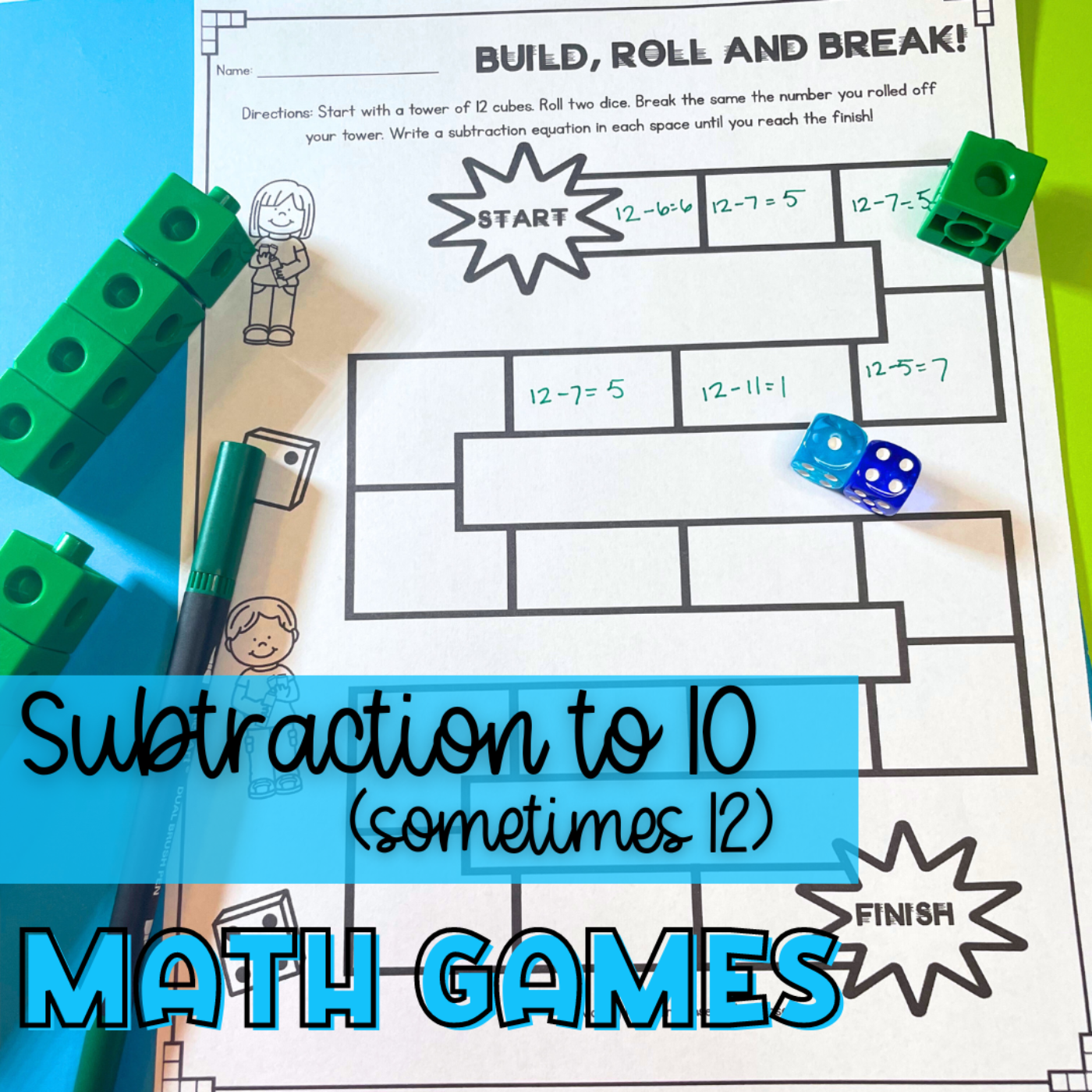
3:14 - Build, Roll, and Break
4:00 - Spin, Roll, and Remove
4:32 - Jump Around
Helpful Links
Addition and Subtraction Games Bundle
Let's Connect!
Available Results
Generated results are saved to the knowledge database for reuse and search.
Extract Knowledge
Pick what you want extracted first. Model, scope, and chapter options appear after a template is selected.
Transcript
1
00:00:00,000 --> 00:00:05,100
Subtraction games can be a little trickier than addition games because with a lot of addition games,

2
00:00:05,100 --> 00:00:07,800
you get two or three dice and you're good to go.

3
00:00:07,800 --> 00:00:13,200
But with subtraction, it can be tricky because we're not wanting to get into negative numbers

4
00:00:13,200 --> 00:00:16,400
with, you know, K1, 2 students.

5
00:00:16,400 --> 00:00:20,800
So you have to be a little bit more thoughtful about the games that you have your kids do

6
00:00:20,800 --> 00:00:23,600
so that they don't end up in negative numbers.

7
00:00:23,600 --> 00:00:36,100
And in this episode, I'm going to talk to you about five subtraction games that you can use with your students.

8
00:00:36,100 --> 00:00:41,600
Hello and welcome to Making Number Sense Make Sense, a podcast for elementary teachers,

9
00:00:41,600 --> 00:00:47,600
specifically early elementary teachers looking to really make an impact in the number sense of their students.

10
00:00:47,600 --> 00:00:51,400
Sometimes it can be hard to visualize games just through audio.

11
00:00:51,400 --> 00:00:57,000
So you can go ahead and go to my Instagram and I have reels of all of these games that you can see them in action

12
00:00:57,000 --> 00:00:59,800
really quickly and get a fun story or two in the meantime.

13
00:00:59,800 --> 00:01:05,300
The first game is similar to the game that we had last week in the addition episode.

14
00:01:05,300 --> 00:01:08,000
Instead of spin and add, it is spin and subtract.

15
00:01:08,000 --> 00:01:13,300
So the main difference here is that you're going to have your students starting with a full 10 frame.

16
00:01:13,300 --> 00:01:19,200
So these are all subtraction from 10 backs that they're working on and then they would spin their spinner

17
00:01:19,200 --> 00:01:23,800
and then whatever they spun would be the number that they take off of the 10 frame.

18
00:01:23,800 --> 00:01:30,800
And then again have the opportunity to write a subtraction equation that goes with what they just did

19
00:01:30,800 --> 00:01:35,700
so that they could get practice with their number writing, equation writing.

20
00:01:35,700 --> 00:01:39,800
And it's helpful for you to be able to see what they're doing and how they're doing.

21
00:01:39,800 --> 00:01:44,200
And if there's any confusion with writing equations and symbols.

22
00:01:44,200 --> 00:01:47,300
If there is confusion, I want you to tune in next week

23
00:01:47,300 --> 00:01:51,700
because I'm going to be discussing how I like to introduce the addition and subtraction symbols

24
00:01:51,700 --> 00:01:58,200
because the reality is they don't need those symbols to be able to do addition and subtraction.

25
00:01:58,200 --> 00:02:03,400
It can start to be symbol overload with letters and numbers and equal signs and all of that.

26
00:02:03,400 --> 00:02:09,800
So I have a little trick that I like to use to introduce those things to help kids remember

27
00:02:09,800 --> 00:02:13,900
what the different symbols mean and have them writing equations in no time.

28
00:02:13,900 --> 00:02:17,600
Okay, the next game is called spin, roll, and color.

29
00:02:17,600 --> 00:02:21,100
And so for that game your kids will spin a number.

30
00:02:21,100 --> 00:02:28,500
They go to 12. I usually have them just roll one die because they might spin a lower number than the dice

31
00:02:28,500 --> 00:02:31,100
and then they're into negative numbers and we don't want that.

32
00:02:31,100 --> 00:02:35,700
So if you are going to use two dice, you just want to talk to them about how to determine

33
00:02:35,700 --> 00:02:38,900
if the number that you rolled is bigger than the number that you spun,

34
00:02:38,900 --> 00:02:41,200
then you might have to start that roll over again.

35
00:02:41,200 --> 00:02:47,600
Anyway, for that game you would spin the spinner and then they could build a tower to match it

36
00:02:47,600 --> 00:02:52,200
if they want that visual and then roll one dice and then subtract the number they rolled

37
00:02:52,200 --> 00:02:57,700
from the number they spun and then they can color in that number or space.

38
00:02:57,700 --> 00:03:00,000
Their recording sheet is kind of like a grid.

39
00:03:00,000 --> 00:03:04,000
So it has all of the numbers on the bottom and then they would just color in one box

40
00:03:04,000 --> 00:03:10,400
for the difference that they got and then they're looking to see which one can get to the top first

41
00:03:10,400 --> 00:03:13,000
or whenever they finish their grid.

42
00:03:13,000 --> 00:03:19,500
The next one is called build, roll, and break and for that one, they're going to build a tower of 12

43
00:03:19,500 --> 00:03:21,300
then roll two dice.

44
00:03:21,300 --> 00:03:26,700
They'll have to add together the sum of the two dice and then subtract that from the tower.

45
00:03:26,700 --> 00:03:32,300
So they're going to break off the tower where the sum is and then write an equation to go with it

46
00:03:32,300 --> 00:03:34,300
and they have kind of like a game board.

47
00:03:34,300 --> 00:03:40,000
So they have to fill up the game board to get to the finish line to finish that game, build, roll, and break.

48
00:03:40,000 --> 00:03:42,700
My students really enjoyed that game because they like to build towers.

49
00:03:42,700 --> 00:03:44,600
I think it's fun to kind of break it off gently.

50
00:03:44,600 --> 00:03:47,400
We're not going too crazy here, but those cubes can be pretty tough.

51
00:03:47,400 --> 00:03:53,500
You know, they've had a lot of a lot of little as like we've had a lot of kids using those cubes.

52
00:03:53,500 --> 00:03:58,100
So they should be able to survive the breaking of the tower.

53
00:03:58,100 --> 00:04:00,500
The next one is similar to spin roll and color.

54
00:04:00,500 --> 00:04:02,200
This one is spin roll and remove.

55
00:04:02,200 --> 00:04:08,000
So the idea is they same they spin roll and subtract whatever number they rolled and then

56
00:04:08,000 --> 00:04:13,700
remove it from their tower and that one the focus is more on writing equations

57
00:04:13,700 --> 00:04:15,900
where the other one is just finding the difference.

58
00:04:15,900 --> 00:04:23,500
So they're getting practice of both sides there with the idea being similar so that they can do this station independently.

59
00:04:23,500 --> 00:04:27,700
It will be familiar to them, but come at it from a little bit of a different angle.

60
00:04:27,700 --> 00:04:29,600
So they're working on different skills.

61
00:04:29,600 --> 00:04:31,800
And the last one is my favorite.

62
00:04:31,800 --> 00:04:35,100
It's called jump around jump around is a partner game.

63
00:04:35,100 --> 00:04:41,600
And so the way that that game works is they will spin and that's their starting number.

64
00:04:41,600 --> 00:04:48,300
Then after that they would roll their die and then subtract the number that they rolled from the number that they spun.

65
00:04:48,300 --> 00:04:57,000
The thing that's a little bit trickier about this game is that there's not necessarily built in a place for them to model the subtraction.

66
00:04:57,000 --> 00:04:59,800
They would have to kind of keep it in their head or use their fingers.

67
00:04:59,800 --> 00:05:04,200
So it's a little bit more challenging than the other ones, which is kind of why I said it last.

68
00:05:04,200 --> 00:05:10,800
And the reason that it's called jump around is because on their game board, there's all the different sums that they might have.

69
00:05:10,800 --> 00:05:15,900
And so what they're doing is looking for the sum that they got jumping around to wherever they find it.

70
00:05:15,900 --> 00:05:19,100
And then they can color it in with whatever color that they choose.

71
00:05:19,100 --> 00:05:22,700
So maybe one player is the blue player, one player is the green player.

72
00:05:22,700 --> 00:05:25,700
And so they would color in all of their spots blue.

73
00:05:25,700 --> 00:05:28,400
Their partner would color in all of their spots green.

74
00:05:28,400 --> 00:05:32,100
And then at the end, they're trying to figure out who got the most spots.

75
00:05:32,100 --> 00:05:37,100
The numbers on the game board, I tried to pick more of the ones that are more common.

76
00:05:37,100 --> 00:05:42,700
So they're not rolling and spinning and spinning and spinning, trying to get like a one or something like that.

77
00:05:42,700 --> 00:05:49,000
But like I said, it's a little bit trickier because they kind of have to keep the number that they're using in their head and counting down.

78
00:05:49,000 --> 00:05:52,000
So they maybe spun a 10 and then rolled a five.

79
00:05:52,000 --> 00:05:53,600
Well, that's not a good example. That's a double.

80
00:05:53,600 --> 00:06:01,400
They might have spun a 10 and rolled a three, so they could either count up or count back to figure out what the difference is.

81
00:06:01,400 --> 00:06:05,800
The idea is they want to keep going to see who can color in the most spots.

82
00:06:05,800 --> 00:06:09,400
It's a little bit faster paced, a little bit more intense.

83
00:06:09,400 --> 00:06:16,600
But of course, if they need it, you can definitely offer them a 10 frame to use or cubes to use to support them.

84
00:06:16,600 --> 00:06:21,700
If they're not quite ready to just do that mentally or with their fingers, they can have a model of it.

85
00:06:21,700 --> 00:06:24,900
They can use a 10 frame or cubes to represent what's going on.

86
00:06:24,900 --> 00:06:28,800
Some of these games have the print and go version where you could just print it, color it.

87
00:06:28,800 --> 00:06:32,500
Others that have a print and go version and a color version.

88
00:06:32,500 --> 00:06:36,900
So you could laminate that one and then just reuse it again and again.

89
00:06:36,900 --> 00:06:38,400
There are options here.

90
00:06:38,400 --> 00:06:40,100
I hope that gave you some ideas.

91
00:06:40,100 --> 00:06:52,800
Stay tuned next week for when I talk all about how I introduce the symbols and what they mean so that they really stick and minimize confusion between addition and subtraction symbols in equations.

92
00:06:52,800 --> 00:06:59,800
And until then, I will catch you next time.