#195 Antibiotic Duration & BALANCE Trial: Beyond Journal Club with NEJM Group
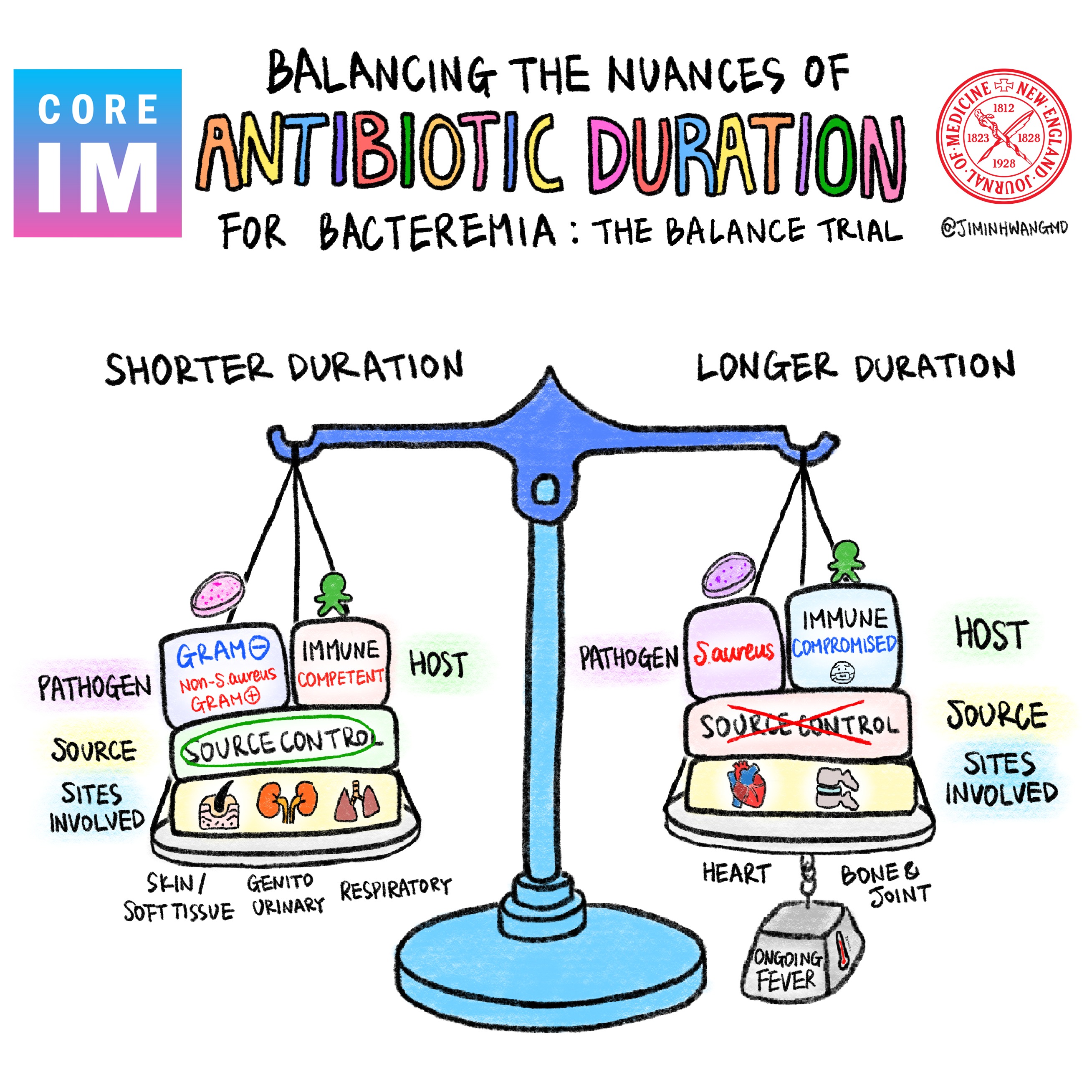
Antibiotic duration for bacteremia is something most of us learned by habit, not by trial data. In this episode, we walk through the BALANCE trial and use it as a lens to revisit how 1) host, 2) organism, and 3) source should guide treatment. When shorter really is enough, and when it isn’t?
🔹 Sponsor: Oakstone CME
Use the code "CORE30" for 30% off: https://www.coreimpodcast.com/MKSAP
Timestamp
(02:58) | Host, Organism, Source: The Core Framework Behind Duration
(09:02) | How Evidence Shifted Practice
(11:27) | The BALANCE Trial: Short-Course vs Standard-Course Therapy
(18:55) | Where does this leave us?
Tags: CoreIM, Internal Medicine, Infectious disease, Evidence-Based Medicine, Clinical Reasoning, Hospital Medicine, Medical Education
Find the best disability insurance for you: https://www.patternlife.com/disability-insurance?campid=497840
Our Sponsors:
* Check out FIGS: https://wearfigs.com
* Click for 15% off Premium Starter Kit at Branch Basics: https://branchbasics.com/COREIM
Advertising Inquiries: https://redcircle.com/brands
Privacy & Opt-Out: https://redcircle.com/privacy
Available Results
Generated results are saved to the knowledge database for reuse and search.
Extract Knowledge
Pick what you want extracted first. Model, scope, and chapter options appear after a template is selected.
Transcript
Antibiotic Duration & BALANCE Trial: Beyond Journal Club with NEJM Group – Core IM Podcast
Back to Top
Skip to content
Episodes by Series
5 Pearls
At the Bedside
Beyond Journal Club
Career Paths
CME
Gray Matters
Hoofbeats
Interprofessional Education
Mind the Gap
Miscellaneous
Whiteboard Animations
View All
Episodes by Topic
🏡 Primary Care
🏥 Hospital Medicine
👥 Interprofessional Education
👴 Geriatrics
💊 Medications / Pharmacology
💦 Nephrology
💩 Gastroenterology
📓 Stories in Medicine
🗼Career Paths
🙌 Miscellaneous
🛌 At The Bedside
🤝 Addiction Medicine
🥼 Medical Education
🦠 Infectious Disease
🧁 Endocrine
🧐 Clinical Reasoning
🧪 Rheumatology
🩸 Heme / Onc
🫀 Cardiology
🫁 Pulmonary
View All
Bytes
12 Lead Thursday
Behind the Lead Shield
Focus POCUS
Food For Thought
In the Nick of Time
Miscellaneous
Reading Room
Stats With Core IM
Stay Sharp
Trivia Tuesday
Whiteboard Animations
View All
About
About Core IM
Join Our Team
How to Use Podcasts
Contact Us
Subscribe
Shop
Search
Beyond Journal Club
Episodes By Series
Episodes By Topic
💊 Medications / Pharmacology
🦠 Infectious Disease
Antibiotic Duration & BALANCE Trial: Beyond Journal Club with NEJM Group
Posted:
December 10, 2025
By:
Dr. Shreya P. Trivedi, Dr. Clem Lee, Dr. Greg Katz, Dr. Minali Nigam and Dr. Matt Gwiazdon
Graphic:
Dr. Jimin Hwang
Audio:
Claire Yvon Ompoc Abatayo
https://media.blubrry.com/core_im/stream.redcircle.com/episodes/a960fb9e-2fb3-45ed-94b4-c1186d257287/stream.mp3
Podcast:
Play in new window
|
Download
Time Stamps
Show Notes
Transcript
References
Time Stamps
02:58
Host, Organism, Source: The Core Framework Behind Duration
09:02
How Evidence Shifted Practice
11:27
The BALANCE Trial: Short-Course vs Standard-Course Therapy
18:55
Where does this leave us?
Sponsor:
Oakstone CME
Code CORE30 for 30% from 11/1/25-1/31/26
https://www.coreimpodcast.com/MKSAP
Financial Disclosures from Guests:
None
Show Notes
BALANCE Trial Outline
How do you approach antibiotic duration for bacteremia?
General concepts:
Consider a variety of factors (host, organism, site), no “one-size-fits-all”
Historically: 7-14 days of antibiotics for most non-Staph cases of bacteremia
What factors affect antibiotic course? “H, O, S”
Host
Organism
Source
Both undertreatment and overtreatment risk harm to the patient
Undertreatment → harms due to infectious complications
Overtreatment →harm from indwelling lines and antibiotics
Factors to consider:
The Host
Patients who should be treatment for LONGER
Hemodynamically unstable and unstable vitals
Patients with hardware
Risk of becoming infected
Immunocompromised hosts
Patients who should be treated for SHORTER
Hemodynamically stable and stable vitals
Quick clinical improvement (e.g., fever curve, blood cultures clearing)
The Organism:
Organisms requiring longer treatment
Staphylococcus aureus
or
S. lugdunensis
higher risk of complications (e.g., endocarditis)
Gram-negative bacteria
often cause severe disease but clears quickly
Nuances occur with certain bacteria:
The risk of endocarditis
varies with species of
Streptococcus
Esoteric and atypical bacteria (e.g.
Coxiella,
mycobacteria ) have different treatment courses and general guidelines do not apply to them
The Source/Site of Infection:
Ask yourself: “Where did it come from, where did it go?”
Lack of source control may warrant longer antibiotic treatment
Additional sites of infection associated with bacteremia may warrant longer treatment (e.g. osteomyelitis)
Are shorter antibiotics really better?
General concepts:
Movement toward shorter antibiotic durations overall, though there are some notable exceptions (e.g. osteomyelitis)
“Complicated” vs. “uncomplicated” bacteremia is defined variably in trials
One definition used by experts
for “uncomplicated” is the all 4 of:
Source is urinary, intra-abdominal, catheter-related, pneumonia, or skin and soft tissue
Source control has been obtained
Host is not immunocompromised
Clinical improvement within 72 hours of appropriate antibiotics, including defervescence and hemodynamic stability
STOP-IT Trial
(2015):
Participants:  518 patients with intra-abdominal infections (1–2% with subsequent bacteremia)
Intervention: Randomized to control (up to 10 days of antibiotics) vs. short fixed course of antibiotics (4 ± 1 days of antibiotics)
All patients underwent procedures for source control
Results:
short course (median 4 days) of antibiotics: non-inferior to the longer course (median 8 days)
For the following 30-day composite outcomes:
surgical-site infection
recurrent intraabdominal infection
death
Bacteremia Duration Study Group Trial
(2019):
Participants: Randomized 604 patients with uncomplicated gram-negative bacteremia
Results: 7 days of antibiotics was non-inferior to 14 days
for the following 90-day composite outcomes
mortality
relapse
complications
readmission
extended hospital stay
von Dach et al.
, JAMA (2020):
Participants: 504 patients with uncomplicated gram-negative bacteremia randomized to 7 days of antibiotics, 14 days, or CRP-guided antibiotic duration
Results: Both 7 days and CRP-guided duration of antibiotics were non-inferior to 14 days
For the outcome of 30-day treatment failure
TAKEAWAY:
For uncomplicated gram-negative bacteremia:
shorter duration antibiotics is non-inferior to longer courses
mirroring trends in the treatment of all infections overall without any worrisome safety signals
The BALANCE Trial
Trial acronym stands for “Bacteria Antibiotic Length Actually Needed for Clinical Effectiveness”
Methods:
Trial type: international multicenter open-label non-inferiority trial
Population: 3608 patients
Inclusion criteria: patients with various types of bacteremia
20% of the participants had gram-positive bacteremia
Patients had a variety of infectious sources, with the most common being urinary tract infection (and
E. coli
the most common bug)
Exclusion criteria: immunocompromise (neutropenia or immunosuppressive therapy for transplant), prosthetic heart valves or endovascular grafts,
S. aureus
or
S. lugdunensis
bacteremia, syndrome requiring longer treatment (e.g. osteomyelitis), bacteremia from rare organism, fungemia
Arms: 7 days of antibiotics vs. 14 days of antibiotics
Primary outcome: death from any cause 90 days from first positive blood culture
Non-inferiority margin was set by investigators at 4%
Results:
The 7-day antibiotic treatment group was non-inferior to the 14-day group
Mortality: 14.5% in the 7-day arm vs. 16.1% in the 14-day arm
Secondary outcomes were similar between groups
ICU admission
Relapse of infection
C. difficile
infections
infection or colonization with drug-resistant organisms
length of stay
Caveat: drug resistance was not actively surveilled for!
So cannot rule out possibility of shorter courses impacting resistance, which may have implications for antimicrobial stewardship on large scale
Limitations:
Variability existed in antibiotic selection, dose, and route
No placebo controls were used
Only 20% of bacteremia was gram-positives
However, the absolute number of patients with gram-positive bacteremia was still large (there were more gram positive infections in this trial than in any other antibiotic duration trial)
Protocol deviation was high!
24% of the 7-day arm received more than 7 days
Suggests unmeasured variables (confounders) that prompted clinicians to treat for ≥7 days for shorter arm
However, the median antibiotic therapy in the 7-day arm ended up being only 8 days – so not much longer and still separated from 14 days
17% of the 14-day arm received fewer than 14 days
This trial cannot be applied to excluded esoteric organisms
TB
Listeria
Capnocytophaga
Brucella
Takeaways
Reinforces the existing direction of evidence!
shorter duration antibiotics = adequate for most patients with uncomplicated bacteremia
Consider 7 days as default For an immunocompetent patient with uncomplicated gram-negative bacteremia
rather than just an acceptable option
Meta point:
Trials like this are warranted in evidence-based medicine!
While they do not dramatically alter clinical practice, they can reassure us that current practice is based on solid data and is not harmful!
Ensures the current practice does not need to change
Treat the patient
Physicians must still individualize treatment based on the patient, organism, and source of infection;
Longer courses may still be required depending on host, organism, and source factors!
Remember previous point that both undertreatment and overtreatment risk harm to the patient – so ultimately need to balance both
Transcript
Dr. Matt Gwiazdon
: One thing that I liked that someone said to me once was, it’s not always right to follow the guidelines, but if you’re not following the guidelines, you want to be able to articulate why you’re not following the guidelines.
Dr. Shreya Trivedi:
Welcome to Beyond Journal Club, a collaboration between Core IM and NEJM Group.
The goal of Beyond Journal Club is to take landmark clinical trials and put them into context, telling the story of how we got to where we are and what it means for how we take care of patients.
Dr. Clem Lee:
Today we’re talking about antibiotic duration. I know that I’ve struggled to answer, “When can my patient come off antibiotics” more than a handful of times?
Dr. Minali Nigam:
It turns out this is a difficult question to answer and many factors go into.
Dr. Greg Katz:
So first, we will try to think like an ID doctor about how to approach antibiotic duration, which may feel like pulling random numbers out of a hat to some of us.
Dr. Clem Lee:
Then, we’ll look at the prior data, investigating different antibiotic therapy durations specifically for bacteremia.
Dr. Shreya Trivedi:
That will bring us to the BALANCE trial, which asked the question “is a 7-day course of antibiotics long enough to treat bacteremia?”
Dr. Minali Nigam:
Finally, we’ll dive into how this trial can change clinical practice, if at all.
Dr. Shreya Trivedi:
So, Minali I loved that you choose a study on antibiotic duration and then I found it so surprisingly that when we reach out to our ID colleagues for their input their first response was,  “i feel
somewhat uncomfortable to even discuss bacteremia as a generalizable thing divorced from nuances
.”
Dr. Matt Gwiazdon
: And so I think it’s hard to design trials that capture the nuances of every patient. So my process of going through this study, the balance trial was initially were sort of recoiled from it of I don’t want this trial, I want something that tells me something really specific about enterococcus or something like that.
Dr. Shreya Trivedi:
And so it rightfully made us appreciate that to even have a meaningful discussion about antibiotics duration, we first have to understand the unique points about the host, organism, and primary source of infection that goes into the antibiotic duration.
Dr. Clem Lee:
So for bacteremia, we are often thinking do we need antibiotics of 7-14 days?
Dr. Greg Katz:
And then there are a handful of patient-specific factors we need to think about. Are they hemodynamically stable or unstable? Do they have good source control? How quickly do they get better? Do they have hardware that could get infected? Are they immune-compromised?
Dr. Matt Gwiazdon
:
So if someone is in full minute septic shock when they come in, but they get a dose of antibiotics, they briskly improve blood culture’s clear.
I would typically feel pretty comfortable going with the short end of the spectrum of duration in terms of seven days.
But for example, if the patient came in sort of really sick with septic shock, the blood cultures kind of stayed positive for just the next day, one out of four bottles or something like that, they took a while to improve. They’re a little bit older
or some minor nudge of immunocompromised. We might say we would be discussing on rounds
seven days versus 14 days and where we fall based on our judgment of the patient in front of us.
Dr. Clem Lee:
So comforting to hear that the love of deliberating on rounds doesn’t stop when internists go through fellowship! So there is a lot of nuance in terms who that host is and how they are responding in terms of fever curve, blood culture clearance, if they have hardware, source control, etc.
Dr. Minali Nigam:
And then the second big factor is the actual organism. In thinking about shorter antibiotics, we’re not talking about Staph aureus bacteremia or Staph lugdunensis [lug-di-nen-sis] bacteremia, which behave differently and have higher risk of complications like endocarditis.
Dr. Matt Gwiazdon
: Gram-negative rod bacteremia typically makes people quite sick and clears quite briskly. It’s not as troublesome as staph aureus. I think that other gram positives and enterococcus, some of the streps are sort of a more nuanced decision.
Dr. Greg Katz:
My job as a cardiologist when i see anyone with bacteremia is thinking what is their risk of endocarditis. If i see strep viradins, I’m thinking this is really high risk vs. strep pyogenes does not make me scared in the same way.
Dr. Clem Lee:
Dr. Gwiazdon showed us this beautiful graphic we can
link
in the show notes that shows the different types for strep and their risk of endocarditis, color coded from green to red for low to high risk. I couldn’t stop thinking about this graph and I’ve been having dreams about it.
Dr. Minali Nigam:
Glad to know about this high yield, go to resource! And then the last big factor is the actual site of infection. For example when we have osteomyelitis associated bacteremia, you want to treat much longer versus the bacteria associated with cellulitis:
Dr. Matt Gwiazdon
: Group A strep cellulitis. Our guidelines say you can do five days even in patients associated with bacteremia. So I think there’s guidelines and there’s studies and there’s expert opinion and there’s sort of all of these overlapping resources to draw from.
Dr. Clem Lee:
Man the more we talk about it, the more it does seem like antibiotic duration is hard to talk about in broad strokes since there are so many variables.
Dr. Minali Nigam:
Exactly, the most important thing is do no harm to our patients and have a relapse or recurrence, lets take a look at the research and the direction has been trending towards shorter durations as a safe option for many patients.
Researchers really started looking at this question of optimal antibiotic duration for infections at large in the late 90s and early 2000s with larger scale randomized controlled trials coming out within the past decade.
Dr. Clem Lee:
Yeah research has shown that for many of the common infections, like urinary tract infections, community-acquired pneumonia, and cellulitis, shorter courses are just as good as longer ones. There are some major exceptions to this — notably osteomyelitis. So in bacteremia, there is the question of whether shorter is just as good, just like most other infections, or is this an infection where shorter would do harm to the patient.
Dr. Greg Katz:
And then there’s the
STOP-IT Trial
which was the 1st contemporary trial to do a deep dive of shorter antibiotics was good enough? STOP-IT published in the New England Journal of Medicine in 2015 was was super provocative and courageous and even asking in patient going for surgery asking if less is acceptable.
Dr. Minali Nigam:
Investigators looked at patients with intraabdominal infections from various sources, including 1-2% of patients with sources that came from bacteremia. They either got up 10 days of antibiotics or only a median of 4 days of antibiotics.
Dr. Greg Katz:
Important to note that patients in this study underwent procedures to obtain source control so there was no untreated abscess or anything lurking.
Dr. Shreya Trivedi:
And of course as you predict the punchline that the shorter antibiotic course of a median of 4 days was noninferior to longer antibiotic therapy when it came to any infection recurrence or death within 30 days after procedural source control.
Dr. Minali Nigam:
And so even though it was just 1-2% of those patients who had bacteremia, we saw there was no signal for harm with the  shorter course.
Dr. Greg Katz:
And then there was the
Bacteremia Duration Study Group
that published a trial in 2019 randomizing 600 patients with uncomplicated gram-negative bacteremia to receive either 7 days or 14 days of antibiotics.
Dr. Clem Lee:
The 7 days of antibiotics was noninferior to the 14 days of antibiotics for 90-day composite outcomes of all-cause mortality, relapse and readmission or extended hospital stay.
Dr. Shreya Trivedi:
That 7 day timeframe for uncomplicated gram negative bacteremia was reinforced after
von Dach et al
published an RCT in JAMA in 2020 looking at adults with uncomplicated gram-negative bacteremia. They found that adults in the 7 day antibiotic treatment and CRP-guided duration arms (im a fan CRPs) were noninferior to the fixed 14-day treatment arm with regards to the clinical failure rate.
Dr. Greg Katz:
This builds on data from VAP, pyelonephritis, CAP, cellulitis – you name the infection, there’s probably a trial suggesting that shorter duration of therapy is just as good or non-inferior to longer durations
Dr. Clem Lee:
So Let’s get into the
BALANCE trial
. BALANCE stands for
Bacteremia Antibiotic Length Actually Needed for Clinical Effectiveness (BALANCE).
I love “actually” a little bit of sass from the ID doctors.
Dr. Shreya Trivedi:
The BALANCE Trial was a large, multi-center, open-label, non-inferiority trial that randomly assigned patients with various types of bacteremia to either 7 or 14 days of antibiotics. Sources of the bacteremia included urinary tract, abdomen, lung, vascular catheter and skin or soft tissue.
Dr. Minali Nigam:
Investigators enrolled over 3600 patients across 7 countries from 2014 to 2023. It’s 6 times larger than the largest trials in this area, so it’s by far the largest study to date that investigates antibiotic duration for bacteremia.
Dr. Clem Lee:
and it’s probably the largest that we’re going to see, and so a trial this large often ends up being the final word for quite some time.
Dr. Greg Katz:
So i think its important to talk about who was excluded from this study, those who were immunocompromised patients (defined as neutropenia or immunosuppressants for transplants), those with prosthetic valves or grafts, infections with certain complications endocarditis or osteomyelitis.
Dr. Minali Nigam:
Sounds a lot like those patient specific factors that make an individual at higher risk that we talked about earlier.
Dr. Clem Lee:
And patients with staph aureus bacteremia were also excluded, which reinforces the difference between staph and many other organisms, as we also discussed before.
Dr. Shreya Trivedi:
The primary outcome was death from any cause by 90 days from bacteremia diagnosis, which was based on the date of the first positive blood culture.
Dr. Minali Nigam:
And what they found was that the 7-day antibiotic treatment group was non-inferior to the 14-day antibiotic treatment group for 90 day all cause mortality — 14.5% of patients died in the 7 day arm versus 16.1% of patients died in the 14 day arm.
Dr. Greg Katz:
There were several secondary outcomes as well including ICU admission, relapse, C diff, secondary infection, length of stay, among others, but none of them showed significant difference apart from number of days of antibiotic free days which favored the shorter antibiotic duration arm.
Dr. Clem Lee:
Yes, but remember we can’t conclude that this is better for antibiotic stewardship .We didn’t see any difference in c diff infections, drug-resistant organism colonization, or length of stay.
Dr. Shreya Trivedi:
Right because there would still be clinical scenarios where I would lean towards longer durations, even in light of the BALANCE Trial.
Dr. Clem Lee:
The primary outcome seems like a promising finding, again moving in the direction of shorter antibiotic duration as with many of the other infections in ID.
Dr. Shreya Trivedi:
But before we get too excited, let’s talk about the limitations.
Dr. Minali Nigam:
Yeah, it’s important to remember that there was variability in antibiotic selection, dose, and route. Because there was a variety of pathogens and antibiotics there weren’t placebo controls.
Dr. Greg Katz:
But I think the largest limitation is that a significant portion of these patients had E. coli bacteremia from a UTI, in other words, uncomplicated gram-negative bacteremia which we’ve had previous trial data for.
Dr. Clem Lee:
Some gram positives were included in the study — organisms like enterococcus, coagulase-negative staph, strep pneumo, strep pyogenes, and strep agalactiae. But the total percentage of gram positives was only about 20%.
Dr. Greg Katz:
that’s true it was only 20% of patients, but if you add up all of the other patients in the other bacteremia trials with gram-positive bacteremia, this surpasses that amount.
Dr. Shreya Trivedi:
you’re right in that this is the largest gram-positive bacteremia cohort, but the vast majority of patients have uncomplicated, gram negative bacteremia.
Dr. Minali Nigam:
And another thing to mention was that  rates of deviation from protocols were pretty high – 24% of the patients assigned to 7 days got much more than 7 days and 17% of those assigned to 14 days got much fewer than 14 days.
Dr. Clem Lee:
So the median antibiotic therapy in the “7 day” arm ended up being 8 days.
Dr. Shreya Trivedi:
If you search OpenEvidence I can imagine someone quoting this trial would say the headline — 7 is noninferior to 14 — but here we get to see that its non-inferior with some muddy crossover, and that there were nuances with the various bugs involved.
Dr. Clem Lee:
So yes im glad we went through all but i feel like ive been doing 7 days of antibiotic duration for bacteremia for some time now.
Dr. Minali Nigam:
Well at least now we have stronger evidence to make us feel good that what we’ve been doing is on the right track.
Dr. Greg Katz:
Some trials are paradigm changing and some trials are paradigm reinforcing. Infections are an area where more and more data has been pointing us towards the idea that shorter duration antibiotics is probably good enough for most patients. And now BALANCE comes in – with 6 times the number of patients ever enrolled in a trial on bacteremia  – and tells us that those small studies haven’t been barking up the wrong tree.
Dr. Clem Lee:
Does that make you feel like the resources used to run this trial could’ve been used elsewhere if we already suspected what the results were going to be?
Dr. Greg Katz:
No, there is a difference between the results we expected to be true versus results we actually know be true. A trial result doesn’t have to be unexpected to be important. Think about how many topics we know very little about and don’t have great quality studies to guide our decision making. This paper tells me that we can feel comfortable that the direction of the evidence has been moving in the right direction and we don’t need to upend our messaging to tell people that, no, well actually you’ve been doing this thing wrong
Dr. Shreya Trivedi:
Right, and as we’ve discussed on prior episodes, sometimes small trials may point to a certain direction, but then a large trial comes along, perhaps in a more modern era, and completely goes against what those small trials show. An example of that was MINT trial for transfusion thresholds that we previously covered.
Dr. Greg Katz:
Exactly. And so this trial is important, not necessarily because it’s breaking our paradigm or it’s moving the needle on a million patients. But it’s reinforcing that the direction of the evidence has been moving correctly and if the default changes, that means a lot of really important things for antibiotic stewardship
Dr. Minali Nigam:
Key takeaway here is that for an immunocompetent patient with uncomplicated gram negative bacteremia, 7 days is the default rather than just an acceptable option.
Dr. Matt Gwiazdon:
So I think if you start at seven days and then you end up doing 10 days or 14 days and you can articulate, and this is often what we’re doing on rounds, just to be completely transparent, patient needs at least seven days, but they were sort of still had a low rate bacteremia on day two of treatment were really sick coming in, they’re elderly, they’ve got these comorbidities that I think in our judgment we’re doing the patient a favor rather than a harm by going for 10 days or a longer course. But a lot of that is sort of nuanced decision making that’s not necessarily captured by a super targeted trial,
Dr. Greg Katz:
I see this all the time where people name drop a trial without fully understanding the results and limitations and why you could still do something different in clinical practice.
Dr. Clem Lee:
Yeah if you don’t take the time to read the fine print, we can definitely misapply and do possible harm.
For, example hopefully no one is mislead that 7 days of abx is also fair for esoteric bacteria such as HACEK organisms, MTB, NTM, Salmonella, Brucella, the other ‘ellas, Listeria, Capnocytophaga, etc.”since those organisms weren’t included in the trial.
Dr. Minali Nigam:
Thinking about the exclusion criteria – I would still consider longer antibiotic duration if a patient has complicated Staph aureus bacteremia, endocarditis, osteomyelitis, no source control, or persistent fever despite appropriate antibiotics.
Dr. Greg Katz:
Or if a patient is immunocompromised or has an underlying condition that would make them more vulnerable. But treatment for bacteremia is not a one-size-fits-all approach. We still need to individualize treatment based on the patient’s clinical status, the source of infection, and the organism involved.
Dr. Minali Nigam:
Certainly we’re hoping this Beyond Journal Club episode can leave people with the nuanced understand to interpret this trial and see where it fits to apply to your patient or not.
Dr. Clem Lee:
And there’s not one place to look for all the answers. Determining antibiotic duration for each patient requires a combination of trial data, institutional guidelines and clinical judgement.
Dr. Shreya Trivedi:
I feel excited next time on service and ID recommends 7 days or 10 days or 14 days, ill feel more in the loop as to why versus just taking their word for it and ordering the PICC line for the patients who need longer therapy. Ultimately, optimizing antibiotic treatment duration for bacteremia is nuanced with the provider having to weigh efficacy and the risks of overtreatment.
Dr. Clem Lee:
And it’s important to remember that while you want to err on the side of caution, overtreating also has its consequences. You have to BALANCE both sides when deciding on antibiotic duration for each patient.
References
Chamat-Hedemand S, Dahl A, Østergaard L, et al.
Prevalence of Infective Endocarditis in Streptococcal Bloodstream Infections Is Dependent on Streptococcal Species.
Circulation
. 2020;142(8):720-730.
Heil EL, Bork JT, Abbo LM, et al.
Optimizing the Management of Uncomplicated Gram-Negative Bloodstream Infections: Consensus Guidance Using a Modified Delphi Process.
Open Forum Infect Dis
. 2021;8(10):ofab434. Published 2021 Oct 11.
Sawyer RG, Claridge JA, Nathens AB, et al.
Trial of short-course antimicrobial therapy for intraabdominal infection.
N Engl J Med
. 2015;372(21):1996-2005.
Yahav D, Franceschini E, Koppel F, et al.
Seven Versus 14 Days of Antibiotic Therapy for Uncomplicated Gram-negative Bacteremia: A Noninferiority Randomized Controlled Trial.
Clin Infect Dis
. 2019;69(7):1091-1098.
von Dach E, Albrich WC, Brunel AS, et al.
Effect of C-Reactive Protein-Guided Antibiotic Treatment Duration, 7-Day Treatment, or 14-Day Treatment on 30-Day Clinical Failure Rate in Patients With Uncomplicated Gram-Negative Bacteremia: A Randomized Clinical Trial.
JAMA
. 2020;323(21):2160-2169.
BALANCE Investigators, for the Canadian Critical Care Trials Group, the Association of Medical Microbiology and Infectious Disease Canada Clinical Research Network, the Australian and New Zealand Intensive Care Society Clinical Trials Group, and the Australasian Society for Infectious Diseases Clinical Research Network, Daneman N, Rishu A, et al.
Antibiotic Treatment for 7 versus 14 Days in Patients with Bloodstream Infections.
N Engl J Med
. 2025;392(11):1065-1078.
Tags:
antibiotic duration
,
antibiotic stewardship
,
infectious disease
Comments
Leave a Reply
Cancel reply
Your email address will not be published.
Required fields are marked
*
Comment
*
Name
*
Email
*
Website
Δ
Connect
Comments? Questions? Feedback? Reach out to us!
Community
We'd like to thank
Clinical Correlations
for giving us our first home and head start! Check them out and subscribe for some great reads!
Join
Interested in joining our community?
We are always looking for new potential contributors (educators, writers, editors, artists, social media enthusiasts, or roles we haven’t even thought of yet)— if you have a passion for inspiring curiosity and critical thinking,
click here
for more details!
Disclaimer
Opinions in this podcast are our own and do not represent the opinions of any affiliated institutions. Please don’t use this podcast for medical advice but instead consult with your healthcare provider.
© Copyright 2026 Core IM, 501 (c) (3)