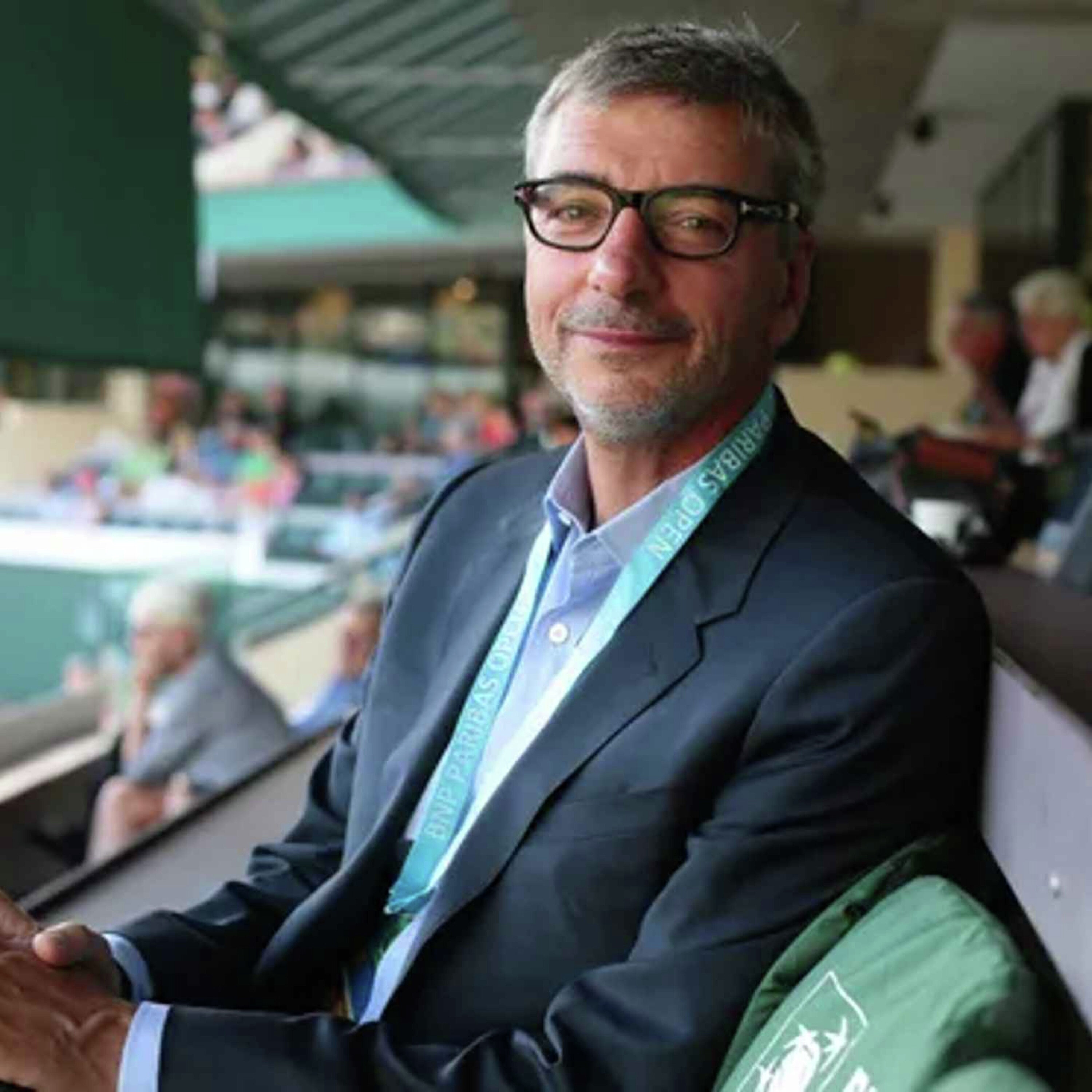
Live: The Future of Tennis
BNP Paribas USA CEO Jean-Yves Fillion joins Rennae at a live event in the California desert to discuss the way the French bank is pushing for a more socially equitable, diverse and sustainable future of the sport.
Hosted on Acast. See acast.com/privacy for more information.
See omnystudio.com/listener for privacy information.
2022-04-08
32 min
Transcript
Available Results
Generated results are saved to the knowledge database for reuse and search.
No generated results are available for this episode yet.
Extract Knowledge
Pick what you want extracted first. Model, scope, and chapter options appear after a template is selected.
Generated results for public episodes are saved to the knowledge database so they can be reused and searched later.
Transcript
00:00:16
Speaker 1: Okay, hi everyone, and I want to say thank you very much Caitlin at Racketbert for everyone that's come tonight, thanks very much.

00:00:24
Speaker 2: We have some really cool people who are so thanks.

00:00:26
Speaker 1: So I'm just going to start because the last interview I did for the podcast was actually with John eve here and it was during the pandemic year, which was never great.

00:00:36
Speaker 2: But it is fantastic to be back here interviewing you again.

00:00:41
Speaker 1: One of the things that you know, I love so much about this tournament and you and the support that BMP gives is we're just so thankful.

00:00:49
Speaker 2: So first of all, I am a servant volleyer.

00:00:52
Speaker 1: Anybody that's played against me knows, and I want to jump right into the initiatives that BNP has done through the years.

00:00:58
Speaker 2: In particular, I'm going to go through a couple of things that you've actually done at BNP, so you all know and aware of we have Team b and p P Mac one.

00:01:08
Speaker 1: Okay, we're going to get into all of this BNP P Open Scholarship Program, Aces for Trees, which is my favorite, and FAA Points for Change. So, first of all, random re coorse of that because you guys give back so much and I want to know because this tournament is also a sustainable tennis paradise. I mean anybody who's been here, I want to know first of all from you, how much it's meant to you through the years of being here and the support that you've given this tournament.

00:01:41
Speaker 3: First of all, first you've done made peace base way because you've on is listed everything and I'm not exactly get there. I'm not sure I'm going to do as good of a job as she just did about BNP power By then, thank you for that. Listen that first and foremost is the privileged to be with you. It's supervit edge to be with you all here. And abviously the podcast. I was looking at the list of the audience here. It is so impressive the diversity of you all here, from singers, actors, tennis players, artists. Then I think it's an amazing illustration of diversity in so many ways, and I think this is what we love with And I know your servant value and you go straight to the topic. But I wanted to say that last year during the pandemic, it was in October, you were one of the very few professionals I do a lot of live TV and so on, and you showed up pandemic. It was in October. We were, you know, in person together. Listen. I value digital I value everything that you know Zoom and Webbex and team and everything else. It got the world going and we benefited from it as a business. But I was telling Ronnie earlier, I think I know how to maintain or monitor trust digitally. I don't know how to create trust digitally. And the fact that you were here, we spoke, we still connected, meant a lot to me. Then that's my opening comment.

00:03:19
Speaker 2: Thank you.

00:03:19
Speaker 3: Diving into the topic. I have a personal history with this tournament. It's back in two thousand and nine. For the ones who followed tennis, it used to be the Pacific Life. She knows because she played here. She won't actually I wish she had won the bnly Bibe Open, but she made it Pacific Life for us. But no hard feelings here. And remember financial crisis, Pacific Life drops it. We were already the largest sponsor oftennis in the world. Accidentally met with the tournament staff here. It was way back when Raymond Moore, Charlie Pacerella, Peggy Michael ab you see see here Raymond as well, and we threw to Paris and when they flew back, we had a deal and we've become the title sponsor of this tournament. It's the thirteen thirteen TIERO. I'm involved with this experience and I have to tell you I would have never thought, you know, what it would have become. And obviously it's a teamwork. So many people jumped in Realison himself. I think it's become one of the most respected preferred tournaments in the world. And it's usually you don't think about actually what is going to become. You just engage, involve yourself, you do your best, you trust the people you are in and off we go.

00:04:39
Speaker 2: Yeah. Well, I can tell you when the tournament of the year every year voted by the player, So that's because of the support of BNP. But let's talk about Team B and p P mac one give us a little overview of what should.

00:04:51
Speaker 3: You Then you might be familiar with two brothers, John and Patrick McEnroe, and I have the privilege for many, many years to be very intimate with the two of them, and it's an amazing experience in many ways. And it started with the dinner back in twenty eighteen with Patrick and you know, John and Patrick have this wonderful academy and they have the foundation and everything else, and it was like we were like, how can I help you but in doing something different than what you already do, and we came up well, actually, he came up with this concept of you know, we would love John and Patrick to one day have a kid, boy or girl or both from New York City to be an amazing player on the tour. And this is not something that really exists in the academy, but they wanted to be from the city. They grew up in the old Queen's you know kids. Basically, Okay, I'm French and nobody's perfect, but I try to help see if I can do something in this direction. Then in New York. Now live in New York. Well, actually I lived in Chicago. French born French American, lived most of my life here, lived in Chicago, lived in Los Angeles for quite a long time. For I know, we have some actors here my my past, in my past life, what financing independent movies? This is why I lived for so long in La been in New York for the last twenty years. But still then we came up with the concept. But it had to have three dimensions to me and honestly to John and Patrick, this is why it took off. First, kids have to stay with the families and and you know New York City kids training in New York City, they don't go like across the country, trans atlantic obviously whatever. They stay with their friends. The communityans on first dimension. Second one, you see, it has to be the plan is to train excellent players, the best coaches and training. John and Patrick fully involved in the department, make one third concept. Education. You know, education is critical. They have to be good at school. They have to work hard. If they don't, they have to go to school. And if they don't deliver at school, they cannot be part of the program. And hopefully what I'm going to say is going to come out the right way. We look at deserving kids, meaning kids who cannot afford you know, this kind of training. If we agreed on the four components, it took off ten kids. The bank is you know bank, I can speak a bit about money. We provide half million each year for the ten kids, fifty k per kids. It's a lot of money. But when you're on the too young, you know, most of them are it Franked. It's not that much, but it pays for the training, the traveling, the coaching and so on.

00:07:48
Speaker 2: We have a professional tennis player in the room, so she knows I.

00:07:50
Speaker 3: Can see that. Oh sure, Joseph, Sure, sure, Okay, then nice to see you again. And I mean, long story short, but I have passion for that is most of them are I franked. We already had two wild cards here Sabby this year Sebastian Theater. Last year, we just welcomed a new member of the BNP Piba mac One. His name is zizu Is. Actually was my next question.

00:08:25
Speaker 2: Let's talk about him because he's not even twelve yet they're only supporting.

00:08:30
Speaker 3: And he's eleven years old and is not one in the country in his age class. And Sabby and then that's kind of the high level you know tennis. But Sabby is eighteen. Then he got into the program older. Uh, he just got accepted to Princeton. Uh, this is what you know, John and Patrick Cole plan B. I mean, it's a wonderful plan A for most of us, you know in this film. Then that's that's I've been a bit long, but this is the story.

00:09:00
Speaker 1: The thing is is, but you and I talked about because one of the things that you know, you can go to college or you can be professional, but going to college, going to Princeton now allows him to maybe come back here in three or four years exactly as an intern and.

00:09:11
Speaker 3: Run this tournament, and run this tournament, and I believe it's going to have a great career as a tennis prayer with with Princeton anyway, then that's that. That was what the concept We're going to go to the next topic. But I think the main concept it's easier said than down. It gives me so modest I'm not saying, well there. I think the future of tennis, probably the future of anybody. It's how do we give back, but giving back in a real way, giving back you have to believe in it. Otherwise your giving back is not really sustainable. It's only a one off in time. And I think this bank has managed and there is so much more we can do to leverage tennis, including to leveage this tournament. Trying to really go beyond the tennis itself and really focus on committing to the communities, you know, equity, the social dimension, equal access as well as systainability.

00:10:08
Speaker 2: Yeah, and talk about also the local for you, the high school that you are also supporting here in the Chella Valley. That's pretty impressive as well.

00:10:16
Speaker 3: I mean, you know you know this so well when it's so impressive. If that's another Like most of what's happening in my life, it's usually I wish I could say I strategized, I had the plan. That's but that that would look good, right I Actually, embarrassingly enough, it's pretty much the opposite same thing here.

00:10:33
Speaker 2: It's more very French.

00:10:34
Speaker 3: Maybe that's the side or you know of me that always comes back and is in the way of trying to do the things right. But my American side has saved me many times in this country, and I think been here for so many years. One day Peggy and I sat and I said, same thing, pretty much the same story, like the one I had with Patrick, probably late in the process versus early. But I said, I love this place, but how can I know it better? How can we contribute better? And and she said, are you ready for a ride? I said, with Peggy always but I said, yeah, sure, let's Then she gave me a ride in the Coachella Valley. She showed me the schools we met with the people there. She said, you want to contribute. I said, I would love to. That's how it happened. Then we started six years ago with two scholarships, a boy, a girl, you know, twelfth graders. We started with the fifteen thousand dollars per kid. Usually it's a time, sometimes even more than their parents make, to be honest, and we send them to colleges, to colleges they wanted to go, but you know, you see La, you see your wine, you see San Diego, Santabara, you know, and we follow them. Then it worked so well. I mean, then we we shifted to for scholarship three years ago while people notice there is some inflation in this country. Then this year we're going to do the forced scholarship as well, but we are going to make it twenty thousand dollars apiece to make sure they go through the program. Another dimension of that one. Because you are an amazing tennis player, you've been to trophy ceremonies, you receive twelphees. These kids, I've seen this stadium from the outside since there were kids. What we do We invite them the recipients you know, in the stadium, and they get their scholarship checks on this you know court in front of twenty thousand people, and we give them the mic and they speak. I can tell you they're so eloquent. They have to see it right exactly.

00:12:47
Speaker 2: Also, the thing that I love is the love the aces for trees, so.

00:12:53
Speaker 1: That I mean you talk about giving back with the kids, but also the environment is super important for being p Perrybar moving back to that and this this tennis stadium and this city needs so much help with that as well.

00:13:05
Speaker 2: What is tell us about the.

00:13:07
Speaker 3: Well, this this one really started with the bank committing beyond California, beyond him in the US to to you know, fight deforestation with an English world. It is right and uh and this is what we do worldwide and we are so committed to it. And obviously locally here an opportunity was the you know dramatic wildfires that you know are devastating, uh, this this region. Then we started with this concept a few years ago, but specifically last year or the concept is for each ace score in the tournament. Until last year, we were committing to plant.

00:13:48
Speaker 2: A tree, giving a good day today because right.

00:13:51
Speaker 3: Right, right then I have to make sure that yeah, you know, it's an investment. Right well, to give you a sense, last year we planted over three thousand trees. This year we basically do three trees for one eighth and I'm expecting to have much more tree than twenty twenty two than we had in twenty.

00:14:12
Speaker 2: Yeah, I'm thinking that. I'm certainly thinking Riley of perlk is going to help with the tree.

00:14:17
Speaker 3: Keep an eye on him.

00:14:17
Speaker 2: Yeah, yeah, exactly.

00:14:19
Speaker 1: Also, you know, I love that you get involved with some of the players and FAA Felix Asia Alisiim who has sadly lost the other day, but he is also something is super important to the initiatives of the FAA points.

00:14:31
Speaker 2: Explain that because he sadly.

00:14:33
Speaker 1: Lost the other day, so he would have been contributing a lot more with his five dollars you match with the fifteen give us a little bit.

00:14:39
Speaker 3: About it, right well. You know you have already explained very well on a similar concept here. It's for each point one.

00:14:46
Speaker 2: It's pretty amazing.

00:14:47
Speaker 3: He wins a lot of points, right yeah.

00:14:49
Speaker 2: But I have to say for a single player to give back that much is pretty extraordinary.

00:14:54
Speaker 3: And it's pretty coming. Same thing. Most of what we do, what we contribute to somebody you leads believe in something and we try to to to to accompany. Basically, then he had he had this you know concept. It's giving five dollars to a foundation called Care and Care is basically, you know, raising funds to protect children in Togo, an African country where his father is from. Uh, to protect them candidly from violence there and trying to give them some education. Then what we do, we triple much what he does. Then when it gives five, we gives fifteen. Right five time three fifteen?

00:15:34
Speaker 1: Right?

00:15:35
Speaker 3: Yeah, right, it works, right, it's simple math. I cannot under more than that.

00:15:44
Speaker 2: We're getting a lot of help in the room from Andrew Pekovic.

00:15:50
Speaker 3: Then that's that's unfortunately, as you said, he lost, but it's the program is here, but we we match his program worldwide, you know, everywhere he plays, and that's that's that's another way too, as you said so well on it to to give back again, it's it keeps me very modest. It's only maybe one tenth of the world. But if we don't do this one sense, you know, it's uh, it's it's never gonna start. Then we we love it. And when you believe in tennis, which honesty is this from is. I have to say, I've been working for this bank for the last four years. Then it was partly by initially like JP Morgan, right, it became BNPP like GPY Morgan Shade, and I basically I got acquired, I got lucky. I'm still here. But but it's I have to say, they have tennis in their DNA. That's that's that's And I know you're gonna ask me why. I'm not sure I have a good answer. But the answer I have is I can see common values. We discussed it last year. Right, Tennis is about many things, but it's about sportsmanship, it's about you know, self confidence, self I would say progression. Honestly, in the world we live in today, I think it's about mutual respect that is so critical. And it's about diversity. When you have presidency in seventy two countries, how cannot you be diverse and understand the diversity is your main asset. I think that's what the world of tennis is bring getting it here. It's it's in Indian Wales, you know, in California. This tournament is broadcasting around the world, and that I think that has tremendous value to me. And this is what the bank is about.

00:17:32
Speaker 1: So you and I talked last year, we're talking again this year. You know how much racket just we're trying to better the game of tennis. We're trying to broaden in every way. Diversity is super important to us. So how can we continue to make things better going forward?

00:17:49
Speaker 3: Well, never, you know, I think it's something you've done so well in your tennis career. Never stop going faster in this dimension, I like going faster. If anyone's ever been in a car with me, never stop, you know, pushing harder. And again it's it's it's easy to say, it's nice. They're a nice world. And always you know, look at look at how does the evidence match the you know, the worlds Uh, well let's let's take here. It's equal pay. Yeah, it's been equal pay since two thousand and nine or twenty ten. Were joined in.

00:18:26
Speaker 2: Two thousand, that's about when I retired. But thank you.

00:18:30
Speaker 3: I was always sad to learn about it. But but we're here together.

00:18:34
Speaker 2: Yeah, yeah, yes, as we are. But I appreciate it.

00:18:38
Speaker 3: Equal pay. We we you know that that was absolutely centual. I can tell you you would you wouldn't better this better than anybody else. That was not an easy concept at the time. Still today it's one. But not even building the map right then we said, if we do this, tournament have to be equal it is equally pay. Uh.

00:18:56
Speaker 2: We have a tournament director in Peggy, who would.

00:18:58
Speaker 3: Have any anyway. I had no other options and I have, you know, and I happened to be the father of three daughters and I have even less options. But it's then, that's that's a concrete illustration of if you believe in something. Here, the leverage was tennis. The leverage was to get into a tournament that needed support. Okay, then if it's if it needs support, we wanted to be under certain terms and terms where equal pay, equal access, diversity and sustainability and across the program you so well listed. I think hopefully you see these dimensions and and and values resonating in what we're trying to do. And again I'm saying this very modestly. It's it's it's not even halfway. We can do so much more together.

00:19:47
Speaker 2: Yeah, I look forward to coming back here for another twenty years and it's each year, right, But sadly I did retire too soon. But anyway, we did start today just asking basic questions, finding out a little bit about BNP does.

00:20:01
Speaker 1: Obviously what Racket loves to do as well, but we actually sent out some questions to some fans Racket various things. And one of the fan questions was tennis has been ahead of the curve when it comes to gender equality and do we have more work to do?

00:20:16
Speaker 2: And I think you've kind of already answered that, but.

00:20:18
Speaker 3: The answer is yes, yes, and yes, but yes to tennis has been at the forefront. It's the good news is I hopefully what you see with the bank, we're leveraging tennis every in every single way we can to push diversity, gender equality, equal pay. And we commented on some real illustrations. That's the good news. What would be the bad news is to believe that were we've arrived. We've barely started.

00:20:49
Speaker 2: So one of the next questions was how do you push other sports to do that together?

00:20:53
Speaker 3: And I think, you know, I believe in I believe in leading by example. I mean, if you do it right. Maybe I'm a bit naive, this is my French side, but I believe I believe in the concept of if you do something right, and you communicated. By the way, thank you so much for giving me this opportly to speak about it. I think, particularly in the world of today, it resonates. And then if you do it right with one sport and you know, not not like any sports, Tennis is so, you know, well appreciated global worldwide. I think it basically you have this good contagious effect and I see it happening. By the way, well, it might not happen, it might not happen at the same pace. That's what's happening, but it's happening. Then that's one one dimension of it. The the other one is to is to just make sure that you know, in the corporate world, which is the other world, I have some leverage on that, you know, what we believe in tennis actually has to be implemented in the company as well. And I again, why not where we where I dream of being. But I can tell you today in terms of diversity, in terms of ethnicity, in terms of gender equality, in terms of equal access, I think equal access is very important. I mean, if i'm there is a fine line between saying well, the next job is for the people who have green highs, black glasses and a black sweater, right or just randomly. Well, it's very important because but in the meantime, you have to make sure that it's being done with the right mindset. Because if I'm being told you get the job because you have green highs, I'm like, I'm not motivated, right, I'm actually humiliated. Then it's really about making sure that it's equal access irrespective of your ethnicity, values, gender, and a lot of other dimensions. Then you can compete in a very fair way. And I think that's that's exactly what tennis is because if they play against you on this court, I want to win, yeah, but you want I wan't, right, but then I have to you know, I still have to be there.

00:23:05
Speaker 2: But you have a dream.

00:23:06
Speaker 3: You have a dream. You have a dream, so you know then we have to play soon, right.

00:23:10
Speaker 2: Yeah, that we might have to make that happen on Sunday. So fifteen, Yeah, exactly, do I get your pay?

00:23:18
Speaker 3: Well, let me speak to my team, Okay, I'm just.

00:23:21
Speaker 2: Wordrying on that.

00:23:21
Speaker 3: We that.

00:23:22
Speaker 2: So next year is the fifteenth year I believe of being peace sponsorship.

00:23:26
Speaker 3: All right, close? Fourteenth right, fifteen fourteen?

00:23:29
Speaker 2: Next year?

00:23:30
Speaker 3: Yeah, this is the thirteenth year.

00:23:31
Speaker 2: Right, Okay, so there you go.

00:23:35
Speaker 1: So I was kind of right, but anyway, were so, do you have anything you have anything planned for next year because it's a big, big year.

00:23:43
Speaker 3: Well, I think it's an excellent point. We're going to have to think about it. What I have planned today? We all want to know, and this one is really to well, you're right, one has to celebrate in life, and I'm a little bit behind the curve. As you noticed that we have to plan about the party and the celebration. What I really look forward is normally the fifteen you know, because I've reknewed this contract probably four times of the last you know, fourteen years, and I know what it is to go through the next phase, think about the future. I look forward to celebrating this again, this is my French side. We celebrate a lot in front, but I look forward as well to when we get into the next phase, you know, the next five years. Exactly what you were saying about gender diversity, about equal access, about sustainability, what exactly is going to be the meaning of this tournament. I think it's a lot of trees. I think more diversity, probably more mutual respect, and I think this tournament you know we we pubaly sponsored by one hundreds of tournaments in the world, you know, in all dimensions of tennis, from family tennis, you know, a team tennis across around the world. Then we have a sense. We do the French, we do the Village in Kincup, we do the Davis Cup. I can tell you being involved in most of these tournaments, this one is special. Then how can we continue to make it special? I do believe it's not exactly what we've been discussing obviously Grand Slam. You know, quality and content and attendance. That's creditic on this is this is the tennis side, and I think it's going to continue to get better and better making this venue And thank you to Larry honestly like like a unique venue that is unmatched. Uh. That's the second dimension and the third one. I truly believe that what we touch upon today around diversity, around gender equality, around mutual respect amongst around sustainability is something that's we won't celebrate this next year because I don't think we're there yet, but this is to me, uh, the plan for the next phase, okay, and I look forward to it.

00:25:55
Speaker 1: I'll keep an eye on you, Okay. So, so one of the things we wanted to do today was just open up the for questions, what do you want for the future of this time or tennis in general?

00:26:04
Speaker 3: Right, right, No, it's it's an excellent question. Actually, I have another connection with with Newport because I well, I grew up playing tennis. I love the game, but I really grew up sailing and skiing and former member of the French sailing team. I'm a member of New York Art Club, which is pretty much next to the Tennis out of Fame in terms of distance. Uh, it's a good point. Well, I think contributions come from from from many contributors. I'm already a very large sponsor of the Tennis out of Fame for the last you know seven years. I'm actually they give me the privilege of you know, supporting. I supported the most of their project, including the museum, and I'm one of their largest corporate sponsors. I'm actually a board member of the Tennis out of Fame, which I feel very privileged to be, and they give me the privilege to be their opening speaker every year at their you know, gadad dinner in New York City during the US Open then, which is, by the way, called the legends. Then that's my contribution to the Hall of Fame. I yeah, I think you're right. The tournament is a great terma. I think it's a two fifty or right, and I think that this is where hopefully we will benefit from this contagion effect that you know, all the corporate sponsors and they have some you know, but will continue to push the concept forward. I'm a big fan of the Hall of Fame. I think it's it's protecting the tradition, but they do it in such a way that it's protecting the tradition projecting themselves into the future of tennis. What I have to say for the last for the certainly not that was my worst day. That was to be on record, that's my worst day. Uh. What I'm going to give you two Well, I've had the privilege to hand the trophy over here over the last you know, eleven years, and I have to say it's not only a privilege to do it and reward or be one of the ones who was contributing to the winners, because it's an amazing accomplishment, but it's a wonderful opportunity for me in a few minutes to speak about the bank, to speak about a commitment to tennis, a commitment to the sports, and addressing you know, eighteen thousand people in a way I hope translate or convey some passion. And I love that. I have an anecdote actually which keeps me very modest about brand recognition. And that's my second good day, I guess. In terms of tennis, you spoke about the Hall of Fame. By the way, I have a program with Billy Jion King in New York. It's called City Parks Tennis. It's not the John and Patrick mcenroll thing. It's not like you know, uh, coaching kids to become to go players. It's really providing tennis education to six thousand kids during the summer months, but long summer, like from early June to late August, and uh. And these kids played deserving kids, you know, in the city parks, you know, all summer. Then this is the story I was. Then every year I go there with a Hall of Famer. I think that was Virginia, either Villagine or Virginia was right Australian. Well, you're right, but very Australian, exactly right. Right then, and a little kid a little girl. She was playing so well by she was probably six or seven. She grabbed me. She grabbed me and she said, you know, can I speak to you? I think I was, and I'm like sure, and she said, one day I want to be like you. I can tell you the first time somebody in my life told me they want to be a banker. And I look at Virgin, I'm like, and she's like surprised as well, you know why somebody would want to be like you? And it's another discussion we had with then. Then I said, really, She said, yes, I want to be like you. I see you on TV. I want to run a tennis company like you do. Then I had to explain to her that being pipe I was not a tennis company but a bank then totally of big, big, big disappointment, but that we're very community to tennis. And we loved it. She was a meeting. She she looked at me, she said, I get it, and then she turned around and she went back and played, I love that's you know, back to your point. Was it a good day? I think it was actually because it kept me very modest. I love the transparency of this young girl. And and and I think that's that's what branding is about. At times you don't care why you are being known for. But but but you are being You're being known, you are being in the community, you are being part of it. And I think she actually she put on the name of the bank amazing linguin.

00:31:11
Speaker 1: Well, I want to say thank you Johnny for again supporting tennis in a way that no sponsor sports supports it throughout the world. So thank you in every way, and thank you for having us tonight. Everyone can enjoy this great match now and I just want to say thank you, thank you so much for having me to pre
Chapters
No chapters available.