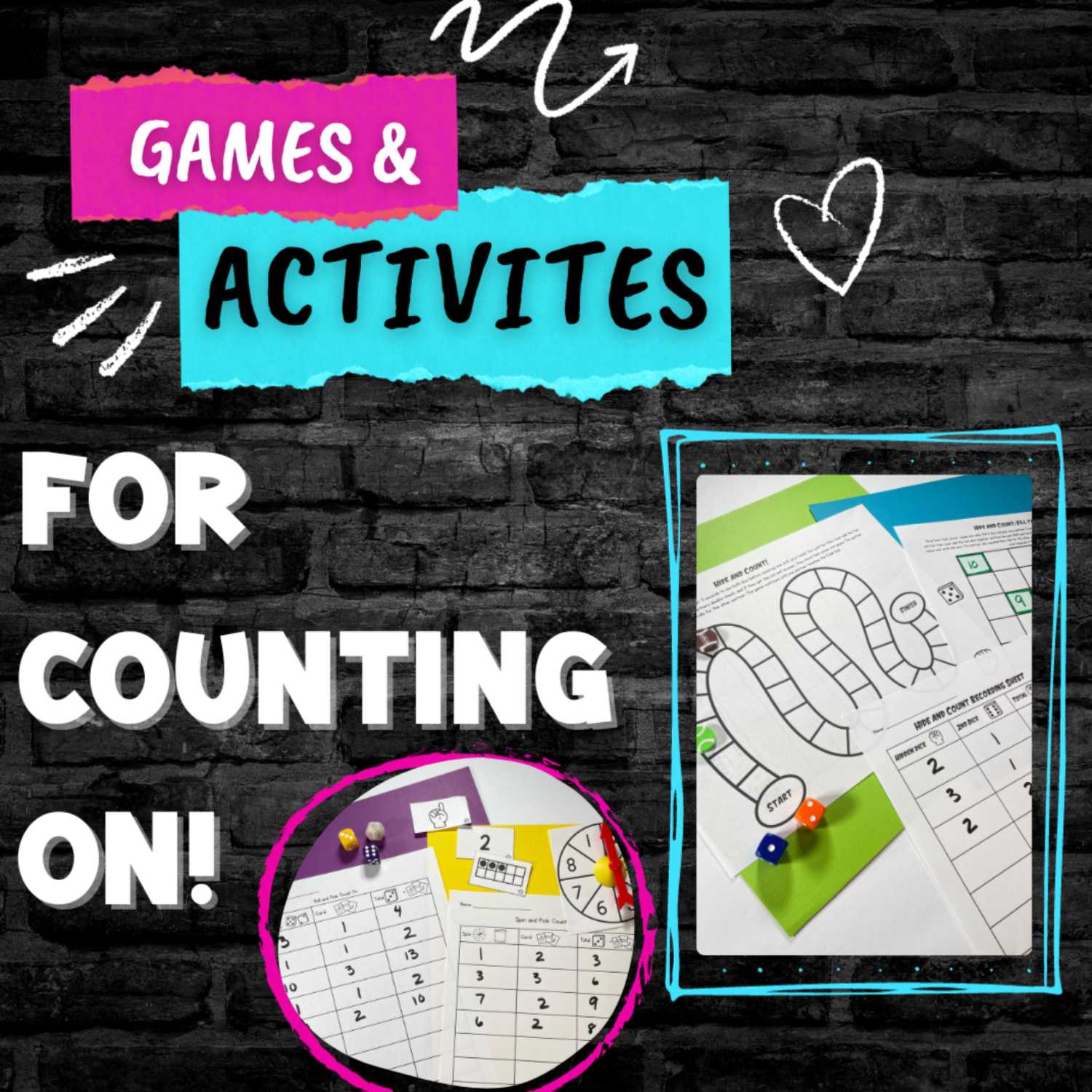
Ep 19.5 Games for Counting On
Making Number Sense Make Sense: A Math Podcast for Early Elementary Teachers
This episode comes from this YouTube video so you can see the games in action! Though some prefer to listen than watch!
Your students may know their numbers to 20 in the figurative counter stage, but can they use them? In this video, you will learn 4 games you can play with your students to help them develop more sophisticated counting strategies.
These games are perfect for students who are past the tricky teens and are starting to work on addition. Since the numbers are small, they can feel confident in their ability to answer, begin to solve problems, and develop a sense of how numbers work together!
Helpful Links
Hide and Count On!(partner game):
✨Save on the Figurative Counting - Counting On Bundle
See the Games in Action in this YouTube Video!
Looking for More Information about the counting stages?
Get the presentation slides for free here!
Let's Connect!
Available Results
Generated results are saved to the knowledge database for reuse and search.
Extract Knowledge
Pick what you want extracted first. Model, scope, and chapter options appear after a template is selected.
Transcript
1
00:00:00,000 --> 00:00:04,880
I'm going to talk with you today about games to help kids learn to count on.

2
00:00:04,880 --> 00:00:09,760
Now, when kids are in this counting on strategy, they're usually pretty good with numbers to

3
00:00:09,760 --> 00:00:13,840
20. They're pretty good with their T numbers. They can count them. But what you want to do is

4
00:00:13,840 --> 00:00:20,720
move them from counting by ones to be able to count on. So for example, if I rolled two dice

5
00:00:20,720 --> 00:00:26,160
and one was a five and one was a four, I don't want them to have to count one, two, three, four,

6
00:00:26,160 --> 00:00:31,120
five, and then count four. I want them to be able to hold on to that five and then count on from

7
00:00:31,120 --> 00:00:37,680
there. So five, six, seven, eight, nine. Kids in this stage of counting are figurative counters.

8
00:00:37,680 --> 00:00:43,280
And figurative counters can count forward to 30, but not quite to 100. They might have trouble

9
00:00:43,280 --> 00:00:47,600
crossing a decade. They may have trouble counting backwards from 20. They could probably count

10
00:00:47,600 --> 00:00:52,400
backwards from 10. They recognize numbers through the teens still working on numbers to 100. They

11
00:00:52,400 --> 00:00:58,400
usually know their finger pattern to five. They recognize common arrangements on a 10 frame. They

12
00:00:58,400 --> 00:01:04,800
can describe common dice patterns. So they have a good foundation. We're working on developing more

13
00:01:04,800 --> 00:01:10,960
sophisticated counting strategies. They'll be able to solve addition tasks. But if I said,

14
00:01:10,960 --> 00:01:15,920
I have five, how many more do I need to get to eight? That might be a little trickier because

15
00:01:15,920 --> 00:01:21,200
they have to have their five and then track how many more they counted to get to eight. So we're

16
00:01:21,200 --> 00:01:27,200
working on those types of skills and to work on that type of skill. What you're going to need to

17
00:01:27,200 --> 00:01:34,560
do is figure out a way to have kids practice kind of having to keep a number in their head, not being

18
00:01:34,560 --> 00:01:40,320
able to see it are represented. So make it more abstract and less concrete. So I'm going to share

19
00:01:40,320 --> 00:01:46,560
with you four games to help your students learn to count on. The first game is called how many

20
00:01:46,560 --> 00:01:54,400
candies. So for this game, the kids would spin a spinner and that spinner has numbers and a hand.

21
00:01:54,400 --> 00:01:59,920
So the hand is kind of pretending that inside that hand is that many items, but they can't actually

22
00:01:59,920 --> 00:02:05,360
see it. So they spend their spinner say that they spawn a three. So they have to keep in their head

23
00:02:05,360 --> 00:02:10,880
and that there are three and then they move their spinner over to the candy side. And then however

24
00:02:10,880 --> 00:02:17,120
many there are, they have to count on that many. So if I wrote spun a three, I spin it two, I think

25
00:02:17,120 --> 00:02:26,240
three, four, five, and then that's my answer five. And so they can either record on a dry erase if

26
00:02:26,240 --> 00:02:31,920
they're using a mat or on a recording sheet what their spins were and then move on. If they're

27
00:02:31,920 --> 00:02:38,160
still needing to create the three, you can have those counters available to them. But the idea

28
00:02:38,160 --> 00:02:44,000
is that they're moving from meeting all of their counters to being able to count on. The next game

29
00:02:44,000 --> 00:02:49,440
you can play with a spinner or a dice and it's called roll and count on or spin and count on.

30
00:02:49,440 --> 00:02:55,760
So for this game, you would roll your dice. That's your first number and then you would pick a card

31
00:02:55,760 --> 00:03:02,400
and the card either has a finger pattern on it, a numeral on it, or a 10 frame. So whatever number

32
00:03:02,400 --> 00:03:09,440
you rolled, you have that number. So say six, I rolled my six, I have it, and then I pick my card.

33
00:03:09,440 --> 00:03:15,200
Maybe my card has two, so I have my six and I count on seven, eight, and then I write my total on the

34
00:03:15,200 --> 00:03:21,920
side. So I have my number I rolled, card I picked, total. And if you're doing the spinner, it was

35
00:03:21,920 --> 00:03:29,920
number you spun, card you picked, total. Next game is called hide and add. So for this one, similarly,

36
00:03:29,920 --> 00:03:36,560
you're hiding your number in your card. So you pick a card and those cards have hands on them,

37
00:03:36,560 --> 00:03:43,360
again hand closed. So the idea is they're imagining that inside that closed hand is whatever number of

38
00:03:43,360 --> 00:03:50,160
items is on the card. So I might pick a seven. There's seven inside this hand and then I roll

39
00:03:50,160 --> 00:03:56,640
my dice and however many I get is how many more I'm adding on. So I have seven on my card, seven,

40
00:03:56,640 --> 00:04:01,920
and then I rolled two more, eight, nine. Nine is my total and I'm writing on my recording sheet.

41
00:04:01,920 --> 00:04:08,560
And my next game is a partner game that you can play either with a board or in a print and go

42
00:04:08,560 --> 00:04:13,200
version. You can just print it out and then each student gets a color they can color in.

43
00:04:13,200 --> 00:04:19,520
So the way that this game works is the kids have two die. So they roll two. So the first player

44
00:04:19,520 --> 00:04:26,320
rolls both die, wait three seconds, and then cover just one die. So they roll, say that they roll a

45
00:04:26,320 --> 00:04:31,600
three and a six. So they wait three seconds and cover up the three and then the partner has to

46
00:04:31,600 --> 00:04:37,520
think, oh how many was that one? Three. And then from their three count on or from the six they

47
00:04:37,520 --> 00:04:42,400
have six over here and then count on the ones that are hiding under their partner's hand. So they have

48
00:04:42,400 --> 00:04:49,920
six, seven, eight, nine. And they can either move their counter nine spaces if you're using a game

49
00:04:49,920 --> 00:04:56,320
board or color in a nine on their print and go version. And again there's an optional recording

50
00:04:56,320 --> 00:05:01,280
sheet if they want to practice their note, sneak in a little number writing practice with this game.

51
00:05:01,280 --> 00:05:06,080
So I hope you got some ideas for counting on. I'll have the link to all of these games in the

52
00:05:06,080 --> 00:05:20,960
description.