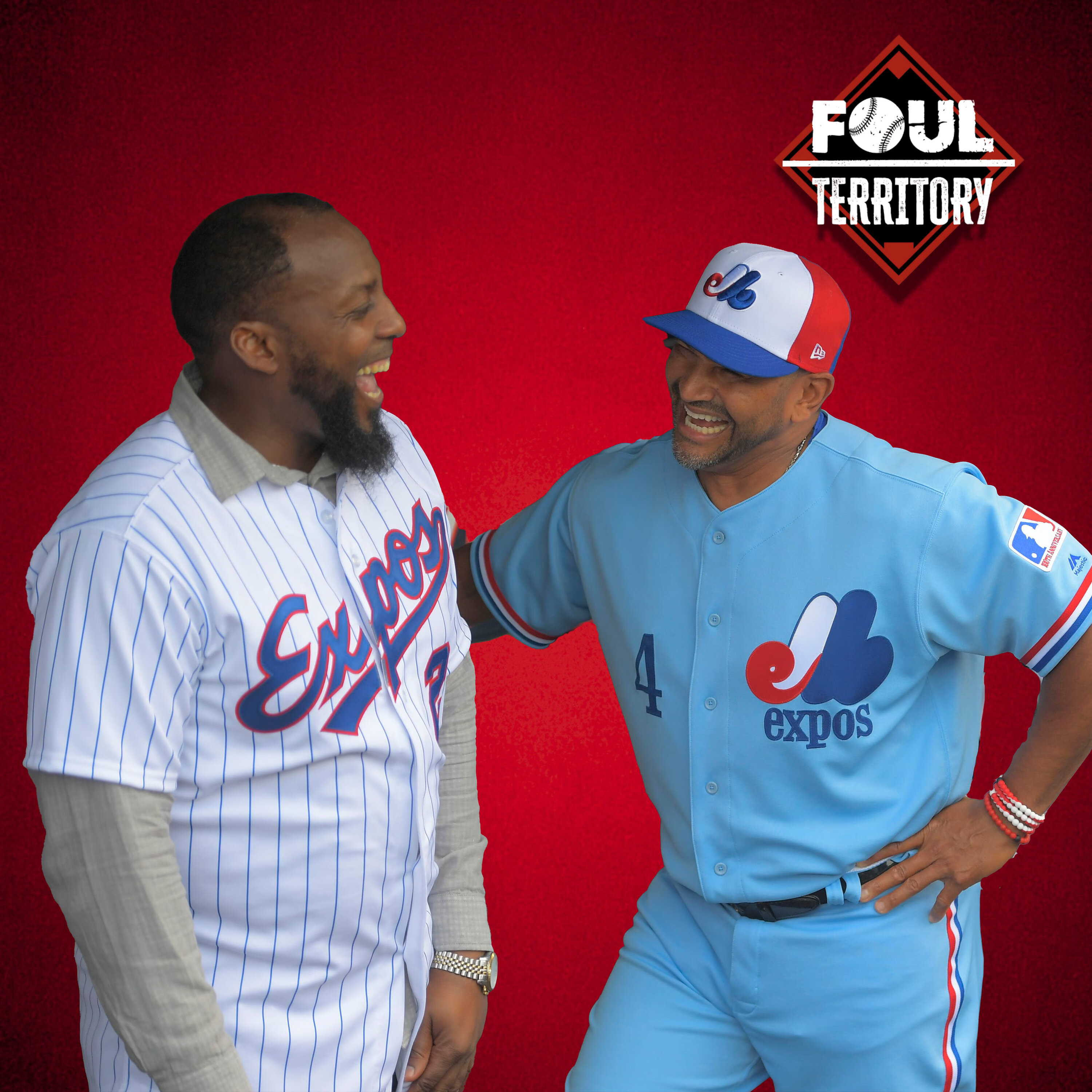
'Who Killed the Montreal Expos?' doc Director Jean-François Poisson
Jean-François Poisson is the writer and director of the documentary, 'Who Killed the Montreal Expos?' and we ask him who the true top villain was in this mess. How did Expos fans handled their fandom once the team was gone? With the Blue Jays in the World Series, are Expos fans rooting for or against the Canadian team?
Hosts: Jason Kipnis, AJ Pierzynski, Scott Braun
Foul Territory Presented by FOX One: Start your 7-day free trial today at FOXone.com
Download Cash App Today: capl.onelink.me/vFut/hap8idx8 #CashAppPod. Cash App is a financial services platform, not a bank. Banking services provided by Cash App’s bank partner(s). Prepaid debit cards issued by Sutton Bank, Member FDIC. See terms and conditions at cash.app/legal/us/en-us/card-agreement. Direct deposit and promotions provided by Cash App, a Block, Inc. brand. Visit cash.app/legal/podcast for full disclosures.
See omnystudio.com/listener for privacy information.
Available Results
Generated results are saved to the knowledge database for reuse and search.
Extract Knowledge
Pick what you want extracted first. Model, scope, and chapter options appear after a template is selected.
Transcript
00:00:03
Speaker 1: Hasan joining us right now on foul Territory. He's the writer and director of Who Killed the Montreal expos It's now available on Netflix. Wow, good timing there to put this out. I know it's twenty years so that's part of it. But baseball is kind of a big deal in Canada right now.

00:00:19
Speaker 2: How you doing. I'm good. And yesterday I think is amazing. I couldn't have think of it.

00:00:29
Speaker 1: Yeah, incredible, and we all watched it. I watched it late last night. I really enjoyed it. It's a great ninety minute. We have plenty of questions. I'm actually going to start this way because it was turbulent times. I want to bring you into this. The Minnesota Twins went through all kinds of crap during your time period. It was the same stuff with retraction, right contraction or contraction, contraction, contraction, retraction. But give him your perspective here because this will help for the conversation.

00:00:53
Speaker 3: So Jean called. I watched this and having been on the Twins at the same time, it was a kind of the same thing with the Twins. We need a new stadium. We can't survive where we are. Oh and then Major League Baseball came up with this excuse my language, freaking brilliant idea, let's just get rid of two teams, and one of them was the Exposed and one of them was supposed to be the Twins. So every day, I think it was the two thousand and one offseason, we had about three times a week we had to get on the phone with the Players Association and this and that and try to explain to us why they were trying to get rid of these two teams. For note, now everyone wants to add teams. At the time, they were trying to get rid of teams instead of trying to make it work. And what I got from this documentary was it wasn't one person that killed the Expos. It was a really lot of bad decisions by not only the people with the exposed, people in Major League Baseball, the Lauria Sampson, the poor one bore guy Brushaw Bruce Saw felt so bad for that guy. But this contraction thing was it was unbelievable that they were even thinking about. We went on and won the division and save Baseball Minnesota and the Expos sadly never had that opportunity because of ninety four, because of ninety four with the strike. But to me, it's like, man, I felt it just kind of pulled on my art strings because I went through this kind of with the expos at the time.

00:02:09
Speaker 2: Yeah, and it's relevant for every cities that lost the team anywhere in the world. It's just almost the same thing. I remember this this a contraction thing. I think it was. It was a way to push cities to just build new stadium. I think so. So yeah, so Minnesota I one and Montreal I think did it. So they're gone.

00:02:34
Speaker 1: Hey, I want to go to one of the pressing questions in the dock And obviously the story already exists. You're just taking us inside of it. But part of it has to do with figuring out who the number one villain is, and you present cases for a number of people within the documentary. Do you have an opinion, like, do you think that there's one person? David Samson kind of talks about how it's like it's not like one moment to find everything. Okay, that's fine, but is there one person who could have done something differently more than anyone else in this entire situation that would have changed it, Like it could be the commissioner could be Bud Selig because he was part of the ninety four strike. And if there's no ninety four strike, maybe the experts make enough money and don't have this problem.

00:03:20
Speaker 2: But who do you think? Yeah, one person's hard. But if I had to pick one person, I would blame mostly the businessmen in Quebec because they could have done something, put some money. I know it was hard. I know the strike was hard, and it was obviously maybe the beginning of the end, but I don't know there was maybe a lack of did they really wanted to keep the team. I'm not sure. I wouldn't blame the Americans. Of course, of course everybody here blames them, and that's why I really wanted to have David or Jeffrey Lauria in the film, because their point of view. Here in Quebec we never heard it, and it was important for me to get that and to made people in Quebec realize that maybe they're wrong, and maybe there's more than one suspect, but for sure, maybe Kibikwah businessman could have done something more to keep that team. They weren't ready to put some money. And if you don't put money in the team. How do you manage to keep it here and may make it win?

00:04:35
Speaker 1: Jean Fartois. I thought it was really cool to get David Sampson in there, and he's a media guy. He's been on our show too, so I give him credit. And he's even admitting like, hey, I've got a ton of ego and we listened to his show often too. My question is how you think he is perceived in this. There were some stories that came out like, oh, he's perceived as a villain, and he didn't realize that during the whole conversation. So I went into this thinking oh, oh, it's going to be really bad for David. I felt like it was okay. I felt like he had good comebacks to what you're talking about, which is, hey, businessmen of Quebec, you have a piece of this team. Can't give us money, but you can give millions of dollars to lawyers. I thought like that kind of line, and there's more of them in the doc that I encourage people to check out. I thought it was a good comeback. So how do you think he was perceived in this? And what was it like working with him on it?

00:05:25
Speaker 2: For me anyway, I knew he was aided in Kibet, so I didn't know what to expect when I went in his home. But I knew that he know the drill, and he he know how to put a good show, and he knew what we were doing. He knew we wanted to have every point of view, so he gave us testimonies with a lot of character. I have to say he's entertaining and it's a good way to make your points. It would have been easy to put him as the villain because he sounds like it. And for people people in Quebec, we're not used to that kind of confident tones in business here, it's not the same. We don't want to fight, we don't want we're more consensual and hearing David, people get a little bit scratchy. But but I wanted to be fair for everyone and for him. And if people think now that he is the omniplan, it's not because of what he said about the team. What he say about the team. Maybe it's because of his tone, the way he say it, and maybe because some part of it are true. I think I think.

00:06:51
Speaker 4: For all your parents out there like me, with teenagers trying to already keep a million things under control. Cash App is here to help us make sure your team's money and their spending isn't adding up to craziness.

00:07:03
Speaker 1: With the cash app card available to teens thirteen to seventeen with sponsorship by an eligible parent or guardian, every transaction triggers a real time notification for you to see, empowering your team to practice independence while giving you peace of mind by keeping track of their spending. You can also manage everything directly from your own cash app account without having to switch between the two. With the cash app card, you and your team's balances receive twenty four to seven fraud monitoring, and if something ever feels off, you have the ability to lock their card right from your phone in just one tap. If you're ready to give your team more independence while staying in the loop, start by downloading cash app and setting up their account today. For a limited time, new cash app customers can earn ten dollars if they use code family ten in their profile at sign up and send five dollars to a friend within fourteen days. Terms apply. Cash app is a financial services platform, not a bank. Banking services provided by cash apps bank partners, prepaid debit cards issued by Sutton Bank member FDIC Direct deposit and promotions provided by cash App, a block ink brand. Visit cash App, Dot App Slash Legal Slash podcast for full disclosures.

00:08:02
Speaker 3: The one guy I feel sorry for. I never feel sorry for David Sampson because him and him and Jeffrey Lauria, they sold the team, they got the Marlins, Max MLB made that and then they won the World Series the next year, and then he sold the Marlins again and made another crap little money. So I don't feel sorry for Yeah, I don't feel sorry for them at all. But the one guy I do what's Brochhoe? Yeah, Broshue, He's the one guy I feel sorry for. This guy really cared about the Expos. He tried everything in his power to save the Expos, and people just crapped on him. And now I was happy in your movie You're like kind of and You're It was like, this is a redemption spot for him, for all these people to stop crapping on this poor guy who genuinely cared and wanted to do the right thing for the Expos. And the other owners were like, no, he doesn't know what he's doing. Let's try this other guy, and then that didn't work clearly and got rid of him. So I'm glad you made this movie for for for Broshu.

00:08:55
Speaker 2: Thank you, because because you know, a lot of people pointed him, even here in Quebec, it's him, it's him. He took bad decisions. But when I met him, and it wasn't an easy an easy interview, everyone was treated the same, David and Claude and the other guys. But I had at some point some hampthy for him because I think he really, as you said, wanted to keep the team here. It was the legacy of Bronfman and he had the same values and he wanted the same thing. It wasn't the same economic context, and there were no there was nobody here with enough money to just manage the team alone. So he tried to find some people. Maybe that wasn't the good ones. I don't know. Maybe he took bad decisions when the strike happened. Maybe, But did he really wanted the team to stay in Montreal? I think so, I really think so. And I think he didn't deserve this oh media frenzy bullying against him. I think that was bad, and I wanted to show that because that for me, that's wrong.

00:10:14
Speaker 1: Okay, so let's push forward. Here. There are A's fans, Oakland A's fans that are going to watch this segment and wonder what life looks like twenty years from now. So my questions are all kind of combined. Here is baseball as popular now? I'm guessing that's now in Montreal? Do people root for the Blue Jays? Because the commissioner of the sport currently in baseball thinks that all of the Oakland A's fans are just going to eventually root for the San Francisco Giants. And let's get that first. Then I have one more on baseball now in Montreal.

00:10:49
Speaker 2: Yeah, I think the first ten years was art as I when I spoke to people, they told me that they were not able to watch a baseball game for ten years, and then they switch for the Blue Jays because you know, they had to find something to, you know, if they wanted to watch baseball, so the Blue Jays became their team. It's baseball popular, It's still it's still popular amongst the youngest people. I can see games outside. Obviously it's not the same right now, there's a kind of an excitement. This is this is a new thing. But but no, it's not as popular as it was. But we can still and this is really true, we can still feel exposed DNA in the city. They are not forgotten. I can see logos everywhere. There are murals with up and stuff like that. Every time, every time we passed next to the the Olympic stage and we think about them. They're not forgotten. But of course it's not the same. He's baseball dead here. I wouldn't say so, but it's not the same. Of course, it's it's there's a sentiment of sadness, of course when you think about it. But I think it's a privilege to have a major league team and we add one. For so many years we tried to keep it. The economics weren't there. But you know what, I want to feel proud because we had this privilege for so many years and we took it and that was a wonderful team and the souvenirs we have. This is not dead. This is not dead.

00:12:45
Speaker 5: Well, you are one of the most level headed fans then that I've ever heard speak about it, because it does not go that smoothly. And I think the sadness and the popularity is just a reflection of obviously what's happened to the team, and it has a baseball hasn't been in there. I think, you, guys, I think the happiness and memories and new memories would come flooring back in with a new team. Do you think the city would be able to handle a new team, because I know MLB has been talking to it for a little bit.

00:13:14
Speaker 2: I don't know. This is a hard question. I don't want to be I want to be positive for fans in Quebec, but you know MLB business, this is big money. Now we are talking about billions of dollars. Could Quebec sustain that without the help of the government, I don't know. Is there enough money here to maybe a big company. It works for the Blue Jays. I think it's Rogers that own them. So maybe if someone with a lot of money, I can see that it could work again. It would work. But now me, for me personally, I wouldn't bet on it my house.

00:13:57
Speaker 4: Don't do that. Don't do that.

00:14:01
Speaker 1: This episode of Foul Territory is brought to you by Fox One. Fox one is now live stream all of your Fox favorites together in one place. From MLB postseason games, to the NFL on Fox to Big Noon Saturdays with Fox One, you get it All live. Start your seven day free trial today. Offers are subject to change. Go to Fox one for complete terms and conditions. We have the website in the description of this episode. It's Fox one. It's streaming now for the baseball fans here on fteen. We know you love baseball. If you're listening to the show, you get LCS games right and the entire World Series every year is on Fox. So if you don't have normal cable or you can't get the channel, Fox one is the solution for you. Now the app that solves it all again. Go to Fox one and start a seven day free trial to see for yourself how money it is.

00:15:04
Speaker 3: I'm gonna ask you one serious question, and I want to end on a less serious question. Okay, So the first one is in the credits, MLB is credited with Thanks to MLB. What did they have to approve? And did they charge you a billion dollars for the highlights?

00:15:18
Speaker 2: Like?

00:15:19
Speaker 3: How did they get money from this? Do they did you have to pay them? Did they pay you to do this movie?

00:15:24
Speaker 4: How were they involved?

00:15:26
Speaker 2: So didn't they didn't paid us at all. We obviously need the MLB to do a movie like that because they own all the archive footage from the game, and they have a lot of cool archive exclusive archive footage. They also own all the license for all the logos and stuff like that, so we have to talk to them, and we had good conversations with them every I think my producer was talking to every week for I don't know the old process, and they were really in it. They didn't really told us anything about the narrative, so they were good with it. They only help us on the fact checking because we wanted the facts to be really right and true. There are so much stuff that has been said about the expos What is true? What is not true? Do we have prooved to say that thing is? It's conspiracy? Stuff like that, So they help us with that. But they were not They were not implicate on the narrative. That was my story to tell and they were fine with it. They were fine with it. Thought they were good. That was that went really well. Actually, that's good to hear.

00:16:57
Speaker 3: I'm glad because they can be not so easy to work with, but this one was great. Okay, good good to hear. Now, before I let you go. You mentioned Yupie. Okay, so I saw Upie in the documentary. Upie is mister Expo up But then did I see him? Did he Is he a trader?

00:17:13
Speaker 2: Now?

00:17:13
Speaker 3: Did he go over to the Canadians because I saw Yupie? Oh?

00:17:17
Speaker 4: So he went?

00:17:17
Speaker 3: So he he didn't leave, he stayed and they just switched leagues, I guess sports.

00:17:22
Speaker 6: Yeah, it was kind of a culture pop icon here in Montreal, so I think if I remember that, the Montreal Canadian just took.

00:17:32
Speaker 2: It back and brought him with them. So since two thousand and five, he is the mascot of the Canadians and he just switched his jersey. So he's there every game here in Montreal at the arena at work. Yeah.

00:17:50
Speaker 3: But are the are the Are the Expo fans rooting for the Blue Jays in the World Series or they hate the Blue Jays like the Canadians hate the Maple Leaves.

00:17:58
Speaker 2: Yeah, I think it's kind of both because I can read a lot of stuff. I can read a lot of stuff on the web. But I think in the majority they are routing for the Blue Jays. It's so fun to feel baseball excitement again in Canada. It's been a while, so I think they just want to go with it and have fun. And it's cool to hear about baseball because I did this documentary and I thought it was dead and then it's just coming back. And I was so excited the day before the release of the movie, just watching the game, and I went to bed thinking and the Blue Jays would not win. And when I wake up, I was so surprised, and I told myself, this is the better timing I could have to just release this movie.

00:18:51
Speaker 1: It really is. You can't get me any better.

00:18:54
Speaker 3: One of my big regrets of my career is I never got to go to Montreal, really because the one year I was with the Giants, we were supposed to go went to Puerto Rico. That was an MLB ow, didn't they. Yeah, we shipped our up to the Puerto rican All I had heard about for years was how awesome Montreal was, and I never got to go. I'm so mad about it.

00:19:10
Speaker 2: You gotta go.

00:19:12
Speaker 3: Yeah, it's too cold right now, though, I have to wait till.

00:19:15
Speaker 1: The summer summer, and.

00:19:18
Speaker 2: Right now it's great.

00:19:20
Speaker 1: Well, this was great, Thank you and great job on this. Thanks for joining us. Maybe the sequel is the raves that went on there that I heard about. For like ten seconds, I could watch that Samson.

00:19:32
Speaker 3: Drop the line on that. I mean in the stadium.

00:19:34
Speaker 1: He was like, there's like, there's there's raves.

00:19:36
Speaker 2: You can find e on the floor. Excuse me, what that is true? That is true?

00:19:43
Speaker 1: All right, So that might be your sequel for a different crowd, but just throwing that out there. Yeah, thanks again, and great job.

00:19:51
Speaker 2: Thank you so much. Glad you liked it. You're a baseball persons and uh that meant that look to me. Thank you. Yeah.

00:19:58
Speaker 1: Yeah, we eat sleep and bre so I encourage everyone to check without and we'll be right back.

00:20:05
Speaker 4: M