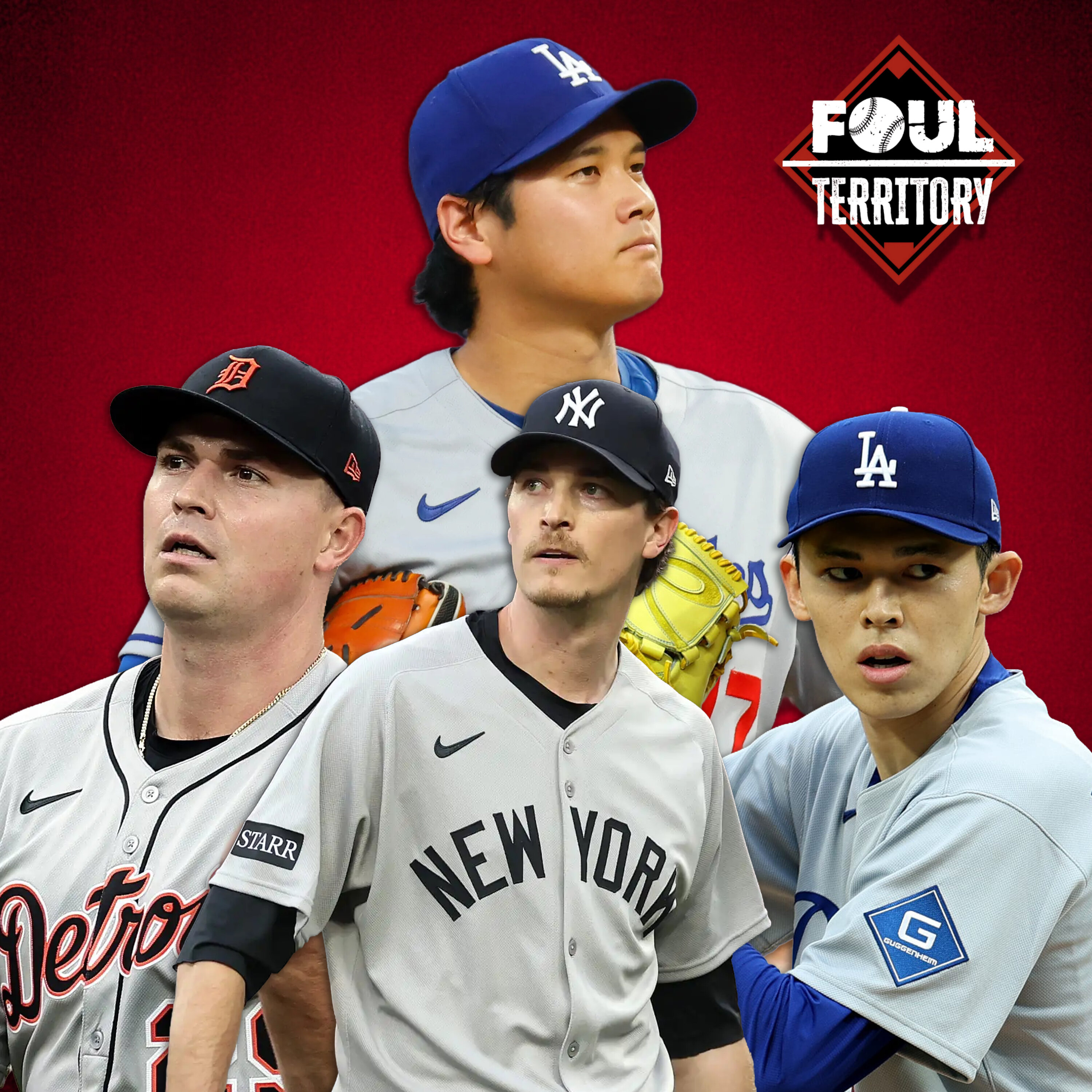
Pitching Ninja joins FT
Pitching Ninja creator Rob Friedman breaks down the topics in his new book Unhittable. He also discusses whether players could someday throw 107–108 mph, shares his pitching awards for the season, explains what Roki Sasaki needs to improve on, and outlines his criteria for what makes an ace.
Hosts: AJ Pierzynski, Erik Kratz, Scott Braun
See omnystudio.com/listener for privacy information.
2026-03-30
18 min
Transcript
Available Results
Generated results are saved to the knowledge database for reuse and search.
No generated results are available for this episode yet.
Extract Knowledge
Pick what you want extracted first. Model, scope, and chapter options appear after a template is selected.
Generated results for public episodes are saved to the knowledge database so they can be reused and searched later.
Transcript
00:00:03
Speaker 1: Now Pitching Pitching Ninja. Rob Friedman joining us right now back on FT and happy opening day to you, Rob, and also happy opening book to you. Right this is the first book you're putting out there, so give us the goods on that and we'll mix it into the conversation.

00:00:15
Speaker 2: I'm excited, absolutely, I'm excited too, like both for opening day and Opening book day. So I wrote a book about like how pitching has changed over the years, and how pitchers are now engineered to be dominant and I feel sorry for hitters.

00:00:33
Speaker 1: Well, let's go there right off the bat. And you can also, of course tell us some of the pitching that you're exciting you're excited to see this year, whether it's rookies, new pitches, the whole deal. But tell us more about that topic from the book. How much has pitching development advanced in comparison to hitting development.

00:00:54
Speaker 3: Well, like for pitching, it used to be either you have it or don't.

00:00:58
Speaker 2: We said you couldn't teach velocity, or you couldn't teach someone how to spin a ball. It turns out you can, and that's why you're seeing pictures throw a lot harder now. It used to be through luck or you know, back in the day they used to be farm strong. Now they can be in the weight room. We used to think that would make pictures too muscle bound, but it doesn't. If you train them correctly, we can break down somebody's mechanics improve them very quickly. We can do things like use high speed cameras to watch how the pitches, how the ball's coming off someone's fingers, and measure it and say, if you just moved it a little bit over, we can make this pitch even nastier.

00:01:36
Speaker 3: So it's a lot of things that pictures.

00:01:37
Speaker 2: I'm not saying necessary that the pitchers are even better today, like they're not necessarily better athletes, but they have a lot more at their disposal to help them train, and maybe that some guys back in the day would have been way better today if they pitched today because of all the training.

00:01:56
Speaker 4: One of the stories you actually have in your prelimb to the book is about your son Jack and how this like set you on the journey. He went from seventy seven to ninety five and then he ended up having labrum's issues. The first thing that's brought up when I was in Tripa talking to young pitchers what does it take to make the big leagues? And I said, nobody wants to just make the big leagues. They want to stay in the big leagues. So is all this information and all this ability to spin it, to throw it harder getting guys hurt? And is there more value in getting there but not having a long career than getting there and having an average career that's longer.

00:02:37
Speaker 2: Yeah, I think that's a great question. Unfortunately, to get your foot in the door today, here's a reason why people sit behind the backstop with radar guns. They do it because that's how they judge initially, how you get in. That doesn't mean that you constantly always want you're there, have to throw as hard as you can. And as a matter of fact, I think the trend now is to throw many, many different pitches because it makes it tougher for a hit or to hit if they don't know what's coming. If you have eight different pitch types and you can command them, that's as good as somebody just can blow you away with one hundred and three and maybe a little less stressful on your army. So you're seeing guys like Paul's schemes to versify his his arsenal. He doesn't top out at one oh two every game. He's backed off it a little bit, but can keep hitters off balance throwing them a bunch of different looks. So I think you're seeing a lot of that to help people stay around, but in order to get in the door. The problem is if you don't light up a radar gun and a coach takes or a scout makes a bet on you, you're if you're wrong. If that scout is wrong, it's on them. It's their judgment that was wrong. If you lit up the radar gun and they said this guy throws one oh two, he got to draft them and you don't and the pitcher doesn't succeed, then the scout did what he was supposed to do kind of and the pitcher just didn't have it or did it, you know, broke down. So it is there's a little bit of a blame game going. I think that goes on with analytics in general. But uh, I think there's I would love to see it come back to a little bit more gamesmanship. I have no problem with that at all.

00:04:12
Speaker 5: Rob In your book in earlier you just talked about how pitching analytics are ahead and in your book, thank you. I got a line in your book, so I'll be expecting your royalties at some point.

00:04:22
Speaker 4: Thank you.

00:04:23
Speaker 5: But I said it, and I've been saying this for years, that pitching analytics are so far ahead of pitchers, And in your book it's kind of what I said, like you can tell a guy and you can just slow motion cameras, just move your finger or do this or do that, and it changes everything about the way they throw the ball and the way the ball comes out of your hand. Is there any way for hitters to catch up? Because I mentioned the trajet machine, But you know, you talk to organizations, they don't love it. They don't say it's the best thing in the world. Yeah, it's cool, it's a cool gimmick. But how do hitters catch up to what pitchers are doing? Because hitters don't have slow motion cameras. Every swing is a little bit different, every pitch is a little bit different. There's not a perfect swing, right, So how to hit catch up to what pitchers are doing? Because it doesn't seem like it's possible.

00:05:04
Speaker 2: It's really hard because baseball's a weird sport. The offense doesn't have the ball like the pitcher really is on offense and the hitter's reacting. The hitters a counterpuncher. So I think that's what makes it tough, is that if I'm a pitcher, ideally I should be able to spin the ball away I want, put it where I want, throw it as hard as I want, and I know the heat map of the hitter, so I can put the ball exactly where that hitter's weak spot is. I think the way for hitters to catch up Number one traject does help in seeing a nasty pitch over and over again, so you might be able to make that pitch a little less nasty when you see it, So that might help. But I think other things like potentially AI and picking up pitch tipping or something like that, if a hitter knows what's coming, he's got an advantage. And if you can just like if there are guys who tip, I think it would be very useful to do things like that, doing your homework, looking at your own scout report against you, even different bats.

00:06:03
Speaker 3: For different pictures.

00:06:04
Speaker 2: You could do stuff like that, but in the end, pictures I think are always going to have somewhat of an advantage.

00:06:10
Speaker 4: Who's the pioneer of this. You mentioned a few people early on in your book about Tom House, Nolan Ryan, and not one of them individually, but how they all got to get how they got together and helped each other, going to Randy Johnson helping him, and then even you mentioned later on in your book about like a Trevor Bauer who has you know, kind of gotten a little bit of backlash. But who do you feel like is the pioneer of this development age? And then who do you feel like is doing it the best right now?

00:06:40
Speaker 2: So you daled it with Tom House. I think Tom House was the first person to ask why. He saw Nolan Ryan and he saw Sandy Kofax, and He's like, these guys are just people.

00:06:50
Speaker 3: Why are they doing what they do? How do they go about this?

00:06:53
Speaker 2: So he broke it down, built his own biomechanics lab in his house. Cost him his marriage, he says, look at pictures all the time and try to figure out what does what. So he is really the start of this whole thing. Guys like Kyle Body at drive Line took it to the next level. I mean, he's got an engineering background, so he started looking at it at stuff from a engineering or computer programming sense. Step by step, and you're right, Bauer took it into the clubhouse where like him or not, and I understand.

00:07:24
Speaker 3: Obviously the backlash, but.

00:07:26
Speaker 2: He certainly did break down a lot of barriers, weighted balls, high speed cameras, rap sodo, just training, biometrics and training and all that. Like the game, there's a little bit of debt ode to him is where the game is today that pictures are now taking. For granted, someone like Paul Skeens has really perfected. He's taken a lot from a lot of people. If you watch his warm up throwing footballs that's a Tom House thing. He's got a connection ball that's a Ron Wolforth type thing. So he's got a lot of different drill that he does.

00:08:01
Speaker 3: I think he has perfected.

00:08:02
Speaker 2: He's also perfected the personality that goes along with it because he doesn't rub people the wrong way. He's a competitor that goes in, listens, synthesizes information, and goes out and competes. And I think that's kind of, to me, my perfect pitching model. There's no perfect, but he's kind of where that goes.

00:08:23
Speaker 4: Perfect pitching model is the one that stays healthy, has success for twenty years and then he's the anomaly, not the not the norm. We are seeing all of this, all this technology. Every bullpen guy or every bullpen has a guy that throws one hundred throws ninety nine miles an hour. If you're not throwing ninety seven in high school, blah blah blah. But why do we not ever reach where Eradus Chatman was, why do we not ever every like we're peeking out? Is there something in the future that's going to get us to that one oh seven one eight category?

00:09:01
Speaker 3: Likely?

00:09:01
Speaker 2: So, but I can't promise you they won't break down if they do that, because as you know, as a competitor, as an athlete, you know you're trying to be you redline your body right, You're fighting through stuff. If you see a number attached to you, you're going to try to achieve it.

00:09:15
Speaker 3: And beat it.

00:09:16
Speaker 2: That is just what you do as a competitor and an athlete. So you're always going to push your body as far as it can go. No matter what that number is, You're going to want to eke out a little bit more so, I think you're always going to run into that ceiling. The key is knowing your body there may be technologies that can keep you healthier, understanding that rest is important and recovery is important, monitoring that.

00:09:40
Speaker 3: But will pitchers continue to break down? Yeah?

00:09:43
Speaker 2: Probably until we like you'd have to tell what the weak point was before it would break, and you know, maybe like car monitoring systems, that warning light comes on. You know, I think we have stuff that's being developed, but that's going to be the main problem.

00:10:01
Speaker 5: A guy who seems to be in a development crisis is Roki Sazaki. What can he do? What tools does he need to figure out to get to where people thought he would be once he came over to the major leagues?

00:10:12
Speaker 3: You know he does.

00:10:14
Speaker 2: He is a little bit more complicated mechanics than someone like Yoshinobayamamoto, who is as streamlined as can be. I also think some of it is almost overthinking his mechanics. To me, at least, listening to every interview. Every time he struggles, it seems to be, well, it was my mechanics were off.

00:10:31
Speaker 3: I did this wrong, I did that wrong.

00:10:33
Speaker 2: Most pitchers don't lose command because of their mechanics. They're losing command because of a focus type thing or not understanding where their misses tend to be. It could be a variety of different things. But I think if you start feeling like you have to be at one hundred percent mechanics wise and physical wise every game to throw strikes, it sets up a spiral where all of a sudden something goes wrong, and that goes wrong again and goes wrong again. Think he's in a situation now where when he starts throwing balls, he starts throwing pitches out of the zone. It starts getting in his head and he starts trying to make adjustments and he just can't do it.

00:11:11
Speaker 3: Sometimes you do. Sometimes you have.

00:11:13
Speaker 2: To figure out a way to compete through it, and it's not always a mechanical thing, all right.

00:11:19
Speaker 4: You quote tweeted one of the conversations that we had about aces, Andy McColl and I were in we're in cahoots on the fact that Yamamoto is not an ACE yet yet, and visceral hate exploded on the internet. What is your list of aces and what is your or what is your criteria of an ace, because I think people stopped listening to what the criteria of an ACE was even you just brought in the picture of him having a great postseason and one great season in the big leagues. So what's your criteria for aces in the big leagues.

00:11:56
Speaker 2: Yeah, and in fairness, I don't think for Yamamoto it's one great season. You're talking about a legendary pitcher in Japan who won three Solar More Awards and MVPs and legendary low eras comes over to the States, had a solid first season and then an excellent second season and dominated in the postseason, pitching on one day's rest in the World Series.

00:12:17
Speaker 3: To me, and I think to most pitchers that.

00:12:20
Speaker 2: Watch that competitiveness and stuff, they would say that as an ace without a doubt. People were like I talked to Ryan Dempster after that. He was like, oh my god, that was what I love about the game. I've talked to other guys like this is an ace. This is an old school horse. So to me, that is that's my criteria. It is you know it when you see it. There has to be stats to back it up, but it's it's being counted on in big situations for your team to come through and carry that team and go relatively deep into starts, or put your career on the line like he did and come back on one Day's rest. To me, that's a no doubter that he's an ace. Paul Skins obviously, Logan Webb's an ace. You have a lot of them throughout the league. Garrett Crochet is an ace. It's guys that you know you can count on that make me want to tune in, and they're proven themselves over at least a full season, and you feel like there's no reason they can't continue with that.

00:13:21
Speaker 4: Who's next?

00:13:22
Speaker 3: Then?

00:13:22
Speaker 5: Who's next?

00:13:23
Speaker 4: On the list?

00:13:24
Speaker 5: If guys like Verlander, Scherzer, guys like that are starting to get a little bit older, Kershaw's gone now, who's the next wave behind scooball Schemes? I guess you could put Web in there.

00:13:36
Speaker 4: Who's next?

00:13:37
Speaker 5: Who's the young guys that you've watched that you say can be the next let's say three best in the next ten years.

00:13:43
Speaker 3: Yeah, that's a great question.

00:13:44
Speaker 2: I mean, I've really liked what I've seen out of I think Hunter Green is on the verge of do you consider him an ace? I think that he is a guy that I would if he has a strong year this year, he's an ace. He's a guy that I like watching pitch and he's you know, kind of one of the next guys I can see in that category.

00:14:05
Speaker 3: Bubba Chandler, a.

00:14:06
Speaker 2: New guy I think is going to be very, very good. I think Nolan McLain for the Mets is a guy I can't stop watching because his stuff is made for pitching Ninja, because it's just eye poppingly good, like twenty inches here, twenty inches east west, throwing ninety nine and a competitor. That's a guy I can see up there. Chase Burns is another guy who I've loved since he was in college, and I think he's got unhittable stuff when he's on.

00:14:36
Speaker 4: All right, Well, what about show Hey? A lot's always asked about, like the one year where he didn't pitch and he became an MVP just as a DH and he launched his he launched his hitting to another level. Show Hey when you watch him, and I think last night he just had ten punchouts in like four innings. It was ridiculous against the Angels. But there's that. But do you think if he just p he could be a cy Young Award winner or do you think he just slightly is outside of your everybody's an ace category?

00:15:10
Speaker 2: He has got what he's on, he's got who has better stuff? Like legit throws over a hundred sweeper that's wicked, splitter that can't be hit, constantly improving a tax the zone. You see him come through in big moments like if you want, if you want somebody on the bump in a big moment, a competitor and somebody who's going to dig deep and show you something that you've never seen before. That's the guy that I would love to see out there. So he meets my criteria other than the innings part.

00:15:44
Speaker 3: Because you know, I'd like to see, you know, more of that.

00:15:49
Speaker 2: But I think he's absolutely a pitcher. He's absolutely pitch for pitch as good as anybody in baseball. The question is how much do you want him to pitch because his hitting is so good?

00:16:00
Speaker 4: All right, So we're making predictions. I think some people have it. It's easy like Cy Young Awards, American League, National League. I want to hear your top three finishers in the in the Cy Young Award for the National League and American League this season.

00:16:15
Speaker 3: Yeah, that's I mean, I've for the American League.

00:16:17
Speaker 2: I've got to stay on the schoolbol train until school ball shows signs of fading. I think that that would be tough to back off of him. I would then go, I mean Crochet also, he's he's on, he's so good, So that's that's another guy that I would find hard to back off of.

00:16:38
Speaker 3: And then.

00:16:40
Speaker 2: I mean Max Freed is always there. I can go with Max Freed in the NL. I mean, Skeens is just scratching the Skenes is just now like how many years have you even pitched full time? So it's hard to say anything negative about Paul Skeens's chances of winning another cy Young So he would have to be number.

00:17:01
Speaker 3: One on my list. Number two.

00:17:06
Speaker 2: I mean, I can see someone like I mean Christopher Sanchez had a great year. I'm probably going Logan Web maybe and then maybe a surprise. I mean, I would love to see and this is more picking with my heart, but I would love to see someone like Noelan McLain have a solid season this year and really open some eyes because his stuff is that good. His stuff is as good as anybody in baseball, maybe better than anybody in baseball.

00:17:32
Speaker 1: And he'd been doing the two way thing, so now he's just focusing on pitching, right, So you feel like there's still more that he can unlock. This is his first full season two. Feel like we've been talking about him a lot, but you know, because of the WBC in this strong debut last year, but this is his first full ride.

00:17:49
Speaker 3: Yep, and had a velo jump in the WBC.

00:17:52
Speaker 2: I mean he had what was mostly topping out at ninety eight and he'd ninety nine point two. He told me he's never hit one hundred at any level and I'm going to take credit for it.

00:18:01
Speaker 3: If he does this year, well we'll give it to you.

00:18:05
Speaker 1: And also we'll shout out the book on the way out. So tell us you know you can get it wherever, right, is that how books work these days?

00:18:14
Speaker 2: Absolutely anywhere, Amazon, Barnes, and Noble. I'll even deliver you on if you really want.

00:18:19
Speaker 1: It that bad, well depending on where you live, but yes, maybe at a ballpark. Unhittable is the name of the book. Rob Freeman aka Pitching Ninjur. We love having you on. Congrats again on the book. Happy opening day to you and we'll catch up soon.

00:18:35
Speaker 3: Thanks thanks for having me on.
Chapters
No chapters available.