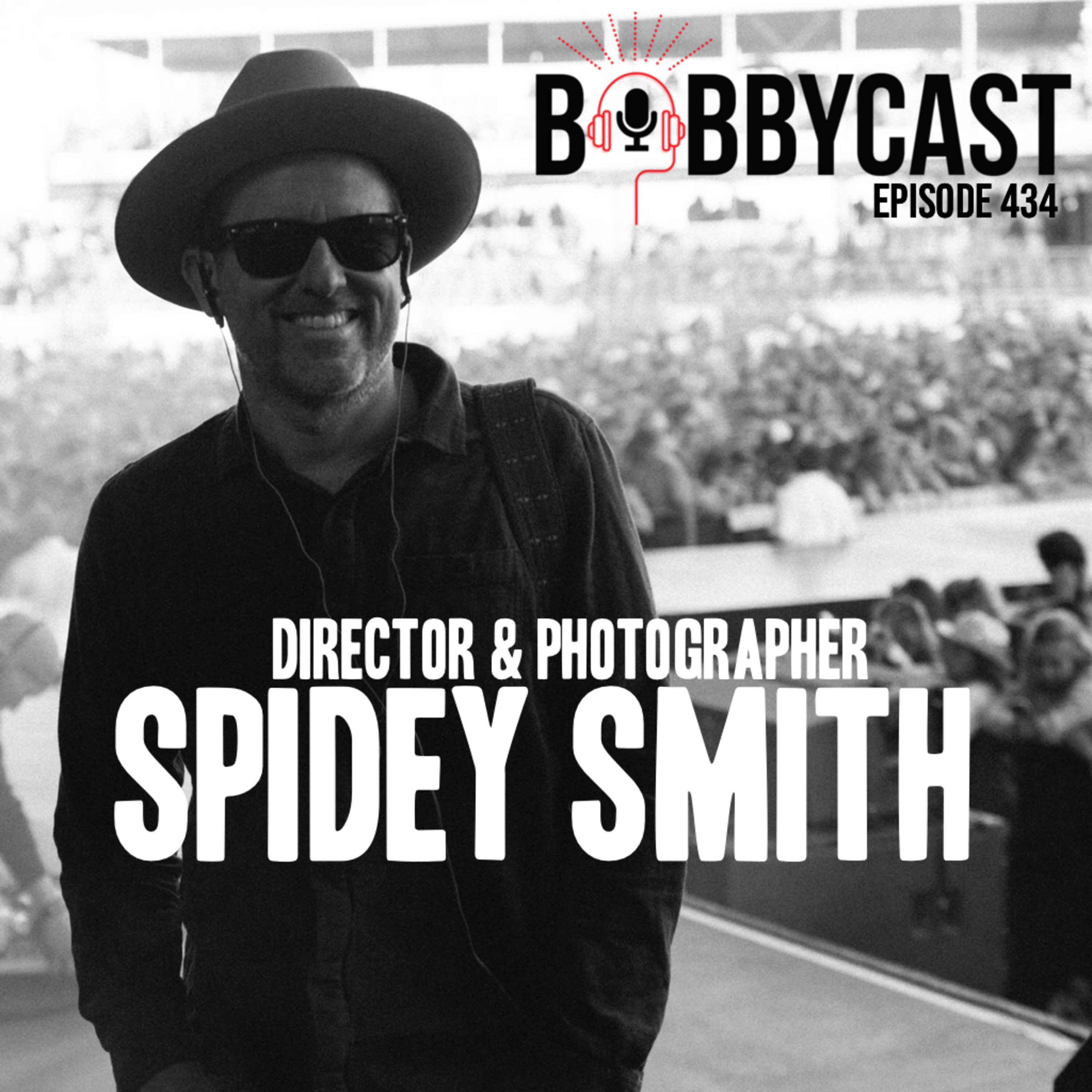
#434 - Director & Photographer Spidey Smith on Shooting Morgan Wallen’s Album Cover + Directing Eminem in a Music Video & The Joke He Played On Him + How Jason Aldean Gave Him the Nickname
Director and photographer Spidey Smith (@Spideysmith) sat down with Bobby Bones to explore his love for capturing the moment. He has directed more than 150 music videos and shot some of the most iconic album covers including Morgan Wallens Dangerous and One Thing At a Time. Spidey recalls how during a low moment in his life he got the call from Morgan Wallen to shoot his album cover, and it helped gain back his confidence. He also shares a story of the time he directed Eminem in a music video and the joke he played on him. Spidey also explains how Jason Aldean gave him his nickname, which music video he's the proudest of and more!
Check out Spidey's Podcast: In The Trenches with Spidey
Follow on Instagram: @TheBobbyCast
Follow on TikTok: @TheBobbyCast
Watch this Episode on Youtube
See omnystudio.com/listener for privacy information.
Available Results
Generated results are saved to the knowledge database for reuse and search.
Extract Knowledge
Pick what you want extracted first. Model, scope, and chapter options appear after a template is selected.
Transcript
00:00:06
Speaker 1: Probably the second rock bottom that I've gone through. And I get a phone call from Morgan's manager, would you like to photograph arguably one of the biggest albums covers of country music.

00:00:18
Speaker 2: I was like, Yes, welcome to episode four thirty three with Spidey Smith, who is a director and photographer. He's a podcast host of In the Trenches with Spidey Now. Basically he's a celebrity photographer. He's a celebrity music video director. He lives in Nashville. I worked with them a bit at jac Owen's charity event when I went down and did stand up and he was down there for the whole weekend. But I was talking with him as like on a Saturday or something, and he had mentioned Eminem and I was like, oh, you know EMINEMI is well, I did the music video for him. I was it, really So we started I started like trying to pump in for information because I was just interested, and it was like Bone Thugs and Good Charlotte and three Doors. I don't want to know anymore. You just have to come over to the house and talk to me about this, because I don't think we've had a not many that like celebrity photographers. So that's what we did here. We talked with him and you know, he has a podcast where he gets in into the Trenches actually, which is the name of the podcast. But we talked about a lot of this where his dad was. He talks about special Forces, which is crazy to have. Can you imagine the discipline you grew up with? If that If your dad is Special Force, that must have been tough. But he's also shot, you know. And I have a client list of like the massive brands, but I thought this would be cool for you guys to hear. It's a little different angle. You know. We're always trying to focus and feature creatives. You can go to a site spidysmith dot com here. He is celebrity photographer and director living in Nashville, Spidy Smith. When we were together, some people were calling you Ryan, some people are calling you Spidy.

00:01:55
Speaker 3: Yeah.

00:01:56
Speaker 2: What are your friends call you? What are your closest friends call you? Yah?

00:02:01
Speaker 3: It's uh, it's morphed into Spidey.

00:02:03
Speaker 2: Now, Uh, why is that? What's what's up with Spidey? Where'd that come from?

00:02:06
Speaker 3: Where did it come from?

00:02:07
Speaker 2: Yeah?

00:02:08
Speaker 1: It came from Jason Aldan and Brian O'Connell, who was high up in the promoter promoter of Live Nation.

00:02:15
Speaker 2: Yeah, I did a tour.

00:02:18
Speaker 1: Well, I got in, I got back into photo when I when directing kind of was in a shift and I had hollered at Jason. I was like, yo, I want to I want to come out on tour and just get my photo chops back up. And this is before Instagram, so uh, AnyWho long on the short I would build tunnels underneath.

00:02:37
Speaker 2: The stage so you can get around.

00:02:39
Speaker 3: I can get around.

00:02:40
Speaker 1: So he would see me here and you give it to me there, but you know whatever, and then you'd just go over here and like see me there within too fast.

00:02:48
Speaker 3: So he was always like, are you webbing your way around? You know? But no, I secretly had tunnels that I would make under.

00:02:54
Speaker 4: I was like a little I would call it you cartel, I was gonna say, I but I would actually stash lenses in these areas and many times even on Jake Cohen when I did it, obviously the Long Beach, we were already well into the bus on the bus packed.

00:03:15
Speaker 1: Up ready to go, and I freaked out that I left a pretty sizable lens underneath.

00:03:19
Speaker 2: This one of the many that you leave under the stage. You thought maybe you left one of them there? Yeah, I did, you did? I did.

00:03:25
Speaker 1: I jumped off the bus before it was going to the airport and ran and uh, I think the stage hands got it for me.

00:03:32
Speaker 2: I saw one of my friends post a picture of you, and I didn't know that. I don't know who knows anybody, but maybe it was your podcast. His name Zach Massey as my friend. Do you know Zach? I don't, okay, but he's a great digital guy.

00:03:47
Speaker 1: I was just mentioning it to my producer Toroy and the way here about Zach Massey, I was like, man, he was really supporting the podcast. And then hearing about his story from my friend Chase, I want to get him on the podcast.

00:04:00
Speaker 2: So I saw you on his and I thought, are Zach? And it's mighty cool. But I didn't know you guys didn't know each other. But Zach's really good right as well? I'm sure, yes, I don't know enough about it. It's like people that act and they're like this person's a bad act or I can't. I can tell if somebody sucks yeah yeah, and I can tell if something like really great and moves me but I don't know, like I wouldn't know a lens or a difference in a lens. So like, how do you get an interest in taking pictures? And at what age and when do you realize that you could actually turn that into something where you can make money, because again it's art and art it's hard to make money in art because everybody wants to do it.

00:04:42
Speaker 1: Yeah, I started very young taking pictures. I was a little surfer kid and a lot of my friends were in bands, you know, just picking up a mic and singing, and I wasn't into that. I kind of was into the visual side of what they look like, and they're busted up jeans and stuff like that. So I started shooting pictures early.

00:05:03
Speaker 2: But like what that one of those cameras, know it was a film?

00:05:06
Speaker 1: It was early film was my father's from Vietnam, his camera. But somewhere in there I decided I wanted to move into directing, and then got back into pictures when directing got a little too big.

00:05:19
Speaker 2: So your podcast that we just mentioned in the Trenches with Spidery, what like, what's the premise? What are you guys doing there? Sure?

00:05:26
Speaker 1: I have a guest each week, whether it be an artist that I've worked with, or just an artist, DPS, directors to managers, painters, just it's really celebrating the art form and how it relates to entertainment. I it came up because I was on a I've been thinking about how can I connect with people again. I feel since COVID, you know, I just do my job, and even when I do my job, it's less team these days. And I came from an era where it was a lot of teams, a lot of that stuff.

00:05:59
Speaker 2: So it was a way to make friends. That's why I do this.

00:06:04
Speaker 3: No, it was it was a way.

00:06:05
Speaker 2: I can't get Bay to come to my house unless I'm like, come to a podcast. He even said that.

00:06:08
Speaker 3: Yeah, I was like, I need you.

00:06:09
Speaker 2: Body would never come over unless I was like we're gonna We're not even recording this. This is all just a way for me to make yes, to make friends whenever. Because I met you through Jake. We were all in Florida at Jake's charity event, and the way that he introduced you to me was not actually us face to face, like hey this is Ryan or Spidey Bobby. He said, hey, you see him. I was like, yeah, he goes, uh, yeah, he worked at Bone Thugs in eminem and Duran Duran, and I was like doing what he said? He said, he's just done visuals for all of them.

00:06:39
Speaker 3: Directed videos at a very young age.

00:06:41
Speaker 2: So all those were videos, all official.

00:06:43
Speaker 1: Videos at nineteen twenty twenty one, very young, very young.

00:06:48
Speaker 2: How do you get in those specific circles to be able to direct or do anything artistic for them? Let's just do one specifically, Let's do Duran Duran. How did you end up on a Duran Duran to being the director of their video.

00:07:01
Speaker 1: I'll tell you a great story about Duran Duran. I was driving with my then girlfriend to San Francisco. We had already written one treatment for Duran Duran. The commissioner the record label said, we love your work. Can you rewrite the treatment to a new idea. I called my agent and I said, hey, remember that Mars Volta treatment.

00:07:21
Speaker 2: Just recycle that by from the other band.

00:07:24
Speaker 1: Yeah, yeah, all right, cool bye. Got to San Francisco in that time. They wanted to meet with me.

00:07:31
Speaker 3: Fly that day, fly back to La that time.

00:07:35
Speaker 1: I don't know if things have changed, but Simon and Nick did not get along, so I had to go meet Simon at the Four Seasons and Nick at the Chateau. Well, when I all on this same day, I was already driving to San Francisco.

00:07:50
Speaker 3: Now I'm here and.

00:07:54
Speaker 1: I don't even know the treatment, the Mars Volta treatment that was recycled for them. So I sit down with Simon, but as I get to the pool, he's having lunch or drinks with Keeper Sutherland. And this is back during the twenty four show, and they're sitting there talking about my honey bits in my hair. I was, you know, my boy band like Frosty La Frosty. Yeah, hey, Ryan, I happened honey bits, you know. And then I went to the chateau to meet with Nick about the idea, and then shot the video.

00:08:26
Speaker 2: What was the video?

00:08:27
Speaker 3: The video was for a song called what Happens Tomorrow?

00:08:31
Speaker 2: And what were they doing? And did you have to keep them apart from each other? And is that why you met with both to tell them kind of yep, they had they I had.

00:08:37
Speaker 1: To convince them of the creative so they would sign off on it. But it had to be two different two different locations. And then even when we shot the video, you'll look at how there's a stage and Black. I could put two band members there, they can leave, put the other two band members, and then I can cut because I have Black to do it. And then the whole narrative was was really the expense.

00:09:02
Speaker 2: And the band members hating each other not unheard of. It happens all the time, all the time. They were smart enough to stay together eve though they hated each other.

00:09:09
Speaker 1: Yes, I think they had a little dip, a little sabbatical, and they came back and I was.

00:09:14
Speaker 3: We were the That was the first video on the way back.

00:09:16
Speaker 1: So it's a lot of a lot of attention to it, and I can one of the funniest things about that video when you turn into it, it was like a five hundred and fifty thousand dollars video.

00:09:27
Speaker 2: God late time.

00:09:27
Speaker 3: It's just so different Now it might have been six hundred. Yeah, I don't know.

00:09:31
Speaker 1: But when you turn in the rough cut, it's not colored, it's not tightened, it's just here are the edits.

00:09:37
Speaker 3: Do you like it? Do you like the visuals? Blah and not.

00:09:41
Speaker 1: Simon Nick, he got on the phone, he rattled off probably forty different exotic cheeses of what the rough cut felt to him. He described everything in a cheese, which I could only think was he hated it. He felt everything was cheesy, cheesy. Sure, anyway, he's kind of sewer. He must be, because I.

00:10:09
Speaker 3: Didn't know the cheeses he was mentioning. I was like, it's that good?

00:10:11
Speaker 2: Is it bad? But was it good? That's good?

00:10:13
Speaker 3: That's expensive.

00:10:15
Speaker 1: It ended up being well loved, and he ended up calling when it was all done. He loved it and all that. But it's an interesting story.

00:10:21
Speaker 2: So let's go to Eminem then. How totally different? Everything different, everything different with Eminem.

00:10:27
Speaker 1: Eminem came by by me being friends with Paul Rosenberg. Paul Rosenberg is is is it synonymous to to Marshall. He's partner of of of Shady Now I think he's president of def JAM, but he's also on some of his records too, like doing Am it's Paul, you know you're I hear you're shooting the gun out back. Anyway, he's he's an amazing supporter of mine, and uh god man, we were I was young, so my my days and stuff could be a little off years, but we started on like exhibit for get your walk on, get your walk on back?

00:11:05
Speaker 2: That ass up?

00:11:06
Speaker 3: You know, that video and then Cypress Hill.

00:11:09
Speaker 1: So you worked your you, you you, you earn your trust to get to the to the top.

00:11:15
Speaker 2: Was all of that just you were doing these hip hop videos and they were great and people liked them. Or were they all connected by a certain couple of people like from Cypress Hill to Exhibit to like was there like one string or did just word get out like this guy Ryan, this guy Spidy. I guess you've been Ryan to them like this guy Ryan's like legit is Young's fresh? Or was it like the same agent booking you for all three?

00:11:40
Speaker 3: Interesting?

00:11:41
Speaker 1: Great question, A combination of a couple of things. My career has been a bit of a of a of a of a a story book because I have always taken the allegiance to the artist. I'm with them in their back there they're lows, and by by proxy I'm with them in their highs. So that my avenue has always been through artist management, and that I guess indirectly forced the hands of the record labels. Sure you see, and they don't like that because they have an agenda to say, well, we only have one hundred thousand dollars exhibit, and then exhibit come up with.

00:12:21
Speaker 3: The idea it's gonna be great.

00:12:23
Speaker 1: He's invested, it's awesome, it's going to cost one hundred and thirty thousand dollars.

00:12:26
Speaker 3: They don't like that.

00:12:28
Speaker 1: They want to go to the person who they know they can get it for ninety and less than one hundred, you know. So that was always a struggle for me. My agent back then, Tommy Labuda, who is probably the biggest music video director's rep there is still he started with me and I started with him. So that was really a unique bond for someone who's got the gift of gab who can sell ice to an Eskimo who was coming into the game fresh him self with young for snapper, young guy who's like, yeah, I'll do it whatever us go. So our street game was insane. I'd be hanging out with Disturbed at a concert, boom on our two Ways, flip your two.

00:13:12
Speaker 3: Way or your next ELP.

00:13:14
Speaker 1: You know, hey, yo, hit up Giant Records, who's the commissioner. It's going great with them. I mean I worked the streets. I was a I definitely worked the.

00:13:24
Speaker 2: Street because you were young, which means just naturally you're gonna be innovative because you know new technologies, and this has just been consistent through life. Right you're young, you're using it, Therefore you know it because you feel like you could do it a bit cheaper but just as good because you kind of had to and you knew the newest, Like you could do it with it today. You can do it with an iPhone, Like there's somebody awesome with an iPhone. They can be like, listen, I can shoot this thing for mucheaper because I can use three iPhones and it'll still look great. Were you able to do that instead of like going super old school with all the big cameras and be like, I'm nineteen, so I don't how to do things old folks. All these old guys don't know how to.

00:13:58
Speaker 1: Do honestly, coming from the film era of big cameras, thousand foot mags, roll in film planning at your shots because you have, hey, before you even shoot, you're like, how many.

00:14:12
Speaker 2: Roles of film do this film? Because you can't just go absolutely once you're on it, it's on it absolutely.

00:14:17
Speaker 1: And I was one of those people who was like, digital is not going.

00:14:23
Speaker 3: To take over film.

00:14:25
Speaker 1: Clearly did and that was a massive, massive crux.

00:14:31
Speaker 3: Might have been the very moment.

00:14:35
Speaker 1: That I started shooting photography again because I could not figure it out. It didn't make sense. These cameras are weird. The lighting is so sensitive to these things film.

00:14:45
Speaker 3: We're blasting light.

00:14:46
Speaker 1: It needs the CELLULARID needs that. The look we would get would be pound light, crush the blacks and all that stuff.

00:14:52
Speaker 3: That's that look that everybody.

00:14:53
Speaker 1: Loves about the nineties. That's not the look now you can't get it from digital.

00:14:58
Speaker 2: So it's a bit of the opposite of what I'm saying. So you had been so schooled and you knew how to do film so well.

00:15:03
Speaker 3: I had to relearn and so that's so I was getting it. I had to relearn everything.

00:15:08
Speaker 1: So now I really feel like I'm putting out the work I was meant to do.

00:15:17
Speaker 3: I honestly feel, and I would say this out loud.

00:15:19
Speaker 1: I know that a lot of the videos I did are iconic and special, and there are special to me. But I honestly feel like I was young, and it's like so many creatives do. You're looking at the peers above you, going they're getting those budgets and doing those artists. Okay, how can I produce? How can I make that happen for this, Okay, I do that. So all I was really doing was reverse engineering learning how to produce what they're doing.

00:15:49
Speaker 3: Then now it's a massive amount of wisdom. You see. I can tone, visual tone, all those.

00:15:59
Speaker 1: Things that go into the the the the emotive part of film.

00:16:04
Speaker 3: I've got see.

00:16:06
Speaker 1: Back then, you're just shooting to shoot and hell, I said that to eminem.

00:16:10
Speaker 3: On the first job.

00:16:11
Speaker 1: I was just happy to have him in the lens.

00:16:14
Speaker 3: I'm just like, you know what I mean.

00:16:16
Speaker 1: And I even told yellow Wolf when it was the second time directing him, I'll refrain from the language I use, but I was like, I'm going to direct this guy like I'm going to really go into him. I'm at that point. I was at forty one or something. The second time I worked with him and it was on I was like fun. I was no, no, that's not it, and that's not it. You know, it's really pushing him to it, and it was fun.

00:16:42
Speaker 3: Had had the confidence.

00:16:44
Speaker 1: I had the experience to know how the years, even in front of Marshall when he would be like, I would be like he wanted to watch every take one day shoot, it's very I like to really take advantage of the full day, and he wants to watch every take, make the take, go back and watch it because he wants to overlap his movements to where he's saying things in the song, which is crazy. And I was like, hey, so he's sitting down. There's a photo of it somewhere. I'm like, so, how do you feel? How do you feel what it's looking? He's like, I don't know, I don't know.

00:17:25
Speaker 2: It's just.

00:17:27
Speaker 3: It's probably just me, but keep doing you whatever. Yeah.

00:17:30
Speaker 2: I was like.

00:17:32
Speaker 3: Mortified in front of everybody.

00:17:34
Speaker 1: Paul and everybody's quiet listening to Marshall go but whatever, you know, we're here.

00:17:38
Speaker 3: So make the best of it.

00:17:40
Speaker 1: Super dry. I was like, okay, you know, I got a solution. I know what it is. I know what you're feeling wrong. I'll start walking away, say Spidey, Spidy yo yo. I'm just just messing with you, you know, So you know.

00:17:51
Speaker 3: What I mean.

00:17:51
Speaker 1: So it's just he's very witty and dry. And you know what was the video you do with him? That was for yellow Wolf, a song called best Friends?

00:18:00
Speaker 2: Didn't he didn't? He because I remember Eminem and Yellowolf being together, like he like discovered him or or was a big part of his uh entrance into hip hop. But I've seen Yellow a couple of times in the past six months. Musual friends, they're not they don't like work together anymore.

00:18:17
Speaker 3: Huh.

00:18:17
Speaker 1: No, Marshall definitely discovered and brought him to Shady and Interscope, and they did their they did their stuff, their their their records and albums. And now Wolf has his own. He's on his own imprint, and he's like Pearl Jam.

00:18:33
Speaker 2: You got a lot of tattoos.

00:18:34
Speaker 3: He does it all, Yes, he does.

00:18:37
Speaker 2: Yeah, it got a lot of tattoos.

00:18:39
Speaker 5: Hang tight, The Bobby Cast will be right back, and we're back on the Bobby Cast.

00:18:53
Speaker 2: Which music video do you look back at and you're most proud of? And you could see really your maturation and in directing.

00:19:03
Speaker 3: From the old days.

00:19:04
Speaker 2: It doesn't matter.

00:19:06
Speaker 1: You can give me one old, one note, one old. I love my girls and boys, Good Charlotte. And the reason I love it is because I was going to meet Benji and Joel Up at Mel's Diner on Sunset Boulevard and I was dry. I had heard that another director was already doing this video that I had already written, not written a treatment for or written one and it wasn't liked. But I back to my street game, was going to meet the guys, and I was out of light and not far from it, and I look over and I see this Ferrari with this this old dude and these young girls getting out like that. It was just when I was playing the song like crazy girls don't like boys, girls like cars in mine eye, and I'm like, immediately on the phone, but that song was you were playing that?

00:19:58
Speaker 3: I was playing because.

00:19:59
Speaker 1: I get the music from the artist, Yes, to think of the song, and that's playing as I'm driving.

00:20:03
Speaker 3: To them trying to come up with an idea.

00:20:05
Speaker 1: I'm literally bluffing, trying to steal the video from another director. I'll say it's many, many years, but I called my partner, and my directing partner he wrote it while I was having dinner with them. Came in with the treatment and I was like, so, guys, here it is. And then like a week later we were in New Zealand shooting that video. And that was another reason why I love it. I discovered myself there on that new video.

00:20:36
Speaker 2: But on that video, so you're watching old dude, young girl. Yeah, is that what the video?

00:20:42
Speaker 1: Oh? I'm sorry I didn't clarify that. The video concept.

00:20:45
Speaker 3: Yeah, I'm sorry.

00:20:46
Speaker 2: That was good.

00:20:47
Speaker 1: Charlotte hanging out, being playing a song. Everybody in their world were seventy five and eighty years old, skating eighty year olds, throwing milkshakes out a car and ditching eighty years old stage dive off of you know, eighty years old. Everybody's partying, you know, eighty seventy elderly. Yeah, and they're having the time of their life.

00:21:06
Speaker 3: And it was. It was a well received video. Once a VMA and that's awesome.

00:21:10
Speaker 2: Yeah, anybody break a hip?

00:21:12
Speaker 1: No, but if you watch it, there was a guy in the back who does a cannonball in the pool. I had to stop because I made him do like seven of them and he was getting winded really bad.

00:21:23
Speaker 2: All right, new new video. Let's say the more recent season that you look at and you're like, dang, I did that one to the best of my ability.

00:21:32
Speaker 1: Yeah, I got it. Yeah, Jake Owen up there down here, pretty yeah recent. Yeah, that was Jake allowed taking the chains off. He's like, go make what you want to go make and we talked about it and the fact that it then got he who had a day off in Wyoming, you know, and we get to shoot a performance there, which really allowed me and the team down in Florida to really hammer home narrative.

00:22:02
Speaker 3: It was fun.

00:22:02
Speaker 1: I think it all came together and that is one of my more recent phaves.

00:22:06
Speaker 2: What to do this? You know, there's a couple of ways to do it. You can actually go and class this Trent. You can train, or you can just do it. Yeah, right, like my guy read just did it and figured it out and then took and just kept learning as he was doing it in media or in music, that happens to a lot, right. You can just sit in your garage and play and then start, or you can go and like what was your style and how did who did you learn from? Or was it just doing it and screwing up?

00:22:33
Speaker 3: No, I mean filmmaking.

00:22:35
Speaker 1: I think there's a different era now coming up where I don't think young people are coming up learning the craft. They're learning DIY cameras go good it back then or not back then? But where I came from, it was more like learning a craft and honing that.

00:22:53
Speaker 2: What was the when you learned? Did you learn mostly by doing it? Yes and doing it wrong? Or learning by like a teacher going this is the class way.

00:23:01
Speaker 1: I went to college merely so I could slow down. And I did go to film school, but I rated the film I took. I literally took film cans from the classes and.

00:23:12
Speaker 3: Would go shoot music videos.

00:23:14
Speaker 1: So I got waved out of I don't even know thirteen classes.

00:23:19
Speaker 2: Is that like clept It would be the same thing. Yeah, like you have enough experience where like you're you're good enough past this class anyway?

00:23:26
Speaker 1: Yes that they Yeah, And I turned in Bone, Thugs and Harmony my senior year. I turned to exhibit my junior year projects, you know, and teachers would just excuse me because I want I got into USC Will you let me make music videos?

00:23:40
Speaker 2: No?

00:23:41
Speaker 3: I got a UCLA. Will you let me make music videos?

00:23:45
Speaker 2: No?

00:23:46
Speaker 3: Laurel and Mayormount. Yes, that's what I did.

00:23:50
Speaker 1: I've spoken to colleges film schools all around the country. Full Sale number one most asked question. How did you get to doing this so young? I knew what I wanted to do and went and did it.

00:24:03
Speaker 2: Did it?

00:24:03
Speaker 3: There was no backup. There isn't They can't be a backup.

00:24:06
Speaker 1: I can't have a fallback plan because you're going to fall back on it, you know, It's just that it was that way. So yeah, I learned by doing I did. I put myself out there and developed the skills by doing.

00:24:24
Speaker 2: Do you have to look back at any of your work. You don't have to answer this and go, oh man, that kind of sucked, because I do all the time on my stuff, like their stuff. I've written their stuff. I'm just like, oh, And I feel like, if you're not cringing a little bit by your old work, you haven't grown from Absolutely.

00:24:38
Speaker 1: I pooped the bed many of them, not many by three videos might not mention the names because they might get a little sore that I said it. But can I be honest with you, I would prefer that they weren't film jobs. What do you they were the new me coming into video me learning these cameras. I didn't they were heavy, they had air conditioners like fans.

00:25:01
Speaker 3: I didn't know how to move them, you know.

00:25:04
Speaker 1: And I also don't forget they were coming out There was red, these big, bulky cameras, and then you had these five d's. Everyone's oh, they're the greatest thing. Oh yeah, yeah, you know, and it's like, oh god.

00:25:12
Speaker 3: They moved weird jittered like.

00:25:14
Speaker 1: That's not it, that's not it. So I had to That was the big part. That was the big thing for me.

00:25:21
Speaker 2: Did you ever consider doing films like was that ever? Because obviously there's a love for it.

00:25:28
Speaker 1: Yes, I was attached to a movie, maybe two of them, but definitely I was attached to one. I was with cia ICM agents and stuff like that, and the amount of effort and time it takes to get a film off the ground. I guess I was young and green. I thought, Wow, I'm attached to a movie. It's in daily variety. I'm gone, I'm to the moon. Guys never got made. You're sitting there in development, you're turning down jobs or because you're you're too busy trying to This is gonna be it a storyboard. This it never gets made. So I guess I just followed what I was good at and what I knew. And I've always been a lover of music. I mean, it's crazy how much I love music. And I love the underdog so and to me, that's what music is. You know, I just the fight. So you know, I stayed in that part, and even recently I started I had to come to that conclusion again with commercials, I'm like, you know, as a director, you want to be able to do short form commercials and such, and it's like, for some reason it just doesn't seem to translate. I'm like, I'm not someone's cash cow. And I'm like, I've the.

00:26:37
Speaker 2: Hell with it.

00:26:38
Speaker 1: I'm tired of putting all this effort and all these things into it, and like now I'm gonna go where I'm needed, I'm wanted, you know, artists want to work with me, and I'm gonna go there and I'm gonna pursue.

00:26:49
Speaker 3: I'm just gonna go head down on that.

00:26:51
Speaker 2: So do you think some of your ah pursuit and the way that you challenge yourself is because your dad and being your dad was in Special Forces and I'm sure you don't. You don't get to be special Forces unless you are dedicated, disciplined and trusting of the process. Absolutely, And how how did that translate into you doing this everything?

00:27:18
Speaker 1: A trust the process is something I've heard in my whole life as a tennis player, that's trust, your trust the process. You can't you can't be you can't enjoy tennis unless you're really good just nins. You're decent. You go play pick a ball if you want to go play. My dad was intense. He raised me to be a bit of a perfectionist.

00:27:37
Speaker 2: Uh they were.

00:27:39
Speaker 1: When I said I wanted to be a Navy seal, I trained like hell. I was running oh courses, obsticle courses.

00:27:45
Speaker 2: I was.

00:27:46
Speaker 3: I was running fourteen miles in combat.

00:27:48
Speaker 1: Boots with with with the waits on weights on, I was.

00:27:52
Speaker 3: I was in San Diego doing it.

00:27:54
Speaker 1: Then he would actually put me in the swimming pool before school, ankles in and would like, He's like, how do you want to do? Is this still something you want to do when the music's not on? You know, when you're in your room and you're listening like Pantera or whatever, you're like, I'm gonna go do this, you know, when you're eighteen nineteen or whatever. He was integral to saying, Okay, if you're going to go to the Service, then.

00:28:21
Speaker 3: Go to college.

00:28:23
Speaker 1: Get some get some number, gets some credits so you can come in higher in the service. So I took the easiest classes I could, and there were film classes, film moving, moving classes, and within two days I was done.

00:28:37
Speaker 2: I was hooked. So you looked, you went in and you were like, I'll do film. It seems easy, So I get my credits and go be in the service. But then you fell in freaking love with doing film two days? And did you go to your dad and say, you know what, I kind of like doing this now. I didn't really expect to, but I don't. I'm not going to do the service thing anymore. What did he say about that?

00:28:53
Speaker 3: He loved it.

00:28:54
Speaker 1: Yeah, he was nervous for a while there until he got my tax returns on.

00:29:00
Speaker 3: How many days did you work this year? X? Keep doing it? Well, he's very proud of me. I mean, he is my biggest fan.

00:29:09
Speaker 2: Do you think you could have been a seal?

00:29:11
Speaker 3: Yes, like you, no question.

00:29:15
Speaker 1: I will do what I put my mind to, and he I was raised for that, and I have no doubt.

00:29:22
Speaker 3: Even when I'm shooting.

00:29:26
Speaker 1: Car Cremer car ads for a photo oftentime, I'm left in the woods with a one hundred and fifty thousand dollars prototype truck. And but before I got there, yeah, I'm hiking in snow, no one's around. I don't bother the well, sorry, it's a part of like a five million dollar job. And photo goes off and does in that photo is just me. So it's it's definitely all that training and all that discipline is just never give up.

00:29:54
Speaker 3: You know. The only easy day was yesterday.

00:29:56
Speaker 2: When you do photo. One of your first big jobs, maybe if not your first was Bone Thugs for video, oh for video for video. It was so whenever you're working with somebody that's famous, or you're working with somebody that you're kind of intimidated buy and you're very young, like what are the rules? Can you just like go up to him with the camera or they stayed there beforehand? Is it? Everybody has a different kind of personality, so you have to handle everybody.

00:30:18
Speaker 1: Differently different You have to be a chameleon. But what you said really triggered something because you said.

00:30:24
Speaker 3: When you were young.

00:30:25
Speaker 1: I remember, you know, back then and maybe still now, but you would give rappers a four hour ahead call time, knowing that they would be late.

00:30:38
Speaker 3: They would dig into it. Well, lazy Bone showed up early.

00:30:43
Speaker 2: That doesn't make sense because his name is Lazybone.

00:30:45
Speaker 3: Yeah, I know, he dropped the ball.

00:30:47
Speaker 2: Yeah he really did. He didn't live up to it.

00:30:49
Speaker 1: But I was downstairs shooting concept and I came up out of this dark warehouse and he was on top of a car just yelling and screaming or something like that. And he comes down, jumps off a car, he pulls out a pistol, a gun.

00:31:04
Speaker 3: He's like, what's up, what's saw me?

00:31:05
Speaker 1: What's going on?

00:31:05
Speaker 3: But I hear you can scrap.

00:31:07
Speaker 2: I hear you scrap.

00:31:08
Speaker 3: I'm like, oh shit, let me see that. I grabbed the gun.

00:31:11
Speaker 1: WHOA handed to my ad and then I start talking to him. You know, we had to actually shoot another day. We had to shoot another day because there was just a lot of that. Some of the takes weren't as they weren't as fresh as they could have been. The guys, the guys, Yeah, we had another full day of shooting for some of those.

00:31:31
Speaker 2: Easier dynamic Working with a rock band or a rap group.

00:31:34
Speaker 1: That's so awesome of a question. One hundred rock bands. The rap game comes with all the entourage. That's a big one. Rock is is pretty easy, pretty fun.

00:31:48
Speaker 5: The Bobby cast will be right back. This is it's a Bobby Cast.

00:32:01
Speaker 2: Do you ever have somebody come in so messed up? Because I had to do this before too, where you kind of have to cover for them and shoot differently because they're just either so high and you can tell, or so drunk that music video.

00:32:14
Speaker 1: Not too often it's more like shoot it out, shoot. I might have to adjust an angle to cover something, but then you limit it in the edit.

00:32:20
Speaker 3: Yeah, usually that I haven't. I've had scripts thrown in my face because.

00:32:25
Speaker 2: They didn't like it. They're upset with you.

00:32:27
Speaker 1: Just I have no clue why that one. It was it was a female artist, and it was it was a rapper. She was a queen, pin was her name.

00:32:37
Speaker 2: But what was the words attached to the throw she like? Was she like you're funny? Poo?

00:32:42
Speaker 1: No, it was a bit on the white guy thing, one of those things, you know.

00:32:46
Speaker 3: But I mean, you know, were you always?

00:32:48
Speaker 2: And take this because I'm saying it from me to you? Were you always? Because I consider myself a pretty nerdy white dude?

00:32:54
Speaker 3: Oh?

00:32:54
Speaker 2: Were you always? Like?

00:32:56
Speaker 1: Yeah, I'm a nerd, I'm a film nerd. I mean I collect sports cards still with my son.

00:33:01
Speaker 3: You know.

00:33:02
Speaker 2: It's like, and you still looked like that regardless. Did you try to blend in with the rappers or the rock guys?

00:33:10
Speaker 1: Again, I tried to blend in when I was doing when we were doing all the good Charlott's. Yeah, I had the I had the Dickeys and the Converts and oh yeah, I mean it was I was signing Louis Vauton purses and stuff. When you go to a good Shot, it was a It was an interesting time being young and being known as their director at their heyday.

00:33:30
Speaker 2: Sure album covers, Morgan Wallen, you have talk? How many of those have you done? All? Oh? Three of them? All thine? How did that? First of all, did you get to Nashville? Let me just back up from the Morgan stuff? How'd you get to Nashville?

00:33:43
Speaker 1: Uh?

00:33:44
Speaker 2: Hmm?

00:33:44
Speaker 1: I was fed up with LA. I watched the business. It was two thousand and five ish napster. I know it sounds weird say, but napstrall was really a thing, and Internet and budges were being cut, and LA is you know, being on top of the internet, the technology wave whatever it was dying.

00:34:05
Speaker 3: It was dying.

00:34:06
Speaker 1: MTV wasn't playing anything but country music CMTGAC. People were still buying in La. There would go on the iPads or iPods. Here there were still buying the CDs at Walmart and jamming out through lake. You know, so, I I believe I was fortunate enough to see that and to get in when the windows shut and it clipped my ankles as I jumped through that one.

00:34:31
Speaker 3: I feel like I barely made it through.

00:34:33
Speaker 2: Did you know anybody here to make those connects or at least your first couple connections. Yes.

00:34:38
Speaker 1: Sean Silva, who is the owner of tackle Box Film, is a great director. He was at the company I was at in La, but he was he was at that time. He was saying he was challenged because the being a country director and doing rock videos wasn't translating. But being a rock director doing country videos, he was like, dude, you'll do great.

00:34:59
Speaker 3: So I kind of I was.

00:35:00
Speaker 1: And and and my my my wife in uh La. She's from here, so it was all the reason to move here. And I started doing very well. But Jason Alden was one of the first people I started working with. Immediately I saw him at h on a TV and on a Texas roadhouse. Driving here from Oklahoma, I called my agent, I want to meet with Jason Alden. Alden Alden, You're like, okay, But then like a couple of weeks later, I'm at his house doing it.

00:35:28
Speaker 3: So it's yeah.

00:35:30
Speaker 2: I used to collect garbage pill kids. Oh yeah, when I was a kid, and none of them really all of them. And I collected baseball cards too. Your son still likes to collect cards. I'm assuming it's because your passion for it that you've had it. What do you guys? Like? What's fun for you guys to find? And how do you how do you do you buy them? Do you do breaks? Like? What how do you do?

00:35:52
Speaker 3: We're not into that yet, but I wanted to teach him.

00:35:55
Speaker 1: He's a lot like me, and he's spassy and he's just all over the place, and so I wanted to slow him down a little bit, teaching teach him a little business stuff. He loves John Morant, so we we nerd out on the Grizzlies and he collects. Actually, he doesn't like collecting sports because he's like, ah, they get injured, they get suspended. I don't, I don't, I don't like it.

00:36:16
Speaker 3: So he collects cars, bull keets.

00:36:17
Speaker 1: Oh really, that's ways make Huh. They stn't make them though, Yeah, Oh they do, numbered graded all that stuff. I mean, like, yeah, fifteen hundred dollars cards.

00:36:29
Speaker 2: You mentioned a minute ago. You you mentioned tennis. I assume you played tennis then at some level, because that usually doesn't come up.

00:36:35
Speaker 1: Yeah, do you play tennis still? I haven't played in the latter part of a year. But I'll tell you why I was. I started playing tennis at five. I was one hundred and fifty one hundred and forty something in the nation as a junior tennis player in California. California is arguably probably the best state for tennis. Florida is good too. Quit when my best friend cheated on me in a big tournament, broke like ten tennis rackets over a trash can, and then ever played until my wife about a couple of years back. So you're a workaholic, you need to go play tennis. I didn't have glasses, I'd have anything. I got back into it so diligently that it was distracting my work. It brought back that that thing.

00:37:16
Speaker 2: That I are you obsessive?

00:37:17
Speaker 3: I'm I'm yeah, yeah, I'm yeah.

00:37:20
Speaker 2: I'm not not even saying cossive. But are you Do you get obsessed? And then it's hard to not.

00:37:25
Speaker 1: Yes, yes, yes, I'm a I'm a go getter, you know, if I put my mind to it.

00:37:30
Speaker 3: For it's something that I've locked into my brain.

00:37:32
Speaker 2: I got to do it to an unhealthy state. Yep. I'm on OCD medication. And for a long time I was just like, I just you know, I really like stuff. But then I started to realize it wasn't natural how much and I could not focus on anything else. And I come from a family baddict, but I didn't always put the two together. But I'm on an OCD medication, So I asked that from somebody who also deal with that. And it would be a bit unhealthy for me because I would not I would have blinders on whatever I was doing, and it would kill other relationships or romantic but I would just be me and that that's it until I either conquer it or am board with it.

00:38:15
Speaker 1: Still I would be I would be on an anniversary, not with my wife. But I remember back in the day, I would be driving to a dinner and I would get a phone call from the post facility saying, hey, uh, someone just canceled. We can bump you in like turn over, go in and work. Hey, we get dinner there. It just this is the way I am. It must come with some drawbacks, but I also think it's a superpower.

00:38:45
Speaker 3: I honestly believe that. I mean I've met my family.

00:38:48
Speaker 1: No, I mean, I'm not like organizing my shoes too crazy, but my office is absolutely OCD organized. I mean even before our podcast, I'm looking at the we have a collage of all my plaques and I'm like, you know, we get at everything has to be all the squares corner you're adjusting seven pictures when it's just a little off. But yeah, I mean the Morgan album covers, you know, let's get back to that. How did how did those come about? And I'm assuming the first one that's cool, but he wasn't what he is now. No, the first one I think was kind of probably something from the record label.

00:39:25
Speaker 2: But the first one you did, I did.

00:39:27
Speaker 3: And they were like, they brought me in, got it and we hit it off great.

00:39:31
Speaker 1: I think all of our shoots, all albums, if I know me, dangerous and one thing at a time, have all been two hours or less quick. The first one was definitely motivated by the label. We hit it off great. The second go I go into a quick.

00:39:50
Speaker 2: Story, you're going to a long story.

00:39:53
Speaker 3: COVID happened.

00:39:55
Speaker 1: And probably the second rock bottom that I've gone through, maybe third but this rock bottom was worse than anything I've ever felt, because I was married with kids and it was I hadn't worked in eight months, didn't make a penny, living this down the street and driving a Tesla, and I had to change things up.

00:40:19
Speaker 3: It was a real tough time. Anyway.

00:40:20
Speaker 1: I got a phone call in the new house and I was off doing checklists while the kids are off of school.

00:40:26
Speaker 3: Wife is trying to make some money.

00:40:29
Speaker 1: I'm home alone doing checklist you know, like, this is not what I'm meant to be doing.

00:40:34
Speaker 3: And this is on the what month nine?

00:40:36
Speaker 1: And I get a phone call from Morgan's manager, Tracker. He's like hey, and I see it. I'm like, whoa, what's this? He's like, how are you? What?

00:40:46
Speaker 3: You doing nothing?

00:40:49
Speaker 1: He's like, hey, how would you were you doing Saturday? This was like Thursday. Would you like to photograph arguably going to be the one of the biggest albums in country music for Morgan? I was like yes, because he told me a little bit about it. It's gonna be a double thing. We've already done some photos, but Morgan didn't think they were fitting. He did he requested you and that meant everything to me. At that time, I can't even, I can't. It brought me out of it. It brought me out. It brought me out of the dark to know that someone really At that time, there was a first phone call. The first phone call for work was Morgan wanting to work with me because he wasn't happy with what he got. He really wanted something unique. It's because of that he called me. That's the that's that was big.

00:41:44
Speaker 2: Was there a pressure then for you to go, Okay, he wants something unique. Yeah, I gotta figure something out that isn't traditional but not too wacky or no, it's going to be overboard.

00:41:54
Speaker 1: My style is is is to unarm the artist, to just shoot a bit of the candidness, but make it feel like lightning just struck in a perfect location, you know, So like you know, I'm obsessed with the four corners of the frame. If I got a great photo but the background is not great, or it's off of this, and if somebody's coming, I don't I won't use it. I don't care if it's eminem or Madonna, I don't care. It's got to go through my criteria process. And so I guess the only pressure I have is me because Morgan's just he's extreme gentleman to me. I mean, he's just like he really does kind of yes sir, yes, sir, whatever you want.

00:42:38
Speaker 3: It means it's awesome.

00:42:40
Speaker 1: So I think the pressure is me and I put a lot of it a lot.

00:42:44
Speaker 5: Let's take a quick pause for a message from our sponsor. Welcome back to the Bobby Cast.

00:42:58
Speaker 2: Oh when you get one of those calls like hey, we want you to come either make the video or just shoot you know, for whatever it is. It could be commercial, it could be music concert. Who's the call you got? There? Like holy crap? Like personally, you were a fan, so it was really cool.

00:43:16
Speaker 3: I got a phone call from an artist.

00:43:18
Speaker 2: Just saying I want to hire you, or their manager was like he wants to hire you, she wants to hire you, And You're like, that's super cool because I'm a massive fan of that person. He maybe didn't say that, but to you, you were like, Wow, this feels kind of cool in a personal way because I love their art.

00:43:33
Speaker 1: Honestly, I would say yellow Wolf I put him high on that list of artistry.

00:43:39
Speaker 3: He is, Yeah, he is such a.

00:43:42
Speaker 1: Scrutiny of art and style and what he wants for him to work with me on fourteen music videos and four albums, that's that's an honor, And honestly, I take a lot of pride in my repeat business. Three albums for Morgan. You know a lot of my work is multiple stuff. That means they're coming back for a reason, and that's what I kind of hold that as a badge of honor.

00:44:08
Speaker 2: Really, do you have any moments where it's like they're like, oh, you got that because something happened and you're like, yeah, yeah, yeah, I got that or I missed that? Always really always give me a good tell me you got that moment.

00:44:18
Speaker 1: They're all the time. But you're hoping that you didn't get that. Are you saying that I didn't get it?

00:44:23
Speaker 2: It could be either one. Right, I've missed.

00:44:25
Speaker 1: Moments before and you say you got it and you just yeah, yeah, it's great, it's great, and you honestly are just hoping that they forget and they do you just service, you service another photo and you're like, cool, but yeah, I've I've I've run into that before for sure, and uh not really on client Yeah yeah, yeah.

00:44:44
Speaker 2: I ever had like you shot a picture and you didn't even know until you looked at it and there's like Haley's common in the background or something cool that you didn't know was in the picture, because that would be pretty cool.

00:44:53
Speaker 3: I did shoot photos. I was doing Breaking Benjamin.

00:44:56
Speaker 1: You know, they rock band, and I did So Cold and Diary of Jane for them, and I did uh so cool. Diary of Jane was in Yonkers, New York, in a haunted mansion a manner of some sort. And I was also shooting photo for them as well. It's like album. And we went to this pool and shot the photo and the old pool it was abandoned and just cool tile and just very.

00:45:24
Speaker 3: Ornate and beautiful and abandoned.

00:45:26
Speaker 1: And we took a picture in their orbs everywhere.

00:45:29
Speaker 3: We didn't see that until we got back to the hotel, which I.

00:45:32
Speaker 2: Was gonna see. Could you see anything where you were shooting?

00:45:34
Speaker 1: No? Yeah, when I shot the picture, we were shooting film on the video. But when I shot photo, it was digital and I'm shooting click clicklick, okay, back to this, back to this click click click. You know, so I didn't get to see the photo untilay I went back to the hotel.

00:45:48
Speaker 3: It was everywhere.

00:45:49
Speaker 2: So what do you think that was.

00:45:51
Speaker 1: I do believe it's spirits or something going on there. It couldn't have been anything else. I just I know lights. I tried to defunk all that all time. I had a really messed up situation like that in h in the dress school in Austin.

00:46:06
Speaker 2: Yeah, they stayed there a bunch. What happened.

00:46:09
Speaker 1: I was there with my wife. She was doing a modeling job and I was. We were in the hotel sleeping. She had to be up at like four in the morning, so she's not trying to cause any drama or you know, like we were sleeping at separate beds because we had singles because I came.

00:46:23
Speaker 3: I came unannounced.

00:46:28
Speaker 1: And we were sleep We had gone to the mezzanine area and taken photos and we're really acting obnoxious with a group of us and just kind of like, oh, you know this and that, And we went back to the hotel the room slept and I, you know, you wake up and you're kind of like I couldn't breathe, but you were kind of like whatever. And I hear my wife and the other bay go Ryan. I'm like, she didn't know I was awake. What I can't breathe somebody's on me. She couldn't breathe. I didn't tell her what I was going through. I was sleeping, sideway is going right, and she I feel like somebody's on my chest, pushing this, this and that. And it was just a real creepy thing. But we got back again. One of the photos we saw after the fact was like in the Mezanine where you can shoot, you know the mirrors, you shoot into a mirror, but behind his mirrors that just goes back into infinity of mirrors. There is a literal woman in a cloak screaming, no way. I will try to find it to you and steer. She's like this, she's got a cloak, and it's like, okay in The guy who took the picture was a UFC fighter.

00:47:32
Speaker 3: It was ghost. He was white as a ghost.

00:47:34
Speaker 2: He saw it. And you don't think that that was how I don't. I don't know the science of it, but I'm a woman in a or. I can understand it because you can define it.

00:47:43
Speaker 1: I'm gonna find this old cell phone. Yeah, but when you stayed there to dress school, what was that like? Did you feel anything? Andy Lennox said that I.

00:47:52
Speaker 2: Said fifty times nothing they like me. I don't like me. I hooked up with the but I knew it wasn't didn't scare me because she I picked her up in the bar as it goes, it's familiar. Yeah, so we'd known each other, so that wasn't weird.

00:48:08
Speaker 3: No, it shouldn't be.

00:48:09
Speaker 2: Yeah, we did a few times.

00:48:10
Speaker 3: Mine was a little weird because I I it's messing with them.

00:48:13
Speaker 1: Yeah.

00:48:13
Speaker 2: Yeah. Would you have your son do the same thing you do if he wanted to, if he said fifty to fifty, Dad, should I do what you do? Yeah?

00:48:23
Speaker 1: Yes, I I really do. Don't think I work a day. I don't work.

00:48:29
Speaker 3: I love what I do.

00:48:31
Speaker 1: It's it's a challenge and it was hard and it was a lot of sacrifice to get to that point of love. And I don't know if I would want that for him or do I want that for me. I mean, it was you know, it's like you're you're coming up.

00:48:44
Speaker 3: He wasn't just you know.

00:48:47
Speaker 1: Yeah, it's career, it's it's character building. They're very creative people. We live we have a very untraditional house in the sense of you know, I've got Iam Tongy coming in for a podcast and Yellow and people coming into the house and they get they hang out with them, and it's different.

00:49:05
Speaker 3: So they see that.

00:49:06
Speaker 1: And of course now with the YouTube thing, and my son's like, Dad, can I make a YouTube channel?

00:49:10
Speaker 3: You got one?

00:49:11
Speaker 1: I'm like, okay, you know, so I they're interested in it, and I think I know a lot of people and can coach them.

00:49:19
Speaker 2: The last couple few episodes of your podcast, like what Who's been on? What do you talk about? Oh?

00:49:25
Speaker 1: Well, Iam Tongy and I for he's the American Idol winner. We talked about our trip in South Pacific.

00:49:34
Speaker 3: And just his music. I love hearing how he came.

00:49:37
Speaker 1: Artists come up and hearing their stories, So I get that perspective from different positions, you know, directors and things like that. But I think my favorite thing is learning the artist process. We all have different processes and process whatever, you know what I mean. And it's even as an artist. Do you know a of your process? Have you stopped to think about what your process are? You're just going mad doing, you know. I mean I used to do that until I heard someone say about the artist process or trust the process or whatever you know, and you're like, what is my process? And actually was working with Yellow Wolf in the studio when he was making the Love Story record. I realized my process more honed because he is his his in mine are very similar.

00:50:27
Speaker 2: See, you're cool with your kid doing something creative. There's no stability, as you know, have to create your own stability, and even that can be wiped out. Do you see a lot of you and him?

00:50:40
Speaker 1: He yeah, yeah, My oldest son is a spinning image of me. Clumsy, looks like me a little add What did you do in school?

00:50:55
Speaker 3: Three point two ish?

00:50:56
Speaker 2: So good?

00:50:57
Speaker 1: But you probably couldn't. I wasn't focused. I didn't I wanted to be doing the other things. But when I was at l m U College, it was like a three point nine eight and that was you got You got doctor a minuses.

00:51:08
Speaker 2: Because you were focused. Because what I wanted found what you want?

00:51:12
Speaker 3: It was my money, you know what I mean?

00:51:14
Speaker 1: I was like, So I understand that, and I and I'm parenting him a lot differently than I was parented. I understand what he's going through or what he's thinking, and I'll explain it to him in the way that I know that I would have wanted it, and it's it's helping.

00:51:29
Speaker 3: He's like, thanks, Dad.

00:51:29
Speaker 2: It helps in the trenches with Spider. You guys check out his podcast. He's a directorates photographer, he's a podcaster. H and at Spidey smith S p I d e. Y Smith on Instagram.

00:51:41
Speaker 1: Uh.

00:51:41
Speaker 2: I really enjoyed the hour we did here, man.

00:51:43
Speaker 3: Thank you.

00:51:43
Speaker 2: That was super cool. We talked about this being in Florida together and I was like, should come to the podcast and uh and Georgia Georgia then, but like, this has been super cool.

00:51:52
Speaker 3: I appreciate it. I was tickled to do this. Thank you.

00:51:55
Speaker 2: I'm tickled right right now, are Yeah. At Spidey Smith you guys follow it. We'll put it on the notes here as well. Spidy, thanks man, thank you, thanks for listening to a Bobby Cast production.