Dr. Daniela Zappi - Brazilian Plant Ecology
Dr. Daniela Cristina Zappi is a Brazilian botanist, plant collector, and research scientist at the herbarium of the Royal Botanic Gardens, Kew noted for studying and describing Neotropical flora, Rubiaceae, and Cactaceae. She has described over 90 species, most recently a new species in the cactus genus Uebelmannia (U.nuda).
In this episode of Crime Pays, we discuss the different biomes and plant communities of Brazil, what "ecological islands" are, the biogeography of the cactus family, bat pollination in Pilosocereus, edaphic endemism in "ironstone" habitats of Northern Brazil and how iron-rich soils affect the evolution of the plants that grow on them, and why truckstop food in Brazil is not only tasty but also so damn healthy.
In this episode of Crime Pays, we discuss the different biomes and plant communities of Brazil, what "ecological islands" are, the biogeography of the cactus family, bat pollination in Pilosocereus, edaphic endemism in "ironstone" habitats of Northern Brazil and how iron-rich soils affect the evolution of the plants that grow on them, and why truckstop food in Brazil is not only tasty but also so damn healthy.
2024-07-03
110 min
Transcript
Available Results
Generated results are saved to the knowledge database for reuse and search.
No generated results are available for this episode yet.
Extract Knowledge
Pick what you want extracted first. Model, scope, and chapter options appear after a template is selected.
Generated results for public episodes are saved to the knowledge database so they can be reused and searched later.
Transcript
Hello, Welcome to the Crime Pace, but Bonni doesn't podcast. I haven't
recorded an intro for one of these podcasts in a while, but I was
so blown away. I was so touched by today's conversation that I felt compelled
to do it. And it's also important to remind people of some of the
concepts in Brazil, which is the subject of today's podcast. Today's podcast is
in interview slash conversation with Daniella Zappi, who is a researcher and botanist who's
done an immense amount of work. I mean, you look her up on
Google's scholar you get like forty papers, probably more in Brazil and specialized in
the cactus family, and more so in the concept of biogeography and how plant
communities change and plant community species composition and just looking at the bigger picture.
It's really really cool stuff, and it's something I think that so many of
us would gain from having an ion and kind of keeping, you know,
in the back of our minds. I always notice these species occurring together,
or this ecological phenomenon with this species, and it may not be, it
may not be able to put my finger right on it, but I noticed
this, I'll make note of it just being more observant. Brazil is probably
one of the most diverse places. It's the most diverse place I've ever been
to. I mean, it's a tie between that in South Africa, the
habitat, the biomes. I mean, I was just in Mina seriais and
Rio Degenerio state didn't hit the Amazon at all. But you see this thing
that occurs in Brazil very commonly, this idea of an ecological island, an
idea of you know, like, for instance, a rocky arid microsite surrounded
by an ocean of dry deciduous forest, and that forest would outcompete any of
the things that live on this rocky arid microsite. But because this rocky arid
microsite, which might just be a rock out cropping the size of a football
field, because there's no soil there, you have to have a different set
of strategies if you're a plant, to be able to cut it on this
site as opposed in that dry force, so that that dry forest, dry
deciduous forest wouldn't be able to grow on this rocky site. And that's what
enables certain plants like many cacti and romeliads and some of these cool drought adapted
aeroids, and the list goes on Siagaris, palms, Leganocarpus, Sedges,
et cetera to grow here. Uber Mania is a great case of that.
Uber Mania is a cactus genus. And this which originally got me wanting to
interview Daniello, was this new species of uber Mania that she described, was
discovered by two researchers colleagues of hers, and then that she helped describe,
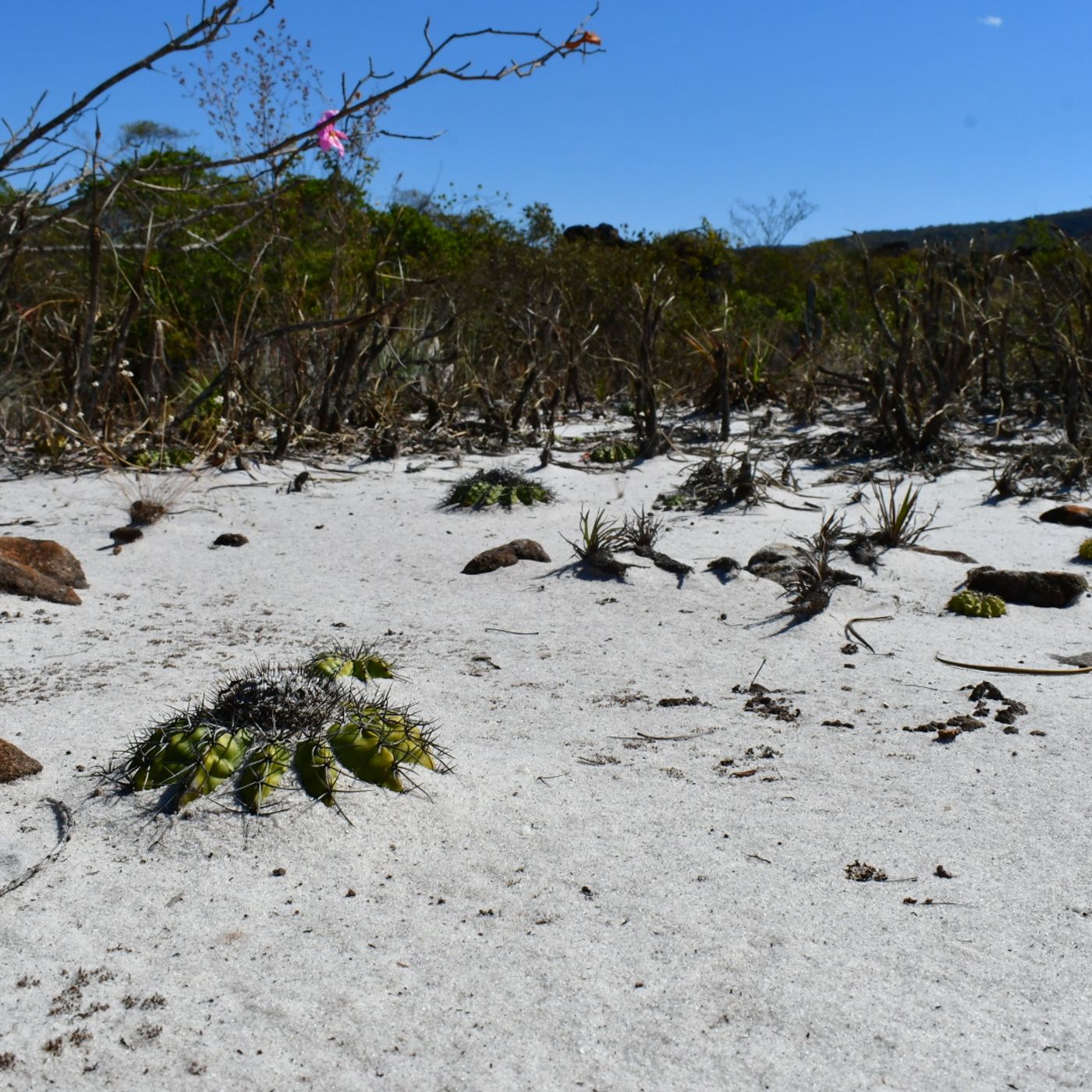
and it was it's weird for the genus because it doesn't produce spines, so
it's evolutionarily lost spines. It doesn't have any spines and aerials and it kind
of grows subterranean, half subterranean beneath this translucent sand, which is another result
of the geology here. Brazil, like Western Australia, has very old the
very old rocks, very old nutrient poor rocks, and that's what composes a
lot of the soil there. Not all of Brazil, but for a large
part of it. It's quartz, sandstone, metamorphos sandstone, very old.
Hasn't been volcanic activity there in a long time, volcanic volcanic vulcanism kind of
you know, spews out the newer geologic material. More nutrients, builds a
healthier soil as it weathers and breaks down by the elements, not the case
with quartzitic sandstone or very old granite in a case of Western Australia, et
cetera. And so when you get these harsher sites, you get a richer
plant community. Generally, you get a richer set of diversity because that stress
is what induces speciation, that stress in the geology. And so I was
just I mean, Brazil is one of the few places I literally felt like
I was going to have a panic attack, Like I was so overwhelmed.
I didn't know what to take photos of. I wanted to document everything.
I still have unidentified observations on my I naturalists their plants. I may never
know what they are, probably a few species that are new to science.
In fact, I know there's one or two species that are new to science.
I was having to contact researchers and bodanists from all the universities, you
know, from Sapaulo, from Rio wherever, just to figure out what the
hell I was looking at, begging them to go on my inn at and
look at these foot or emailing them photos. In some cases, there's a
number of families that are incredibly species rich. Aerio calls, which is in
the order of grasses, you know, we get them here in the southeast
of the United States. They're kind of like, it's like a cute little
button. Yeah, they got a flower head that looks like a button,
kind of like a little daisy, no relation to daisies, but it's a
flower head composed of many individual tiny flowers, you know, whatever. They
grow in swamps. They I don't really pay much attention to them down there.
They're insane. Some of them are shrubs. They look there's just a
diversity of forms. New species being described. I saw a genus called Comanthra
on some of these sand plains that occur and dry desciduous forest another case of
ecological islands. I saw Comanthra species there that I think is new. I
sent it to a Comanthra specialist. They said, this species isn't even known.
If this is the species we're thinking of, it's not even known to
occur in the region that you were in. It grows a few hundred kilometers
to the northeast. If this isn't that species, it's a new one.
I posted on the Instagram a few posts back. It looks totally insane.
It's got influorescence, p it's got peduncles that are like a foot long.
The whole plant is like a foot or too tall. It's got a little
tough it looks like a cushion plant. And then it sends up this inflorescence
that looks like a pom pom on a foot long stalk. And it grows
on these sand plains with a number of other just insane species, I mean,
just wild wild plants, like really bizarre. How does this evolve?
What causes it? How do you know? So just the great mystery.
The whole plant itself is in enigma, you know, Philcoxia. This this
subterranean leave, it's got subterranean leaves, grows on this white, translucent sand,
and it's carnivorous, the only carnivorous genus in the family Plantagena seed,
a family of pencil I. Could go on, and then of course there's
cool cacti everywhere. This is in minas you rice, uh wonder, Lichia
mirabolis. It's a member of the sunflower family. That's a giant tree that
looks like a torch it's got the it's drought dry dry, excuse me,
drought deciduous. So when we saw it, it was in the dry winter
season, which is still hot as hell, and it just looks like a
fifteen foot tall white torch. It's got white bark. The flower buds are
covered in this white wool. Looks like a you know, like a torch.
It's not on fire, it's just like a it's just wild man,
and it's bat pollinated. Anyway, there's so many cool plants on there,
so and I kept hearing Donielle's name whenever I was researching these things and seeing
it in papers, and I said, when I just reached out to her,
Thankfully she was willing to come on the podcast, and I was so
grateful to talk with her because Brazil is probably one of the coolest places I've
been to botanically. So I'll just cut right to the chase and let you
listen to this hour and a half long conversation with Donielle Zappi. We talk
about a lot of cactus species, we talk about ecological phenomena, we talk
about plant communities, we talk about different biomes, we talk about that cool
moonflower cactus subject of the movie Margaret and a Moonflower, which is like an
epiphytic cactus that grows. It's just it's just weird, man. It's just
there's so many weird plants, and how it's most closely related to this tall
columnar cactus that grows in tree cactus that grows in Bolivia. It's one of
those. Brazil is one of those places that just makes you fall in love
even harder with Earth's plant life and and just really drags you out of the
depressing pit of despair that you know. Places like the I thirty five Corridor
in Texas puts you in, you know, when you're surrounded by parking lots
and the death cult and strip malls and just the you know, streets with
no sidewalks. And it's really hard to for anyone not in the United States,
it's really hard to articulate just how depressing and lifeless many of the landscapes
we've created in this country have become these human dominated landscapes. They slowly kill
me inside, they kill my soul. Places like the Sahato or the Katinga
or or the compost Repestor's habitat in Brazil are the antidote to that. They
bring me life. So anyway, whatever further Ado enjoy this hour and a
half podcast with Daniella Zappi, researcher botanist worked at the University of Brasilia.
UH taught at the University of Brasilia and has co authored and written an immense
amount of papers on really really cool subjects. We talk about the ironstone formations
to talk about a deafic endemism. That's another It's another thing I need to
add to my list of uh, you know, examples of of depic endemism,
i e. A plant being restricted to a certain soil type or a
certain soil type, unusual soil type inducing speciation in a plant. So anyway,
UH enjoyed this, enjoyed us conversation. Have a good rest of your
day, evening, morning, whatever, go fix it up by I'm gonna
show you what it's like. Well, I'm not gonna show you uns apart
in section. You know, on the outside, the soft a goat nice
soft liberal barriers and they just started tagging each other and clause come out.
You know, I've seen a couple of night things in that room before.
Get a bunch of hippies club any charts to humorphology. We're starting to get
the other chief of Africatist Night for eighties. They're about to go bad,
but they're not heading well. Okay, welcome to the Crime Payers A Bodany
doesn't podcast today. I'm so I'm so enthralled to be speaking with this person
today. We're having a Danielle A. Zappi, who's a botanist and researcher
from the University of Brasilia in Brazil who studies cactasi and a number of the
really just one of the most hyper diverse places in the world next to South
Africa. I mean, it's just mind blowing and I guess we'll just launch
right into it. So, Danielle, how you doing. I'm fine,
I'm fine, I'm good. I'm good. You know, just getting ready
for the hurricane that's coming to South Texas, uh, which is not good
for a lot of cat they cacti. That's worrying. Yeah, yeah,
but uh, anyway, I guess the spot I want to start too is
when most people who aren't from Brazil or haven't spent much time there, think
of Brazil, you know, think of plants. When they think of Brazil.
They think of the Amazon, but there's a multitude of different biomes and
habitat types there, especially in Minas your Ice, which is the one of
the states of Brazil, and it's probably I mean, I was there last
July and it just blew my mind and I wanted to talk with you because
your name kept coming up in research papers I was reading, and among bodanists
I would talk to there about some of the plants, and so I guess
going into this, let's just start off, what are some of the There's
a number of different habitat types. Right, there's katinga sajado compost for pestres.
What else am I missing out on? We have seek major biomes.
We call them biomes here in Brazil. It makes more sense first because there
are divisions of phitto geography that sometimes don't agree with all the diversity and we
have. So the biomes that we have in Brazil are of course the Amazon
Forest, then the Atlantic Rainforest, which is a coastal strip of forest that
runs from the north and northeastern Straits all the way to Hugens do So,
which is the one that's for the south. And then we have the Sejado,
which is I'm not sure it's my favorite, maybe my second favorite,
which is a savannah that is very seasonal and is in the inner part of
the country from Minnigeras going to the west. We also have the Catinga,
which is the dry forest, which is exactly the biome where I inhabit nowadays
I live in the Kachina. And we also have the pumper which is that
grassland that Brazil shares with Argentina and Uruguay. And the pantan now, which
is the biggest How do they explain river basin flooded. It's not really a
forest, It's got a multitude of environments, but it's the pantana is very
important, especially for a wildlife. And when people visit they get to see
the pantan now when they go to the Egoso Falls for example, or south
from that. The interesting thing is there there are six major ones, and
everybody keeps mentioned in the Kampo pastry, which crops up mostly in bay Yea
and Minagueries, which are two states that are side to side. There are
one in the north which is by Yea inserted in the Katina Byome, and
they one to the south which is Minageries which has a Kampo pastry bordering between
the Atlantic Forests and the Sajadi, both very rich environments. The thing is
that we have extensive biomes and then we have islands of different vegetations and different
vegetation types. It's very difficult sometimes. Were we were traveling last week and
we were between the Atlantic Forests, there's Ajad to the west and then the
Catinga to the north, and we were in this zone of ekotonos vegetation where
you have elements of all of them, and it gets very complicated to define.
So you can imagine that those biomes, they have strips of vegetation where
they encounter where you can be, you know, jumping from one to the
other, or you can have a mixture of species from one living in the
other. Yeah, it was that. Yeah, No, that was great.
That was great. I was going to say, yeah, because they
don't it's not concrete. They all blend into each other. And then we've
also got to talk about the geology that underlies most of Brazil, or a
large part of it exactly, which is exactly very important. Metamorphoused sandstone generally
like hort site, right, it's very nutrient poor in some places. Yes,
the funny thing is that's not how you say instinctive. But we have
more richness of species where the soils are poor. If you go to agronomine
college or something like that, you get told that to have good plants you
have to put a lot of nitrogen and all that. But in our case,
through evolution and those very complicated geomorphological situations, we have a lot of
diversity that's very very adapted to living in those nutrients for soils. So lots
of species, lots of microspecies, lots of carto species, and other interesting
families like the same. The everlasting flowers, for example, that are very
very nice in Minigation must have come across them. What do you say was
when the velocies they ever lasting flowers? Oh god, yeah, God,
that's insane, because yeah, they look like pompous things. Yeah, and
they're they're in polis, right, they're in the order of grasses and here
in the south grasses and yeah, they're they're insane. They're totally insane.
That was I mean, everywhere I went in Minas my mind was blown.
I just I was overwhelmed. It was like a constant dopamine flood and serotonin
flood of just being amazed and in love with the plants, the aero cooles
here and there. Most I think they're most diverse in the American southeast.
But they're just these little things like, yeah, they're cute, you know
whatever. Yeah, there's swamp plants. You go to there, there's you
go to Brazil, there's there's dryland aerocoles. Some of them are four or
five feet tall. Some of them are shrubs. It's just some are meini
and they grow in the mouth of covers as well. Oh yeah, some
of these amazing yes, some of these little compact pin cushions. And I
did do you know much? I mean, I I was having so much
trouble identifying some of the plants down there because I could, I could get
it to family, but then it would be a completely different genus, I
mean, And that was part that's part of the richness of having an eye
for plant taxonomy and plant identifications. You go to a new place and you
can tell somethings a certain family, maybe even a certain genus, but it's
a wildly different form from anything that you're used to back home. And just
that sense of amazement then you try to figure out how did it adapt?
Why is it growing like this? How did it what caused it to grow
this way? Why is this have wooly leaves? The species I'm used to
back home doesn't have wooly leaves. Why is it growing in this monocollus habit
where it's leafless for the bottom eighty percent of the stem and it looks like
this Doctor SEUs style plant. I mean, that was a really weird thing
I encountered down there too. What do you call that? I mean that
habit that so many different plants take on on those sandstone, that corson sandstone.
Yeah, you cannot really say one habit. You will have to think
in the way of their adaptations. Despite the fact that you and there in
July, you probably think it's very dry, but it's not very dry throughout
the year. So you have a regime of rains that come in October all
the way to March April, and in the y because it's high we have
the Atlantic weather influencing it. So the clouds from the Atlantic will reach as
far in as miniature eyes in the highlands, and you have a lot of
water and a lot of mist, and those plants. A lot of their
adaptations are to capture dismissed a bit like the cactipe from Chili. They don't
get any precipitation, but they are they're prepared to capture dismissed. So you
have a lot of those hairs stell It has. You have geometric shape that
you said that like doctor Zuyah, they can be in spirals and all that
is to do with rosettes that will accumulate water in the in the cup a
bit like bromelias. But some of the recordase you have similar behaviors. You
also have a lot of variation in terms of the indumentum of plants, and
you also have insectivorous plants like rosers and incredible things like that. So the
diversity is amazing. And the other thing is like sometimes I studied plants for
more than thirty years now, and you have to have another life if you're
going to enter a family like aero colasy, because the size of the number
of species, you know, you need another life for the ieroclasy, for
the daisy family, for theraci and another life also guess for the for the
poesy, for the grasses, because those are very specialized. So what we
try to do is to team up generalist people who will be able to spot
things in one in one location and do more or less a good job of
collecting generally. But we also have to bring in people who have the speciality
much more in their training, so people who study poeesy, people who study
ay or or legumes or asy. We do need those people because once they
are joined joining the expedition, you get a multiplication of the number of collections
of those families that you get if you just went yourself there. Okay,
one daisy, next daisy, fourth days you close the press and say enough
of you because it's just too many, far too many. But it's because
we have the biggest diversity of plants in the world. We forget to make
a big deal of this. You know, our neighbors in South America they
get a bit cross because every time a Brazilian walks in the room, they
have the biggest days and the largest death and it can be quite irritating.
But humbly I can say that we did database, then we did count them,
and in terms of recorded species, we're still in the lead in the
worldwide for the number of plants. The state you went to is the top
state more than South Africa. You went to the state with more diversity of
plants recorded. I keep saying recorded because we have the problem of unrecording in
the Amazon. So if you look at the size, I don't know how
much you like numbers. I quite like numbers when I have to explain this
to my students. But in terms of size, the Atlantic strip that that
forest I explained about has more species in that small biome that doesn't make more
than twenty percent of the territory. It has more species than what is recorded
in Seja Dou or in the Amazon forest. The Seja Do and the Amazon
Forest. Despite of the difference of size, the smaller in area than the
Amazon forest, the Seja Do has gotten as many plant species as the Amazon
forest recorded so far. So we're about thirty eight thousand, forty thousands of
plants plants species recorded, but we still have unrecorded diversity. They we went
and discovered the new or bill mania. We're getting of that we're gonna I'm
gonna ask you about that, don't worry. That was like top of my
That was the paper that finally pushed me over the top, and I got
to reach out to this lady. This is this is insane, the diversity
down there. I mean it was I was. I felt like I was
about to get heart palpitations because I was just so overwhelmed. I was standing
in a Campos repastorous habitat with my friend Dylan. He was looking for some
rare bromeliad and I'm just sitting there looking at plants that they're asked racey when
I see the flower, but they look if there weren't flowering that I wouldn't
think they were asked racy at all. They've got this this aroquoid leave thing
going on. These you know, no, these sessile leaves. Uh,
they're leafless for the bottom eighty percent of the stem. It's just a single
stem coming up. They get about six feet tall. They're kind of blowing
gently in the breeze. Uh you know they start to branch maybe you know,
three quarters of the way up the stem. They've got these arochoid leaves.
You know, they are just sasile. No petioles are lickno for us.
I guess what you think. Yeah, I mean, like not for
us and everything. Then there were also have other giant days. It's like
like like that's called god that was Yeah, a fifteen foot tall, dry
deciduous white torch. It just looks like a white torch. And what pollinates
that is it bats? It's a large large I think it's a lot.
For a lot of the things we do not know yet, we don't have
We have hints, isn't it. We can tell the syndrome. But for
a lot of the plants in Brazil, we still don't have the empirical demonstration
of what is pollinating them. Yeah, and you're sometimes we have we have
different things, different pollination pollinators visiting the same plant. We have nectar robberies.
So there's quite a lot to investigate. You can just you know,
say, oh, that looks like it smells bad, so it's probably at
pollinated flower. Well, I don't know. We have to sit there in
the dark. Yeah, yeah, yeah, I mean wait, but you're
right though, I mean the specialist thing. I didn't even think of that,
because there's some of these families, christ some of these tribes in asta
Aci are so hyper diverse that you need someone that's dedicated, just like aero
caoles. You need someone that's dedicated just aerocoles. I kept trying to find
somebody by the way when I was down there. Well, there are people
here, Yeah, there are many people. This fabi Is is a friend
of mine, Fabiani in Giamanchina. She's an expert of Ercolese. There's another
lady expert in Herio cole in University of Brazilia. At the moment she just
started her tenure as a lecture. And my supervisor, of course is an
Aerocolese expert doctor and Juliac the mother of most of the botanist in Brazil.
Yeah. And the thing that's cool, there's so many I mean, it's
not just speach is that you can talk about like individuals. There's there's so
many ecological phenomena that you can talk about that are just exactly so much going
on at the same time. Because you see the camp Who Pesty that they
have been published as a as a biogeography geographical province. Now, so we
have a southern one that is where you were, and the northern one,
which is the one where I am. Now, so those those provinces of
camp who Pastry, I don't like to say to use the name Kampo Hoo
pestry for a vegetation type because for me, it is a mosaic. So
it starts when you're reaching the part of the highland at above nine hundred one
thousand meters altitude above sea level, and then you can have an echo ton
or a transition between a forest or between Sejado and this camp hoo pest.
And then as you move higher you may have also gallery forests that are really
to the rivers that come down and have nebular forests that are on top of
the tips of the mountains facing generally west. You can have swampy fields,
rocky fields, and sandy fields, all those different things where you find yourself.
It's very difficult to distinguish. Sometimes they share species between each other.
Sometimes they have very distinct species. So it's all very how do you say,
like we were saying at first, it's so diverse that it's very difficult
to distinguish. When you are in a habitat there in Texas, you will
have several different cactie that grow there and some cross bushes or whatever you have
in the desert there, and you will be able to say this is a
plant community which these ten fifteen species that are representing the majority of the biomass
here, But it's very difficult to do that in the Kampohupesti because we have
such high diversity and we don't really have enough experts that can sit down in
a parcel of you know, three by three meters and count how many grasses
and how many and how many of different species sterile and then be able to
put names on those things. Yeah, so it's very difficult to do so
our studies of plant community get hindered by this year difficulty and the volume of
different plant names that you have to deal with when you're in one of those
areas. Yeah, there was, there was. I mean you like the
campos propaestoras, like you could be on compost repastorates looking at a rock out
crop with very thin no soil and in the cracks of the rocks or growing
like twenty different species of astracy, one of which looks almost like a woolya
gave. Looks like a woolya gave, but it's just tinically a sunflower.
It's in one of the Vernonia's Vernonia. Try then you'll see little phytic orchids.
Then you'll see a little pittic romeliad. Well, now one you see
like five. Then you'll see a weird aero call ac, and then you'll
see a philodendron, and then it's just it's don't forget the pillows that you
find as well, and right, don't forget the cattyches. So that's a
good and you're forgetting the velow. Romantically, of course, things that are
they are related to pandams, and they are such beautifully and they can some
of them can They have those lovely petals and some of them can completely dry
out, which is insane for an Yes you think that, yeah, you
think that that. And the those stems that they have are not really woody.
The roots run inside the leaf sheets into the soil where or the substrate
where the plant is attached, so it doesn't really form a stemp. Do
you look at it and it's like a like a drassina isn't like a cordelini.
But it's not. They are those roots in there. It's technically roots.
Yes, the roots running inside the leaf sheets is a massive dry leaf
sheets and roots. God man, it's very interesting. And the flowers are
huge. I mean, yeah, they look like lilies. They're beautiful,
they're not they're not tiny. They're not inconspicuous. They're large, and I
mean it's like something that someone would put in a bouquet or something. I
mean, fancy got it. Oh yeah, anyway, Okay, I'm getting
off. Try but this is talking speaking of Pelosi serious and cactye. This
is a nice segue to move in to. Well, I want to talk
about this new species of uber Mania that was that you helped describe that you
described, which is a genus of cacti. But the uber mania that I
saw there grow Speaking of ecological phenomenon, they grow entirely surrounded by dry deciduous
forests. So you got a wet season that lasts a few months and then
a dry season that's very long and it's and of course, at least at
least those seasons are predictable. When you come to the biome to the north
of where you were, the seasons are not so predictable. Right, But
let's go in the se handle until until a lot of this struction finishes it
off and there's no more water in the Amazon that rains onto do we have
this phenomenon that is there hob of range with regularity. So this is what
makes the difference between the comple who passed in the south and the comple who
passed in the north. But the cacti like bull because the cacti they like
those azonal habitats where they are growing in a crack of a rock. Right,
and we say they like it's not that they like cacti cannot compete out
compete exactly leaf plants. Right, You've got so they actually are pushed into
those habitats. Yes, that's right. You've got these ecological islands. An
ecological island of like a massive rock out cropping surrounded by dry deciduous forests and
the forest that rainfall regime, generally speaking, is caused by the it c
Z and the latitude that this region is that you know, you get a
summer wet season and it's just like in Mexico. Yes, but so let's
sEH, but we get go ahead. Sorry, but we are more tropical
than Mexico. Mexico is more subtropical. So there is the code factor as
well there that we don't have so much of in the altitude a little bit,
but it's not a factor that affects Brazil in its tropical part, which
is most of it. So we've got we've got this island effect. This
you know, it's a different plant community and these rocky microsites surrounded by dry
deciduous forest, you know than you would get in the dry situs forests.
Two different plant communities, but they're grown right next to each other. One
is i mean any other. But then you've got this other kind of ecological
island effect that these sand openings in certain areas in the yes, because the
the substrate is so old and weathered that we don't really have you know,
volcanoes and mountains in Brazil, we have the the the modern rock, the
rock, the bedrock being erolded in differential way. So despite place where you
went in the Camp of Pesty is one of those areas where the rock was
at its hardest and is being eroded slowly. So those sound banks that you
saw have to do with the erosion of those of those rocks, and those
are very specific habitats for some of the are coming as more basil in the
philogenies we're working with at the moment, which is very interesting. Those sand
patches they seem to be places where because Monia comes basil to the whole tribe
Theirea, which is a tribe of cacti with laws of species and the two
cups throughout throughout the Americas. So it's very interesting to see that whatever money
is one of those reliced general. Yeah, I read like something left over
there, poor thing, I read that. Yeah, So uber Mania is
one of the more early branching lineages. And it's it's again the fact that
hers and these weird ecological islands of these sand openings. I mean, that's
where we saw Philcoxia, that speech, that genus that was just described twenty
years ago, that carnivorous genus and disco cactus everywhere, and which you know
that half the disco cactus were growing almost underground, like they were growing beneath
the sand, and they grow on their ground and the sand is trans germinate
at about we could say, between one centimeter and an inch and john half
centimeters, and the seiblings will germinate in there because otherwise they'll be too exposed
to the light. And when they grow like that, they are quite deep
purple. Did you ever did you notice how how dark they are when you
know on Earth one of those ceilings, they are very dark because they are
concentrating all the pigments in order to absorb as much sunlight as gets through the
stones. That's why. Yeah, I always assume that those pigments were like
stress pigments or those those beetline pigments, that there were stress pigments and disco
cactus. And this is a mouth poule needed genus too, right, So
yes, the ecology of disco cactus, I mean, what happens in the
wet season in these sandy islands, because it probably rains a ton there,
but again it's just sand, so it doesn't really get absorbed. Yea,
it is very it doesn't retain. And I think a lot of the cacti
that we lose. We grow a few cacta in the backyard here. We
lose them if we put them in pots and it range too much, and
the roots are very sensitive to water logging. M Yeah, I don't think
the heaven of the fences. You know, they're very vulnerable to bacterial infection.
And from in they wrote, oh I bet they just they're they're like
a dry sponge. They're so adapted. They're soaking up moisture whenever they get
it. That yeah, it's really easy to give them too much. So
okay, so this new uba mania is similar to disco cactus. Correct,
do you want to tell tell us about this new mind? Well, my
friend Fabi she sent me a photograph saying, oh, what is the thing
that we found? Because she could tell that it was something very strange.
And I looked at it in the phone. We do communicate by mobile and
looking at what's happened? This thing looked like a disco cactus. I said,
oh, what a fantastic disco cactus. Can you can you send a
specimen for me to have a lot to see what it is, And she
promptly sent me a specimen to look at. And when it arrived on the
post, I looked at the epidermis and I could see that it wasn't disco
cactus. But I will build money species. That's fascinating how this thing just
tricked us, you know, for for for the time it took for the
post to arrive, we were like fooled by the plants. And then when
it arrived, you could see if the epidermis of weil Monia is very rough.
We don't really know why it's very cause if you looked at it under
the lenses, you see that it's called bumps that the disco cactus normally doesn't
have, so that was that was what gave it away. And maybe be
those those bumps or something to do. It's not allowing the sun to be
too close to it, pushing the sun a little bit. I don't know.
There are so many things that we don't know about about So she sends
me this thing, and just know, we got it in a in a
in an inspection we were doing with the environmental agency. We went by helicopter,
so it's it's quite quite a remote place. Hopefully people won't find it
because there is malicious trade going on. Oh yeah, there's a van full
of checks already en route. I'm sure you know. Or so collection.
I hope people have a bit more sense. I have the best collection in
the world I had. I had a letter from a type person, an
email from a type person wanting seeing of the thing, and I said,
I've never seen the seed of this and it's true, we haven't seen the
seed of this pot yet. It is very providential that we have a team
of colleagues that work with philogeny in Sorocaba, their geneticists Professor Evandre and Fernando
and other students, because that way, we could very speedily get a DNA
analysis so we could check where those where this plan to come up in the
phylogeny, so we don't need to have all the elements of the plant and
delay, and this thing gets discovered and poached and all those things before even
it has a name. Yeah, yeah, so I'm hoping it doesn't get
pugd anyway. It's nuts they got I mean, yeah, they go this
huge market now and social media makes it, you know, all the more
easy to get out. Yeah, because it's like that with animals as well,
isn't it. It's something that we have to be so careful with.
Sometimes we're looking at some some cute cats. Okay, cute cats are fine,
but that is a cute sloth or a cute say snake or lizard that
shouldn't be in somebody's house. It's this monkey brain, you know, it's
this we're we're primates, right, monkeys as well, we're social primates.
Yeah, monkey is the right but but no pun intended. But it's this
monkey brained I you know, thing that you have to own it. It's
like these obsolete evolutionary impulses because we're you know, human primates and I've got
to own it. I've got to collect it. It's like this, you
know, but there's no appreciation for the habitat or the evolution or any of
that. So yeah, it gets I've seen it with so many cacai.
It's notts and vermeliads and orchids and whatever. But but the ecology of this
uber mania and this is uber Mania, and Newda is the new is the
special Team, right, Yeah, because it doesn't the areos don't have any
spine, so it was the easiest name to give it without too many fights.
And try not to put names of people on the plot. Yeah,
good good, that's oh god, that's awesome. I love you. Okay,
Well, so this but this thing grows subterranean like disco cackte yes,
yes, semi interred in the sun. They're very it's kind of a at
the course sound or very fine gravel. It's transparent or translucent white. When
you're trying to photograph those things, it's help because the camera over exposes the
sun, so you have to to choose your moment and and the settings of
the camera as well. Yeah, I was there. I was when we
were doing Phil Coxy. I kept having that not helpful because the flower is
yellow as well, and you know yellow with the white sund in the background,
the whole thing was over exposed, so you have to be controlling the
situation very firmly. So those those those colleagues of mine Fabi and Cemoni and
Paula, the latter ones worked for the environmental Agency Ibama no Semi, and
those were the people who actually discovered the plant. I just had a look
and I knew it was new, so we publish it as a as a
consort of lots of collaborators. This is becoming more and more common. I
think back of the times when I started botany. It was just me and
my plants, and I would publish them, and I would write about them,
and and I didn't interact very much. And luckily nowadays we have opened
our eyes to the to the advantages of interacting and people having different roles in
the paper makes more solid, more robust papers, and more satisfying experience.
If you're a person's persona if you're one of those loners that only likes to
do their whole thing, that and the spirit of cooperation, sorry right now,
yes so, but but so what other species tell us what other species
were growing in this habitat, like what are there a number? Like how
many other? Because again this this ecologic growing and that one is one is
the disco characters we probably have seen. If you want to to grown more,
go or to or to the places nearby. Dise Cocaccus cell doing sickness.
It grows in sand as well. And the other one is simple Cereus
crassi sepalus, which also grows in sand. It's got funny blue fruits.
Sprus as a genus has got why what what is the adaptive benefit of that?
Is that a sun protection? Do you know? No, they're very
tasty. I eat everything happened. I think if you if you put your
hand on those things, your fingers and your finger to them, you find
that the color is mostly conferred by this glaucus wax that's on top of the
fruits. And like you said, it may have to do with scorching from
the sun. Yea, what is they probably are protecting themselves. What is
the it's not summer temperature that's the problem. In summer it rains, so
the temperature goes up and the rain will bring it down. The temperature that
it's got. The biggest amplitude is the winter temperature that can easily go from
twelve degrees at night just as a dawn you get twelve degrees and then it
goes up up up until thirty. So you have a huge amplitude of temperature
those plants have to put up every day. Yeah. Yeah, so they
are sometimes that are coming slowing down because there are ten degrees that slows the
plant up, and then when they when the sun comes, it starts hitting
them up steadily until they reach you know, thirty degrees. Yeah. I
always tell people, and that's too much because people, again, people in
the US normally think of cacti as desert plants. But cacti didn't evolve in
deserts. They evolved in these these you know, seasonally dry biomes, correct,
I mean where it's not really quite a desert because you've got a wet
season, but then you've got this long dry season too. Yeah. People
think I don't need water, isn't it out there? It's true and it's
not true that they don't need water. So you have catti in all like
all environments of the Americas. You start from Canada with pedio cactus and things
like that, and you go all the way to the Andean and Patagonian area
with ma huenia, so you have you have an amplitude of climates. Those
plants put up with a lot of them go under below freezing, like the
Andean puntioids and other cacti goes below freezing. So you have you have this
this tolerance of all sorts of environments. You have plants in the most humid
areas of the Atlantic Forest, like the the Christmas cactile, those epifittic cartie
and they can put up with with daily drought, but then with lots of
torrential rain and they are fine. I was so they live on top of
trees. I was impressed too when I saw rips lists just growing like weeds
in the trees in uh like Nova free Burgo, Like there's rips lists in
all the street trees and some of them are like dangling down from the Yeah.
So yeah, that's Limbergian. It's like a cut. It's so cool.
It's like they've just and it's very tolerant or pollution as well, because
it grows all the way real as well, getting real with all those buses
and cars and traffic I have evolved everything. Yeah, that's why. I
just I mean the other you know, succulents and carry offy lelies too,
like anacamp sarra tasty are really cool. Some Portula casey, but uh they're
just they're just so robust and they they seem to speciate pretty readily. But
this uber mania, what do you think the adaptive benefit? Like, how
could it evolutionarily lose its spines? I guess because nothing can see you if
you're growing half underground anyways, what do you think that's about? Yeah,
this habit, this habit much is much as a lot of cactile from Mexico,
the group growing flooded planes and underground. There are general like achino Cereus
where you find things without any spines whatsoever. And I think it's to do
with living in a in a geo geophytic, in a in a subterranean way,
the benefit of spine is very very little. There is also disco cactus
horst in Grandma Good that is almost completely under the gravel for most of its
life, and it's got spines that are very different from normal spines. They
are they're not punging. They thought they look a bit like propullant really,
and they work a bit like sponges and they absorb water from the environment.
So spine I think they are the spines of disco cactus. Horst is being
has been proven with with water that is marked with radioactive elements. You can
see it entering the spines and then going to the vascular Oh my god,
this is blown my mind. So there's a cat that's a particular one.
There's a yeah, oh no, I'm familiar. Yeah, I've seen I've
seen people growing it here. They have to graft them because they wrote too
easily. I saw some guy in too. But but it uses its spines
to absorb moisture. That's insane, exactly. Yeah, So you can see,
but you can see other things like for us, they don't have any
spines. Look a bit more like like like animal spoos, don't they.
Yeah, and you I mean you know, yeah, it was just you
know, like you have you have this thing is a plant economy. If
the spine is not going to be very useful, it becomes becomes I mean,
you know, evolution have to talk properly. But the spines, they
are an adaptation that is no longer selected by the environment, and they may
disappear right and they can be evolutionary evolutionarily lost without any any negative impact to
the lineage, you know, yes, or maybe even some positive impacts,
because if if they were spining, maybe they'll be noticed by by a rodent.
I don't know. We don't don't have roof, but we have these
more cod would be like a like a like a large guinea pig that that
goes and choose on on on things as spiny as the singers, which areoids
from the cutting of them doing it. Macy Is is a rodent, but
like a large rat with with short tail. Because we have here in South
America have lots of creatures related to guinea pigs. Yeah, it's something of
that they can just take cactus spines, just chew on them. Yeah,
yeah, Yeah, there's that. There's that small peote that was just discovered
that Alberto void Techi however you pronounced that that grows in Yes, and you
know places mud flats will be inun data for three or four days underwater,
you know, and you'll see it here in South I mean I live in
South Texas. We just we have a conservation property with a bunch of loa
on it and kind of serious Poselgora and any you can't that's all these all
these wonderful plants and that. Yeah, they'll grow in mud. I mean
they grow in really thick clayey soil and it's just so hot that it dries
out relatively quick, so they could take it. But okay, so let's
let's talk about because I know there was the tribe Ciri, which is the
tribe of Sirius and a number of other cool cactus species, right right,
Oh god, we got to talk about close series too. I read in
one of the papers that it was kind of it was hard to target.
It was hard to get a good phylogeny using genetic sequencs, so you had
to use something called target enrichment sequencing. Can you elaborate on this. Yeah.
The problem with with those plants it's a little bit like with the saprophyte
or the plants that don't have chlorophyll I have lost their leaves, so they
have big deletions in there in the DNA, and that's problematic for you to
do an analysis because you cannot compare absence with absence. You have to compare
things that are similar so when you start looking at the fine grain of the
family Cartsi, you had a lot of contradictory information because they were looking at
only a few sites of locky lossy of chromosomes. And these people in Soroka
but have developed a probe called Probe five nine one Cates five nine one that
is more tailored for the cacti and the particularly particularity of their genome. They
have about thirty eight lossy rather than two or three, and the lossy are
from the chloroplast, from the nucleus of the cell as well, and I
think mitochondri as well. So you have because other things that we're discovering even
with this wonderful probe five nine one, is that there's so much hybridization that
is very difficult to retrace the history of the of the plants. The hybrid
is not only now but also a long time ago. So we have a
lot of problem to understand how these plants evolved because while they were evolving and
then there were separations of the of the biomes where they were leaving and they
became isolated, and then with the changes in the climate, those habitats became
together again. So the bats did naughty things. The hummingbirds did naughty things,
and when up with species that have you know, parts of the genome
of others, and they can be quite quite dramatic like that. So we're
having we're having three weeks go quite a lot of discussions with the genetics team
that because the good thing about geneticist they are much more worried about the process
and it doesn't go into this battle of name things, which is a problem
because it's much more important for me to understand the concept of species we're using
and how where do they stop? How can you circumscribe them in a way
that's both practical for people and that translates the evolutionary process. But it's very
difficult to do. Having a good time at the moment, it's very instig
it's instigating, so it's good. It seems like a spaghetti bowl of genetics.
Man of DNA barcodes. I mean, it's with that much hybridization and
yeah, you've got range contraction and then habitat change and they come back.
Yes, So some things they get together when they're not even formed the species,
so they enter contact again in a way that sometimes in the cloudograms in
the in the phylogenetic trees. Instead of retrieving a branch of related plants,
we retrieve the branch of similar locations. So a lot of species that are
growing together sympathically tend to qualless or appear at the end of a branch together.
If you look at them, they have nothing to do with each other.
So it's yeah, well, but I think what is what is good
in our favors that we've been working with the taxonomy and distribution of those plants
for more than thirty years, So it's not like there are things we just
met. Yeah, yeah, and we can try to come to a reasonable
taxonomy even with all this difficulty. Yeah, it's I mean, it's either
way. It's it's really mysterious and cool and just you know, I just
because I always think about that whenever I meet a new plant, is why
is this like this? Why did this evolve this? What other forms has
this taken? You know, in deep time in the last five six million
years? You know what lineage is when extinct? What other species in this
genus when extinct? However, were how many things that are missing that we
cannot see and that make the link between things? Like we were talking with
nudge about Strophocactus, the moonflower that Margaret me painted in the Amazon and the
other the other species here in northeastern Brazil is called stropho Cactus braziliencis and is
related to a thing called nel Ramondia from Bolivia and Chili, which is an
enormous capture. So this this thing is a big scrambler and the moonflower is
an epiphyt, and then it is related to this tree like things. How
many things are not there that we're not seeing. We're in the other valleys
and went extinct for anybody listening that that moonflow what was there was a film
they made about that called Margaret and the Moonflower. Yeah, yeah, really
cool. That was lovely artists. And what is that that grows? That
grows that leaves in the ega Po forest. It's a flooded forest, then
epiphyt of the flooded forest, and it's got adaptations on its fruit and seed
by which the seed floats, and it's very viscus and attaches to the stem
of the tree when the water is flowing between those tree trunks, attaches itself
and Germini's and starts growing upward to avoid being underwater because the river goes open
down it must have like a musilaginous fruit, like a glue kind of then,
yeah, well many of them do. If you if you're used used
to cleaning seeds of cacti, you find that there are some that are totally
going very difficult to get rid of. The of the mucilage. And you
know, those are the things that are the active principles of so many medicines
because they use them here Brazil for coughs and as emollients and as skin treatments
because very popular the local people. Really doesn't go so much to the pharmaceutical
industry, but because they have these mucilage that retains water just like all of
the so that principle that the plant developed to keep the moisture in because you
think of a cactus, a barrel cactus is full of water, but it's
not as full of a tissue that's very sticky and gooey and doesn't let the
molecules that don't let the water molecules to be on the loose there. They
have to be attached otherwise they evaporate through the stomata. Right, So this
this mechanism is very important, very important for the plant, and it's very
useful for human beings as well. Yeah that mucilage, Yeah I didn't even
yeah, yeah, I mean I cleaned a bunch of cactusy. I just
smash them on paper. And it's always that mucilagis and mucilaginist stuff is always
like, oh god, how do I how do I get rid of your
fingers? And it's a little bit like like that that the cartoon where you
get stuck to the thing, and the thing is every moment it becomes worse.
Yeah, that you know that. The thing with cacti and I,
it's I always kind of like because it's there's such a weird sect of the
cactus nerds, and I love it. I'm excited that people are obsessed with
plants. But there's always, yeah, there's always it's always generally male,
and it's always like the collector mentality, and I always want to get people.
I'm like, come on, look at the ecology and the evolution.
It's so much cooler, it's so much more fascinating. But but when I
talk about cacti, people like, why do you like cacti so much?
And I'm like, because they've just they're just is a case study and evolution
and adaptation. They're just so remarkable, like there's so much, there is
a model system. They're just insane. And that to learn that this thing
that evolved in this flooded humid forest, which is the last place that you
think a cactus would live, Yes, what is it doing that? And
it doesn't just grow epiphetically. It grows oppressed like someone glued it to these
yes, like the height against these trees. And then it produces this huge
flower. Is it mouth pollinated or bad pollinated? It's a mouth pollinated flower.
It's very fragrant, and it flowers around the moment when the moon is
full, because it's a visual clue for the moth to have a flower reflecting
them. Yes, I didn't actually watch it is that movie Margaret and the
Moonflower, but I will now I just know about it. But I mean
to learn that that's that somehow is related to neo Romandia or perhaps speciated out
of it, or shares a common close common ancestors as wild Man. I
mean they have. I'm not sure it's the close common ancestor. I think
it's far far away because they're very isolated clades of plants, but they have
a common ancestor. As there's a few missing links in there. Yeah,
probably, yeah, some missing links of many. Imagine maybe we should send
those nerds, those captose nerds back in time, you know, to do
a collection of things that nobody ever saw. I think we need to do
some get them to studying genetics and evolutionary biology. But you know, but
also if you think of landscape designs, I have this. I had this
boss in Singapore, genius guy called doctor Tan, and he he saw the
similarity between the capti and succlents and and creatures from under water from sea from
the scene, you know, like urchins and aug and things like that.
And he made a corner of one of the greenhouses in Singapore Gardens by the
Bay into a kind of marine display. But it was all of cacti and
circlings with weird and wonderful shapes. Oh that's kind of cool. Yeah,
yeah, he's a very cool guy. So many times, yeah, this
looks like it should be underwater. I've heard that so many times. Looks
like something it's seen in a coral reef. But okay, we'll moving on
to pelosis. Serious let's talk about this genus, because this is another pretty
diverse genus in Brazil and South America in general and in the Caribbean. Yeah,
yeah, yeah, exactly. And we have pollination, which is the
states in Florida, keys, right right, exactly, yeah, and there's
quite a few in Mexico, I believe too. Okay, but this is
yes, yes, but this is uh pollination by beetles, bats, bees,
hummingbirds, moths, butterflies. And then it's got this uh all the
tri coombs, I mean, pulos, so serious, What what do you
have to say about this thing? With them? They are primarily pulling it
by bats. There are opportunistic beetles that tenter flowers. Butterflies I don't think
so, but maybe ten percent of the pollen exchange may be carried out by
moths in some of the species. Hummingbirds are funny because they visit just when
the flower is starting to open at the end of the day, when the
sun is setting. Sometimes the hummingbird visits those flowers as well. They have
a very big reservoir full of nectar in the in the just above the ovary
of the flower. So it's fantastically But if you when you ask me,
oh is it but is it moth? Well, those pilos a series and
the bat pollinated cactile, they have more stout structures because to westand the visit
of a bat's quite something, you know. They are quite violent flyers,
and they come, they invest against the flower, put their tongue out and
suck the fallen and go for the next one. So they are rapid and
they are heavy compared, for example, with the hawk moth. So the
flower for the hawk mot's much more delicate, slender, with very satile stamens
that just touch the head of the mouth, and everything is done in a
more delicate way. But with the butts it's a fast and furious business.
So the bat flowers are more stout. They have all the pollen presented as
a pompound as you know, as a structure. So when the animal goes
there, ends up with the beard or with the head or the belly or
even under the belly full of pollen, and goes and goes to the next
one to deliver this pollen and does a trapline behavior, which means it visits
the same flower every so many minutes, and there's a trail of flowers,
allowing the flower to replenish the nectar chamber. Wow, so this is all
things we learned from watching the plants at night and seeing all the all the
behaviors and all the all those interesting things. And how many species of Pelosa
sirius are there? And what's the biogeography of that? They come from the
Florida keys. They go to Mexico, west and east and north of South
America, Colombia, Venezuela, Ecuador, but not so many species. But
when it gets to Brazil, it's a boom of more than thirty species of
pilowso cereus in the compoupestri in the Catinga, in the Sejad proper always almost
always, when it's not in the Katinga, which is a dry twenty forest.
They are almost always associated with rockout crops with aizonal habitats because of the
competition problems. And some of them grow very beautifully in the in the coast
of huge genera and spiritual santos, so they can be found in the in
the coast of vegetation as well. It's very it's a very wide distribution,
but whenever you go to one place, you find you can find sometimes two
or three species sympathically, and that seems to be when the problem happens with
the bats and the hybrids and the genetics going bud. Yeah, yeah,
I can see that. Yeah. We saw peloso serious full volnatives in northern
Minas. Yeah, yeso, yeah, yeah. What's up with that species?
Is that relatively restricted? What's the distribution? Like, yes, it's
endemic, endemic to those two or three municipalities with I think one there is
one sister species called brown new Orum or yeah, somethings like that more towards
the but it is nandemic to the municipality of Gradool in Christanlia. And it's
a very iconic cactus, isn't it. It's got bright blue skin and the
hairs from pillows on the Pillowso hairs are these occur and rusty colored that contrast
with the kind of pale green flower that opens in the evening. Yeah,
and presumably just beautiful. Those hairs are just protecting the flowers and the fruits.
I take it from the sun, is it? Yes, From from
the sun that is ever so strong. If you went out there without sunscreen
you remember, m hm, Yeah, And so what what is the very
punish pseudo cephalium. I mean, what what is the correct yes in the
case in the case of of Pillowso cities we have the floriferous regions may not
be specialized, so the flowers may appear anywhere from the middle to the tip
of the stems, or they may be more specialized, and we call it
sell the cephalium when they're very hairy, very hairy around the floor flowers,
so the area produces a lot of hair and the bud forms inside those hairs.
And then you have more specialized situations where it's a full cephalion that obliterates
the sunlight. So in a side of the plant, like in coleocephalosis,
you don't the plant doesn't receive some rays, that doesn't have photosynthetic tissue in
the part of the plant where it flowers. And if you know the text
Turban the the mellow cactus, you can see that in action, that's the
plant that is in fact monocarpic. It grows to a certain point, then
develops the cephalium and it starts really growing the vegetative part. The cephalum becomes
taller and taller and around in the area of the cephalim there is no photosynthesis
happening, right right, It's just it's just a definition for a true cephalium.
Yeah. The definition of a truceive valium is a structure that obliterates that
sundlight, so you don't have a chlorophyl inside it is that That's what this
does. Go cactus does to disco cactus has been recently been found to be
the sister species of melo cactus. Not so recently, but when we first
started selling the cacti, we all, no, disco Caacus has something to
do with the gym local lisium, and we put it that way and so
on. But now it all came to pieces and disco cactus and mellow characters
are related to cacta. And there's a student that we know called Millionaire who's
doing philogeny of those two groups in tandem. To to do a bit of
comparison, because it's very interesting how melo cactus is much more while the distributed
than the disco cactus. Yeah, yeah, there's it's just when you look
at the distribution of some of these plants, and not just cacti, but
you can see, you know, especially like some of the tribe Ornonia.
Yes, you know, you look at going up the Caribbean islands into the
end Hillies. I mean, oh yeah, those are just stepping stones to
South America. You know, it's there's probably a land bridge at some point
when sea levels were lower or close enough. You know, the islands were
the wind because those plants are wind wind dispersed. In the case of mellow
cactus, they are dispersed. They can be dispersed locally by lizards, but
maybe also by birds. And the thing that makes this go characters. So
mellow cacter saw so much more widely dispersed that, unlike the majority of cacti,
is a plant that is able to self pollinate. Yeah, so no,
mellow cac cactus is unable to do that. Yeah, that's why mellow
cactus occurs in the Caribbee and in cool By's everywhere, I think, even
Peru, yeah, Mexico, even and throughout south throughout Brazil, very hot
place. The adaptive benefit of that cephalium is that you don't have to create
more stem to flower. You've just got this basically division of yes, you
do it millimetrically, isn't it. Every millimeter there will be another flower and
it goes firally inwards and and it grows taller. Every grows a bit taller,
so you have another batch of flowers to to to to surge from there.
It's very good. Okay, good design. Can I can I ask
you? Can I ask you something about a non cactus related plant? Is
that? Okay? Family? Okay? And I might even be mispronouncing this.
It's in order mertiles, So the order of Eucalyptus and gabo vo chiesy
a vocizi voc Yes, the tails and they only have one stamen each.
Yeah, the flowers only have one stamen. If you look at mertailis in
general, like pomegranateo or marta or calyptus, you have or the attractiveness that
is based on the presence of stamens. And yet in the same plade we
have occasias with a single statement, and the stamens are placed alternately in the
flower so that when the pollinated lands, it gets you know, it gets
the falling in one side of the body, and then the next flower where
he visits or the other will have the stigma in the mirror positions, so
that this pollen can be transferred. So it's to promote outcrossing basically yes,
crossing, but with major economy comparing with with the other members of the clade.
Yeah, these were These were really cool to come because I had never
heard of the family before and I was just standing, you know, on
the side of the road looking at one of these things in the blazing sun.
Just mind blown. It's got this scleorophylous leaves, you know, really
hard pleaves are amazing. Yeah, it feels like plans. And the flowers
of most of them, if I'm not wrong, they have a calker like
like a spur, So that's also related to the pollination. Very different from
the flowers of all the other metals that are mostly radially semmetric. Those ones
are zygomorphic and they have this spur. And if you really go to the
to the floral formula very carefully, you find that they are not even zygomorphic.
They are irregular because they don't have this You cannot even cut it into
plants into house because they only have one standing. So I was I was
looking at it. You know what they look like. They look like from
the you know, the the Sigourney Weaver movie Aliens flowers, and the flowers
kind of look like the alien head. They're really they're so weird. It's
such a weird shape of it' very weird, but very beautiful as well.
We call them powerdy to come because something about the flower looks a bit like
the beak of a token. Yeah, and some of these to canoes are
always puzzling to They seem to be flying backwards, don't they. I wish
I would have seen one, and we didn't see any two cans down there.
But but the but so you've got which is the genus, and there's
another pretty daminant quality as well, with a big flag shaped petal. Very
beautiful. Some of them, yes, some of them are. The majority
is woody. We don't have any herbaceous. They always have wood That's something
to do with that clade of of the of the tail is the dominance of
predominance of plants are woody. Of course you have bush, bushes and trees,
but don't have herbs. Salverdia convalerio dora. Yeah, that was a
common one. So vertia, Yeah, that one they called. Yeah,
it's very used meditionally, it's very widespreading in its distribution and it can be
something that you can say is related to the whole of the biome of the
because of course from Mario and Pa all the way down to minus ice and
sometimes and what pollinates? What pollinates these? I mean, what are some
of the dominant pollinators? You know those are bees, bees of different size,
sizes and shapes. Some some of our bumblebees are quite big carpenters as
well. God, they were so cool. Yeah, I think it's a
large bee. Yeah. These plants were and the habitats they occurred and were
always incredibly rich and cool too, and they were you know, some of
these they were really common, really dominant plants there was. Yeah, they're
very abundant in that habitat, but once you live that the habitat, they're
also common. Are they do they what about the I mean, do they
are they like semi succulent? Do they have any kind of like storage mechanisms?
A lot of the plant have rootstocks that have reserves. I don't know
particularly about the book, is whether the don't have that kind of thing.
I know, the asteracy the days is, especially the tribe you mentioned,
the Venoni, they have those wood the rootstocks that have storage in them so
the plants can survive fire. The ability, Yes, xylopodium and the fire
passes and burns most of the area part of the plant, but it can
risprout from the body. Yeah, yeah, that's another Yeah, so we
see that like that, you know, really, you know I can do
that, you like, what's what species? What are some examples. Caulis
has a tuber like formed by the base of the cloud and also class semples
you may have seen and in the habitat of Wemonia go mifa that one has
like a carriage, like a nappiform route. So a lot of them they
can withstand fire because of that, because the fire is a natural process in
a had it's not as it doesn't happen as often as the man putting fire
on it, but is a natural phenomenon. So plants have adaptation. So
there's a lot of fire adaptation in saharow environments. A lot of plants have
evolved in adaptation to fire. Is there any seed dormancy that needs fire to
germinate or anything like that? There is evidence of seed dormancy and lots of
the families they need to be exposed sometimes to smoke, or they have to
be scarified. You have to break into them open, make little openings on
the side of the seed to be able to allow the water in, which
would be things that are similar to what happens in Australia. In Australia,
it's easier to find fruits that have to be fired or there was nothing will
happen in Brazil, is not so. I mean, it's not that we
don't have adaptations. We don't have a list of very obvious adaptations as we
have in Australia. We also have plants that will come to flower after a
few this burned. Every plant comes in synchronic flowering and those could be from
many different families, very very easy to do it, Iery Dasy as well.
So you have you have this flower synchronicity which helps in the in the
process of pollination, cross pollination and production of fruit. H Okay, how
much time do you have to know that you got enough? You got like
half an hour, lefter. I don't want to take your whole afternoon.
But I'm having a blast there, just so you know. So I'm very
shacking. You're okay, People tell me you're okay. I'm fine. Half
an hour is fine. More than that, I think I have to water
the plants, okay, okay, So okay, well I don't want to
I don' want to take your whole afternoon, but okay, so I want
talk about there's a couple of papers you wrote that I was pouring over yesterday
that are just just really really interesting stuff going on. One was called the
DFIC Endemism and the Amazon. I think you co authored it, and it's
about let's talk about some of this endemism that goes on in the rainforest on
Iron Bridge, on iron rich soils. Yeah, that's very interesting because that
was it was time when I was working for the mining company as a botanist.
Of course, all those companies need need the input of biodiversity people to
tell them what is growing in the grounds and what they had to watch out
for because it's very important that if there is any endemics, they must make
all possible efforts not to extinguish species. So it's very important and very sensitive
subjects. But as part of that study, we went to a place that
is absolutely like like a minor bit too batter plan but it's like you have
places where the soil is very special and the substrate very interesting. And this
place is Characters, which it's called one of the biggest mineral provinces in the
world, and the quality of the air and oil from that area is so
high that is unbelievable. However, on top of this very special specific open
vegetation, we have a series of more or less forty or perhaps more now
plants that only grow in those in that environment. So we were studying those
plants and identifying in them and describing all the distribution of those plants in order
to provide data on them, because it's very important that those things are well
known so that it's not like with the rest of the things in the vegetation
that get destroyed before we even know them. So that was the purpose of
that work. And it's very interesting to see how this endemicity, these endemics,
they belong to very different clades of the tree of life, and depending
on the area where you are, you have a predominance of some of those
clades and indetterment of others. That was very interesting to study in terms of
biogeography of the plants. So what are those plants that were amazing? Yeah,
yeah, I was going to ask you what are some examples? And
also how does because I'm used to serpentine, I mean when I learned aficc
endemism, I was Unserpentine in California. I was very lucky there. What
how does ironstone formation direct the evolutionary trajectory of some of these lineages? And
what are some good examples of the cool plants that occur? Well, the
the the properties of the iron stone, which is for the geologies, they
don't like us to call it stone nation. There are more. Is very
dark. We are talking about two degrees south of the equator, and the
color of this stone is black. So imagine when the sun shines on that,
it's like friezling the fries almost everything. So a lot of the plants
have very dark pigments, like Brazil Brazilians in the melestone family. It's like
the leaves are all red. The plants is all read Karajazia conga as well.
Carajaza is minute. It's like a plant about five or six centimeters tall
and totally differentiated from other weedy rubiaci that I know. You have a nippomele
with a bright red flower pollinated by hummingbirds. You have sorts of different things
there. It's like you landed in the alien place because all the plants are
so different, and you are surrounded by pair humid forests all around you.
Then there's an elevation of five hundred to seven or eight hundred meters above the
sea level, and on those crusts of very dark rock you have those plants.
However, is more water yielding than the granite that we studied next door
to it. We did a study on the granity outgrop and not many of
the plants from the from the Ganga, we call it the iron lock grow
on top of the granite. You have another group of plants growing in the
granites. It's quite interesting. You're like, you know, five kilometers ten
kilometers of the crow fly, but you have a totally different flora on the
on the two areas. You can only distinguish those things if you have the
lock to have a large team of people with their specialties and know their plants
and their traditional taxonomists. So it's very difficult to get to that level of
diversity and handle it if you don't have a team of people. Oh got
it. What what is as far as the color of the leaves and this
this darker color, what what element of the environment is selecting for that?
Is it like blending in to avoid you know, herbivores or is it a
stress response to the heat and the I think it's a stress response to the
light, to the high luminosity that that you have when when the sun is
running on top of this blackstone, everything will becomes corch unless your pigments are
very condensed and concentrated. I'm assuming realizes that grow there. They are purple,
The lives are purple. That's crazy, God, that sounds amazing.
I'm assuming things don't get very tall here and these ironstone habitats. No,
you can have. You can. If you have water bodies, information of
soil, things start changing. The soil starts changing and you start having like
copses and groves of plants. But in general, no, you have this
bare, bare rock. And one of the things we had to prove was
that this bare rock in the Amazon was different from the bare rock in the
state where you visit the minergeries near the city of belloy Zoune, because for
people who are lay and are very interested in the substrate, be much nicer
to say, oh, these are all the same plants, it's all the
same thing. But we found in our research that the flora bears no resemblance
to the one from so far away. Is our toc to news is locally
evolved. We don't know how long, for how many millions of years it
took, but it's very precious and it has to be preserved so isolated.
God, I bet man, how many endemics. I mean, there's got
to be hundreds of it. We only because of the because of the trade,
of the mining trade. We called it endemic affic because there are also
species that grow both in the conga and in the granny or in the sand
Sundy area below. So we had to discount a those So oh, you
know, we made forty forty two species that a pandemic to the to the
iron ore in that region. So you guys, you guys, that are
it's quite a high number. Yeah, that's well. It was the floristic
floristic work. We had floristic accounts, which are like accounts with the descriptions
of the families general and species for all the families we found, because we
also wanted to see what the biodiversity was, so we got to more than
I think seven hundred species growing in those in those outcrops. We discounted the
forest because you need another another five lives to do the forest. But to
be clear, the Congo is ironstone, iron habitat surrounded surrounded by Amazonian rainforest
by perubid Yeah on Brophilus forests. Yeah, God, that sounds so cool?
Is there? Do you know? Is there like a good book even
if it's in Portuguese, of that you could recommend the listeners. I wrote
a book. I don't know whether you can't get get the book. I
wrote a book for the company when I was there. It's called Landscape and
Plant Landscapes and Plants from Karajans. And it's bilingual, so it's called bull
languages and is interesting. Maybe it existed the Amazon c A R A j
A j A s Is there is there a good Is there a good like
textbook on and all the different this sounds kind of like a tall order too,
and all the different biomes and and ecosystems of Brazil or even like or
even just one on campus pro Pesstorates, one on Saharo, one on Kachinga.
You know where people can read where these relationships where it's not just about
one plant species, but it's about the biome itself and the plants that grow
there in the plant community. Is there anything like that? You know?
I think there are some in the Atlantic forest that I can remember. And
there'll be books on the Sehado for the protected areas on the Sejado so for
the Chapados viad something comes to mind. I don't know the titles by heart,
but they will be mostly relating to the to the protected areas like national
park somethings like that. And I think there is a wonderful book on webeil
money that deals much more with the shoots and ma shadow, that deals much
more with the with the habitat and the interesting things of webil money than with
the species. Is excellent book and very well illustrated. What is the name
of it, you know? I think it's the genus web build money.
Let me see it's on the shelf. Get to the shelf. Oh my
god. Your library, your personal library has got to be amazing. It's
a bit problematic because half of our life was in the UK and the house
is his, so the library is likewise divided. So you have the book.
It's called webbel Monia. The authors are Shoots and Shad Shoots U L.
T C S C H U L z shoots without the t Okay,
there is there is a book on the cartings that's good. Is the Floor
of the Cartingers of the San Francisco River. That's also by Ling Books.
I mean there's there is an English and a Brazilian edition and the author is
Cicada Florida Floor of the Cartinga Flora of the Cartingas of the San Francisco River.
It's very nice because it includes natural history and conservation. And that's with
three a's right, yeah, yeah, to to start and want to finish.
Okay, So with this with this ironstone, how do you pronounce the
heir? But that type the conga and g yeah, conga. So I
presume this iron is there. You know, it's very old rock, great
oxidation event, that's very old. Is that is that generally speaking correct?
I mean because normally when you find iron ores, you know, dated to
the Great Oxidation event, it's very old rock, you know, two billion
years old. It's yeah, it's old, but at the same time it's
dynamic. You know, the diversification we talk about in terms of the species
here in Brazil, even in the super diverse habitats like campest Is Plaily your
place to see it doesn't go back further than there was all this. Who
have about the theory of the museums and cradles? Remember that one what was
that everybody was talking about that? Well, that the origin of some groups
of plants? Was it an old origin? Like you're looking at the Camp
Hopest and is it a museum or you're looking at the Camp Hopest and is
it a cradle of new new species lineages? Yeah? I think so far.
Yeah, yeah. The the only the only thing that was proven is
that is the species that we see now theres are very recent, right right
right, Well, I'm talking of the geology itself. Thought so when when
I look at the yeah, the geology is old, but the dynamics of
what is on top of the geology is quite fast, you know, because
we have climatic changes that occur every so many, you know, hundreds of
thousands of years, so you don't have a stable environment everywhere, and things
move a lot, and there are major moments like the moment when when the
grasses evolve the mechanisms to cope with the with the sad and then they expand
greatly, so they do the Sea four mechanism or the cam mechanism. In
the case of the cacti, those are key moments when plants migrate from one
habitat to the other. On the other hand, you have this this dry
and dry and hot periods alternated with wet and humid periods, so you have
an expansion of those forests that in in Brazil there there are two major areas,
one forest in the coast, one in the Amazon, and those things
seem to have united at some stage. Imagine it leaves very little habitats for
the cacta. Yeah, that's you know, that was when that happened.
I didn't see many grasses even though I was or maybe I just wasn't.
I saw lots of leganocorpuses that that diamond diamin and genus are said, yeah,
yeah, but I didn't see I don't remember seeing many grasses. But
Saharo is a grassland, right, Yes, it's a grassland. But we
could says the grassland of in general, because you have the sedge, just
the separation, the recal relation. However you do have you do have for
example, the Conga work we did. Our leader was Pedro Viana is grass
expert and the biggest family of plants in those outcrops was the grasses. The
thing is that people don't have a good eye for grasses, so they all
step on the grasses and the grass is just like the next one. But
it's not so, it's not so. It's a very diverse group needs another
lifetime, and luckily we have our friends that are dedicating their lifetime to them.
But the grasses are very diverse. The other thing you went in July
when the grasses would be all over, and only when the rains start they're
going to develop. And there's some beautiful grasses in the Cat's amazing, is
there the congo stuff though? I mean, how threatened is that? I
imagine if it's sitting on a bunch of iron ore, it's you know,
there's a demand to tear up. There is a machine looking at it.
Man, that's that's crazy. So so much endemism and so much richness and
an endangered plant a very narrow distribution. Yeah, yeah, exactly, so
the or the There are lots of studies of the dynamics of the populations and
so on, trying to trying to work out how to how to allow those
plans to remain because the grid over this aren ois is just two immense m
hm. And you never know when when one company would hand over to the
other because there is a thing called exhausting the mind, and then the other
companies come and finish, finish exhausting and so dynamics of that trade is very
very very tough. Yeah, yeah, very seriously. There wasn't there There
was a species of Erosia doa was that on iron that was just discovered and
then it was like immediately endangered and they had to move a bunch of plants.
Was that. There's a species of disco cactus called disco cactus species bibles
that is being found on top of of conga recently that we described. Also,
it doesn't sent it grows on on iron or does it like iron sand
or what? It grows on iron pebbles? Yeah, like iron pebbles.
You can see that. Sometimes you have iron gravel and when that forms is
good enough for the disco catters. Some disco catters growing kind of tough limestone
habitats as well. Not all of them grow on sand. What is the
disco cact Is it the one on iron? What's the species name? It's
named after the river called Page Bravo, which is. It means the brave
Fish river. So we name the piece barbarous in Latinised to make an allusion
to this river. It's in northern Meanness, it's not far from Gromgo,
but the land is already owned by the by the mining companies. So this
is a very prospected, very narrow distribution the species, Yes, very narrow.
Yeah, now that's a cute plant. Yeah, but it's the I
mean, this genus is seemingly it's colonized every rough environment where I can outcompete
things that get bigger and yeah, but always always it became it always made
small populations and distribution not very wide. I mean, I think the most
widely distributed is Hepta con Paraguay, I believe in Brazil, but the rest
of them, especially on some eastern Brazil, don't have very big distributions.
How many species in the genus that that are known, because there's new plants
being described in Brazil. I mean when I was there, I saw like
five species that have been described in the last two years. How many species
if disco characters are known? Yeah, some of them are allow, some
of them are disallowed. Are some of them are what? I don't allow.
Oh, yeah, that it's they're they're the same. You're saying,
there's there's the differences. Yeah. I contribute to the Brazilian list and Flora
of plants. That is, that is our web based real time system.
That's maybe we'll talk another time about that one because it takes too long.
But in this one I have in Brazil today, it's slowly in the stuff.
It's about twelve species, ten of them endemics. And yeah, so
that's that's that's the size of it. And the and the stated most of
them it's Minasueta is followed by bay mm hmm. Yeah those but here,
Yeah, we didn't make it, but here I want to go there.
At some point, it just looks it looks nuicte you. I was very
impressed. Getting off topic here for a minute. With the food there,
I got to say, it's you know, you go to like a truck
stop in America, your your your options are like greasy chips and sugary drinks.
But I went to a truck stop in Minas and they had like a
buffet of very healthy food. I was very impressed. You know, the
truckers there have good tastes. It was one of my highlights. So the
truckers were king. You know, it's quite sudden when I think of how
the evolution was when I when I first started botany so many years ago.
You go to the place to the shoe has carreers by the road, and
when you saw enough trucks parked there, so that must be a good one.
So stopped there and had the truck drivers was sitting by this, sitting
and not facing each other in diagonal with another very large truck driver and having
a magnificent meal because they were the owners of the roads. And all that
has has has come to an end in the last ten or fifteen years with
the over provision of well the credit became easier, so everybody could buy a
truck. So there is an excessive offer of freight in the country. So
they have to lower their price, or they do that or they become they
belong to big companies that just paid them a small salary. They were independent
guys, you know, and now they are totally cool. Yeah, the
market totally flooded and they are no longer the kings of the road anymore.
Such because they were quite you know, there were some characters. You know,
nowadays they have two resorts to all sorts of things like drugs and things
to keep driving for longer and longer hours. And oh it's so fun.
They became ubers of trucks. Yeah, yeah, that's yeah. I used
to work for I worked for the freight railroad here in the United States a
while ago. And uh, you always hear that among the old heads,
the people that have been there for a long time. This job used to
be great, and then the company just started screwing their employees and just you
know, fighting them over stuff, and things became you know, the wages
became less, et cetera. But okay, well usual, I've just got
such pleasant memories of going into a truck stop expecting to find like unhealthy trash
food and finding like someone's mom had just made a wonderful buffet, like healthy.
I was blown away with some salad, some beans and that. Yeah,
it was like some sort of None of the truckers here have diabetes,
you know, or they're like four hundred. But that was the solution.
That was the solution for the former mules were like served at the table.
They will bring all those little dishes of things to the table. Be like
Mexico but they invented this Skilo system, which is much better in terms of
use of resource because not a lot of food gets thrown away. You put
on your plate only what you're going to eat, and you wait, and
you know, I have my son in law has a knack of managing to
fit a whole kilogram on one of those plates. But it's quite difficult to
do a stack it. You know, it's an art. Stacking it as
an art. You make a nice little pile exactly. He's he's got circus
talents. So he manages to do that. Must be something to do with
balanced. Yeah, it's amazing. Well, okay, so I'll let you
go here in ten minutes. I want to talk about one more paper beyond
okay, maquisy Okay, yeah, Beyond forst and Amazon biogeography in floristic relationships
with the Amazonian savannahs. We've kind of already talked about this, but what
was this? What was this? How would you sum up this paper?
And what is what's what is it about? Biogology? Again? Again,
it was an investigation that we were able to do because we are a big
team and collaborations are very important for doing largely floristic analysis that makes sense.
So we went to some some campeinn aanas or savannahs in the Amazon and did
collections there and got very curious to know whether this was seja do or not.
And Saha Do is a biome self contained in the center of Brazil,
and it doesn't really enter the Amazon, where you have doe vegetations that are
savanas, but they actually don't have floristic elements enough floristic elements in common with
the shadu to be called sea do. And the work calls because formerly all
the studies just took into consideration the tree flora, the floras of trees,
but we did a complete work looking at every little herb we could collect and
identify herbs lianas, shrubs, trees as well. So if you do that
you may get a different picture from what people were saying before. So that
was the point of that work was to enhance some floristic list, that is
my fourth thing I do all the time, by selling it a bit up
in the market rather than just this is a floristic list, goes into a
little journal, local journal and doesn't get any impact. We are forced to
make impacts of as scientists, so that that's the way you can and do
a very good job that you trust and also that hits other right notes.
I just love the idea of composing a list of species, of not talking
about just one or two species, but the whole plant community is studying the
dynamics that exists within that can. I want to do something like that for
South Texas, because there's not really well there's like a book on South and
I want to do school books. I want to do books for the local
kids here to know that they are not in the Atlantic Forest, because we
live in in the inner part of that year, and there is such an
overvaluation of the Atlantic Forest that when it comes to the Day of the Environment,
which is in June, they come and ring me and say, oh,
can you talk about the Atlantic voice? As I know, I'm going
to talk about the catinga no no athletic forests for you or the couple opestive.
But there's this over emphasis on some vegetations and that place with the psyche
of people pasted. It was even worse because it was more like an European
eeropization of the culture. So you went to school and you learned a both
days is and strawberries and roses and elephants and animals don't care here, so
you don't know anything about the local flora or phone. So I think what
we need to do is is more books that can be e books or hard
copies, but is what I want to do. You know that I was
in near future, I will say, that's something that kind of blew my
mind. Being there was I was so I mean from the minute I got
there and started looking at things, I was blown away and just enamored with
the flora there and just so curious and just just you know, everything was
a great mystery and so cool. And when I went to like a bookstore
and looked up you know, I was looking for like books or like a
guide to like basic plants, there was nothing, Like, there was nothing.
It just seemed like, you know, in popular culture, there was
very little awareness of the native flora of Brazil. And I thought, this
is one of the most biodiverse plays in the in the world. How could
that be? Yeah, Well, it's the same with all sorts of things.
If you got the bookshop, you're not going to find a lot on
the on the local authors, or you find a lot of self help books
translated from American sources or things like that. Women are for from venus and
stuff. So it's it's very if you, if you look at the overall
reader pattern of Brazilian population is very low. People don't have books at home.
It's very very there's very little interest in those things, and people are
very much in crisis because books are going to disappear. Maybe they never existed
after all, do you think, I mean, do you because so few
people consumed? Yeah? Yeah, I mean everything is short form content and
you know, the shorter, shorter attention span with every passing generation. But
but I just the awareness of native plants and the popular mind in Brazil,
like do you think that's never going to be a reality Because you go to
New Zealand, they're all about their native plants. They've got native plants printed
on the currency, the native mushrooms there. I mean, I love the
same. We do have some animals in our currency plants though some animals judge
in perception is a real, real problem in Brazil and the efforts I've been
making with I have a student who's a master's just finished. She's a teacher,
school teacher, and she came said, I want to explain this a
handle to my kids at school, and we did a lot of initiatives with
her. The interesting thing is that it is possible, but the diversity hinders
you. It's much easier for school kids in the UK, where my daughters
went to school, to know, you know, the butter cup and the
bulbs, the bluebells and all those things, and the winter leaves, the
plantain and the platinus and the beaches. It's much easier if you have six
or eight species of three and some twenty herbs. So if you get to
the comple who passed, like I do with the students from the school,
here, where do I start. Yeah, it's too much, it's too
cool, you know for you you're a season botanist, but for you it's
already mind boggling. Imagine for a child that's never you know, nobody introduced
them to any plants apart from you know, perhaps the papaya tree in the
in the back garden or something like that, but not a great variety,
and then suddenly through them then you want them to absorb exactly what So we
are basing our working and noticeable plants because just all of them is too much
and trying it this way. Yeah, yeah, yeah yeah. If you
move it's a continental size country from from the north to the south. You
know you're going to teach us I from my guy from You're going to do
south, or you're going to teach Marti herb To to a person from from
northeastern Brazil, never going to see that plant in their lives. So there
has to be catering for regions. So you need to regionalize the knowledge of
all those things. How do we get how do we It's very difficult to
get them in the curriculum. You have a national curriculum, and how are
you going to do that? I bet we got to get Wonder Wonder,
Licky and Mirabolis on the state flag of miniatures. Could we do? We
gotta voted at some point, we gotta I nominated. We have We have
a municipality in in Bahias and Zida which has three big looking Bahiguda trees in
in its flag. So some some have have seen that have done that.
They are those they're like be bubs no cavan Lesis cavany Lesia trees and they
have a symbol in the in the flag with three of them. Very How
do you how do you spell that? And I'm going to look it up.
The cavan Cavanades Cavanilis was a Spanish botanist. Cavanilis c A V A
I L L E s cal Cavanilesia. Let me see what family is it
in this used to be you know, oh right, okay, yeah,
so it is the Bao bab claid yeah, cavan Alicia, Yeah, yes,
Oh my god, what is this? I didn't even know about this.
This is the next time you come to That's amazing. It's literally a
Bao bab. It's like it's somewhat skinnier, which isn't saying much. Bao
bab? God, where is a very nice plant? Where is this?
Oh? God? And they's associated with limestone grounds. There's limes, yeah,
amazing, limestone associated with the river some Francis. Okay, one last
thing, but this paper we were talking about, there's we're talking about.
I noticed in the paper that we were just mentioning there was a biogeographically we
talked that. It mentioned the Guiana shield and there's kind of are there similar
plants that kind of get into this other habitat For a lot of people want
to want to talk about similar plants between the camp and the Guyana Shield.
But the the the points of Venezuela and northern Brazil and in the Guyanas,
they are very specific vegetation, so you have lots of general datonio there.
In physiognomy, they may look a bit like a campo who pasted, but
it's higher and it's wet all the year around. The people who go in
expeditions there, they can't dry up. Yeah, they went from the moment
the helicopter lands until the moment they are taken away. So it is a
different it's a different climatic requirement. That's the It's got a lot of endemics.
It doesn't have such a big flora overall like each outcrop is, but
between eighty and one hundred species, so it's but all those species are just
amazing. And there are some families that make the bridge, like it's one
of the Rappa, which is close to the groundses that makes the bridge between
them. There's some crazy Bromli that's the dark carnivorous there. That must be
a wonderful place to be. It's a bit pricey though, to pay for
the helicopter. Yeah, I think there's only one or two you can you
can hike up. The rest are just Yeah, they're literally islands in the
sky. I mean it's you talk about. Yeah, they're amazing places.
Yeah, okay, yeah, I'm great for you coming on. I could
talk to you for another three hours, but I'll let you go. Thank
you so much. And I guess is there anything else you want to end
with or anything else you want to say? Wow. I think it's very
important the value of collaboration when you're doing your research, and the spirit of,
of course, you know, the spirit of fun of going there having
grabbed the plant, getting dirty, and for the plant not to be a
number in your matrix, to be a thing, that is, a being
that's associated to a species concept and it's much more to bottomists than just making
crazy number number crunching papers. They're important, of course, but I think
the the life, the life of being behind us those bits of fieldworks is
what really matters, and those experiences, and also the experience of being in
contact with people in those locals and getting to meet them and see how they
live, how they live differently. To sober up a bit from this crazy
scheme of fast food fast life, fast everything, and no life at all.
So I think that's that's very important as a biologist. I was very
fortunate to be able to have a glimpse of a life that's nothing to do
with that. Yeah, very spoiled. That's beautiful. Yeah, no,
seriously, I mean, that's why I'm into this so I can get away
from all that. This stuff is the antidote to that, and that stuff
slowly kills me when I'm in It puts me in a bad mood. It's
very unpleasant this stuff, this living world, Studying this living world, having
reverence for it, that's what keeps me going. So thank you so much.
I mean, I lastly, I guess you would assume, I mean
the people that you're with out there. I mean, it sounds like you
guys all have that reverence, that respect and love for the work you do
and for the organisms that you work with. That's pretty fair to say.
Now, yes, we're all very lucky like that. It's very important.
Part of the commitments to have this respect and admiration for the subjects that we
study, very important. It's substitutes religion. The other day, I had
to explain to a person that I didn't really believe in a god. And
the person said to me, and how do you do I said, well,
I believe in nature. Started with that story that you know how those
things are all working in this unisone. And for me that made as much
sense as her God made for her. Yeah. Absolutely absolutely. Man,
that's a wonderful ending to that. So thank you. Okay, I'll let
you go. Thank you so much for your time, and hopefully we can
do this again. Thank you and yeah, okay, thank you for the
opportunity. It was very pleasant talking to you. Thank you, Danielle A
Zappi. Okay, thank you, all right, everybody else, take care.
Talk to you guys there. Bye bye bye. Take care.
Chapters
No chapters available.