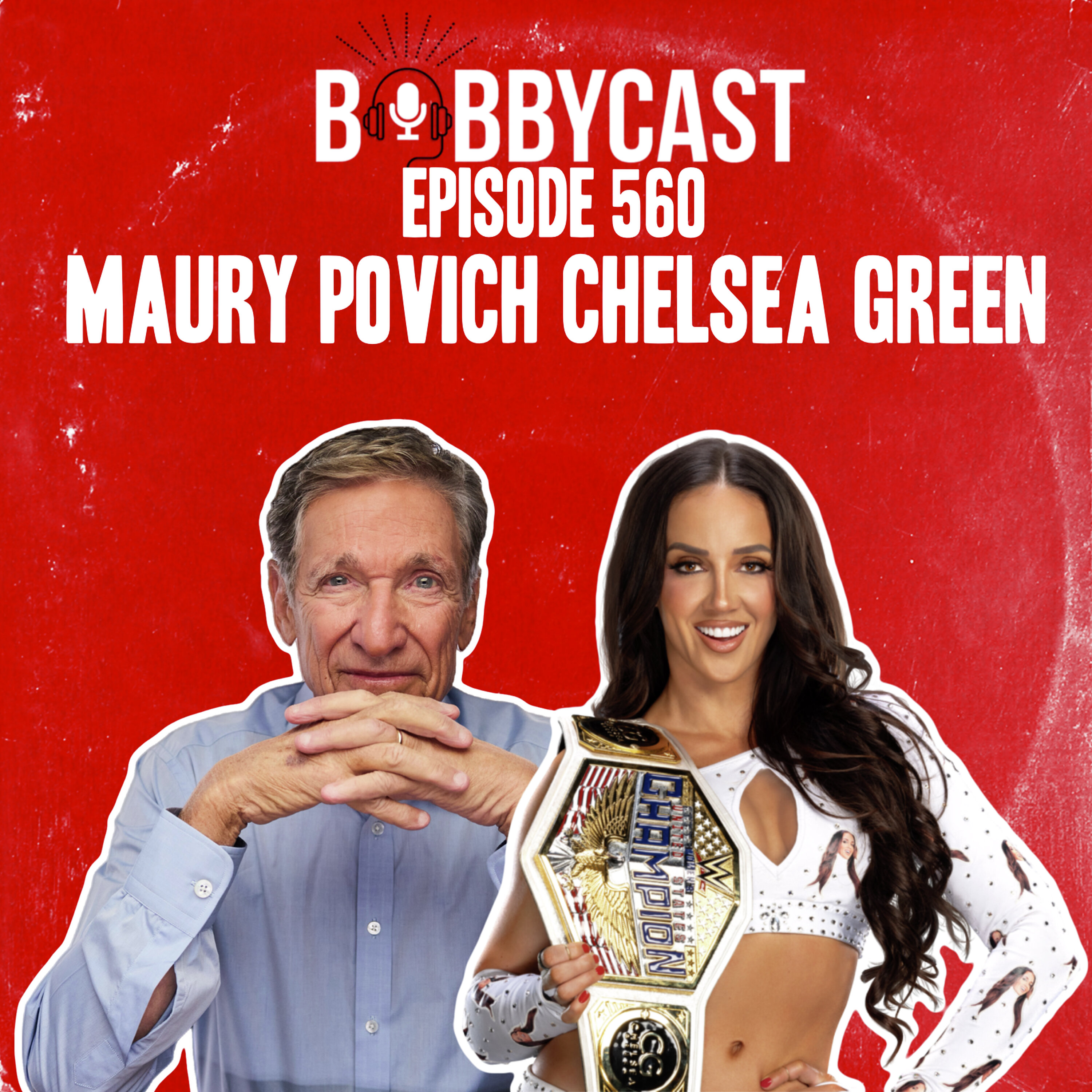
#560 - Maury Povich on “You Are NOT The Father” + Covering Watergate & Martin Luther King Jr. Riots as a Journalist + Why He Still Loves Interviewing People + WWE Superstar Chelsea Green on Carrying Championship Belts Through Airports + The Misconception of Wrestling Being "Fake"
Bobby is joined by TV legend Maury Povich, who looks back on the moments that turned “You are NOT the father!” into one of the most quoted lines in TV history and how that era compares to his early days as a serious journalist. He shares stories from covering Watergate and the Martin Luther King Jr. riots, what it was like being on the front lines of huge historic moments, and how those experiences shaped the way he sees people. Maury also talks about why, after all these years, he still genuinely loves interviewing and what keeps him curious about human behavior. Then WWE Superstar Chelsea Green hops in to pull back the curtain on life in the ring and on the road. She explains what it’s actually like to travel with championship belts through airports, why she refuses to check them, and the physical and mental grind that comes with a job that has no real off-season. Chelsea and Bobby get into the biggest misconceptions about wrestling being “fake,” the skill and risk that go into every match, and why the stories behind the characters are just as real as anything you’ll see on TV.
Check out On Par With Maury Povich Podcast Season 2 which premieres on Dec 8th on YouTube!
Tickets for WrestleMania 42 at Allegiant Stadium in Las Vegas, are on sale now at Ticketmaster HERE
Follow on Instagram: @TheBobbyCast
Follow on TikTok: @TheBobbyCast
Watch this Episode on Youtube
See omnystudio.com/listener for privacy information.
Available Results
Generated results are saved to the knowledge database for reuse and search.
Extract Knowledge
Pick what you want extracted first. Model, scope, and chapter options appear after a template is selected.
Transcript
00:00:07
Speaker 1: Bobby. In the case of your little baby, you are the father.

00:00:12
Speaker 2: Guess yes, it's me.

00:00:17
Speaker 3: Episode five sixty. We're doubling up, double up.

00:00:20
Speaker 4: Uh uh. Maury Povich.

00:00:22
Speaker 3: We'll talk to him for half hour and then we'll get over to Chelsea Green after that. I can kind of tell you a bit about both, but I'll do Maury first. I mean, Maury was what would be on all the time if you happen to be at home in the daytime on a weekday when you were a kid.

00:00:36
Speaker 1: Yeah, I was a kid.

00:00:37
Speaker 4: I didn't know what was going on, but I watched it.

00:00:38
Speaker 3: Yeah, for the most part, about thirty percent I had no clue. Twenty percent I thought was kind of bad. I was like, oh, I shouldn't be watching this, And the other fifty percent I got. But yeah, it was interesting because he was one of those that was kind of like the heyday of daytime talk where it was obviously Oprah and then she kind of elevated, and back in the day it was Phil Donna who way back in the day, Sally Jesse, Maury, Ricky Lake, like, there were like seven or eight of those guys. Jerry Springer ended up coming about it was the golden age of those daytime sit down in the studio talk shows that ended up just getting big ratings because they would do things like You're Not Father. That's what Maury now has known most for because the clips are going viral again and then people are also like recreating them. And so I can read you a little bit about this because I really loved talking with Maury. I don't know he was eighty years old. Yeah, he's with it. He's one of the most with it eighty year olds I think I've ever talked to. Because we were talking with him and before we started, I was like, oh, man, this is gonna be cool because Maury is like a big part of my television childhood viewing, and he's pop culture, big part of pop culture.

00:01:48
Speaker 4: But I was like, guy, it's kind of old.

00:01:49
Speaker 3: May have to like help him through it. Didn't have to help him through it at all. He was even dressed in golf gear as we were doing the interviews, so you knew he had been out on the course before that. So Maury Povich, the King of talked TV, is back. He's got on par with Maury Povich Podcast season two and you can check it out. He has such a history in journalism his dad, and he talks about this was the Washington Post for seventy five years. And then Maury ends up, you know, being really serious in journalism, like he covered from Martin Luther King that that I had a dream speech to Nixon too.

00:02:28
Speaker 4: I mean, he had done it all before.

00:02:30
Speaker 3: He had just kind of backed into doing daytime television.

00:02:33
Speaker 4: And we talked about that story. But Early enjoyed this.

00:02:36
Speaker 3: So we're gonna get to Maury and then after that we'll talk to Chelsea Green, who is if you watch the Netflix series what was that even called if Unreal? Yeah, it's where they showed you behind the scenes. I feel like that really made Chelsea Green look relatable and like normal, right, that's all I became a fan, Yeah, because it was just somebody who worked hard, did everything they asked, never really got a look, kept getting injured, and kind of the fans were undeniable in their cheers for her, so they had to like elevate her.

00:03:05
Speaker 4: That would be my interpretation. What's yours?

00:03:06
Speaker 3: Yeah, she's also like very over the top, makes it her own gear.

00:03:11
Speaker 4: Oh yeah, she's the one that made her own stuff. Huh yeah, with her pace on it. That was funny.

00:03:15
Speaker 3: She was like, I'm waiting for the perfect time in that series, yeah, to wear this, and she had. Yeah, she plays a villain for the most part, but people like her so much. It's like back in the like the uh NW days, like they made it to be a bad group, but then they were just so cool that everybody liked them.

00:03:30
Speaker 1: Yeah.

00:03:31
Speaker 3: So Mari Povich first, and then we're roll over to Chelsea Green. Thank you guys for listening. You can watch all these videos too up on the channel at Bobby Bone's channel. They'll be separate videos, but you can check those out.

00:03:43
Speaker 4: And here we go. Hey, Maury, good to see you, Bobby, nice to be with you.

00:03:48
Speaker 3: Hey, I'm a massive fan for a long time, so this is really cool for me. So I just want to say that upfront, congratulations on the podcast. We were talking about you before you came on, and I my assumption is everywhere you go, people yell at you you are not the father or something like that everywhere you go.

00:04:04
Speaker 1: Or they want me to give them an autograph to say they're not the father.

00:04:07
Speaker 4: Oh you have to sign that.

00:04:09
Speaker 1: Oh of course, you know. Hey, Jimmy, you are not the father or you are the Father.

00:04:15
Speaker 3: That's funny when you were doing those episodes specifically, Yeah, could you tell culturally that was cutting through at the time.

00:04:22
Speaker 1: You know, I'd never thought about it, but uh, I uh. When I used to go to events, it's amazing. My wife Connie Chung, you know, and so we go to these media parties and everybody would want to, you know, surround Connie and talk to Connie. And if I wanted to be noticed, I'd go to the kitchen and then everybody in the kitchen knew who I was.

00:04:52
Speaker 4: That's funny.

00:04:53
Speaker 1: Then I knew then, I knew I was cutting through to the real people.

00:04:58
Speaker 3: Whenever I think about your history, you know, and I think something that a lot of people maybe don't appreciate now as much as they should is your history of covering like some major events before we knew you in daytime television. You know, I think about like Watergate, and sure, and not to jump off it's something super serious now, but you know, as Watergate was happening then, do you are there parallels to now what's happening now with like Epstein et cetera.

00:05:23
Speaker 1: No question, what it's all about is the abuse. Back then, it was the abuse of Richard Nixon and all of the underlings under him, Robert Haldeman and John Erlickman, the chiefs of staff and the number one counselor, and all these people played a role in Watergate, and now you're and if you looked at those three people, Nixon, Erlickman, and Haldeman, back then they were all angry looking people. And my issue, one of my big issues is day is so many people are angry. I mean, it doesn't matter what where you are on the political spectrum. There's just a lot of anger around, a lot of cynicism and negativity, and you know, it's just it's just rough.

00:06:16
Speaker 3: Do you find that there are parallels between And again, I wasn't there for like Watergator for in the seventies, for the protests in Vietnam? Because to me, this feels like the worst time ever. Now as someone who covered it as closely as you did, you were in it, Are they similar?

00:06:36
Speaker 4: Is it worse? Is it more toxic now?

00:06:38
Speaker 3: Because of the ability to have social media and connect with people.

00:06:41
Speaker 1: It's all about government abuse all right. Now. Back then it was you know, solely in the White House, that's where the abuse came. Now, I mean, you see it a lot of places. I mean a lot of agencies. I think when we all cut back on the uh, the budgets of all these agencies where and people are hurting and and the tariffs are hurting people, all kinds of the deportation in a way is hating people hurting people. And so it's more widespread now. Before it was kind of contained. Uh, I don't think it's contained these days.

00:07:24
Speaker 3: Yeah, the political environment is something that I get exhausted just keeping up with.

00:07:31
Speaker 1: It's just terrible. I mean, uh, I mean, you feel that you're drained by noon. If you're if you're looking on you know, on on, not even social media, if you're if you're reading newspapers online, if you're if you're looking at CNN online, if you're looking at Fox online. It doesn't matter, you're You're right, you're exhausted by noon. And uh, I just uh, it's rough. I'll tell you one thing. With me and my life, boy, we're not We're glad we're not in that end of the business anymore. And that's it's it's it's rough out there in media, and it's rough, not only trying to cover things, but I mean Unfortunately. I think there's been a tilt in terms of opinion and news, and it's tough to separate what is actual news and what his opinion.

00:08:27
Speaker 3: Yeah, I feel like there was a journalistic standard at some point that the word standard isn't that. That's not even in our vocabulary anymore.

00:08:34
Speaker 1: Now.

00:08:34
Speaker 3: It's just can we get clicks with sensational headlines with opinions or I should say, it doesn't seem to me that there are standards of just presenting the news in an unbiased way.

00:08:45
Speaker 1: It's very tough. Look, my father was the sports columnist of the Washington Post for seventy five years. I mean, the Washington Post was like the Bible to us. I read the Washington Post today and I got to think, you know, that headline really wasn't, you know, objective, fair news, that story. That story should have been analysis, it should have been opinion. It shouldn't have been straight news, forward, straightforward news. So at the New York Times, I questioned them as well. I question everybody these days. It's very tough. I'll tell you, Bobby, there's one area of news, and you'll under the saying this because you work in local stations around the country, local journalism is treated by the community as a trustworthy enterprise. People trust local journalism. I don't care if it's on TV or in their local newspapers. People trust what is happening in local news in terms of whether it was a fair coverage of a story.

00:09:55
Speaker 3: And I agree with that for the most part, until you get to like when these local TV stations are bought by the same company and then you see they're all being fed the same thing.

00:10:04
Speaker 4: To say, that's.

00:10:05
Speaker 1: True if the parent company has has an acted the grind, or the parent company has a particular formula that they want every station to enact, that's different. But I look, I worked at local stations all across the country in the twenty five years before I ever did Current Affair and the Talk show, and I've never ever had a news director tell me how to cover a story.

00:10:35
Speaker 3: I feel I shouldn't know who the SEC chairman is, and I feel like I shouldn't know that they're political.

00:10:40
Speaker 1: Well they are.

00:10:41
Speaker 3: I mean, it shouldn't be a thing that I should know about. It should be such an a political position exactly.

00:10:46
Speaker 1: I mean, for the President of the United States to mention yesterday the FCC, the head of the SEC when he was berating an ABC reporter for asking a question. I mean, really, I mean the FCC all my I mean, in the sixty plus years I've been in this business, they never had any kind of presence the way they do now.

00:11:12
Speaker 3: Yeah, I got fined a million bucks by the SEC once. And not only that, it wasn't political. I don't even know who the chairman was. And you're right, whenever the FCC is like jumping in in lockstep with any with anyone, it just feels like it's systematically against someone at all times.

00:11:30
Speaker 4: And so it's a weird environment.

00:11:31
Speaker 3: And again, I just respect where you come from because with you, you know, Watergate, MLK, the assassination of MLK.

00:11:38
Speaker 4: How close were you to that?

00:11:40
Speaker 1: Well, what I was close to were the the Aftermats riots in Washington, DC and the way I saw our town. I mean, look, I covered the anti Vietnam demonstrations in Washington, and I've covered a lot of demonstrations in Washington. Never saw riots, never saw whole blocks burned down. And that's what happened after the Martin Luther King assassination. And the interesting thing is one of the first stories I ever did on radio when I was a radio reporter, was his famous speech from the Lincoln Memorial. I was covering it for a local radio station, and my job was to cover all the way down at the end of the mall as far away as you could. I had to cover the counter demonstration by George Lincoln Rockwell in this American Nazi party, all of which there were ten demonstrators and fifty cops. And I could just hear King's speech and the loud speakers all the way down at the Lincoln Memorial. But at the aftermath of his assassination, I mean, I mean they came so I mean they came so quickly. I mean, King is assassinated in April, Bobby Kennedy is assassinated in June. I mean reminded me of Charlie Kirk, same thing. I mean, it's all of this political heat boiling over, and that's what happens.

00:13:15
Speaker 3: Do you feel like you've seen the cycle happen enough times you can almost predict a cycle where it's a pendulum and politically somebody comes in in the opposite and then this happens, Because again I see similarities, but I don't. I wasn't there at any point to see any sort of cycle.

00:13:30
Speaker 1: It's there that we're talking about the nineteen sixties and the nineteen seventies, where there was a lot of upheaval starting with the assassination of John Kennedy in sixty three all the way through Watergate in seventy four in Washington. You covered those events. I mean that was a lifetime, a lot of a lot of coverage today. I mean it's similar. You're right, Bobby, it's similar. There was an EBB and flow back then. In other words, there was this event, then it was over. Then the riots were there and that lasted for about a month, and then it was calm, and then some other event came. Today, it doesn't look like the meter ever goes down. Yeah, I mean it's up all the time.

00:14:22
Speaker 4: Yeah, it's always hot.

00:14:24
Speaker 3: You mentioned your dad earlier in seventy five years, which means he was embedded into sports. Did you get to go to any iconic sporting events with your dad as a child.

00:14:33
Speaker 1: Oh? Yeah, I mean I kind of grew up at his knee. It was in every press box that he ever was in. I started as a sportscaster in nineteen sixty two on radio, and I couldn't get it. I wanted to write, but the Washington Post had a nepotism policy. You couldn't if you were a member of the if you remember the family, you couldn't get a job there. So I kind of gravitated early when I was seventeen eighteen into radio and television and then television. Yeah, we were at boxing. We were at Sugar Ray Leonard and Marvin Hagler fight championship fight in Vegas together. We were at the famous, maybe the greatest fight of all time, Muhammad Ali and Joe Frasier in Madison Square Garden, and so there were several events we were at when I did watch. I mean, he was really a great wordsmith, and his closest buddy in covering sports was Red Smith, the great columnist for the New York Times. And these two guys would be the last guys in the press box putting out their column for the next day. Every light was dark except the light in the press box, and they would they would be there and they're typing, and you know, and they're old typewriters and as if they were bleeding trying to get the right phraseology.

00:16:10
Speaker 4: Did your dad ever not want you to do what he did.

00:16:13
Speaker 1: One time, I did this show called A Current Affair. It was the first big tabloid journalism show. And Tom Shales was the media critic in the Washington Post and he was a Pulitzer Prize winner, and so he wrote. He wrote a brutal review of me and my show. He used every s word in the world, smarmy, sordid, snarky, you name it. So I called up my father and I said, you know, Dad, don't show this to mom. Uh, you know, this is really brutal. He just really took me on. He said, oh, don't worry about son, just go about your business. I said, well, you know, he says, well, you know I helped to hire Tom Shales here at the Washington Post. I said, yeah, Dad, but I'm your son. He says, yeah, son, but good writers are hard to find. That, I mean, that says it all about journalism and my father. That was the most important thing in his life.

00:17:15
Speaker 5: Let's take a quick pause for a message from our sponsor. Wow, and we're back on the Bobby Cast.

00:17:29
Speaker 3: But with your podcast, obviously you're talking to folks and getting their stories.

00:17:34
Speaker 4: If you were to look back at your career.

00:17:37
Speaker 3: Who are some of those folks that you talked to that you you would get super excited to talk to.

00:17:41
Speaker 4: Because it was it was rare air to be with that person, You.

00:17:44
Speaker 1: Know, Bobby, It's very interesting. I always fashioned myself as a storyteller. It didn't matter at what role I was having in my life, whether I was a straight news reporter, news anchor, everything. I always felt myself as a story teller. And I learned that from my father, and as I moved through my career, I felt that every single story on my show was unique. Even though I did thousands of DNA tests and thousands of live detector tests, I found that each story was unique, and so I treated it that way. And I feel that that was the connection that I was able to make. Look, I know when I started to do my talk show, until I ended these talk shows, that's thirty one years later, there were seventy five talk shows in the cemetery that didn't work. And I knew a talk show worked when a host or hostess whatever could make a connection with that audience. It was like it was like an election. It was a campaign. You had to knock on a door, they had to open it, They had to invite you in. You had to become a member of their family. Only the successful talk show hosts were.

00:19:02
Speaker 3: Able to do that, to jump in front of the camera full time. Was it someone that gave you that push or was that just the next step?

00:19:08
Speaker 1: Radio is a big part of your life. I will tell you that. In nineteen sixty two, when I got out of college and I wanted to get into the business full time, I had been an assistant producer for the radio television broadcasters from the Washington Senators baseball team. I wanted to get into the business. You can't get a job in the business unless you have experience. And if you don't have experience, how do you get into the business. So I got into the business as an assistant publicity writer at a five thousand watt radio station, and I hung around the newsroom to the fact that the newsroom direct, the news director thought I was a pest and made me a reporter. And to get into television back then, there was no one in television back then who had not been in radio. For think about that, I mean everyone, I don't care whether you're in the news business or you were in the everybody had to be in radio first. In order to graduate to television. So for me being in radio, the only first job I ever got in television was the sport doing the being a sportscaster on the ten o'clock news at the now Fox station in Washington, DC. And that's how it all started. And then within three months they wanted to do this big three hour a day talk show way before CNN, way before cable news. It was kind of the news of the day, three for three hours a day, and it was a three person anchor desk, and I was the only and they looked around and the only person who grew up in Washington was me, So I was hired for that. So I was a sportscaster and a talk show host within three months of nineteen sixty six.

00:20:57
Speaker 3: Did it ever with your syndication and like your national Rea, were there moments where like you thought it was over but miraculously something happened Or was it just steady growth the whole time?

00:21:07
Speaker 1: No, it was it was serendipity. I'm anchoring the local newscast in Washington, d C for the now Fox station, the ten o'clock news. All of a sudden, this crazy Australian named Rupert Murdoch buys my station and the other metro media station, and those become are the Fox O and O's. This is before the Fox Network, way before the Fox News Channel. This is what he had. I get a call three a year later that he bought it. In nineteen eighty six. I'm supposed to come to New York see mister Murdoch. He wants to talk to me. I had never met the man. I go to New York. He looks at me and he says, I have this idea for a show. I said, you know. He says, it's called a Current Affair. It's going to be all the stories that the regular network news departments won't air. Those are the stories we're going to air. Rupert Murdoch had this great ability to see an undeserved public, a public that was underserved, and so he tapped into that, and this tabloid news show became the biggest hit in prime time access between seven o'clock and eight o'clock in the country. And Murdoch and that I mean, he told me. He says, well, if this show doesn't work out, you'll go back to Washington. And meanwhile, you just got married. You live in Washington. Your wife lives in New York. Maybe you'll find out if you could live together.

00:22:44
Speaker 3: It seems though that is a bit what he did again with this version, exactly Fox News.

00:22:50
Speaker 1: No question, Fox News. I mean, it was all Murdoch. He saw an undeserved huge amount of the public that he felt weren't getting what they wanted, and he gave it to them. And he's still giving it to them. And that's, you know, twenty five years later.

00:23:10
Speaker 4: How do you do have an interest in people?

00:23:11
Speaker 3: I mean, I feel like you've talked with everybody about everything, and yet here you are still doing it.

00:23:16
Speaker 1: Well, I tell you, it's very interesting. Everybody says, you know, you're well in your eighties, and I said, look, I'm still curious. I'm still curious. I have a curiosity. I want to know things. I want to find out things about people. I mean, we're starting this second season on this podcast. I had so much fun, Bobby, this is the stretch of the people I had. Alice Myers, this unbelievable content creator. Never heard of her in my life, fascinating person who has all of these followers. I did Leanne Morgan, Okay, you know, Leanne Morgan, I do yet she's one of the biggest comedians going. She's sixty years old from this little town in Tennessee. You ever watch the show Billions?

00:24:05
Speaker 4: I know it well.

00:24:06
Speaker 1: Wags of all the characters in Billions. Wags this guy who's been playing these character actors in Breaking Bad and in Better Call Saul, David Costable and so William H. Macy. Okay, anybody's seen Fargo? Anybody seem shameless? William H. Macy is a great story. I love this stuff.

00:24:30
Speaker 4: I love it. What do you find? The through line is of very successful people.

00:24:35
Speaker 1: I think, more than anything else, when they lose, they bounce back. The greatest fear anybody in my business would ever have is being fired. I go to Los Angeles. I'm the second banana to my wife, who's the big star out in Los Angeles at the CBS station. I'm hired by a guy. Six months later, he's gone. The new general manager fires me. Eight months into my job. I thought I was I thought I would die. I mean, and then guess what I still have. I still have all of my my digits. I have my legs, I have my arms, I got my hands, you know. I lie down on the couch I'm walking watching newscasts, and I'm saying, you know, I think I'm just as good as these guys. I I think so, and so I end up three months later getting a job in San Francisco at the ABC station. And so I think, with actors, how about all the additions they lose, how about all the auditions that they go to and they don't get it, you know, and they keep going, they keep going. How about al Pacino in the Godfather, when the guy didn't even want him there, wanted to throw him out. Robert Evans, the head of Paramount, wanted to throw him out, didn't want Coppola to getting koppel insisted. I just think, even even when others kind of bitch and moan about you and criticize you, I've always, for some reason, it's always kind of washed off my back.

00:26:16
Speaker 3: In season one, you did Pablo Torre, who I'm a big fan of.

00:26:19
Speaker 4: Because here you are.

00:26:21
Speaker 3: Yeah, he and I thought the episode was great, and he is an investigative journalist, like he's old school but young in new school.

00:26:26
Speaker 4: What did you like about him?

00:26:28
Speaker 1: First of all, he's so smart, and I also feel honored because he said to me, he says, you've been in this business. What is going to happen? Because I'm getting a lot of blowback, and I said, well, here's what's going to happen, Pablo. The NFL is going to get on you, and and the problem is that, I mean, the NBA is going to get on you. The problem the NBA is going to get on you. And the problem is are you going to lose your sources? And the key is obviously you had sources who were executives, if not owners of NBA teams. You can't allow those sources to dry up just because you're being called out by a lot of people. And secondly, I know if the NBA is going to have an investigation, that law firm is going to be calling you and they're going to be asking you, you know what. As a journalist, they're going to want to know who your sources are. And you always have to protect your sources. So we've had a back and forth for many months now. I just I have so much fun with him. Do you know what he and I did that you might not know about? You know who Nick Cannon is.

00:27:53
Speaker 4: I do know Nick Cannon, but I don't know what you're talking about.

00:27:55
Speaker 1: Nick Cannon has a podcast. It's called We Plan Spades, and we played spades. Pablo Tory and I played spades against Nick Cannon and his co host and we beat the hell out of him.

00:28:11
Speaker 4: That's funny. You go to his house and take his Yeah, that's good.

00:28:14
Speaker 1: It was great, and Pablo was great. Connie and I just did a just did another episode of Pablo. I mean, I've I've been on Pablo's podcast maybe two or three times now. And Connie loves him. Connie loves him because he's smart. And he went to Harvard.

00:28:32
Speaker 3: I know a golfer when I see one. Mostly I saw your foot Joy. I saw your FJ Yeah yeah, as a golfer myself, I spotted him out really yeah yeah, oh you're a big golfer.

00:28:42
Speaker 4: I am all right. Did you play today?

00:28:44
Speaker 1: How'd you know? I did?

00:28:47
Speaker 4: I saw the foot Joy.

00:28:49
Speaker 1: I walked in to be with you in a half hour before I just finished up.

00:28:53
Speaker 4: So what do you play? Do you play nine eighteen a day? Do you live on a course?

00:28:57
Speaker 1: No, I don't live on a course, but I live like I'm in Florida these days. I left twenty minutes away. My wife always says to me, I don't understand it, Maury. You go find a golf club and then we have to find a house. I mean, why is it that way? I mean, so we spend some of the winter in Florida, and I belong to a course here. We've been living in Montana for the last twenty six years. Twenty eight years. Actually, I have two little courses there I play. I have a course in New York because we still have a place in New York. So I mean, I never played golf till I was thirty. I never had a lesson until I was fifty. My wife researched it at fifty. As a birthday present, she gave me this coach teacher. His name is Peter Costas. He used to be on the CBS golf broadcast for thirty years. He's a great teacher. And my wife says, well, this guy is like the golf god. And so now for the last thirty six years, I've been following Peter all around the country, and she calls him the golf devil.

00:30:15
Speaker 4: How many hole on ones.

00:30:16
Speaker 1: I've had two? Man, I never had one until I was maybe, oh maybe fifty five or sixty.

00:30:24
Speaker 4: Tell me about the first one.

00:30:25
Speaker 1: It was at Hollywood Golf Club in Deal, New Jersey, a great old course, the Walla Travis Courts. His signature hole is this short par three uphill, all surrounded by by bunkers, and it's just one hundred and fifty yards. And I was a member there for twenty five years. And I just hit this shot. And the good news was that we had a foursome, a forceome up on the green was letting us play through. So they were like eight or wow wow yeah, And so I never saw the ball go in the hole. And before that I always said Ben Hogan never had a hole in one competitively, and his excuse was that he said he never aimed at the pin, and so I was using that excuse until, of course I made a hole in one.

00:31:18
Speaker 4: What's your handicap?

00:31:21
Speaker 1: Well, I'm very upset. My handicap now is five point five. It was six months ago it was three point five. So now you see how upset I am about life. I mean I've been I've been scratched once in my life. I played Costas got me so good that I played. I qualified for the United States Senior Amateur. I made match play in the United States Senior Amateur I played the three British Senior Ameters. I was really good when I was about fifty five to sixty. Ever since then, it's just moving up a tee.

00:32:03
Speaker 3: If you're if you're a five handicapped Morey, that's pretty freaking good.

00:32:07
Speaker 4: That that's that's really awesome.

00:32:09
Speaker 3: Well, I don't want to keep you any longer, but I am a massive fan of like the different version, like the different I feel like you had different sections of your life that all were very instrumental in different ways, and I think that that's what I'm a fan of, of the different ways that you were able to a make a difference or be cut through and sometimes at the same time. But even like you're talking about even with like your your talk show, like you were cutting through and you were doing in my opinion, with that show what you talked about was happening with the idea of a current affair or Fox News like you were doing that. You were finding the underserved and actually giving them something they could relate to.

00:32:48
Speaker 1: You.

00:32:48
Speaker 4: Do you think that's that's correct?

00:32:49
Speaker 1: You know, I never thought of it that way, but you're right, I mean, and I you know, I'm kind of proud of that. I mean, I. I mean even today, it doesn't matter I see a caddy. Oh, I grew up watching you. I mean, in fact, I have a great caddy story in terms of the show. So a friend of mine said that he was he always hung out in the caddy shack where the caddies at the golf course, and there was always a TV on, and he's just listening and one caddy sand or the other. You ever had that situation where somebody accuse you of being the daddy and their kid and the guy says, oh, yeah, yeah all the time. He says, well, what do you say? He says, I tell him all the same thing. I ain't the daddy till Maury tells me I'm not.

00:33:35
Speaker 4: Okay, I'm going to let you go.

00:33:37
Speaker 3: But oh so I'm about to have my first child. My wife is pregnant.

00:33:42
Speaker 1: Oh wow, boy, here we go.

00:33:44
Speaker 3: Yeah, yeah, yes, I have to. I wasn't gonna do it, but I have to do it. So I am the father. So do you mind, Mary?

00:33:49
Speaker 1: Oh yeah, but but do we have a name.

00:33:51
Speaker 3: We don't have a name or agender yet.

00:33:53
Speaker 1: Okay, Bobby, in the case of your little baby, you are the father.

00:34:03
Speaker 4: Yes, yes, it's me.

00:34:06
Speaker 3: All right, Maury, I love your podcast again, I love the history of Maury and hope everybody checks out on par with Maury Povitch. Season two is coming out, but go look, go go listen to season one. I know season two is coming out, but I want to encourage everybody. You had some really great guests in season one. I was a specially Lewis Black and Pabulatry were two that I really loved, and so thank you for your time, and I hope, I hope you have a great rest.

00:34:28
Speaker 1: Of By the ways, Lewis Black addicted golfer, Yeah, addicted.

00:34:32
Speaker 4: You can always you can tell.

00:34:33
Speaker 3: It's a look we have, Maury, it's a look we have. Have a great rest of the day, and hopefully we'll cross paths sometimes.

00:34:40
Speaker 1: Bye, Maury, appreciate it. Bye bye.

00:34:43
Speaker 6: The Bobby Cast will be right back. This is the Bobby Cast.

00:34:57
Speaker 1: All right.

00:34:57
Speaker 3: We're gonna go now to WWE Superstar Chelsea Green, which if you watch the Netflix series on the WWE, which was kind of that docu series, that's where I really became a fan of her. I already knew her from wrestling, but I just knew her as somebody who had a big personality and was kind of the villain.

00:35:10
Speaker 4: It was somebody who lost all the time.

00:35:11
Speaker 3: They kind of just set her up to be big and then to get beat up and now not so much. Because while we're talking to her, she's holding two massive championship belts and I felt like they were a bit heavy. Yeah, I felt like she wanted to put them down, but she was like, I'm not putting these championship belts down. WrestleMania forty two tickets are up now WrestleMania Saturday, April eighteenth and nineteenth in Las Vegas, and go over and get the tickets. They went on sale a few days ago, but you can get your tickets now. But here she is. Follow her if you want to see what she looks like, just go to Instagram. Chelsea Green but a big fan. Here she is Chelsea Green. What belt is one of those attag team?

00:35:47
Speaker 4: Which one is that?

00:35:48
Speaker 1: Yep?

00:35:49
Speaker 2: This is oh wait no, this is a tag team and this is the United States Women's Championship belt.

00:35:54
Speaker 4: Do you carry those with you everywhere you go?

00:35:57
Speaker 2: Of course?

00:35:58
Speaker 3: How do you get them through the I mean I'd be afraid that, like one of the screeners at the airport would be like wanting to wear it and take a picture.

00:36:04
Speaker 4: With it or something.

00:36:06
Speaker 2: Yeah, they do.

00:36:06
Speaker 3: I love it, Like do you You don't check it though?

00:36:10
Speaker 1: Right?

00:36:10
Speaker 3: You take it? You carry it on.

00:36:13
Speaker 2: I carry it on because God forbid, Yeah, God forbid it goes missing.

00:36:17
Speaker 3: Can you imagine what's the role on if you are the champion and I've seen how they remove the names on the sides of the belts, right like it's like a ceremony.

00:36:27
Speaker 2: Yeap, the name plates are here.

00:36:29
Speaker 3: So you don't get to ever keep the belt. Can you ask for a replica belt if you've been the champion and then it's gone.

00:36:35
Speaker 2: Yeah, yeah, absolutely, I've got We've got all of our replica belts. Some of the replica belts will actually come from the WWE shop and are they're sold and they are amazing. And then others we actually get made from the belt maker, the original belt maker.

00:36:55
Speaker 3: I think that would be cool to have those. I have a belt. It's obviously I didn't wrestle. Well, I did the Major League Baseball Celebrity Softball Game and I was MVP, and they gave me a WWE belt and on the sides it has the specific event and so I have that out, but I think that would be so cool to have like all the belts from all the championships that you've won.

00:37:15
Speaker 2: No, it's so cool. And I actually so I just won this. Wait this, man, this has really screwing me up here having two belts. I just won this one for the second time. And I texted my husband. I'm like, like, what's the rule here? Do I have to buy another belt? Or like how did this work?

00:37:32
Speaker 1: I don't know.

00:37:32
Speaker 2: I never expected this.

00:37:34
Speaker 3: Yes, I think you need a second one. So I'm a big fan for a lot of reasons. And I think, to me, what I thought was really cool about you was how much Netflix showed like your work ethic whenever they did the series, Like, aside from your athleticism and your background or how great of a wrestler you are, I think it showed why people root for you. How did you feel about once you saw what they edited, and how'd you feel about what was aired?

00:38:02
Speaker 2: So when they called me, I'll never forget I was in the Salt Lake City airport. They called me and asked me if I wanted to do it, and I was like, look, I will absolutely do it, but I'm not going to edit myself, like, you guys need to edit me, because if you want me for the reasons I think you want me, which is my openness, my candidness, my willing to just you know, talk about like whatever. I'm not afraid, as my fans know, like I'm not afraid to say how I feel. I was like, you guys are gonna have to edit me. They said, no problem, We're not going to hold anything against you whatever. I film for months on end and then I forget about it, and then it airs and I was sitting on a plane next to bron Breaker and I saw him watching it, and I was like, oh, I just can't do it, Like it's so cringey to watch myself. And I don't ever want to change who I am. I am because I've seen myself and I gave myself the ick because I've done that before. And it's the same reason why I don't watch myself wrestle. I don't watch myself do promos like I just I like how I am on camera and how people perceive me. I don't want to change myself because I'm judging myself. And then I started doing media and I realized really quick, if I don't watch this episode of myself. I'm not going to know what I'm talking about. And so I watched it, and I was so pleasantly surprised. I felt like, besides the fact that it could have been so much longer, that you know, we had months of footage and months of just like other stories that we could have put in that episode. I thought it was totally me. It was the relationships I have with everyone. It's everyone, you know, talking shit to each other, and like nobody has to be serious around me. Everyone can say what they want. And my family was there and you know, showing kind of the I mean a little bit of the trials and tribulations we go through as wrestlers, and my story. It was just, yeah, it was really cool. They did a great job. It's like they know what they're doing.

00:40:04
Speaker 4: Yeah, I know.

00:40:05
Speaker 3: I think the thing that made me like it for you the most was it made you likable because of the hard work that obviously you've put in all the injuries setbacks, and not only that that, like how your performance and the crowd reacting to it is really what put you over more so than it seemed like just a person going I now, deem you to be the one. It was like the people were able to do that for you.

00:40:30
Speaker 2: It's funny because I worked so hard for the past almost twelve years to get to WWE. Now that I'm here, I realize, thank god I didn't get here in twenty fourteen. Thank god it took me this long, because that is why the fans are behind me. They know my story. They followed me getting fired multiple times. They followed me, you know, not winning tough enough. They followed me when I was on the independent scene and struggling and trying to come up with these characters or at TNA as the hot mess, and that is why they want so badly to see me climb this ladder because I'm not the chosen one, and it's very obvious I'm not the chosen one, and I like that for me, but for years I wanted so badly for that to be me.

00:41:19
Speaker 3: I have friends that are massive country stars now and they will talk about specifically shows where they played for six people, and it's crazy to even watch the videos because now they've played to arenas or stadiums. When you were wrestling independent, Are there any shows you can think of where there were you know, seven, ten twenty people in the crowd.

00:41:36
Speaker 2: Okay, there's a show. There's a show in Calgary, Alberta kind of in a rough part of town in Calgary, and Mike, Calgarians will know. It's in the northeast.

00:41:48
Speaker 1: They know.

00:41:51
Speaker 2: And a guy, an old old man, was wrestling before me, and I was watching and I saw his old wrinklely balls come out of his trunks, and that was a moment that I thought, what in the hell am I doing here? I don't belong here. I'm too good for this. Get me out of here. And that's something that I will, you know, take with me forever. When I go out there on you know, on a WrestleMania stage, or I fall off that ladder at money at the bank, I think about that man's that man's old wrinkly balls.

00:42:26
Speaker 3: Yeah, wrinkly scrout, I'm gonna do it. It really change your perspective on where you are in life. So athletically, there are stories of like Lebron or you know, even some guys that I work with that are athletes that invest a lot of money into their body because that's their tool. Like, so what are you what are you doing like physically to make sure you stay healthy.

00:42:49
Speaker 2: So I've been really I've been obsessed with personal training, diet, exercise, all that stuff since I was probably fourteen, and then I went to school University of Calgary for kinesiology, So that's kind of ingrained in me. No matter what, I'm always going to be a somewhat healthy eater. I'm always gonna work out for my mental health. It's second nature to me. But I think what I've learned being on the road so much in the past three years. You know, I have not been home this month. I've been on the road, and as any WWE fan knows, we don't have an off season the way that the NFL, the MLB, you know, the NHL, whatever have We don't have. That routine is really important and I've learned to find that in traveling. I've learned to find, you know, a routine when I get to my hotel room, a good sleep pattern if I can find one, and just those things the comforts of home while I'm on the road that make me feel grounded, well rested, and just keep me sane because it's tough, you know, being away from your own shower and your own bed, and your family and your friends and still looking the way that people expect you to look. Performing at a very very high level. It's hard. It is very hard.

00:44:20
Speaker 3: I'm going a walk in boot now and I've been on a scooter the last couple of weeks because that ankle surgery and a little bit of that's mess with my mind because I am a pretty active person. Like mentally, it starts to like affect me to the point where it's like, man, am I starting to get depressed because I can't do anything except lay in the bed. But you've been through so many injuries, and when that is your job, Like, was it your mental health? Did you have to really was that a struggle for you?

00:44:43
Speaker 2: I mean, yeah, of course, especially especially when it comes to injuries. I mean, look at mental health. It's going to be a struggle no matter what. And then it's going to be a struggle when you're sleep deprived, or when you haven't eaten enough, or when the pressures of show business are put on you. But it's really tough as an athlete when the thing that you love the most is kind of ripped out from underneath you. And usually as a wrestler, it's not in this amazing fashion. It's something really crazy, like tripping and falling or like you know, we fall on our butt and we break our wrist, which I've done three times. It's not in this glorious fashion of you know, I fell off a twenty foot ladder through a blaming table and everyone was cheering and I broke something. That's not how it happens. It's always the simplest of things. When I had my first injury, it was in India and I broke my collarbone mid match and I actually had to get airlifted to a hospital in India and receive treatment there. I went through surgery in India. That was crazy, you know, But again I was on the Indies. I was able to go home. It wasn't not tough on my mental health. It was tough when I had my first injury in WWE because it was on live TV. It happened, and then I was off live TV and my dream was kind of ripped away from me. And that happened again when I had my SmackDown debut. I broke my wrist on live television just before I was about to qualify for a Survivor series. And you know, seeing this amazing road in front of you, you know, I'm going to do all these things. I'm debuting, I'm going to be a star, I'm going to get a raise, I'm going to be on WrestleMania. I'm going to be the next John Cena. And then all of a sudden, you're stuck at home for six to twelve weeks and you're not doing anything. You're not going to work, you're not filling your cup with you know, doing media or getting hair and makeup done, or doing any of those things that you have been doing every single day for weeks on end. It's really really tough. But I learned with my last broken arm that if you don't have hobbies and things outside of this that you love, whether you're injured or not, you're going to go insane. Because this doesn't last forever. This is show business, and show business is so cutthroat. You need to have other things that fill your cup and that make you whole and that keep you happy.

00:47:20
Speaker 3: You know, growing up and you're doing theater and you you have training and dance and anything creative or anything athletic, like, not a lot of stability there, even speaking for myself doing stand up or doing or whatever whatever it is, they're just not stability. So what is like your family, your parents, What do they think when you say, hey, I want to pursue this career with no stability whatsoever.

00:47:46
Speaker 2: Well, first of all, my parents, my whole family is very They're like very put together, like, for lack of better words, posh. Like you know, my dad is an investment advisor in Canada. My mom works or worked, she just retired at a very beautiful boarding school. My grandma is a posh British woman. They thought I was insane. They thought it was absolutely crazy, it was low brow, it was not what they ever expected me to do. But I think now they realize this is exactly what I was born to do. And you know, it was rough when I was on the independent scene wrestling for ten people and not making money and struggling and all that, when I really did have all the options in the world and I was able to go to school and things like that. Now, of course, I'm twelve years into wrestling, and you know, I'm building my dream home, and I'm married, and I have all these dogs and cats, and I'm able to I'm able to treat them to things that they never expected I'd be able to treat them too, like those are the moments where it's all worth it. But it took a while. It took a while, and my grandma admits all the time that she was so embarrassed to tell her friends at morning coffee that her granddaughter was a professional wrestler.

00:49:14
Speaker 3: That's funny.

00:49:15
Speaker 5: Let's take a quick pause for a message from our sponsor, and we're back on the Bobby cast.

00:49:30
Speaker 3: Dancing with the Stars has crushed and ratings in the past like unprecedented, and you have a dance background, would you ever do a show like that?

00:49:38
Speaker 2: I am so glad that you just asked me that I am. I feel like maybe we're on the same wavelength today. And that's crazy because I have been for the past six months pestering the hell out of Dancing with the Stars and out of our talent relations team. They hear from me every single Friday, whether it's in person or by text. Did Dancing with the Stars call yet? Have you asked Dancing with the Stars?

00:50:04
Speaker 3: Have you?

00:50:05
Speaker 1: Oh?

00:50:05
Speaker 2: Yeah, I know the producers of Dancing with the Stars. I've spoken to Nikki Bella, I've spoken to the Miz. I am planting those seeds. I am watering those seeds. I am fertilizing those seeds. I will be on Dancing with the Stars. It's just a matter of time.

00:50:19
Speaker 3: Okay, So if you really so, I won the show a few years ago, like I won the Mirror Ball, and I know if you want, I know the head of casting, I can literally Dina. I can just text her.

00:50:30
Speaker 2: I didn't want to say her name, but oh, I know Dina.

00:50:32
Speaker 3: I will text her and just put in a good word and be like, hey, I was talking to Chelsea Green, like, I think she would be awesome for the show. If that's not like overstepping. Would you mind if I did that?

00:50:42
Speaker 2: Would I mind? I would pay you. Let me give me your zell. I'll zeld your money to do no.

00:50:47
Speaker 3: I'll seriously, I think you'd be so great on it, and there hasn't been a professional wrestler on it, and I think it would be the first. I think I think it'd be fair because again, you're so performative in your wrestling, and obviously you have a background. I think you will be so good on that show. And before you came on, because that show is ending and it's been a little controversial for me this year, but I wanted a few years back, and I was like, I think she'd be great. So I will text her and just just put you from another side. I will say, I think Chelsea Green would be awesome.

00:51:16
Speaker 2: This is I knew there was a reason I woke up early today. This was it.

00:51:22
Speaker 4: How are you how physically? How are you feeling right now?

00:51:25
Speaker 1: Oh?

00:51:25
Speaker 2: Exhausted, Absolutely exhausted. But I mean I dreamt of the day I was going to be absolutely exhausted from wrestling, and so it's it's a really good feeling to wake up being exhausted because I'm doing every single thing I ever dreamt of.

00:51:40
Speaker 3: When you talk about WrestleMania, we're talking about WrestleMania. Before you came on, we were talking about tickets going on so and even behind you it says WrestleMania Vegas. I mean that's that's super Bowl type stuff, like leading up to it, like being there, Like what's the vibe like at WrestleMania.

00:51:58
Speaker 2: I mean, I don't think there's anything like it. We always compare it to the super Bowl and you know, like the pinnacle of every other sports thing. But I don't think there's anything like WrestleMania. Because we've now not only is it, you know, two days obviously this year it's going to be April eighteenth and nineteenth, but it's a whole week of just everyone being engulfed in all things professional wrestling. And what I love about WrestleMania Week is it's now transcended just WWE. The entire wrestling community bases their year around this week, and so I personally get to see all my friends from other companies and everyone. I mean, I don't get to see raw talent, I don't get to see Maxine Duprix all the time. So of course we get to spend the whole week together, and we get to go to the Superstore and now my hat is going to be in the Superstore this year. And I get to meet all the fans that I've been kind of connecting with online through Twitter and through Instagram all year, and we get to, you know, just like have those one on one moments that I personally think make or break a fans relationship with the sport of professional wrestling, because they all just want they just want to tell you how much they love this. And so to be able to stand in a meet and greet line or a photo op line and have them tell me that it's just like the coolest thing ever. It really is. It's my favorite week of the year besides Christmas.

00:53:34
Speaker 3: I have three very quick, super cliche wrestling questions to ask because I'd be remiss if I didn't just ask these questions. Who's your favorite wrestler of all time?

00:53:44
Speaker 2: Kelly Kelly?

00:53:45
Speaker 1: Okay?

00:53:46
Speaker 3: Secondly, what's your favorite match that you lost?

00:53:50
Speaker 2: First of all, I don't know if you know me, but I've lost every match ever my mom basically a losing streak. I don't know how I hold these championships, but it's something has gone seriously wrong in the back for me to even have these titles. But I digress. I would say the money in the Bank match, where I knew Tiffy was winning. I knew how big that was going to be for her. I love her, and I knew that, besides her winning, me being push off that ladder was going to be the most viral thing on that show.

00:54:21
Speaker 3: So that was exciting to you because you knew, even though you were losing, you coming off the ladder was going to be what popped.

00:54:27
Speaker 2: And it was going to be in the most glorious fashion that Tiffy was going to be able to grab that briefcase after pushing me off the ladder. I knew that the crowd was going to be split between Tiffany and myself, and I had already decided I was going to do that stunt. I was dying on that hill. They tried to say, I don't think you should do it, it's unsafe. I said, I'm doing it. The producers were incredible about pushing and saying like, she's gonna do it. Whether you want her to do or not, She's going to do it. And I made sure that that was the last thing that those fans saw before she got the briefcase, because you know, when you're building a match, it has to go like uh uh ah like that, and if you don't have that, you've done something wrong. And so I knew that that was the best thing for right before the biggest pop of the night, which was Tiffany winning the briefcase.

00:55:22
Speaker 3: Final question, super cliche question, what do you think Jen pop doesn't know about what you do?

00:55:30
Speaker 2: I just think that they don't understand. I think this whole F word, the word fake has been thrown around since the early two thousands, that they don't understand how real it is. I did stunts for movies. This is I don't have patting. I'm not rigged up. I am doing these stunts on my own. I am landing on my spine, on my back, on my tailbone, on you know I'm I'm doing. These are all real, real, live stunts in front of twenty thousand people every week, multiple times a week. And I wish that instead of saying is it fake, they would ask me how bad it hurts?

00:56:16
Speaker 3: Well, big fan, thank you for the time. And I will text Dina as soon as we're done, and that would be super cool. I would love to see on the show because it's so much fun. And I and.

00:56:25
Speaker 2: Then will you come and dance with me on the dance that you have?

00:56:29
Speaker 3: Oh you don't want someone come back?

00:56:30
Speaker 4: You don't want that. I want.

00:56:33
Speaker 3: I literally was like everybody's favorite. But I had no dance experience.

00:56:36
Speaker 2: So I love that.

00:56:38
Speaker 3: If there's a time, if you're on and it's hey, bring someone on. But if I don't make or break your dance, but I'm just like a part of it, I will do it. But I would not trust to you in my hands because you'll hurt something again. And I would feel terrible for that reason, but I'll tell you.

00:56:53
Speaker 2: That I just know that my arm is now metal.

00:56:55
Speaker 3: Okay, Chelsea, thank you for the time, have a great rest of the day, and hopefully I'll see you soon.

00:56:59
Speaker 5: Thank you you all right, Chelsea, thanks for listening to a Bobby Cast production.

00:57:11
Speaker 2: Mm hmm