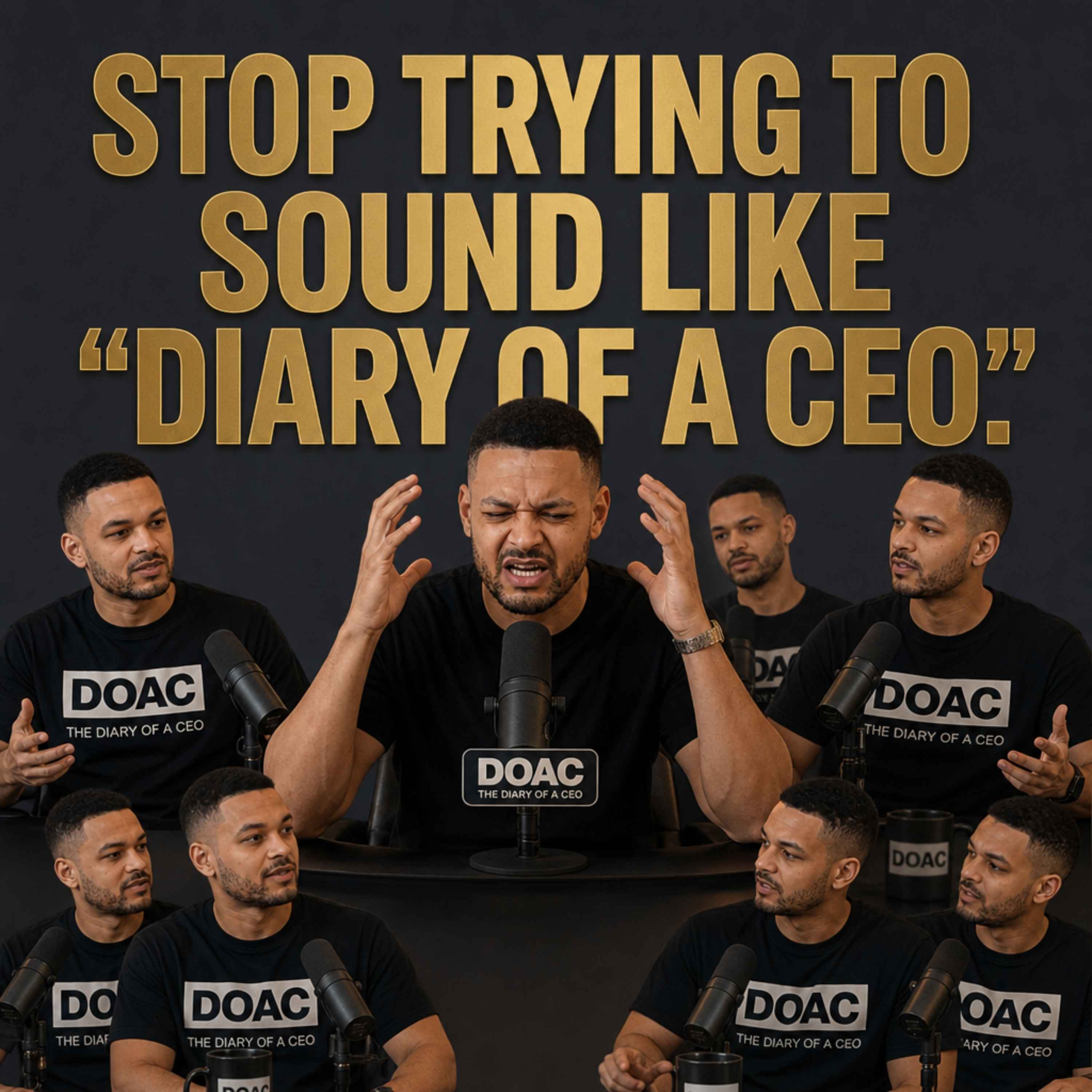
Your B2B podcast looks and sounds like Diary of a CEO. That's NOT a compliment!
B2B Podcasting Insights - business strategy podcast for founders and brands
There's a very specific kind of irony happening across B2B podcasting right now. Someone posts on LinkedIn about the urgent need to differentiate from competitors — gets hundreds of nodding comments, a few congratulatory pats on the shoulder — and then releases a podcast episode that sounds verrrrrry familiar.
Hi, I'm Neal Veglio, founder of Podknows Podcasting and host of B2B Podcasting Insights. And in this episode, I'm breaking down why copying the Diary of a CEO container is actively working against your buyers' trust — and what the one thing is that actually differentiates a B2B podcast. Spoiler: it's not your lighting rig.
Also in this episode:
- Founder FAQ: Dominic from Norwich wants to know why his podcast guests never share the episode after recording — and what he can do about it
- Quick Tip: The simple title strategy that will make every episode you publish sharper, more specific, and more honest than anything you planned in advance
If your show is built around looking successful rather than being useful, this one's going to sting slightly. In a productive way.
👉 Book your diagnostic session: podknows.co.uk/diagnostic
Mentioned in this episode:
Podknows Launch Book
Get our free book "Podcast Launch Strategy"
Learn More About Podknows Podcasting
We're at https://podknows.co.uk/
Available Results
Generated results are saved to the knowledge database for reuse and search.
Extract Knowledge
Pick what you want extracted first. Model, scope, and chapter options appear after a template is selected.
Transcript
Speaker: 00:00:00 That was the moment everything changed. Speaker: 00:00:02 We had to rethink everything. Speaker: 00:00:04 This is the conversation nobody in our industry is having Speaker: 00:00:08 You know what you just heard. Speaker: 00:00:09 You've heard it about 4,000 times on LinkedIn, on YouTube, Speaker: 00:00:14 in Apple Podcasts and Spotify. Speaker: 00:00:16 Every single podcast that has launched in the past three years does exactly Speaker: 00:00:22 the same thing, including a lot of podcasts that I consult with. Speaker: 00:00:26 No matter how much I tell them, "Don't do it. It's, it's done. It's holding Speaker: 00:00:32 you back," they all still default to it. Speaker: 00:00:35 That drawn-out, cinematic, mixed-up, out-of-context montage. Speaker: 00:00:42 Because they all think having a bit of dramatic emotional music Speaker: 00:00:46 is substitute for zero substance. Speaker: 00:00:51 And here's the beautiful irony. Speaker: 00:00:53 People are doing it while sharing posts on LinkedIn about Speaker: 00:00:57 the importance of standing out. Speaker: 00:01:00 So let's talk about that. Speaker: 00:01:05 Welcome to B2B Podcasting Insights. Speaker: 00:01:07 I'm Neil Velio, founder of Podnos Podcasting. Speaker: 00:01:10 We are a podcast agency that help brands and individuals like you to get better Speaker: 00:01:17 results from podcasts, whether that be through the production, the marketing, Speaker: 00:01:23 or just generally telling you where you're getting things a little bit wrong. Speaker: 00:01:27 We're not here to shame you. Speaker: 00:01:28 We're here to help you grow. Speaker: 00:01:31 So back to the point of this episode then. Speaker: 00:01:33 Here's a thing that happens in B2B podcasting, branded podcasting Speaker: 00:01:37 in general, that would be funny if it wasn't quite so baffling. Speaker: 00:01:42 Someone spots a problem, they articulate it quite well, clearly. Speaker: 00:01:47 They post about it with evident intelligence. Speaker: 00:01:50 68% of sellers all look the same to their ideal buyers. Speaker: 00:01:55 Buyers can't tell you apart. Speaker: 00:01:57 Nobody differentiates on anything that actually matters. Speaker: 00:02:00 And the post gets engagement because it's true. Speaker: 00:02:03 It's wise. Speaker: 00:02:04 It is good perceived wisdom. Speaker: 00:02:07 And people are sharing that perceived wisdom because it confirms everything Speaker: 00:02:11 that they've suspected for a while. Speaker: 00:02:13 And then that same person goes and makes a podcast that looks identical to the Speaker: 00:02:18 one that their competition is making. Speaker: 00:02:20 Now, look, I'm not singling anyone out here. Speaker: 00:02:23 Well, I kind of am. Speaker: 00:02:24 But I'm not doing it behind their backs. Speaker: 00:02:26 I have told them to their faces that I found the post quite ironic. Speaker: 00:02:30 But it does lead us into a really important topic that is Speaker: 00:02:35 useful for all branded podcasters to be able to learn from. Speaker: 00:02:39 So let's do that. Speaker: 00:02:41 Let me tell you about this LinkedIn post that I saw just the other day. Speaker: 00:02:45 Uh, someone, a smart person, clearly knows her stuff, shared a Speaker: 00:02:50 stat that 68% of sellers look and sound the same to their buyers. Speaker: 00:02:57 Now, this post had big engagement, lots of people, mm, mm, nodding in Speaker: 00:03:01 the comments, lots of congratulatory pats on the shoulder, "Yes, you go. Speaker: 00:03:07 Well done," Speaker: 00:03:08 and a few people tagging their colleagues and peers with that very specific kind Speaker: 00:03:12 of energy of, "Oh, this is definitely about you, not me." And then in the Speaker: 00:03:16 same post where they were talking about the importance of differentiation Speaker: 00:03:22 to stand out from competitors, they posted a clip of their podcast Speaker: 00:03:27 intro, and when I was watching it, I thought, " This is familiar territory." Speaker: 00:03:32 The swelling music, the dramatic pauses, the carefully edited montages Speaker: 00:03:39 of themselves saying really poignant things, but with not much context, Speaker: 00:03:45 almost like they want you to watch or listen to the thing in full Speaker: 00:03:50 to grab what's really going on. Speaker: 00:03:52 Yeah. Speaker: 00:03:53 It looked and sounded like the Yodel Van had turned up with their team new order Speaker: 00:04:01 with a carbon copy of Diary of a CEO. Speaker: 00:04:05 Someone in their team had been obviously watching a load of Bartlett Speaker: 00:04:08 content and thought, "Yeah, this is the kind of stuff we should be Speaker: 00:04:12 making." Now, I wanna be really clear, I'm not singling these people out. Speaker: 00:04:17 I'm not here to bully people that are trying to get content out. Speaker: 00:04:22 I get it, and the temptation is there. Speaker: 00:04:25 You see something that seems to be working, and you want Speaker: 00:04:29 to recreate the formula. Speaker: 00:04:31 I'm not going after any specific individuals on the internet here. Speaker: 00:04:35 I mean, for a start, that's not particularly useful of our time together Speaker: 00:04:39 here on these episodes every week. Speaker: 00:04:42 We see it every day on LinkedIn, the post that's talking about differentiation and Speaker: 00:04:47 needing to stand out from your competitors before posting exactly the same content Speaker: 00:04:54 that your competitors are posting. Speaker: 00:04:56 Now look, here's the thing. Speaker: 00:04:58 Diary of a CEO is genuinely quite a slick-looking show if you take it in Speaker: 00:05:06 the context of a YouTube video series that happens to also kinda be a podcast. Speaker: 00:05:14 Looks great, sounds great, not gonna fault that. Speaker: 00:05:17 It's done a certain way. Speaker: 00:05:18 It's got a certain feel to it. Speaker: 00:05:21 It's recognizable. Speaker: 00:05:22 It's kind of its own brand. Speaker: 00:05:24 And so what happens is when people are trying to build something that also Speaker: 00:05:29 signals a look, a feel, a brand, what they're instinctively doing is looking Speaker: 00:05:35 at what they think already works and going, "Yeah, we need to do that. Speaker: 00:05:39 That looks great. Speaker: 00:05:40 That stands out What they're not realizing is that even the cheapest of Speaker: 00:05:45 shows that don't even have a team are trying to achieve the same look and feel. Speaker: 00:05:52 They're trying to achieve the same sound. Speaker: 00:05:55 You click play on your Apple Podcasts playlist and you hear Speaker: 00:05:59 podcast after podcast after podcast that has the dramatic intro Speaker: 00:06:04 music and three or four layered out-of-context clips running over it. Speaker: 00:06:11 It's been done to death. Speaker: 00:06:13 Even the lighting has its own branding now. Speaker: 00:06:18 So you see, this is the thing. Speaker: 00:06:19 Podcasts are operating on a couple of levels. Speaker: 00:06:23 You've got the container, which is for video, the pretty visuals, the Speaker: 00:06:29 captions flying around all over the screen, the dramatic sound on Speaker: 00:06:34 the audio version, the clips, the way that they work out of context. Speaker: 00:06:40 All of that is nice packaging, the container. Speaker: 00:06:44 And then the contents is the stuff of substance contained within that. Speaker: 00:06:49 So the reason for me to listen to the founder story, the takeaways and insights Speaker: 00:06:55 I'm gonna gain from engaging in that content for a specific period of time. Speaker: 00:07:01 The container's the easy bit. Speaker: 00:07:03 It's just an aesthetic choice you can apply in post-production. Speaker: 00:07:05 The content, now that's the hard part. Speaker: 00:07:09 The working theory presumably is if you produce something that Speaker: 00:07:15 looks like a successful podcast, sounds like a successful podcast, Speaker: 00:07:20 then you've got a successful podcast And you can trade on that. Speaker: 00:07:25 Which is a bit like buying a Michelin star restaurant style apron and Speaker: 00:07:30 then shoving your lasagna in the microwave and expecting chef's kiss. Speaker: 00:07:37 It's not gonna happen. Speaker: 00:07:38 Now let's talk about what happens on the other end of this, because there is a Speaker: 00:07:42 real human being who is your ideal buyer, that decision-maker that you've been Speaker: 00:07:46 trying to reach out to with your content. Speaker: 00:07:49 At some point, they're landing on your podcast. Speaker: 00:07:53 Maybe someone sent them a link. Speaker: 00:07:54 Maybe it's just randomly shown up in their Apple Podcasts library Speaker: 00:07:59 or in their YouTube algorithm. Speaker: 00:08:00 Maybe they found it by searching for it. Speaker: 00:08:02 Maybe they'd heard something about you and did a little bit of research. Speaker: 00:08:06 Maybe they were just randomly browsing Spotify at 11 o'clock looking for Speaker: 00:08:10 stuff to listen to for the coming week. Speaker: 00:08:13 Either way, they press play. Speaker: 00:08:16 Your dramatic music sting fires up loudly in their ears at full zero dB. Speaker: 00:08:22 Your carefully edited montage tease begins. Speaker: 00:08:26 And they watch a carefully acted version of you stare meaningfully into Speaker: 00:08:33 the distance while a quote pops up and then fades over a dark background. Speaker: 00:08:39 If they're listening to you, they're hearing the rush and crescendo of Speaker: 00:08:43 the cinematic music impacting, boom, and fading gently as your breathy Speaker: 00:08:51 words sizzle through their earbud. Speaker: 00:08:55 And what do they think? Speaker: 00:08:56 " Wow, this podcast's really trying to look and sound like Die of a CEO." Speaker: 00:09:01 Not, " Oh, this company clearly understands my situation." Not, "I should Speaker: 00:09:06 probably book a call with these people. Speaker: 00:09:08 They seem to have all the answers." Just, " Wow, I've heard this sort of thing Speaker: 00:09:13 before. Same music, different title." Speaker: 00:09:16 Here's the thing about Die of a CEO, which I really hate myself for Speaker: 00:09:22 admitting, but it has to be said. Speaker: 00:09:24 I'm all about transparency and truth here, as you know. Speaker: 00:09:27 The show works for Steven Bartlett, Speaker: 00:09:29 not because he's particularly good and not because he's had amazing success with it. Speaker: 00:09:33 Believe me, a huge amount of that success is manufactured. Speaker: 00:09:37 But it works for Steven Bartlett because Steven Bartlett is the product. Speaker: 00:09:42 The drama is him. Speaker: 00:09:45 The emotional arc is his actual life and how he tries to crowbar all of his Speaker: 00:09:50 own experiences into the expertise of the guests that he has on his show. Speaker: 00:09:55 The montage is a tease for a story that the audience already wants to Speaker: 00:10:00 hear because they already have a relationship with the person who's Speaker: 00:10:05 centered in the story being told. Speaker: 00:10:08 When a B2B firm produces a podcast about, I don't know, let's just say Speaker: 00:10:14 supply chain logistics, and then they adopt the same kind of format with Speaker: 00:10:19 the wispy, thuddy, droney, cinematic music and the whooshing in captions Speaker: 00:10:28 and overlays on the YouTube version. Speaker: 00:10:31 And I have seen this. Speaker: 00:10:32 I have personally witnessed a podcast about supply chain logistics with a Speaker: 00:10:38 dramatic cinematic intro, and I never fully recovered from it, by the way. Speaker: 00:10:43 And what the buyer is experiencing along with me when that is Speaker: 00:10:48 happening is not authority. Speaker: 00:10:50 What they're experiencing is, "Wow, this brand has so little confidence Speaker: 00:10:57 in what they have to say, they're dressing it up in this overly, Speaker: 00:11:02 ridiculously slick container." Speaker: 00:11:05 The production must be compensating for something. Speaker: 00:11:08 And buyers, even if they can't really articulate it because it's Speaker: 00:11:12 working on a deep subconscious level, they're feeling that immediately. Speaker: 00:11:16 Whether you like to admit it or not I, I'm sure it probably hurts if you are Speaker: 00:11:21 one of those people who've been sucked into that idea of, "We need to get three Speaker: 00:11:26 or four people editing this podcast because that's what the big shows do." Speaker: 00:11:31 You're putting your energy and your financial investment into Speaker: 00:11:35 the wrong areas of the show. Speaker: 00:11:37 The truth is, the fancier the wrapper, the more suspicious your buyer becomes Speaker: 00:11:42 about what's actually hidden inside. Speaker: 00:11:44 It's kind of like the audio and visual equivalent of a restaurant that spends Speaker: 00:11:49 more time worrying about the font on the menu than the meat in the kitchen. Speaker: 00:11:54 Your buyer doesn't need you to be cinematic. Speaker: 00:11:57 They need you to be informed about their situation and willing to share Speaker: 00:12:03 with them your solutions for it. Speaker: 00:12:06 And those are two completely different missions with your podcast. Speaker: 00:12:11 And one of them is considerably cheaper to produce, but will Speaker: 00:12:15 get you 10 times the results. Speaker: 00:12:20 So if the answer isn't dramatic music and meaningful pauses and Speaker: 00:12:26 moody-looking dark faces staring into the abyss, then what is it? Speaker: 00:12:33 I warn you now, this is gonna sound really underwhelming. Speaker: 00:12:37 Not because it isn't effective. Speaker: 00:12:39 I mean, it absolutely is. Speaker: 00:12:41 But it requires a different kind of effort that can't be outsourced to Speaker: 00:12:46 a probably overpriced video editor. Speaker: 00:12:50 The answer is specificity. Speaker: 00:12:52 The answer is specificity, genuine, uncomfortable, alienating to some degree. Speaker: 00:13:01 Genuine, uncomfortable, alienating to some people, specificity about exactly Speaker: 00:13:08 who you're talking to and exactly what problem you're solving for them. Speaker: 00:13:12 A B2B podcast that's actually differentiated sounds like it could Speaker: 00:13:17 have only been made for one particular person, for one very specific type of Speaker: 00:13:22 buyer, about one section of society that is suffering from one specific problem Speaker: 00:13:30 that nobody else in the industry is currently addressing Not because the Speaker: 00:13:34 problem's a secret, but because saying them clearly requires you to take a Speaker: 00:13:39 position with some degree of authority that could put you at risk of reputational Speaker: 00:13:46 damage should you be getting it wrong. Speaker: 00:13:50 And let's be honest about it, taking a position on something definitely means Speaker: 00:13:55 that someone is gonna disagree with you. Speaker: 00:13:57 And that's frightening to a lot of marketing teams, especially when this Speaker: 00:14:01 disagreement comes in the public comments or ends up becoming borderline trolling. Speaker: 00:14:08 So instead, what they do, they play it safe and they ramp the dramatic Speaker: 00:14:14 music up just that little bit louder. Speaker: 00:14:16 Oh, and they add another couple of graphics and maybe Speaker: 00:14:19 a different colored caption. Speaker: 00:14:20 The podcasts that are actually moving deals, the ones where prospects get onto Speaker: 00:14:25 a sales call with your team and they say, "I already know how you work," we've said Speaker: 00:14:30 it before on all the episodes so far. Speaker: 00:14:34 They don't open with a montage tease about what's coming up in the episode. Speaker: 00:14:38 They open with a sentence that makes it clear to them that you are about to bring Speaker: 00:14:44 them full awareness that you understand their problem and you're here to solve it. Speaker: 00:14:49 They make it feel like your episode is for them and nobody else. Speaker: 00:14:56 And here's the thing that's slightly annoying about all this. Speaker: 00:14:59 That kind of differentiation is available to every single podcaster Speaker: 00:15:03 within the sound of my voice here, regardless of your budget. Speaker: 00:15:07 You don't need an expensive lighting rig. Speaker: 00:15:09 You don't need a team of 20 editors. Speaker: 00:15:12 You don't need someone who's spent 15 years learning DaVinci Resolve or Adobe Speaker: 00:15:18 Premiere or any of the other huge industry tools that charge thousands and thousands Speaker: 00:15:25 per month subscriptions to be able to use. Speaker: 00:15:28 You don't need someone who's an expert in key framing and color adjustment and Speaker: 00:15:33 depth of field shots and wide angles. Speaker: 00:15:37 You just need to know your buyer well enough to say something Speaker: 00:15:41 to them that resonates enough Speaker: 00:15:43 And be specific with them enough with their situation before Speaker: 00:15:48 they've even told you what it is. Speaker: 00:15:51 That's it. Speaker: 00:15:52 That's the winning format. Speaker: 00:15:53 Everything else is just container. Speaker: 00:15:56 Now let's go back to that person who had the fancy podcast intro who waxed lyrical Speaker: 00:16:02 on LinkedIn about the fact that 68% of sellers all look the same to their buyers Speaker: 00:16:09 and there's a need for differentiation. Speaker: 00:16:12 They had the right diagnosis. Speaker: 00:16:14 They just went looking to provide the answers with someone else's production Speaker: 00:16:22 budget, with someone else's style, with someone else's container, and their Speaker: 00:16:27 buyers are probably noticing that. Speaker: 00:16:30 I can't be the only one who looked at that post, saw them going on about Speaker: 00:16:35 differentiation, and then posting exactly the same kind of podcast Speaker: 00:16:41 that their competitors are posting. Speaker: 00:16:43 Even if their competitors, even if their ideal buyers couldn't Speaker: 00:16:47 quite figure out why they felt compelled to hit the skip button. Speaker: 00:16:52 Even if their competitors couldn't fully figure out why they felt Speaker: 00:16:56 compelled to just scroll past. Speaker: 00:16:59 Each episode I answer a question that's come in from a founder or Speaker: 00:17:04 marketer who's working through exactly the kind of challenge that they know Speaker: 00:17:08 that we talk about on this show. Speaker: 00:17:10 And if you'd like to send us, uh, a voicemail, we now have voicemail, uh, Speaker: 00:17:16 we now have a voicemail page Where you can record it on your phone or however Speaker: 00:17:20 you want to get that audio to us. Speaker: 00:17:22 Go to podnos.co.uk/feedback. Speaker: 00:17:25 That's P-O-D-K-N-O-W-S.co.uk/feedback. Speaker: 00:17:27 And this one has come in from Dominic in Norwich, and he says, " Hi, Neal. Speaker: 00:17:31 Thanks for the show. Speaker: 00:17:36 I love it. Speaker: 00:17:36 Quick question. Speaker: 00:17:37 Every time I have a guest on, I share the episode everywhere I can, but Speaker: 00:17:41 they never seem to return the favor. Speaker: 00:17:43 I've tried sending them the link. Speaker: 00:17:45 I've tried tagging them on LinkedIn. Speaker: 00:17:47 I've even sent a follow-up message with the clip ready to go and nothing. Speaker: 00:17:53 It all feels a bit one-sided. Speaker: 00:17:55 Is there something that I should be doing differently, Speaker: 00:17:58 or is this just how guests are? Speaker: 00:18:00 Cheers, Dominic." I'm assuming when you say you've tried sending them the Speaker: 00:18:04 link and they never seem to return the favor, what you're talking about Speaker: 00:18:07 there is that you've been a guest on their show and they've been a guest Speaker: 00:18:10 on your show, and you shared their episode, but they haven't shared yours. Speaker: 00:18:16 It is quite common, and the problem isn't the follow-up, it's the expectation. Speaker: 00:18:21 Most guests agreed to come on and talk, not to help promote Speaker: 00:18:26 and market your podcast. Speaker: 00:18:28 And the way to fix that is something I call frontloading. Speaker: 00:18:32 So before you record, not after it, tell them explicitly what you're Speaker: 00:18:38 gonna be sharing and ask if they're happy to help you and combine efforts. Speaker: 00:18:45 You can also get around this with a one-sheet with, you know, Speaker: 00:18:48 pre-written social copy, uh, handed over immediately after recording. Speaker: 00:18:53 It converts far better than a polite nudge three weeks after you've Speaker: 00:18:59 published the episode and heard nothing. Speaker: 00:19:01 Nine times out of ten, they will have forgotten the conversation even happened. Speaker: 00:19:05 You can go one stage further with this and say to guests that they need to Speaker: 00:19:11 sign an agreement that if they come on the podcast, they have to share the m- Speaker: 00:19:16 they have to, they have to participate in the marketing efforts with you. Speaker: 00:19:20 But you are probably gonna reduce the amount of guest intake that Speaker: 00:19:23 you can get using that formula. Speaker: 00:19:26 But anyway, I hope that helps. Speaker: 00:19:27 I know it sucks when you put all that effort in and it just Speaker: 00:19:31 seems to fall on deaf ears. Speaker: 00:19:33 Of course, always better to find out from ... Always better to source Speaker: 00:19:38 guests that you know are very generous with their social media sharing. Speaker: 00:19:42 And also understand that, to be fair, most of that effort is wasted anyway Speaker: 00:19:46 because social media accounts for less than 1% of your overall podcast traffic. Speaker: 00:19:49 So great for personal branding and great for your social media, but Speaker: 00:19:53 don't lose too much sleep over it. Speaker: 00:19:55 All right, quick tip then for B2B founders right now This Speaker: 00:19:59 one's about episode titles, and Speaker: 00:20:02 this one's about episode titles, and I still, after all these years of doing Speaker: 00:20:08 this, whenever I do audits with people, I still see the same common mistake Speaker: 00:20:14 with titling, and what they're doing is they're naming the podcast episode Speaker: 00:20:21 before they've even recorded it, and then the entire episode is anchored to Speaker: 00:20:26 that con- and then the entire episode content is anchored to that title. Speaker: 00:20:31 Flip that round. Speaker: 00:20:32 Record towards the general pain point that you're trying to address in the episode, Speaker: 00:20:38 and then once you've landed, having listened back to it, on the most poignant Speaker: 00:20:46 and specific version of that pain point, title the entire episode after that. Speaker: 00:20:51 What you'll find is that the title that you land on once you've taken that Speaker: 00:20:56 strategy is always gonna be sharper, more specific, and more honest than Speaker: 00:21:02 the one that you started with when you were planning your episode out Speaker: 00:21:06 because you actually said something. Speaker: 00:21:08 You stood for something, and now you're naming what you said and stood for Speaker: 00:21:12 rather than aspirationally gesturing at what you hope you might say. Speaker: 00:21:17 So try that with your next episode and compare the two titles, the one that Speaker: 00:21:21 you wrote before you recorded and the one that you wrote after you edited Speaker: 00:21:26 and listened back, and the difference will probably completely stagger you. Speaker: 00:21:32 Okay, so if today's episode sparked some thoughts within you, resonated, Speaker: 00:21:37 and you're looking at your own show and you're thinking, "Yeah, all right. Speaker: 00:21:41 I might be sort of influenced by Diary of a CEO," the link to my diagnostic Speaker: 00:21:47 sessions are in the episode description. Speaker: 00:21:49 But just in case you're in a position to just type it out into your browser right Speaker: 00:21:55 now, go to podknows.co.uk/diagnostic. Speaker: 00:22:00 We'll work out together exactly what your show is doing, where Speaker: 00:22:04 it is, where it needs to be. Speaker: 00:22:06 And if you did find this useful, genuinely- I really would appreciate it Speaker: 00:22:10 if you would share it with someone else running a B2B podcast that you know of Speaker: 00:22:14 and who is right now adding dramatic music and stings to their podcast thinking Speaker: 00:22:21 that is going to in some way help them sound and look like a successful podcast. Speaker: 00:22:28 Especially if they're wondering why their downloads haven't Speaker: 00:22:30 moved since they started. Speaker: 00:22:33 I'm Neil Vellio. Speaker: 00:22:33 This has been B2B Podcasting Insights. Speaker: 00:22:36 And until next time Speaker: 00:22:38 Keep that pipeline going. Speaker: 00:22:39 Yeah, that'll do.