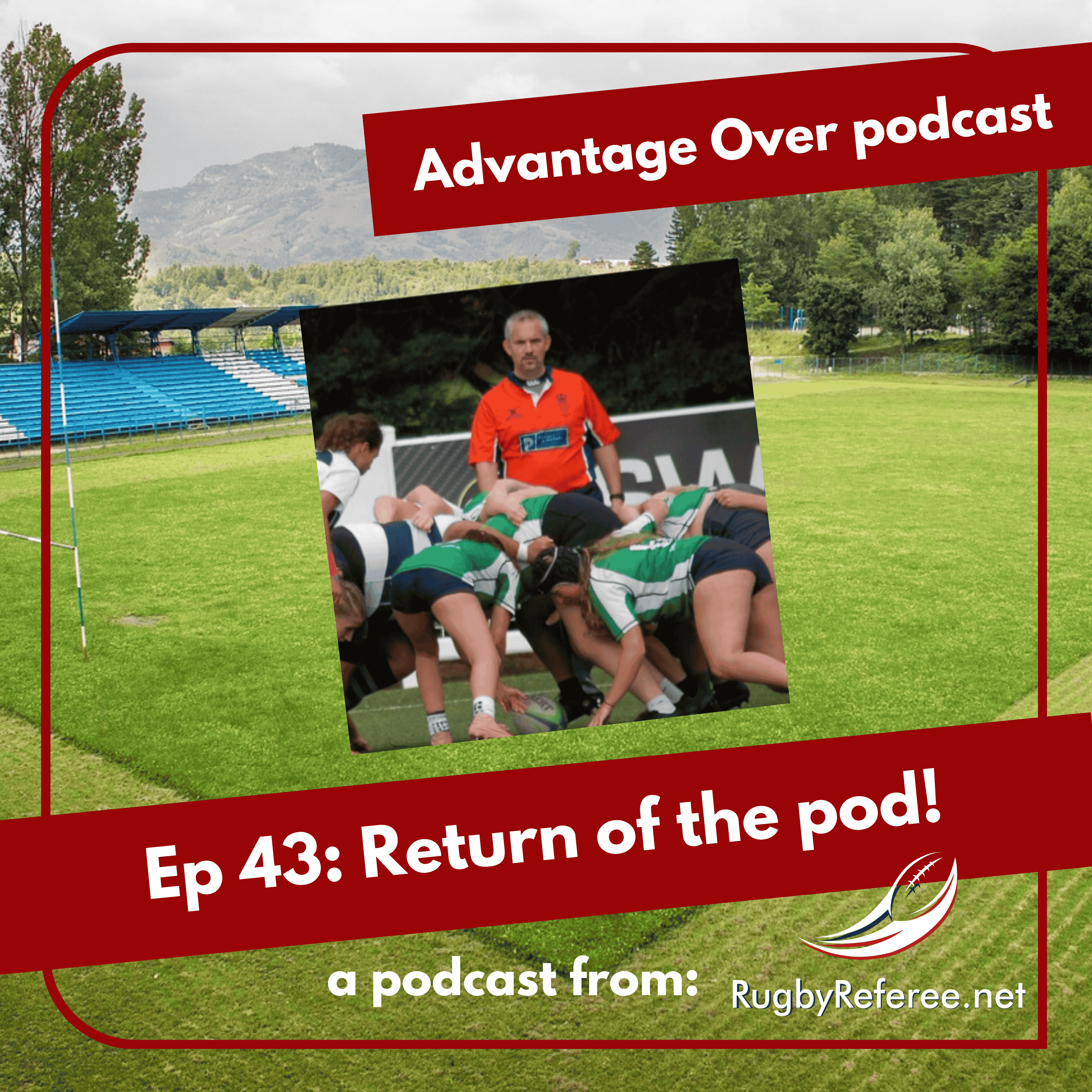
The pod returns
Hi, it's Keith here and after numerous prods from you, dear listeners, it was time to get the recording device out once again.
Bit of a catch up on a few things in today's episode:
- Women's RWC match officiating
- Refereeing a foul play scenario after a try
- Charging down a Try Line Drop out
- Refereeing the new open play pod lift
- A tricky situation for me with a piece of player equipment
Relevant links:
RugbyReferee.net Open play pod lift article
World Rugby approved devices list
Rezon Halos - may well be a great product but not approved for use in matches yet - see their FAQ page
If you have any comments about this episode, or suggestions for future shows, then drop me a line at ref@rugbyreferee.net!
You can follow us here:
Instagram: RugbyRefereenet
Facebook: Page: RugbyReferee.net
Facebook Group: RugbyReferee.net Community
Or you can connect with Keith personally on Twitter or LinkedIn
Available Results
Generated results are saved to the knowledge database for reuse and search.
Extract Knowledge
Pick what you want extracted first. Model, scope, and chapter options appear after a template is selected.
Transcript
AO43-The-Pod-return-converted:
00:00:01
Welcome to Advantage Over Full Rugby podcast to help you become a better referee. Your host today is Keith Lewis. Are you ready? Time on. Hello and welcome to The Advantage Over Podcast. It's Keith here and it's been a while since I've been here with you, but I figured it's about time. Um, after a wicked year of rugby across the world, um, particularly here in England over the last six weeks to get back. Into the podcast space and start talking about stuff that, um, I'm really passionate that I about, I know the stuff that you are really passionate about, um, and how we can sort of en encourage everybody to, to know a little bit more and understand a little bit more about us as referees, but also to help us all to make ourselves a little bit better when we go out and, um, referee on this fantastic game that we call rugby Union. Um, for this episode, um, I've just had a bunch of stuff floating around my head. Um, whether it's from calls from fellow referees, whether it's from incidents that we've seen, um, on tele, some sort of other trend stuff that we've started to see and how we might, um, do it. And I just wanna talk about my own referee as well. Um, 'cause as well as being obviously. Uh, work in the rugby space and do a lot of stuff with rugby referee.net and in our fantastic referee community. Um, I also run around on the field as well, which I sometimes don't talk about. Um, sometimes I forget that I do that as well. Um, but it's some, always brings some interesting nuggets to the fore that, um, I think it's worth talking about. So I've got one of the, a couple of those to talk about, um, today. Um, but this podcast should be more regular than it is, um, and I want you to help me with that. Um, so what I'm gonna ask people to do is to, um, think about. Message me on any of the social media platforms that you can find, rugby referee.net, um, whether you come to my email inbox, um, keith@rugbyreferee.net, and tell me what you want to hear about. Whether it's specific scenarios, whether it's particular areas of the game, whether it's particular people in the game that you'd like to hear from, um, or particular subjects that you might want to know a little bit more about to help you be a better referee. Um, that's what the podcast is all about. So please come and find me. Let me know what you want to talk about and what you want to hear about. And I'll do my very best to, to, to find the answers to those questions. Um, whether they be sort of short form, quick answers to questions, um, or whether they be long form perhaps interviews or conversations with other people. We're gonna try and do a whole bunch of stuff. Um, so I've got four things on the list that have cropped up in the last couple of weeks that I want to talk about. Um, but first we can't let this pass, um, after a World Cup that we've just seen here in England to not talk about the match officiating and the match official team. Um. The country here. Um, and the, the rugby community is talking about a fantastic event of celebrating women rugby. And it's absolutely right that we call out and recognize our colleagues who've been helping to officiate that, um, throughout the the World Cup. Um, I've had the real privilege and pleasure to, to be in the room with some of them. Um, to talk about how they, um, approach the games, how they, um, how they referee. I've got to know some of 'em a bit more personally in, in the free time that they've had been just fantastic. And to see Holly Davidson out there refereeing that World Cup final in front of 82,000 people, um, was just something I will never forget. Um, and also, um, just a, a recognition of the whole match officiating team. Um, we've had, um, people like Sarah Cox, who's reached her 50th cap, Amy Barrett on right behind her on the, on those sort of top end, been been around in the nicest possible way, um, for a long time in, in rugby, refereeing professionally at the highest level, and that's fantastic. Um, but we've also seen a bunch of, of newcomers to the block. Um, Ella Goldsmith from Australia. Um, out there refereeing the bronze final in front of what must have been north of 60,000. Must have been a, a brilliant experience for her. Um, and, and, and just recognition for that toilet we've had. We've got some real, um, great talent coming through the refereeing ranks. Um, it's been great to spend time with them. It's been great to, to, to see them in action up, up close. They're such a great group of people, um, human, human beings as well as referees. Obviously that's why they're there. That's why they were selected. That's why they put all that time and effort. Um, and their, and their reward of being selected to a rugby world Cup is something that they must never forget. Um, and we should celebrate that. Um, and if we look at the whole of the tournament. That the way that people are talking about the game, um, and the growth of the game and the entertainment factor, um, is also down to as well as the, obviously the, the, the 30 other players on the field and the other, um, um, squad, the, the extended squads around those teams. But it's also testament to them and their achievements and them under understanding the game. The fact that they, they all love rugby so much and they, they brought that ethos into the game. Um, and we got some fantastic games out of it. So the fact that we're not talking about. Many refereeing decisions, um, at all, um, is a testament to them all and the hard work that they put in. So, great work team. Um, I think some of you might listen to this. Um, just know how, how pleased we all are as a referee community to see you do your thing, um, and all power to you and your support networks around you. So, fantastic work squad. Um, we're looking forward to seeing what happens over the next four year cycle. Um, and we'll all come to Australia to, to, to see how things are getting on. Um, but other things that I wanted to talk about, um, I had a really good conversation with a fellow referee this morning, um, after an incident over the weekend. So we're gonna talk about discipline matters, um, particularly in a scenario where a try has just been scored. Um, we've had issues in the last couple issues and we heard a couple of random incidents on those. I'm using air quotes there. Things that never happen front where we've, we've seen. Ch um, goal line drop try line dropouts taken, um, badly and score, uh, in the opposition of scored a try from them. So we'll talk about, um, charging the try line dropout, which is slightly different to what some people, um, have experienced or might remember, um, before. Um, we've also seen some new stuff coming into the game, which I think we need to think about as referees, about how we officiate them. Um, and the thing I'm thinking about there, it's obviously started, um, obviously no, it started, um, actually in a school board game that we first saw it in, um, in South Africa. Um, and then we've seen that replicated both at international level, um, both in, um, in South Africa, but also other teams are starting to try as well. And that's where we see an open play pod lift, a bit like a line out pod being lifted in the air, but in open play. So we need to really think about the pictures that we're seeing, the pictures that they're presenting to as, and how we should referee it. Um, so we'll talk about that. Um, and then we also sometimes as referees get put in really tough positions, um, when we. Are presented with things before, um, the game, perhaps a stu check or a piece of equipment that just throws us off balance, and we need to be prepared for how we deal with, um, those tricky conversations. So, yeah. Um, a bunch of stuff that's been on my list initially, so let's just, um, crack on and, uh, talk about them. Um, so firstly just, this is just, and this is a, something I want to do a bit more of is that, um, this wasn't intended to be a piece of podcast content. Um, but as, as, as Mondays go, I tend to get, um, the odd message from, from somebody or the odd phone call from somebody, um, at both domestic and elite level about something that's happened over the weekend. So it's really great to hear from one of my fellow, um, community referees that this morning, um, to talk about a tricky incident that he had yesterday. Um, and we had a really good positive conversation with it. I think we recognized that perhaps he didn't deal with it. Correctly in law. But it's one of those things that so rarely happens if we don't talk about it. No one knows what the right answer is. So sometimes we have to do things wrong in order to get them right. So we'll talk through the scenario. Um, and this, this will be familiar for anyone who's refereed. Um. Men's rugby towards the start of the season or local Darby where these thing, you get games like this, which have a bit of niggle to them, um, where something just happens in front of you, you dunno what causes it, but you get a blowup of testosterone and angst that kicks off. So the scenario, what happened was, um, as it was relayed to me, is that as a, a try was just. A try was scored and at the same moment as the referee was putting the whistle to his mouth to blow that try, um, it then kicked off in front of him. There was a, some RG barge. There was some, um, usual pushing and shoving, usual pushing. There was some pushing and shoving of stuff going on, but then that seemed to escalate and others got involved. And one play out to, um, run from quite a distance away. Arms flailing. Passed the referee. Just missed the referee, and then started throwing punches. Um. F in a typical, as it described to me, none of them landed particularly well. But that's the picture that you might, some of you will have recognized, some of you will be smiling Riley at that and thinking about, yep, we've all been there. Um, but what the, the ref talked to me about was that, what, what should he have done in terms of restarting the game and dealing with it? Um, because what he did was to deal with the fraco, deal with what was going on. Sanctioned, the player who came in whirling his arms around and throwing punches, which was completely unnecessary, highly illegal, always illegal, um, and not a rugby action as opposed to the, perhaps the more understandable instant reaction that you might see from the two players who were involved in something or two other, other players who were involved in something. Um, so he dealt with that and sent that player from the field quite right too. Um, but then he restarted the game with a penalty for that particular action. Um, so when we talked about it. We kind of realized that probably wasn't supported in law. Whilst it was easy as an easy decision to sell, um, to do that, to do that because you've got a red card, so you've got to do it. The sequence of events makes this different because the try was scored, the ball was put down in the, in the in goal area by an attacking player, so there's no issue with that. The ball was scored and then what happened after that is that it all kicked off. So what happens when we have a try? We have a conversion and then we have a restart. And that's the point where any sanction that you have to deal with when the ball is dead, is taking place. Um, and, and just some rationale behind that, um, is actually it buys you a whole load of time and space because if we've got a try and we've got a conversion, we've got 15 players behind the posts, cooling down, taking some deep breaths, and the other 14 players, 'cause someone's gonna kick the ball, are then 50 plus meters away, back in their own half. Doing the same thing. So we've got distance and space for everyone to calm down so we can take the conversion, deal with the conversion. Then we deal with the foul play. And then we deal with the restart from that point. But the scenario that he faced was the first time it had happened to him. It was a really good conversation. He managed. No one argued with it at the time, dealt with the situation, dealt with the incident of foul play as you, as you should have done. Restart with a penalty. Um, obviously that was in the wrong place and the try should have stored in the community game. These things sometimes happen, um, and that's, um, totally okay and we should all recognize that 'cause uh, this is a tough game for us to, to do. We're on our own. We don't have the support of other people to help us out with those scenarios to, as we talk it through, we sometimes hear. On tv we're, we're seeing the referee talk to the AR and the TMO and between them they come up with solutions to problems. We don't have that when I'm out there on my own on a Sunday, on a Saturday or a Sunday, I'm on my own making decisions. I've got to do piece all those pieces of information on my experience together to come up with the right, the right outcome. Yeah. So if we have a try being scored and then foul play. Anything that you need to deal with after the ball was put down, we then deal with at the restart, which is of course is back on the halfway line. We create nice and we create our space, we create our time, we get the process, um, in the right order, um, and then we can restart accordingly. And hopefully that will just give people enough time. To literally breathe and regain composure and start the game, and we get on with playing rugby. So that was a really good conversation. I really enjoy those conversations on a Monday. It's good to help other referees talk through and process those situations. And if we want, if you want to help out here on the podcast, you can, uh, um, I said drop me an email or gimme a shout when I'm not hard to find across the socials, um, to, to get those, um, I, those scenarios talked through. And we can perhaps do it, um, on this pod as well. So that was the first one. Um, the other one is actually a, an issue that we've started to see a little bit more at the, um, try Line Dropout, the formally, the newly rebranded goal line dropout. Um, because in, in law, the, uh, world rugby be changed, the, the goal line to, to try line because that's what we all call it. Um, so therefore the knock on consequences of of that is that the goal line dropout is now officially a trial line dropout. But I think we'll probably all still call it a goal and dropout, um, as I, I'm bound to do in the next few minutes. Um, so we, the issue we saw there. Um, we saw it in the inter, in the South Africa Argentina game. Um, Chely Colby took the, um, took a ball. Uh, the, a goal line dropout was awarded. Um, a trial line dropout was awarded ch chely. Colby had possession of the ball in his own in goal area. Um, and what he, we, we believe he was trying to kick the ball across the field to his teammate to, to take the goal line dropout. But he didn't just who fit or he didn't just throw it to his teammate. He drop kicked it from ING goal across the try line back into the field of play. Um, the Argentina player who was beyond the five meter line, which is what we'll refer to as the sanction line, um, then stepped forward, picked that ball up and put it down over the try line. Um, uh, Angus Gardner said That looks a bit odd. Let's just check what the sequence of what happened. Um, and when they looked at it again, that is exactly what happened. The, the try line dropout was correctly taken, um, albeit he probably shouldn't have done and didn't mean to, but he did drop, kick it, um, out from ing goal acro across the, across the try line. Um, back into open play, the Argentina player was correctly positioned to start with, um, and was entitled to pick that ball up and do what he wanted with it, and of course, score a try. So the try it was scored. Um, but somebody asked, um, a question. The, the question was around not being able to charge over that line, um, and not being able to do that before the ball had crossed the line. And I think that comes back to the old scenario where we had, we only had the 22 dropout, um, because the sanction line and the kicking line were the same. So you could, you, you still can't charge over the taking, kicking line in order to stop the, the dropout from taking place. Um, but. So in a 22, you can't charge over the, um, the 22 meter line to stop the ball being kicked 'cause that wouldn't be right. Um, whereas in the try line dropout, we have a different line for the kicking line and the sanction line. So the kicking line and try line Dropout is on or behind the try line. The sanction line. So it has to travel five, it has to go beyond five is five meters away from that. It's on the five meter line. So that's where the difference is. That's what some people thought. If you, if you haven't actually pieced that all together, you couldn't charge that down, um, then that's the rationale for why it's slightly different. So just something to think about. Um, it's one of those never happens, never going to happen. But has happened and we've, we're now starting to see defenses putting pressure on those trial line dropouts to gain possession of the ball. Um, as long as they start beyond the five meter line and the ball is kicked across the kicking line. So it, it the kick the defending team, kick it from behind on or behind the trial line, and it travels into the field of play. Um. Then that's okay. And obviously the defend, the, the non-kicking team, they're still defenders, although they're 90, only five meters away from the trial line. Um, they, as long as they start beyond five meters and they don't, um, stop it from crossing the goal line, which of course is practically impossible, then that's okay. Um, so just something odd that cropped up in that game. Um, the third issue I wanted to talk about, and I actually did a post on this a couple of weeks ago on the rugby referee.net website, was about how we should referee the open play pod lift. Um. It's, it's the sort of scenario that was, we now started to see a little bit more. Um, we're bound to see some community rugby teams trying it out 'cause they've seen it on tv. Um, and this is one of those things where when it happens, um, it's, and it's done legally. Um, and it's pretty hard not to do it legally. It is totally okay. Um, it is legal in law and it's really explicit in law 9 26, that in open play, any player may lift or support a teammate, and if they do, they must lower that play to the ground safely as soon as the ball is won by either team. So it's really explicit in law that you are allowed to lift somebody in open play, a teammate in open play. There is one scenario where you are not allowed to do that, and that is to stop. A kick at goal from going over the post. So you can't lift to block a kick. Um, but you can in open play for any number of any reasons that you might deem fit to do so. We normally see it a kickoff where the ball is kicked and you get a pod lifting up. Um, so those tall players get hoisted into the air that they claim possession of the ball at the kickoff. Unlike kickoff, catch a catch receipt. Sometimes you might hear that referred to us. So that's where it normally happens. It's never been an issue before. No one really. As it would even bat an eye that that was a problem. But now teams are starting to do it in open play when they have possession of the ball. So we get, um, a sort of, I guess, um, ruck to ruck or, or breakdown to breakdown area where we start to see where we might see that the nine throw a ball rather than flat to 10 or flat to a six or seven for the next phase, they will throw the ball high into the air. Um, so their teammate, that the tour player will kind of be supported up into the air to do that, and they will come down as a three. Um, and the, the issue is what happens next? So that, as I've just described, it is legal. Everything about that is legal. What happens next is what makes it potentially a problem and something we need to think about. Um, so it's not a flying wedge 'cause it hasn't gone anywhere. Um, a flying wedge is where you have those, uh, a pod of three players around the ball moving towards a defender. Um, usually at pace. And it's usually an open place. It's usually around the, around the goal line. So that's what makes that dangerous is that you've got three players moving towards one player. At speed. That's the element of danger. So if they come down together and you get a defender, tries to tackle that ball carrier, and again, they should have access to that, the ball carrier, they can't be blocked from doing that. 'cause that would be obstruction then that's okay. We don't have that flying wedge issue. It's not a flying wedge. Um, because it's literally not flying. It's, it's standard and static. Um, that ball carrier can be tackled by that player. They're not forming if they do it. Straight away then we're not, they're not creating a mall. They're tackling a ball carrier, so that's okay. Um, we can, we can, we can move through that, but, but what can go wrong? And if so, at the moment, it's being done there. You get that pod being lifted, you get the ball being brought down, and the intention is to suck defenders into that space, to either then quickly pass the ball away or to create a mo and then do moley type things again. Perfectly legal. A team is entitled to create a mall in a, in a safe and legal way, which is what they've done there, is that, that the ball carrying team have got a few options. Um. The other reason that it's, it's not, um, a, a flying wedge is 'cause the, uh, it was the players in the air. It's not a wedge. It's not, they're not bound together. They're lifting. So you don't have that. Bind onto each other until everyone then hits the ground, which becomes a slightly more, more gray area. As we said, it's not obstruction. If the ball carrier is taxable, you've gotta be tackle a ball. Is that even a word? It's now. Anyway, the ball carrier comes down, they're facing the, they've got their back to the opposition. But if providing similar to a line out that the defense can get to that player, then it's not obstruction. So we can carry on with that. Um. It's not, um, a sort of, uh, it's not a problem. Um, it's just what happens next. So how, how should teams start to defend it? So most of the legal elements that we've just. That make it a perfectly legal incident are predicated, are dependent on a defender getting involved and attached to that ball carrier as soon as they land. In all the occasions where I think we've seen it so far, that is what's happened. So therefore you've got three or two, um, versus one. We've, we are getting that more formed without any movement to it. So that's what we think, uh, that's what's happening at the moment. Um, so the best thing I can think of in order to defend this is not to engage with it step straight away, is to step off it. So you have to read that it's about to happen. Um, and, and let the attack form up with those multiple pre latches or pre binds to create a flying wedge and then let it get, get moving. 'cause once it gets moving, then we're into flying wedge territory and then we're into obstruction territory. Or a defendant could just come around the back of it and then take the ball off the ball carrier. Um, obviously that's a risk that the attacking team don't do the things that would make it illegal. So they don't bind, they don't obstruct, and the ball stays at the front of that thing. Um, so yeah. So look, it's one of those tricky things to, to see and to, to think about. Um. But at the moment that open play pod lift is perfectly legal. It's risky to execute and to some extent might be pointless and it might work against them. And I think defending teams will start to figure it out quite easily. Um, it's definitely something we need to keep watching and we'll see how often it happens. It might never happen because it's too hard and, um, it's too, too easy and defenses can easily deal with it. Um, but that's the sort of. Thing that we see in the game that happens every now and again. That puts us in, in, in the refereeing spot in a difficult position because it's not the expected thing that we're expecting to happen. We're expecting after a ruck for nine to pass the 10 to do to center or nine to to six or seven, and then to come back for a pop and go, or nine to prop to pick and to carry into the next breakdown. And we repeat that until the ball goes one way the other and someone kicks it. That's what we expect. And suddenly we've got teams innovating. And I think that's a good thing and we should celebrate that in our game. Um, it's really important. Um, obviously it gives us different things that we have to think about in terms of how it's set up, um, how it's, um, created, what happens next. Have we got all those elements of, um, illegality that, um, aren't happening but could happen? Um, and then how we referee that for, but hopefully there's some things there to keep you, um, going. So that was the third thing. Um, the first thing, the first thing that was on my mind, um, is a tough position that I was put in in the last couple of weeks where I went to a game. Um, I saw, uh, in the warmup, um, and that the, the stud, uh, well I check went to check studs. Um, the team, one of the team players was wearing a headband, um, that I'm familiar with. Um, sold by one of the, the manufacturers as a concussion protection device. Um, it's literally a very thick band, um, that players wear just above their ears. Like a headband, like a sweat band. You might have seen people play tennis in. It's just that sort of sweat band type thing, but it's made of a thick, um, material. It looks a bit clunky, um, and things like that. So I didn't make a fuss about it at that particular point. I checked studs. I did the front row briefing, but then I spoke to the coach about it. Um. And this is, um, it's a, it's a, it's a product made by a company called Raisin, R-E-Z-O-N, and I think it's called a Halo Band. Um, and they have some research. They've done some research and they believe, and they are selling it as a concussion prevention tool, whether that's has any science behind it, that's not for, for this conversation. Um, that's for them to, to prove and put it through the appropriate processes so that it can become, um, an acceptable and approved item of. Um, kit that players can wear in the game of rugby, if any, um, product that is put on the market for players to wear has to be approved by world rugby. It has to go through a sign off process. It has to be proven technology, it has to be evidentially checked, that it's safe to wear, and for opponents to come into contact with there. That's what makes approved equipment, approved equipment. Um, that therefore earns the right of that product to, um, to display and show a, um, a, a world drug B logo, and then it will appear on the world drug B approved equipment list on their website. That product doesn't appear on that list, so therefore should not be worn. In the game of rugby, in a rugby match, obviously what people do in training is up to them. Um, but we as referees, we have to comply with law four, um, which states what player equipment is allowed and what's not allowed. And it really says in there that anything that is worn needs to be, um, compliant to world rugby regulations. And then there's a regulation that people can look at. Um, if you look at the World Rugby B website, there is a, an approved. Um, equipment list that you can look at all sorts of products by all sorts of manufacturers of stuff that we're allowed to see. So we see it all the time with padding, with scrum caps, with um, whatever it might be. Um, shin, boots, shim, or whatever, whatever the product might be. The list of equipment is then, if you ever want to look at it, it's in the, it's on the web world Rugby Beats website, and I'll put that link in the show notes. But we're presented with, sometimes we see things and we're presented with stuff. And the, the thing we often hear, and we hear this a lot around studs as well, is that, oh, last, last year's referee, last week's referee said it was okay. Um, and that might have been the case, but that doesn't make it right. Um, and it puts you in a really difficult position as the referee put me in a really difficult position as the referee to say, I'm afraid that player's not allowed to wear that in the game because our responsibility and law is to comply with the laws of the game. Um, if the product was approved, if, if we knowingly allow a product on the field. That we know is against law for, to, to, to, to, to carry through. And something happens either to that player or to the op or to an opponent that comes back to us as referees. So we've got to be strong there, um, and, and make sure that we. We know what we're looking for and that's not an easy process. We see stuff all the time. We are not sure. Um, and sometimes our reaction is to say, oh, if others have allowed it, it must be okay. Other times we know it's not right. We have to be strong and say, no, you can't wear that. We sometimes have those conversations around jewelry and no studs and lip rings and, and tongue studs and those sorts of things. We know they're not allowed to wear them. We have to be strong because it's for their safety. And that's the issue. It's a player safety issue. And whilst products like that are marketed and sold as a player safety issue, um, they need to be put through the appropriate process so that we as community referees, um, are supported when we, we make those decisions. So a really tricky position for me to put in. I had a really awkward and difficult conversation with the, the adult that was with the player. Um, they didn't wear it on the field, and I was, I was comfortable with that. Um, but it did lead to a, a, a difficult series of conversations, both with the player and the coach. Um, which you can imagine wasn't particularly pleasant. Um. In that con, given that context and what it was being thought they were being war for. Um, but I, I remain strong on, on that particular point because I have the experience to do it. But it's those sorts of things that we, we kind of get, sometimes we get, um, we put in those positions. We have to, we have to kind of sometimes know about these things so that we know about them. If you don't know, you don't know, and you might err on the side of, um, the wrong side of caution. And other times we have to err on the right side of caution. And the feedback to the, the, the, the players and the coaches are, look, if, if, if these are products are being sold, you need to make sure that. They are approved and they're okay to do. And, um, but that's just a tricky situation that I found myself in. I thought I'd share that with you. Um, so hopefully you can see there from the conversation that we've, we've had there. We've, there's lots going on in rugby. We we're doing some really great things when it comes to officiating. Um, we're, we get put in some brilliant positions as, as match official to get involved and support rugby. I hope many of you out there are out there doing that week in, week out supporting, um, adult rugby, men's rugby, women's rugby, age grade rugby. Um. T one, non-contact, rugby, walking, rugby, whatever it might be. Special, um, special, um, education, rugby, whatever it might be. I hope you're out there loving the game and giving a little bit back to it and doing what you need to do. Um, I hope you're enjoying yourselves so far this season. If you're in the southern hemisphere, your season's probably coming to an end and you're looking forward to a, um, a bit of time off and a bit of r and r and some recovery. Enjoy that. Um, and I look forward to hearing from you soon about your, um, preseason plans. Um. So lots of bits and pieces there. I hope you've enjoyed that, um, content that we've brought for you. Um, if you want to throw any other scenarios or ask any other questions, um, you can find me atKeith@rugbyreferee.net. Um, we can, uh, get those questions answered for you as soon as we can. And with that, I think it's time to say advantage over. We'll see you next time. Thanks for listening to the Advantage Over podcast from rugby referee.net. We hope you've enjoyed the content that we brought to you this week. What we'd really appreciate is your likes, rates and reviews. Wherever it is you found it, please head over there and leave us a review. We really do appreciate those. Um, we'd also, um, ask you to tell your referee colleagues, friends, community, um, about this podcast. Um, so we hope to get to more earbuds, um, over time. We'd also love your feedback, um, and your suggestions and your comments. Let us know what you think. Let us know what you want, um, and how we can help you become better referees in the future. So for now, that is advantage over.