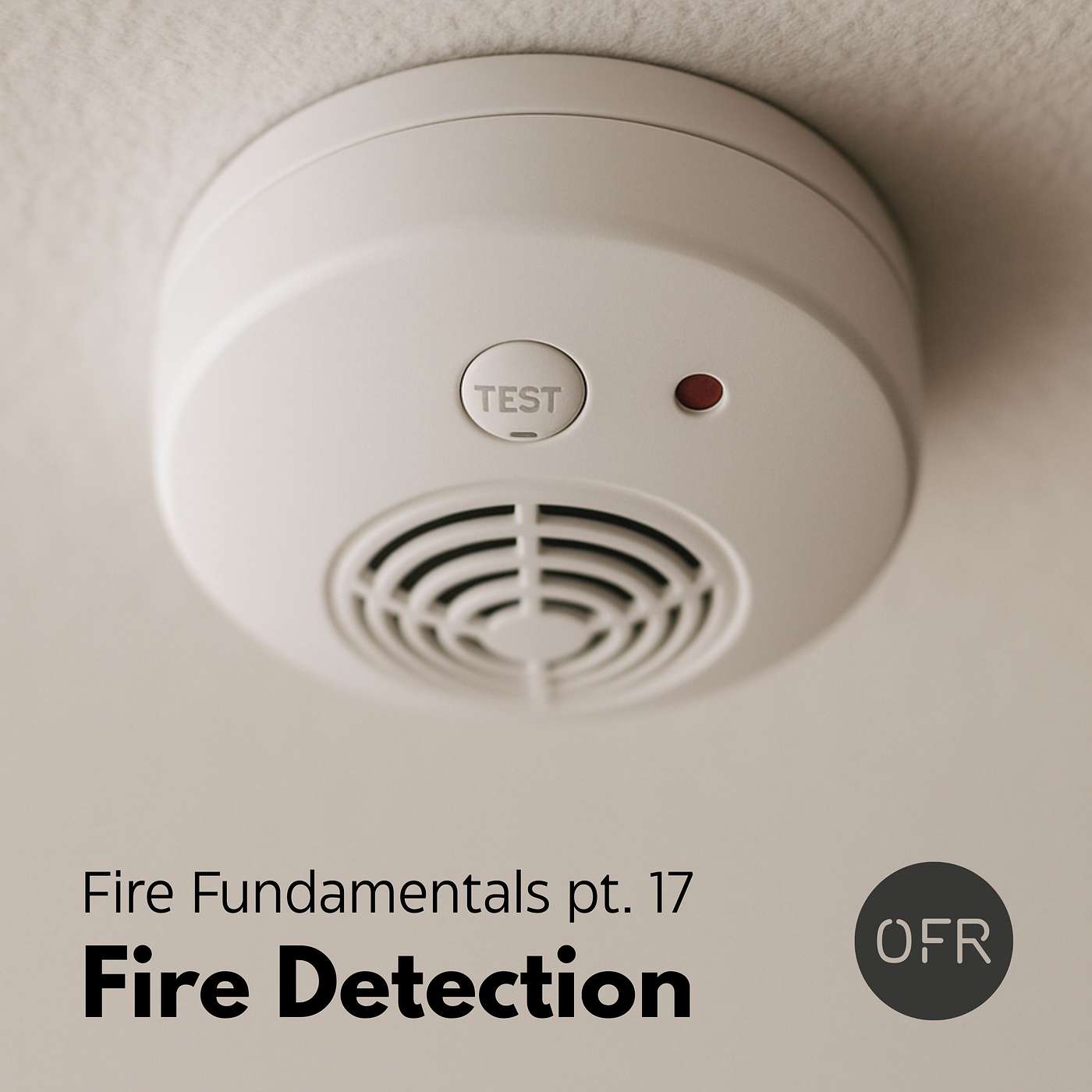
211 - Fire Fundamentals pt. 17 - Detecting fires

Fire Science Show

In episode 17 of the Fire Fundamentals, we delve into the fire detection technology. Fire detection forms the critical foundation of all active fire protection measures, serving as the prerequisite for any fire safety engineering solution to work effectively. Following key points are discussed:

  • Detection systems must balance sensitivity with reliability to avoid false alarms that disrupt building operations
  • False alarms lead to serious business continuity issues and may eventually cause systems to be disabled
  • Test fires methodology to assess sensor viability is discussed
  • Optical smoke detectors use light scattering principles to detect smoke particles in their detection chamber
  • Ionisation detectors utilise a small radioactive source creating an ionised environment in which an electrical current can be present, and gets disrupted by smoke
  • Heat detectors operate based on absolute temperature thresholds or rate-of-rise measurements
  • CO sensors complement other detection technologies to improve reliability and reduce false alarms
  • Line detectors (both optical and heat-based) provide coverage for large areas like atria and tunnels
  • Aspirating detection systems offer extremely early warning by continuously sampling air through pipes
  • Future technologies include camera-based detection with AI processing and thermal imaging
  • Strategies to reduce false alarms include multi-sensor devices, coincidence detection, and verification delays

Without detection, we're blind, and no automated systems may act—making fire detection critical for whatever application of fire safety engineering we implement.


----
The Fire Science Show is produced by the Fire Science Media in collaboration with OFR Consultants. Thank you to the podcast sponsor for their continuous support towards our mission.

2025-07-23 52 min Transcript 7 chapters

Available Results

Generated results are saved to the knowledge database for reuse and search.

No generated results are available for this episode yet.

Extract Knowledge

Pick what you want extracted first. Model, scope, and chapter options appear after a template is selected.

Generated results for public episodes are saved to the knowledge database so they can be reused and searched later.
WEBVTT

00:00:01.362 --> 00:00:03.189
<v Wojciech Wegrzynski>Hello everybody, welcome to the Fire Science Show.

00:00:03.189 --> 00:00:11.647
<v Wojciech Wegrzynski>Last week we had a pretty difficult episode on turbulence in fires and turbulent combustion with Randy McDermott.

00:00:11.647 --> 00:00:16.231
<v Wojciech Wegrzynski>That was something and I'm still thinking about stuff from that episode.

00:00:16.231 --> 00:00:23.474
<v Wojciech Wegrzynski>This week I'll try to balance the difficulty of the podcast a little bit with a more easygoing episode.

00:00:23.474 --> 00:00:30.266
<v Wojciech Wegrzynski>Easy spiel means it's highly relevant, it's highly impactful on the world of fire safety engineering.

00:00:30.266 --> 00:00:39.021
<v Wojciech Wegrzynski>It's just going to be on a more approachable technical level to everyone and we are going to talk about smoke detection and fire detection in general.

00:00:39.622 --> 00:00:51.593
<v Wojciech Wegrzynski>I've never had an episode on the detection technology in fire safety engineering and yet it is one of the overwhelmingly important technologies that we have to fight fires in our space.

00:00:51.593 --> 00:01:00.365
<v Wojciech Wegrzynski>If you do not detect a fire in the building, if you have no clue that a fire is ongoing, there is nothing you can do about that fire.

00:01:00.365 --> 00:01:13.543
<v Wojciech Wegrzynski>So, in fact, successful detection of the fire is the prerequisite to any fire safety engineering solution that has to change the outcomes of the fire in the building perhaps minus passive fire protection, of course.

00:01:13.543 --> 00:01:20.344
<v Wojciech Wegrzynski>But for anything that's active, that's supposed to work inside of the fire, you first have to detect it.

00:01:20.344 --> 00:01:27.454
<v Wojciech Wegrzynski>In this episode I will walk you through the different types of sensors that we are using in FIARs.

00:01:27.454 --> 00:01:30.465
<v Wojciech Wegrzynski>So we will talk about smoke and heat sensors.

00:01:30.465 --> 00:01:32.108
<v Wojciech Wegrzynski>We'll be talking about point detectors.

00:01:32.108 --> 00:01:34.233
<v Wojciech Wegrzynski>We'll be talking about line detectors.

00:01:34.233 --> 00:01:40.611
<v Wojciech Wegrzynski>I'll try to talk about the technologies that are used in those detectors and their principles of operations.

00:01:40.611 --> 00:01:52.194
<v Wojciech Wegrzynski>They're pretty simple, but yet I think there's an immense value in understanding how they work exactly, because that allows you to apply them to different situations.

00:01:52.194 --> 00:02:03.188
<v Wojciech Wegrzynski>We'll also talk about false alarms and how we can prevent false alarms and why, actually, this is one of the most important aspects of designing a detection system.

00:02:03.188 --> 00:02:18.228
<v Wojciech Wegrzynski>All of this in the context of a building fire, of course, but I'll have something in the end for the Wildfire colleagues as well, because we will, in the end of the episode, talk about some future technologies, which include camera detection systems and AI and thermal cameras, etc.

00:02:18.228 --> 00:02:22.711
<v Wojciech Wegrzynski>So there's still something for everyone in this episode, I hope.

00:02:22.711 --> 00:02:27.784
<v Wojciech Wegrzynski>I guess this gets the spirit of what I'm going to talk in this particular Firesize Show.

00:02:27.784 --> 00:02:40.323
<v Wojciech Wegrzynski>My name is Wojciech Wigrzynski and I will be your host.

00:02:56.314 --> 00:03:09.834
<v Wojciech Wegrzynski>The FireSense show is into its third year of continued support from its sponsor of our consultants, who are an independent, multi-award winning fire engineering consultancy with a reputation for delivering innovative safety-driven solutions.

00:03:09.834 --> 00:03:23.544
<v Wojciech Wegrzynski>As the UK leading independent fire risk consultancy, ofar's globally established team, have developed a reputation for preeminent fire engineering expertise, with colleagues working across the world to help protect people, property and the plant.

00:03:23.544 --> 00:03:39.652
<v Wojciech Wegrzynski>Established in the UK in 2016 as a startup business by two highly experienced fire engineering consultants, the business continues to grow at a phenomenal rate, with offices across the country in eight locations, from Edinburgh to Bath, and plans for future expansions.

00:03:39.652 --> 00:03:48.229
<v Wojciech Wegrzynski>If you're keen to find out more or join OFR Consultants during this exciting period of growth, visit their website at ofrconsultantscom.

00:03:48.229 --> 00:03:50.331
<v Wojciech Wegrzynski>And now back to the episode.

00:03:50.331 --> 00:03:53.195
<v Wojciech Wegrzynski>Okay, fire and smoke detection 101, let's go.

00:03:58.259 --> 00:04:00.546
<v Wojciech Wegrzynski>Detecting fires in the buildings was perhaps the first thing that fascinated me in fire safety engineering.

00:04:00.546 --> 00:04:24.091
<v Wojciech Wegrzynski>It was my first years of university when we were learning about those types of systems, and I really, really, really enjoyed those classes and learning about how different sensors can pick up signals and how do they work, how do they operate, how do we connect them all together into one big system that actually can make some decisions inside of a fire automatically, reliably and without causing too much trouble in the building.

00:04:24.091 --> 00:04:31.310
<v Wojciech Wegrzynski>I've also, back then, learned that it's not just about being as sensitive to the fire as possible.

00:04:31.310 --> 00:04:41.261
<v Wojciech Wegrzynski>It's about balancing the sensitivity with some sort of specificity and reliability in terms of not creating too much false alarms.

00:04:41.261 --> 00:04:43.326
<v Wojciech Wegrzynski>But we'll reach that Eventually.

00:04:43.326 --> 00:04:52.944
<v Wojciech Wegrzynski>I even wrote a bachelor thesis on smoke alarm systems, but then I discovered the world of CFD compartment fires, smoke control, and here I am.

00:04:52.944 --> 00:04:55.913
<v Wojciech Wegrzynski>Never realized my passion to smoke alarm systems.

00:04:55.913 --> 00:05:00.024
<v Wojciech Wegrzynski>Perhaps today is a chance to redeem myself in there.

00:05:00.024 --> 00:05:06.115
<v Wojciech Wegrzynski>I said it's an art of balancing the sensitivity with other factors and indeed that's the case.

00:05:06.822 --> 00:05:11.812
<v Wojciech Wegrzynski>We cannot make the sensors as sensitive as possible.

00:05:11.812 --> 00:05:14.709
<v Wojciech Wegrzynski>That's not the point of creating a detection technology.

00:05:14.709 --> 00:05:24.675
<v Wojciech Wegrzynski>We are a pretty advanced technological civilization and we really can sense stuff at very low quantities fairly easily.

00:05:24.675 --> 00:05:29.543
<v Wojciech Wegrzynski>Sense stuff at very low quantities fairly easily.

00:05:29.543 --> 00:05:31.670
<v Wojciech Wegrzynski>It's not a big problem to sense if a smoke or any other aerosol is in the air.

00:05:31.670 --> 00:05:36.281
<v Wojciech Wegrzynski>It's not a problem to pick up a very minute change in the temperature in a space.

00:05:36.281 --> 00:05:40.651
<v Wojciech Wegrzynski>You can also apply a lot of remote sensing technologies out there.

00:05:40.651 --> 00:05:42.601
<v Wojciech Wegrzynski>They're available, they exist.

00:05:42.601 --> 00:05:43.946
<v Wojciech Wegrzynski>They can be very sensitive.

00:05:44.586 --> 00:05:50.932
<v Wojciech Wegrzynski>The thing is you need to be able to distinguish whether the source of the disturbance that you have just noticed measured.

00:05:50.932 --> 00:05:52.322
<v Wojciech Wegrzynski>Is it a fire?

00:05:52.322 --> 00:05:53.504
<v Wojciech Wegrzynski>Is it a hazard?

00:05:53.504 --> 00:05:54.887
<v Wojciech Wegrzynski>What kind of a hazard is it?

00:05:54.887 --> 00:06:00.483
<v Wojciech Wegrzynski>Is it enough to trigger all the things that happen in the building?

00:06:00.483 --> 00:06:04.492
<v Wojciech Wegrzynski>And this is not something you can play down.

00:06:04.492 --> 00:06:24.567
<v Wojciech Wegrzynski>Those are serious things because if you think about a large building, let's say a shopping mall, if a fire alarm goes there and you actually confirm through the system that the alarm isn't going, you will trigger a specific sequence of actions that will happen in the building.

00:06:24.567 --> 00:06:33.879
<v Wojciech Wegrzynski>I had an entire fire science show episode on what happens inside of a building through the building fire automation in a case of a fire.

00:06:33.879 --> 00:06:38.271
<v Wojciech Wegrzynski>So you can go to that episode and refer to this exact sequence of operations.

00:06:38.399 --> 00:06:47.487
<v Wojciech Wegrzynski>But, in short, you will steer everything in the building to be ready for this fire hazard to happen, which means evacuating people.

00:06:47.487 --> 00:06:50.829
<v Wojciech Wegrzynski>For example, evacuating shopping mall is not a simple thing.

00:06:50.829 --> 00:06:52.526
<v Wojciech Wegrzynski>Evacuating an office is not a simple thing.

00:06:52.526 --> 00:06:55.810
<v Wojciech Wegrzynski>It creates immense business disturbance, immense.

00:06:55.810 --> 00:07:11.850
<v Wojciech Wegrzynski>You will turn off all of your air conditioning because you have to put HVAC systems into state of operation that they will not spread the smoke through the building, that they will shut down all the dumpers that needs to be shot.

00:07:11.850 --> 00:07:17.232
<v Wojciech Wegrzynski>This means all your climate control has to be turned off and those things take time.

00:07:17.232 --> 00:07:26.074
<v Wojciech Wegrzynski>They take time to be shut down, but they also will take a lot of time to be restarted, once you figure out your fire was actually a false alarm.

00:07:26.600 --> 00:07:37.146
<v Wojciech Wegrzynski>If you have restaurants in your shopping mall or you just have some cafeteria, perhaps they have a gas supply to cook on gas on stoves.

00:07:37.146 --> 00:07:38.290
<v Wojciech Wegrzynski>Well, guess what?

00:07:38.290 --> 00:07:39.512
<v Wojciech Wegrzynski>The gas is going to be shut off.

00:07:39.512 --> 00:07:45.112
<v Wojciech Wegrzynski>It takes quite a while to restart this source of fuel for them.

00:07:45.112 --> 00:07:54.850
<v Wojciech Wegrzynski>So a lot of little things will happen in the building which tremendously impact the ability of the building to perform the function that it was supposed to do.

00:07:54.850 --> 00:07:59.451
<v Wojciech Wegrzynski>If this happens once, everyone's going to be happy that it was not a fire.

00:07:59.451 --> 00:08:03.670
<v Wojciech Wegrzynski>Everyone's going to go on with their lives and nothing really changes.

00:08:03.670 --> 00:08:16.384
<v Wojciech Wegrzynski>If it's going to happen a few times, people will start being annoyed with that because those will be serious losses due to how the business continuity in that building is affected.

00:08:16.946 --> 00:08:23.045
<v Wojciech Wegrzynski>And if, for some reason, this happens let's say every week or every day it's going to be unbearable.

00:08:23.045 --> 00:08:27.293
<v Wojciech Wegrzynski>Like people will do anything to stop that.

00:08:27.293 --> 00:08:32.736
<v Wojciech Wegrzynski>Best case, they will implement some delays or perhaps some strategies to mitigate.

00:08:32.736 --> 00:08:46.212
<v Wojciech Wegrzynski>Worst case, they will just turn off the system and you may lose the entire beautifully designed smoke alarm system that is a prerequisite for automated actions in the building in case of a fire.

00:08:46.212 --> 00:08:54.802
<v Wojciech Wegrzynski>Therefore, preventing false alarm is not just a nuisance, it's not just something we like to do because it's in the book.

00:08:54.802 --> 00:09:00.220
<v Wojciech Wegrzynski>It truly is tremendously important for managing healthy fire safety.

00:09:00.220 --> 00:09:02.085
<v Wojciech Wegrzynski>Engineered solutions in your building.

00:09:02.085 --> 00:09:15.974
<v Wojciech Wegrzynski>If you don't do that, if you allow false alarms to happen, safety engine solutions in your building If you don't do that, if you allow false alarms to happen, you will end up with system that is about to get turned off or will be fiddled by the user in such a way that it doesn't disturb them anymore.

00:09:15.994 --> 00:09:20.186
<v Wojciech Wegrzynski>I mean, relate to your own home, like if a sensor went out in your kitchen every time you cook.

00:09:20.186 --> 00:09:22.851
<v Wojciech Wegrzynski>That would be quite an annoying sensor, right?

00:09:22.851 --> 00:09:25.264
<v Wojciech Wegrzynski>It's the same thing, just the scale is different.

00:09:25.264 --> 00:09:54.988
<v Wojciech Wegrzynski>Therefore, being able to block those false alarms, to really make sure that the system is sensitive to the fire but it's not sensitive to other things happening in the building, it's not sensitive to the construction works, it's not sensitive to welding, it's not sensitive to steam, it's not sensitive to some other aerosols that can be found in the building, it's not sensitive to other things that will naturally be present in your building, that's the challenge.

00:09:55.008 --> 00:09:58.725
<v Wojciech Wegrzynski>That's the point where you want to reach, and we do that through multiple means.

00:09:58.725 --> 00:10:09.809
<v Wojciech Wegrzynski>One of them is to use sensors that are adequate to the hazards in your building, sensors that are responding to the specific threats that you will find in your buildings.

00:10:09.809 --> 00:10:22.885
<v Wojciech Wegrzynski>If you have a concrete corridor leading somewhere, there's a very low chance you're going to have a long-lasting smoldering in there because there's no fuel of that kind in that space.

00:10:22.885 --> 00:10:36.312
<v Wojciech Wegrzynski>If you have a road tunnel, you probably do not want to put optical sensors in there, which will be destroyed by the fumes and very aggressive environment in the tunnel.

00:10:36.312 --> 00:10:39.429
<v Wojciech Wegrzynski>You may perhaps wish to use temperature sensors.

00:10:39.429 --> 00:10:52.408
<v Wojciech Wegrzynski>These are the tools that we have, and there are also things that you can do to the logic of detection that improve that, so that it's not just one signal that triggers the fire alarm state in your building, but much more has to happen.

00:10:52.820 --> 00:10:56.390
<v Wojciech Wegrzynski>So let's perhaps move into the sensor technologies.

00:10:56.390 --> 00:11:06.288
<v Wojciech Wegrzynski>I've kind of grouped them into groups of point detectors, line detectors, and we'll briefly talk about aspirating sensors in the end.

00:11:06.288 --> 00:11:08.722
<v Wojciech Wegrzynski>So let's try and take them one by one.

00:11:08.722 --> 00:11:18.772
<v Wojciech Wegrzynski>So if you visualize a smoke sensor in your mind, or if you google a smoke sensor, you'll probably end up with a round white object that you put on the ceiling.

00:11:18.772 --> 00:11:27.743
<v Wojciech Wegrzynski>This is a point sensor and this is a device that protects or detects fires in a very specific space in which it's installed.

00:11:27.743 --> 00:11:31.692
<v Wojciech Wegrzynski>It can cover multiple square meters of your building and provide detection.

00:11:31.692 --> 00:11:51.690
<v Wojciech Wegrzynski>Of course, that depends on the height of the building and other factors which we'll not talk about here, but the point is that it's one point in space that is covered by this point sensor, and there would be different technologies of those detectors that can be routinely used in your buildings.

00:11:51.690 --> 00:12:00.123
<v Wojciech Wegrzynski>For us in Poland, the most prevalent technology or perhaps the default technology, you may say is optical smoke sensors.

00:12:00.123 --> 00:12:12.009
<v Wojciech Wegrzynski>So those would be the most used sensors everywhere, basically your first sensor to go for most of the applications, really, and I actually wonder if it's the same worldwide.

00:12:12.009 --> 00:12:20.331
<v Wojciech Wegrzynski>So if different sensors are typically used in your spaces, let me know, because I'm actually curious now whether this is true for the rest of the world.

00:12:21.240 --> 00:12:26.572
<v Wojciech Wegrzynski>The optical sensors they detect the optical characteristics of the smoke.

00:12:26.572 --> 00:12:37.768
<v Wojciech Wegrzynski>So if you have a source of fire that is not really producing any smoke, like fire of metalated spirits, for example, well, it's going to have a really hard time detecting that one.

00:12:37.768 --> 00:12:50.955
<v Wojciech Wegrzynski>The sensor operates first of all, if you look at the smoke sensor, it obviously has holes in it which allow the smoke to penetrate into the detection chamber inside the sensor.

00:12:50.955 --> 00:13:10.826
<v Wojciech Wegrzynski>In the case of an optical sensor, the detection chamber includes a source of light or some other signal close to light infrared, ultraviolet which would usually be an led diode today and it also has a receiver of that light which is a photodiode.

00:13:10.826 --> 00:13:23.948
<v Wojciech Wegrzynski>So photodiode is basically a device that when a light touches the photodiode, the electrons are kicked off the matrix and they're picked up as an electrical signal, so basically turns light into an electrical signal.

00:13:23.948 --> 00:13:26.500
<v Wojciech Wegrzynski>So basically it turns light into an electrical signal.

00:13:26.500 --> 00:13:30.471
<v Wojciech Wegrzynski>So you can say that a light has reached the photodiode.

00:13:30.471 --> 00:13:38.248
<v Wojciech Wegrzynski>So inside that small sensor it's not that the LED is pointing on the photodiode, it's actually quite the opposite.

00:13:38.248 --> 00:13:41.589
<v Wojciech Wegrzynski>There is they like to call it a labyrinth.

00:13:41.589 --> 00:13:50.967
<v Wojciech Wegrzynski>I guess the way how the interior of the sensor is structured is that the photodiode cannot see the light source at all.

00:13:50.967 --> 00:13:56.605
<v Wojciech Wegrzynski>In normal operations there are some obstacles inside the way.

00:13:56.605 --> 00:14:01.923
<v Wojciech Wegrzynski>How those devices are positioned against each other, usually at the right degree angle.

00:14:01.923 --> 00:14:06.493
<v Wojciech Wegrzynski>It doesn't allow to shine the light directly from the LED on the photodiode.

00:14:07.240 --> 00:14:20.460
<v Wojciech Wegrzynski>Now, when the fire happens, when the smoke is present in the air or some other aerosol is present in the air, the aerosols will start scattering the light, and the same happens inside the smoke sensor.

00:14:20.460 --> 00:14:25.048
<v Wojciech Wegrzynski>So if the smoke enters the detector, it starts scattering the light inside of the sensor.

00:14:25.048 --> 00:14:31.730
<v Wojciech Wegrzynski>So if the smoke enters the detector, it starts scattering the light inside of the sensor and suddenly the light is able to reach the photodiode.

00:14:31.730 --> 00:14:43.166
<v Wojciech Wegrzynski>So it starts picking up an electrical signal, which means there is something inside the smoke detector that allowed for this light to reach the sensor.

00:14:43.166 --> 00:14:46.360
<v Wojciech Wegrzynski>And this is basically the principle of operation.

00:14:46.360 --> 00:14:57.327
<v Wojciech Wegrzynski>Now, how to make sure that this is a signal coming from the fire and not just from steam or dust or other aerosol that can be in the air?

00:14:57.327 --> 00:14:59.572
<v Wojciech Wegrzynski>Now that is the part of the challenge.

00:15:00.159 --> 00:15:06.472
<v Wojciech Wegrzynski>Luckily, the smoke from fires has quite a repetitive characteristic.

00:15:06.472 --> 00:15:12.211
<v Wojciech Wegrzynski>I would say especially that we're talking about smoke from early fires in here.

00:15:12.211 --> 00:15:16.431
<v Wojciech Wegrzynski>Detection happens in the earliest phases of fires in the buildings.

00:15:16.431 --> 00:15:21.331
<v Wojciech Wegrzynski>Therefore, we can quite well define the characteristics of the smoke.

00:15:21.331 --> 00:15:24.479
<v Wojciech Wegrzynski>Those characteristics would be the size of the smoke particles, the shape of the smoke particles, the distribution of the smoke.

00:15:24.479 --> 00:15:42.302
<v Wojciech Wegrzynski>Those characteristics would be the size of the smoke particles, the shape of the smoke particles, the distribution of that size, when you know that you're also able to tell how these particles will interact with the light, how the scattering will happen, and for that you can pick a very specific wavelength that will actually interfere with those particles the best.

00:15:42.302 --> 00:15:54.884
<v Wojciech Wegrzynski>And then you get a system that actually picks up those particles that you are interested in and kind of goes around the particles that you're not interested in like dust.

00:15:55.244 --> 00:16:02.726
<v Wojciech Wegrzynski>That would be an overly simplified explanation of how you can make it specific to the fire smoke.

00:16:02.726 --> 00:16:13.352
<v Wojciech Wegrzynski>Of course that's a hell of a science, that's a hell of a research and development to actually reach that point at which your sensor is highly specific to the fire smoke.

00:16:13.352 --> 00:16:19.610
<v Wojciech Wegrzynski>This type of sensor will be very good at picking up smoke coming from flaming combustion.

00:16:19.610 --> 00:16:35.293
<v Wojciech Wegrzynski>It will be very good to picking up particles from smoldering combustion, perhaps even better from smoldering than flaming, because you're going to have much more smoke from smoldering per megawatt or per kilowatt released than you have from a flaming fire.

00:16:35.293 --> 00:16:50.369
<v Wojciech Wegrzynski>As said before, it could perhaps have difficulties picking up fires in which not that much smoke is generated and perhaps at this point you wonder how do we know that it actually responds to those fires and that it's fit to those fires.

00:16:51.030 --> 00:16:51.130
<v Wojciech Wegrzynski>One.

00:16:51.130 --> 00:16:55.528
<v Wojciech Wegrzynski>The research and development of a manufacturer will definitely investigate that.

00:16:55.528 --> 00:17:01.346
<v Wojciech Wegrzynski>So they deliver a sensor that can detect fires and make sure that it picks up the right wires.

00:17:01.346 --> 00:17:11.094
<v Wojciech Wegrzynski>But during the certification stage of a smoke sensor, and in Europe there is a whole series of standards called EN54.

00:17:11.094 --> 00:17:16.647
<v Wojciech Wegrzynski>And those are all types of standards for different smoke and heat detection technologies.

00:17:16.647 --> 00:17:34.321
<v Wojciech Wegrzynski>Within those standards there's one standard particularly POT7, which kind of defines how do we test those sensors, that they're applicable to different types of fires, and we test them through something that we call the test fires TFs.

00:17:34.482 --> 00:17:36.951
<v Wojciech Wegrzynski>You perhaps heard the term test fire before.

00:17:36.951 --> 00:17:48.845
<v Wojciech Wegrzynski>The test fires is basically a test in which we put a smoke sensor inside quite a large room, which we put a smoke sensor inside quite a large room.

00:17:48.845 --> 00:17:51.494
<v Wojciech Wegrzynski>Mine is 10 by 10 by 4 meters and I think that's the standardized dimension of this room that you're supposed to have.

00:17:51.494 --> 00:17:56.027
<v Wojciech Wegrzynski>So it's a pretty large chamber in which you can start off a fire.

00:17:56.027 --> 00:18:13.011
<v Wojciech Wegrzynski>And what you do is very simple you start off the fires, you measure the environment with your calibrated high-precision instrumentation in the chamber and then you check how soon into that fire, that standardized fire, the smoke sensor picked up the signal.

00:18:13.011 --> 00:18:13.753
<v Wojciech Wegrzynski>As simple as that.

00:18:14.339 --> 00:18:17.048
<v Wojciech Wegrzynski>We have different test fires, different TFs.

00:18:17.048 --> 00:18:20.930
<v Wojciech Wegrzynski>So test fire one would be a cellulosic wood fire.

00:18:20.930 --> 00:18:36.421
<v Wojciech Wegrzynski>It's burning wood that produces visible smog with some large particles, moderate heat output, and that's pretty much a test to confirm that the sensor can pick up cellulosic fires.

00:18:36.421 --> 00:18:38.965
<v Wojciech Wegrzynski>There is TF2, smoldering wood.

00:18:38.965 --> 00:18:48.141
<v Wojciech Wegrzynski>That's a slower fire in which the blocks of timber are actually smoldering or pyrolyzing without visible flames.

00:18:48.141 --> 00:18:53.411
<v Wojciech Wegrzynski>This has very, very low heat output but produces quite a lot of smoke.

00:18:53.411 --> 00:18:56.403
<v Wojciech Wegrzynski>We have tf3, which is smoldering cotton fire.

00:18:56.403 --> 00:19:14.000
<v Wojciech Wegrzynski>So in here we are, instead of wood we're using cotton rope, and also you start it by initiating smoldering of that cotton rope and then it's basically burns through in a smoldering fire, creating a lot of smoke and literally no heat at all.

00:19:14.842 --> 00:19:16.926
<v Wojciech Wegrzynski>We have a flaming polyurethane fire.

00:19:16.926 --> 00:19:17.847
<v Wojciech Wegrzynski>That's tf4.

00:19:17.847 --> 00:19:23.584
<v Wojciech Wegrzynski>So you take a pieces of polyurethane foam, you put them on the fire, so that's a high heat output.

00:19:23.584 --> 00:19:30.454
<v Wojciech Wegrzynski>That's a lot of dark smoke, big particles, very dark particles, so quite rapid fire development.

00:19:30.454 --> 00:19:33.163
<v Wojciech Wegrzynski>We have TestFire 5.

00:19:33.365 --> 00:19:34.807
<v Wojciech Wegrzynski>That's an heptane fire.

00:19:34.807 --> 00:19:38.982
<v Wojciech Wegrzynski>That's probably the most fun to run, actually, because heptane fires are quite big.

00:19:38.982 --> 00:19:42.329
<v Wojciech Wegrzynski>Heptane is a very interesting kind of a fuel.

00:19:42.329 --> 00:19:45.696
<v Wojciech Wegrzynski>It leads to very high, very tall, very big fires.

00:19:45.696 --> 00:19:48.021
<v Wojciech Wegrzynski>So it's a liquid fire test.

00:19:48.021 --> 00:19:57.163
<v Wojciech Wegrzynski>Obviously that's a lot of heat, very big fire plume, but actually not that much visible smoke from the heptane itself.

00:19:57.163 --> 00:20:11.419
<v Wojciech Wegrzynski>There's a little pinch of toluene in the heptane to increase the amount of smoke produced, but still it's not a huge amount of smoke, at least compared to the polar retain foam.

00:20:11.439 --> 00:20:13.782
<v Wojciech Wegrzynski>Really, in some specific cases there are other tests.

00:20:13.782 --> 00:20:20.928
<v Wojciech Wegrzynski>We have TF6, which are methylated spirits, so it's a high heat signature but doesn't produce a lot of smoke at all.

00:20:20.928 --> 00:20:24.691
<v Wojciech Wegrzynski>So that's very challenging for some of the sensor technologies.

00:20:24.691 --> 00:20:29.893
<v Wojciech Wegrzynski>And there's also TF8, low smoldering fire.

00:20:29.893 --> 00:20:38.978
<v Wojciech Wegrzynski>But basically those are the types of standardized test fires in which we are capable of confirming that the sensor is able to pick them.

00:20:38.978 --> 00:20:41.564
<v Wojciech Wegrzynski>There's also tests in a smoke tunnel.

00:20:41.564 --> 00:20:55.251
<v Wojciech Wegrzynski>We also have a smoke tunnel in which you would check whether changing the direction or orientation of the sensors against the flow of air will change the sensitivity, where we use paraffinium aerosols to trigger the sensors.

00:20:55.251 --> 00:21:07.644
<v Wojciech Wegrzynski>But basically TF's test fires allow you to confirm that the sensor that is ongoing through tests is actually capable of detecting a particle fire, and you give them a class.

00:21:07.644 --> 00:21:09.128
<v Wojciech Wegrzynski>So that's also good.

00:21:09.819 --> 00:21:13.220
<v Wojciech Wegrzynski>Okay, the next on my list of point sensors are ionization sensors.

00:21:13.220 --> 00:21:16.611
<v Wojciech Wegrzynski>I think they used to be more popular in the past.

00:21:16.611 --> 00:21:27.351
<v Wojciech Wegrzynski>I'm not sure how popular they are today in your countries In Poland I would say there's not that many being used still, but still an important and relevant detection technology.

00:21:27.351 --> 00:21:37.752
<v Wojciech Wegrzynski>And we are actually using a certified ionization detector as a reference to the test fire test and to the smoke tunnel test.

00:21:37.752 --> 00:21:51.012
<v Wojciech Wegrzynski>So actually in the lab it's used a lot as your reference for the amount of smoke that is generated in those fires to confirm that the test fire that we've created is actually the one that we were supposed to expose the detector to.

00:21:51.640 --> 00:21:55.940
<v Wojciech Wegrzynski>Anyway, ionization smoke sensors works in a similar way as optical sensors.

00:21:55.940 --> 00:22:02.945
<v Wojciech Wegrzynski>So you have a point sensor, the smoke can enter the detection chamber and that detection chamber you of course do not have a light source.

00:22:02.945 --> 00:22:05.491
<v Wojciech Wegrzynski>You have a small radioactive source.

00:22:05.491 --> 00:22:12.733
<v Wojciech Wegrzynski>I've been told that it's typically americium-241 as the element that creates the radiation.

00:22:12.733 --> 00:22:15.085
<v Wojciech Wegrzynski>It emits alpha particles.

00:22:15.085 --> 00:22:23.843
<v Wojciech Wegrzynski>So there's obviously different types of radiations alpha, beta, gamma but alpha are the big particles, so that's the one that's being emitted by this source.

00:22:24.384 --> 00:22:33.897
<v Wojciech Wegrzynski>Those particles fly through the air inside of a chamber, which creates a mix of positive ions and free electrons in that air mixture.

00:22:33.897 --> 00:22:46.923
<v Wojciech Wegrzynski>Basically, the air is ionized inside of the chamber hence the name ionization sensor and through this ionized air a small amount of electrical current is able to flow through the air.

00:22:46.923 --> 00:22:56.204
<v Wojciech Wegrzynski>So in a normal state, when the sensor is clean, there is basically a constant electrical current flowing through that ionization chamber.

00:22:56.204 --> 00:23:08.056
<v Wojciech Wegrzynski>Now, once this is disturbed by smoke entering that chamber, the smoke will interfere by the ionized air by attaching to those ions, obstructing their movement.

00:23:08.056 --> 00:23:14.251
<v Wojciech Wegrzynski>Basically physical and electrical interference to the ionized air inside of that chamber.

00:23:14.251 --> 00:23:22.465
<v Wojciech Wegrzynski>And as this disturbance to ionized air happens, the electrical current that was flowing through that ionized chamber changes.

00:23:22.465 --> 00:23:26.260
<v Wojciech Wegrzynski>And that's what is being picked up by the detector.

00:23:26.260 --> 00:23:37.073
<v Wojciech Wegrzynski>It's able to pick up the disturbance in the electrical signal that normally would be very stable, normally would be very controlled, but in presence of smoke it is disturbed.

00:23:37.700 --> 00:23:45.974
<v Wojciech Wegrzynski>It's technically a little bit more sensitive to some other disturbances moisture steam.

00:23:45.974 --> 00:23:53.769
<v Wojciech Wegrzynski>It's a little bit more difficult than optical sensor, I think, for the modern sensors to not be prone to those false alarms.

00:23:53.769 --> 00:24:02.527
<v Wojciech Wegrzynski>However, because of the way how this physics works, it's also super sensitive to small smoke particles.

00:24:02.527 --> 00:24:22.249
<v Wojciech Wegrzynski>So I would say it can pick up the smoke perhaps earlier than the optical sensor could, especially if we're talking about small smoke particles that are produced in the early stages of those flaming fires, like timber combustion, like pool fires, etc.

00:24:22.249 --> 00:24:27.548
<v Wojciech Wegrzynski>So those sensors definitely are very sensitive to those test fires.

00:24:27.548 --> 00:24:46.262
<v Wojciech Wegrzynski>415 that we've just talked about, the kind of downfall in the world of fire engineering, is obviously due to them having a radioactive source in them, which, well, people do not like to see a radioactivity warning on the devices they have in their homes.

00:24:46.262 --> 00:24:50.819
<v Wojciech Wegrzynski>So perhaps that's one of the reasons why they're not as used as today.

00:24:50.819 --> 00:24:58.554
<v Wojciech Wegrzynski>And I guess it's just easier and cheaper to produce those optical sensors nowadays compared to those ionization sensors.

00:24:58.554 --> 00:25:08.748
<v Wojciech Wegrzynski>So well, if you know better what's the reason of using less and less ionization sensors today in the world, let me know, but my bets would be on those two.

00:25:10.080 --> 00:25:13.111
<v Wojciech Wegrzynski>The next type of sensor I want to talk is heat sensors.

00:25:13.111 --> 00:25:17.146
<v Wojciech Wegrzynski>So, as the name says, they detect the heat.

00:25:17.146 --> 00:25:19.372
<v Wojciech Wegrzynski>They do not detect smoke itself.

00:25:19.372 --> 00:25:37.392
<v Wojciech Wegrzynski>They detect changes of heat in the air, which to some extent is related to the production of smoke, of course, and they are able to actually measure air temperature with quite high precision and detect very small changes in the temperature of the surroundings.

00:25:37.392 --> 00:25:45.586
<v Wojciech Wegrzynski>Now, of course, the problem is that not every change of a temperature in your building indicates a fire.

00:25:45.586 --> 00:26:04.833
<v Wojciech Wegrzynski>If you open a window on a very hot day and you suddenly let 40 degrees centigrade air into your very well air-conditioned apartment, you will have a steep increase in temperature in your compartment, but that doesn't mean that there was a fire happening in your building.

00:26:05.380 --> 00:26:08.445
<v Wojciech Wegrzynski>So two ways we can manage that.

00:26:08.445 --> 00:26:17.296
<v Wojciech Wegrzynski>Basically, we're measuring the temperature and we need to interpret when this change in the temperature is a fire and when it is not One.

00:26:17.296 --> 00:26:28.468
<v Wojciech Wegrzynski>We can define some threshold value, because there is probably a predefined temperature threshold at which you can say no at no really normal operations.

00:26:28.468 --> 00:26:31.012
<v Wojciech Wegrzynski>This temperature would be reached in my compartment.

00:26:31.012 --> 00:26:34.787
<v Wojciech Wegrzynski>Let it be 57 degrees centigrade.

00:26:34.787 --> 00:26:38.233
<v Wojciech Wegrzynski>It could be more than that Depends on the climate in which you are.

00:26:38.233 --> 00:26:45.423
<v Wojciech Wegrzynski>But you can define pretty much temperature that should never happen in your compartment and say, okay, you know what?

00:26:45.423 --> 00:26:52.833
<v Wojciech Wegrzynski>If this temperature happens, it means it's a fire inside of my building, because there's no other situation in which this temperature can be reached.

00:26:52.833 --> 00:27:05.974
<v Wojciech Wegrzynski>And to improve the sensitivity, it's not just the fixed temperature level at which you can trigger the alarm, you can also measure the rate of rise of that temperature.

00:27:05.974 --> 00:27:21.069
<v Wojciech Wegrzynski>So instead of just saying okay, the temperature needs to exceed 57 degrees, you can say, and if the growth of the temperature is larger than, let's say, 10 degrees per minute, it also means there's a fire, because the growth is just too fast.

00:27:21.069 --> 00:27:28.248
<v Wojciech Wegrzynski>It can only happen when the heat is suddenly released in my space and that usually means there's a fire in that space.

00:27:28.248 --> 00:27:33.491
<v Wojciech Wegrzynski>And this is something we really rely on in tunnel fire detection, for example.

00:27:33.491 --> 00:27:36.830
<v Wojciech Wegrzynski>Those are not point sensors, those would be line heat detectors.

00:27:36.830 --> 00:27:43.104
<v Wojciech Wegrzynski>But the principle of operation is the same In this case.

00:27:43.104 --> 00:27:48.156
<v Wojciech Wegrzynski>You measure the temperature and you would use some kind of logic to determine whether the detected signal is a fire or is not.

00:27:49.560 --> 00:27:50.301
<v Wojciech Wegrzynski>What kinds of fire?

00:27:50.301 --> 00:27:55.252
<v Wojciech Wegrzynski>This can pick, obviously, all types of flaming fires where heat is produced.

00:27:55.252 --> 00:28:04.344
<v Wojciech Wegrzynski>You don't really need a massive source of fire to heat up air to 50, 60 degrees in your room, especially that we assume that there will be quite a lot of sensors in the space.

00:28:04.344 --> 00:28:12.991
<v Wojciech Wegrzynski>They will be covering little pieces of your space, not one sensor per thousand square meters, so they will populate the building in a quite dense network.

00:28:12.991 --> 00:28:18.666
<v Wojciech Wegrzynski>So to pick up smoke above your fire is not actually that difficult.

00:28:18.666 --> 00:28:34.460
<v Wojciech Wegrzynski>You can actually play with a landmark piece of software called Detect, and with Detect you can put different types of fires inside and see at which height, at which distance from the fire, how quickly the fire will be detected by a heat sensor.

00:28:34.460 --> 00:28:36.868
<v Wojciech Wegrzynski>So yeah, go and play with that.

00:28:36.868 --> 00:28:45.330
<v Wojciech Wegrzynski>That's a great piece of fire engineering history out there that you can actually put into use for this particular problem.

00:28:45.330 --> 00:28:55.344
<v Wojciech Wegrzynski>While being able to detect the flaming fires, they will not be able to really pick up fires that do not produce heat Basically no temperature rise.

00:28:55.344 --> 00:28:59.142
<v Wojciech Wegrzynski>The sensor is blind to any type of fire.

00:28:59.142 --> 00:29:03.310
<v Wojciech Wegrzynski>So smoldering fires this will not work, unfortunately.

00:29:03.892 --> 00:29:13.247
<v Wojciech Wegrzynski>And the next technology which perhaps is kind of opposite, because this one is going to pick up smoldering fires pretty well, to be honest is the CO carbon monoxide sensors.

00:29:13.247 --> 00:29:19.741
<v Wojciech Wegrzynski>So carbon monoxide sensors would be normally used not for the purposes of fire.

00:29:19.741 --> 00:29:23.250
<v Wojciech Wegrzynski>They would be used as, basically, carbon monoxide sensors.

00:29:23.250 --> 00:29:34.730
<v Wojciech Wegrzynski>In Poland, people would heat the water in their homes with propane burners, and those in some specific ventilation conditions can create a lot of CO, which is quite deadly.

00:29:34.730 --> 00:29:40.980
<v Wojciech Wegrzynski>We have a lot of fatalities in the winter season in Poland due to failures of those systems.

00:29:40.980 --> 00:29:48.782
<v Wojciech Wegrzynski>So CO sensors are used here as just a life safety device to indicate that there's too much CO in the air that you are breathing.

00:29:49.484 --> 00:30:04.593
<v Wojciech Wegrzynski>In many buildings, in case of a fire, they are sometimes used as a secondary sensor to a smoke detector, so you would usually find them in multi-sensor fire detectors.

00:30:04.593 --> 00:30:11.722
<v Wojciech Wegrzynski>They will be combined with, let's say, optical and temperature sensor to create a very highly robust sensor technology.

00:30:11.722 --> 00:30:37.876
<v Wojciech Wegrzynski>The reason why CO is complementary to other sensors is that in some kinds of fires, especially when the combustion is not the most efficient and that is basically most types of smoldering combustion you would start producing a lot of carbon monoxide, and there is very little scenarios in your normal building which would produce carbon monoxide in such quantities.

00:30:37.876 --> 00:30:40.557
<v Wojciech Wegrzynski>So you don't really need a heat signature.

00:30:40.557 --> 00:30:43.123
<v Wojciech Wegrzynski>You don't really need smoke particles.

00:30:43.123 --> 00:30:58.154
<v Wojciech Wegrzynski>It's transparent gas in your air, co, which reaches the sensor, and the electrochemical detector that is in that sensor can pick that signature up and just report how much CO is present.

00:30:58.154 --> 00:31:15.846
<v Wojciech Wegrzynski>If you couple that with other signatures like temperature and opticals signature, then combining the outcomes of those three sensors can allow you to really quite reliably say that okay, this is a fire, this is not a, a nuisance alarm.

00:31:15.846 --> 00:31:18.701
<v Wojciech Wegrzynski>We need to trigger the alarm for the building.

00:31:18.701 --> 00:31:22.634
<v Wojciech Wegrzynski>So actually it's not primarily detection technology.

00:31:22.634 --> 00:31:33.924
<v Wojciech Wegrzynski>It's more like an addition to the previous detection technologies to reduce the number of false alarms and to improve the specificity of of the detection.

00:31:33.924 --> 00:31:46.808
<v Wojciech Wegrzynski>Regardless, a very useful technology and just as a life safety device to save people from dying from a faulty heating system, that's a brilliant technology that really, really saves lives.

00:31:47.460 --> 00:31:51.486
<v Wojciech Wegrzynski>And the last type of point sensor technology that I wanted to talk about are flame sensors.

00:31:51.486 --> 00:32:04.253
<v Wojciech Wegrzynski>So flame sensors are basically point detectors which have some sort of a detector that is able to detect specific wavelengths of light that can be associated with fires.

00:32:04.253 --> 00:32:13.355
<v Wojciech Wegrzynski>So you would have some specific ultraviolet wavelengths that are very specific to flaming combustion and clean fires of hydrocarbons.

00:32:13.355 --> 00:32:20.041
<v Wojciech Wegrzynski>You would have infrared radiation that's emitted from the CO2 produced in flames actually.

00:32:20.041 --> 00:32:35.242
<v Wojciech Wegrzynski>So it gives quite a specific wavelength signature that indicates that the combustion process is ongoing and CO2 is involved, and you may also have different wavelengths in the visible light spectrum actually, if you would like.

00:32:35.242 --> 00:32:44.476
<v Wojciech Wegrzynski>And they also use signal processing to figure out what is the characteristic of this wavelength that's picked up.

00:32:44.476 --> 00:32:59.335
<v Wojciech Wegrzynski>So the flames would flicker, the flames would have this turbulent nature that we've discussed in the previous episode, and there are some frequencies related to to fires which the sensor is especially sensitive to.

00:32:59.335 --> 00:33:02.568
<v Wojciech Wegrzynski>So they basically observe you can use term.

00:33:02.568 --> 00:33:24.530
<v Wojciech Wegrzynski>So they're not cameras but their senses, but they basically observe a space in front of that sensor and they just pick up this wavelengths, pick up how the wavelength characteristic changes over time and if this characteristic is something they would associate with a fire, then they would issue a signal that the fire is present.

00:33:24.530 --> 00:33:29.799
<v Wojciech Wegrzynski>And you would like to use those in spaces in which you have to protect a larger area.

00:33:29.799 --> 00:33:40.930
<v Wojciech Wegrzynski>So you can imagine that if this detector doesn't take long to reach the threshold, if the fire is present and it just observes the fire and it meets the characteristic, it just triggers on.

00:33:40.930 --> 00:33:43.367
<v Wojciech Wegrzynski>So it can be very quick detection.

00:33:44.019 --> 00:33:51.988
<v Wojciech Wegrzynski>If you have space in which you're expecting a flaming fire and perhaps you're not able to use different sensor technology, this could be a very good solution.

00:33:51.988 --> 00:33:56.111
<v Wojciech Wegrzynski>It's obviously not going to work for your smoldering fires.

00:33:56.111 --> 00:33:57.330
<v Wojciech Wegrzynski>There's no way it can work for your small ring fires.

00:33:57.330 --> 00:33:58.922
<v Wojciech Wegrzynski>There's no way it can work for small ring fires.

00:33:58.922 --> 00:34:11.496
<v Wojciech Wegrzynski>However, in some applications it can actually be useful to pick up the methylated spirit fires, which otherwise is a very difficult test fire to actually pass through.

00:34:11.496 --> 00:34:32.574
<v Wojciech Wegrzynski>Those sensors would be used in highly specific, usually, usually industrial environments where you could expect just those emissions, maybe aircraft, hangars, and perhaps they would be useful in some sort of outdoor fire detection, because you can cover a large space with a single detector, if you like that.

00:34:32.574 --> 00:34:38.672
<v Wojciech Wegrzynski>So that would summarize the point sensor technology that I wanted to discuss.

00:34:39.260 --> 00:34:40.943
<v Wojciech Wegrzynski>Now let's move to line detectors.

00:34:40.943 --> 00:34:52.842
<v Wojciech Wegrzynski>So, unlike the point detector, the line detectors usually have some sort of emitter and receiver and between them there's a long line, and that's how optical line detectors work.

00:34:52.842 --> 00:35:03.652
<v Wojciech Wegrzynski>So you basically imagine you have a big atrium of your building or you have an airport and you want to cover a large area of space with, hopefully, a single detector.

00:35:03.652 --> 00:35:20.949
<v Wojciech Wegrzynski>So basically, on one wall of your giant atrium you put an emitter of light, on the other end of the atrium you put a receiver of the light Usually, actually, the receiver and emitter is within the same box and you just put a mirror on the other side.

00:35:20.949 --> 00:35:23.588
<v Wojciech Wegrzynski>That kind of improves the sensitivity of the sensor.

00:35:23.588 --> 00:35:38.181
<v Wojciech Wegrzynski>That's a neat trick to actually improve the sensitivity, but anyway, the light travels across your atrium back to the detector and the change in the characteristic of that light is something that triggers the fire alarm.

00:35:38.181 --> 00:35:41.648
<v Wojciech Wegrzynski>In this case they do not really work a little bit.

00:35:41.648 --> 00:36:02.007
<v Wojciech Wegrzynski>They work a little bit in scattering, but what really happens is that light is absorbed as the light travels through the space in which you are evaluating whether the fire is present in there or not, and as the light is absorbed by the smoke, the sensor picks the change in the signal and can tell okay, light has been absorbed.

00:36:02.007 --> 00:36:04.860
<v Wojciech Wegrzynski>It matches the characteristics of the smoke.

00:36:04.860 --> 00:36:06.784
<v Wojciech Wegrzynski>There's a fire inside that building.

00:36:07.827 --> 00:36:13.288
<v Wojciech Wegrzynski>The obvious benefit of that sensor is that you can cover a large space with the sensor.

00:36:13.288 --> 00:36:23.371
<v Wojciech Wegrzynski>The downside is that it is perhaps a little less sensitive to smoke than point detectors would be, so you'd normally need a little bit more smoke to trigger those.

00:36:23.371 --> 00:36:28.340
<v Wojciech Wegrzynski>Also, you need to place them in the correct locations.

00:36:28.340 --> 00:36:40.487
<v Wojciech Wegrzynski>If you place them too low in your space, not underneath the ceiling, it's going to create challenges because you would have to hit the line of light with your smoke plume, which doesn't necessarily always happen.

00:36:40.487 --> 00:36:45.704
<v Wojciech Wegrzynski>So you need to know how to install those to provide the best protection.

00:36:45.704 --> 00:36:56.900
<v Wojciech Wegrzynski>But if you do them well, you can actually cover large areas of a building with a single detector, which is obviously a huge benefit to the project that you're doing.

00:36:56.900 --> 00:37:14.490
<v Wojciech Wegrzynski>And perhaps in case of Atria or other, like big spaces, using an array of point sensors on the ceiling would be very, very difficult to manage, maintain, to actually have them in a useful state through the entire life cycle of a building.

00:37:15.721 --> 00:37:19.552
<v Wojciech Wegrzynski>Another type of a line sensor are linear heat detectors.

00:37:19.552 --> 00:37:25.992
<v Wojciech Wegrzynski>This is a technology that we love because this is the technology that you are using in your tunnels.

00:37:25.992 --> 00:37:30.771
<v Wojciech Wegrzynski>In the tunnel environment you don't really want any point sensors.

00:37:30.771 --> 00:37:35.931
<v Wojciech Wegrzynski>It's hard to have optical sensors because of the corrosive environment that you're working with.

00:37:35.931 --> 00:37:40.244
<v Wojciech Wegrzynski>It's just very harsh for any sensor technology.

00:37:40.244 --> 00:37:48.025
<v Wojciech Wegrzynski>So you really want something that's robust, that's reliable, and linear heat detectors are a technology like that.

00:37:48.025 --> 00:37:51.521
<v Wojciech Wegrzynski>There are multiple types of linear heat detectors.

00:37:51.521 --> 00:38:02.440
<v Wojciech Wegrzynski>Perhaps we're going to do a whole linear heat detector episode with Kuba, because we are just about to get the paper published on the disturbances to linear heat detectors in tunnels.

00:38:02.440 --> 00:38:06.050
<v Wojciech Wegrzynski>So that's a field of science that I'm very excited about.

00:38:06.719 --> 00:38:18.619
<v Wojciech Wegrzynski>Basically, you have either optical sensors that use some sort of optical fiber and the optical fiber changes its characteristics when exposed to high temperatures.

00:38:18.619 --> 00:38:26.443
<v Wojciech Wegrzynski>That's basically one way you can tell that there has been a temperature increase along the line of the sensor.

00:38:26.443 --> 00:38:34.983
<v Wojciech Wegrzynski>You may simply have a multiple thermocouple type points inside the line and measure temperature every few meters.

00:38:34.983 --> 00:38:44.210
<v Wojciech Wegrzynski>Regardless of the technology, the idea is that you measure the temperature along a long line of the cable sensor.

00:38:44.210 --> 00:39:01.269
<v Wojciech Wegrzynski>So imagine you have two kilometers of the tunnel, you put a cable through the two kilometers of the tunnel and with the resolution of, let's say, every one meter, every five meters, you can say the temperature in this point of the tunnel ceiling is this amount of degrees.

00:39:01.269 --> 00:39:11.762
<v Wojciech Wegrzynski>And they really give this great resolution and they really give you this specific information about the location in the tunnel where the heat increase is observed.

00:39:11.762 --> 00:39:16.150
<v Wojciech Wegrzynski>Regardless the alarm, they work just as your point heat detectors.

00:39:16.150 --> 00:39:39.594
<v Wojciech Wegrzynski>So you'd have a threshold value of temperature at which you can say that the alarm is triggered, or you may have a rate of rise kind of criterion in which you measure how quickly the temperature is increasing, is changing, and as this temperature increase is happening, you will know that it has to be fired.

00:39:39.594 --> 00:39:46.114
<v Wojciech Wegrzynski>There's no other things, especially in a tunnel, that can trigger a very quick increase in temperature in your tunnel.

00:39:46.114 --> 00:39:48.708
<v Wojciech Wegrzynski>So this is a linear heat detector.

00:39:49.340 --> 00:39:56.074
<v Wojciech Wegrzynski>There's one more detection technology that I really like that's very interesting and those are aspirating sensors.

00:39:56.074 --> 00:39:59.081
<v Wojciech Wegrzynski>That I really like.

00:39:59.081 --> 00:40:00.443
<v Wojciech Wegrzynski>That's very interesting and those are aspirating sensors.

00:40:00.443 --> 00:40:13.802
<v Wojciech Wegrzynski>So an aspirating sensor is something you would use in spaces in which you really need to know about the fire the soonest, like the earliest type of detection you want to have, and this would be, for example, a server room.

00:40:13.802 --> 00:40:17.431
<v Wojciech Wegrzynski>That's the type of application where you would probably go for aspirating sensor.

00:40:18.019 --> 00:40:42.746
<v Wojciech Wegrzynski>Aspirating sensor is basically some sort of smoke detector technology optical ionization, co heat, whatever highly, very highly sensitive smoke detector technology that is closed in an enclosure through which the air is continuously transported, and this air is coming from probes located inside of your room.

00:40:42.746 --> 00:40:56.710
<v Wojciech Wegrzynski>So you would basically have a long pipe in your room and you would have openings in that pipe and they would suck air through that pipe and then these samples of air would be probed through a higher sensitivity sensor.

00:40:56.710 --> 00:41:19.079
<v Wojciech Wegrzynski>And this can really because you are using this for a very clean room, obviously for a very specific type of a room in which you don't have cooking, in which you don't have construction works, in which, in normal case, you don't really have too much aerosols you can really pump up the sensitivity of the sensor aerosols.

00:41:19.079 --> 00:41:24.831
<v Wojciech Wegrzynski>You can really pump up the sensitivity of the sensor and because you're expecting a very tiny fire in there not a lot of BNC, not a lot of plumes and trainment etc.

00:41:24.831 --> 00:41:26.715
<v Wojciech Wegrzynski>It's kind of localized.

00:41:26.715 --> 00:41:28.005
<v Wojciech Wegrzynski>So you need to probe the air.

00:41:28.005 --> 00:41:31.139
<v Wojciech Wegrzynski>You cannot rely on the smoke reaching the sensor in your ceiling.

00:41:31.139 --> 00:41:38.835
<v Wojciech Wegrzynski>You're just probing the whole volume of the air through the system of pipes and this leads to very, very early smoke detection.

00:41:38.835 --> 00:41:57.418
<v Wojciech Wegrzynski>Obviously, it's extremely sensitive, so if there's any source of false alarm, it's going to pick them and it's going to be a challenge, but those types of sensors would be designed for spaces in which this makes a lot of sense and this would provide you by the absolutely fastest detection possible.

00:41:57.418 --> 00:42:00.369
<v Wojciech Wegrzynski>So these are the existing technologies.

00:42:01.242 --> 00:42:03.108
<v Wojciech Wegrzynski>Let's talk about future technologies perhaps.

00:42:03.108 --> 00:42:11.286
<v Wojciech Wegrzynski>And, as you noticed, I have not said anything about cameras or infrared cameras in here, and there's a reason for that.

00:42:11.286 --> 00:42:20.974
<v Wojciech Wegrzynski>The cameras are not really yet considered smoke sensors, at least not in terms of IN54 type of certification.

00:42:20.974 --> 00:42:30.188
<v Wojciech Wegrzynski>You would not really be able to use a camera to replace a certified smoke sensor as a part of your smoke alarm system.

00:42:30.188 --> 00:43:08.224
<v Wojciech Wegrzynski>We're not yet there and there are reasons for that which are technical, which are related to electromagnetic compatibility and stuff like that, but at this point the visual detection of fires through cameras is not really yet at this level of reliability that we would use as a replacement to smoke sensor technology, but I would not exclude that we will one day, because, observing these developments in terms of optical processing and convolutional neural networks, all those algorithms, yolo, etc.

00:43:08.224 --> 00:43:18.407
<v Wojciech Wegrzynski>That are used to investigate visual signals from different sources, optical signals can be really well interpreted through artificial intelligence.

00:43:18.407 --> 00:43:40.806
<v Wojciech Wegrzynski>Through artificial intelligence, and we've seen countless, really countless examples of camera technology to be applied to distinguish whether something is a fire or is not a fire, and you could even say it's fairly easy, it is fairly easy to apply that it's just not yet the same level of reliability.

00:43:40.940 --> 00:43:50.492
<v Wojciech Wegrzynski>I think this could be perhaps the future, because obviously a camera can cover a much, much larger part of the space than your point sensor.

00:43:50.492 --> 00:43:53.585
<v Wojciech Wegrzynski>Think about it as a flame sensor.

00:43:53.585 --> 00:43:56.030
<v Wojciech Wegrzynski>That's, uh, also sensitive to smoke.

00:43:56.030 --> 00:44:03.572
<v Wojciech Wegrzynski>That's this kind of application and I really, I really think that in future fire safety engineering we will be having more and more of those.

00:44:03.572 --> 00:44:08.452
<v Wojciech Wegrzynski>Actually, it's kind of funny because in tunnels we already have them.

00:44:08.452 --> 00:44:13.932
<v Wojciech Wegrzynski>In tunnels you already have automated incident detection systems through cameras.

00:44:13.932 --> 00:44:18.652
<v Wojciech Wegrzynski>So every space in a road tunnel, for example, is observed by a camera.

00:44:18.652 --> 00:44:28.710
<v Wojciech Wegrzynski>There is no blind spot in a tunnel, every little piece of the tunnel is being observed and this automated incident detection system can also pick up fire and smoke.

00:44:28.710 --> 00:44:46.295
<v Wojciech Wegrzynski>So actually in the real buildings, in real tunnels, when we are testing the tunnel, we often have the information that the fire is happening in the tunnel from the accident detection system, the tunnel, from the accident detection system, way earlier than we have from the heat detectors in the tunnel.

00:44:46.295 --> 00:44:51.311
<v Wojciech Wegrzynski>It's actually quite interesting how quickly they can pick the alarm.

00:44:51.311 --> 00:44:55.248
<v Wojciech Wegrzynski>It's just that they are unable to automatically trigger the alarm.

00:44:55.248 --> 00:45:03.072
<v Wojciech Wegrzynski>In the building, in the tunnel, it's the operator who has to interpret the signal and decide whether it is a fire or not.

00:45:03.072 --> 00:45:12.047
<v Wojciech Wegrzynski>And if you think outside of the building, those are pretty much the only technology that will automatically work, minus the remote sensing through satellites.

00:45:12.047 --> 00:45:24.483
<v Wojciech Wegrzynski>But if you want a live observation of a large area of a forest, for example, those camera-type systems are probably the technology that we would have to rely on for outdoor detection in the future.

00:45:25.244 --> 00:45:39.686
<v Wojciech Wegrzynski>Another interesting technology to detect and I've kind of touched this a little bit when I had an interview with Ryan Fogelman about the wastefires a few episodes ago is the thermal imaging, thermal cameras.

00:45:39.686 --> 00:45:56.568
<v Wojciech Wegrzynski>So basically, thermal camera allows you to spot heat spots on the surfaces of your objects so you can see that part of the space is overheating and you could actually consider this as an indication of a fire being developed in that location.

00:45:56.568 --> 00:46:01.429
<v Wojciech Wegrzynski>In the past, I think the thermal cameras were just too expensive to be used as a sensor in fires.

00:46:01.429 --> 00:46:03.166
<v Wojciech Wegrzynski>Today the prices went down.

00:46:03.166 --> 00:46:05.206
<v Wojciech Wegrzynski>It's much easier to apply them.

00:46:05.206 --> 00:46:10.079
<v Wojciech Wegrzynski>I know some applications which would use very, very low resolution thermal cameras.

00:46:10.079 --> 00:46:25.172
<v Wojciech Wegrzynski>So basically, it's not something you could call an image, a picture, but they can actually divide the space into discrete pixels and measure the temperature at each of those pixels and trigger a potential fire alarm from interpreting that signal.

00:46:25.172 --> 00:46:28.650
<v Wojciech Wegrzynski>So it's also technology that could be used in the future.

00:46:28.650 --> 00:46:46.925
<v Wojciech Wegrzynski>In some applications we have a combination of optical cameras and thermal cameras that together, processed together, can create beautiful images that can be interpreted as a source of a fire or not images that can be interpreted as a source of a fire or not.

00:46:46.925 --> 00:46:50.460
<v Wojciech Wegrzynski>I think in general, ai is actually a very interesting thing for the detection technology because you see those sensors.

00:46:50.960 --> 00:46:54.025
<v Wojciech Wegrzynski>Let's perhaps talk about how the alarm is issued.

00:46:54.025 --> 00:47:00.244
<v Wojciech Wegrzynski>So you can either have a sensor that reaches a specific threshold and issues an alarm.

00:47:00.244 --> 00:47:11.746
<v Wojciech Wegrzynski>It's a binary alarm or you could have a sensor that is just continuously monitoring the environmental characteristic that it's measuring optical obscuration, density, scattering temperature, whatever it be.

00:47:11.746 --> 00:47:20.860
<v Wojciech Wegrzynski>It can just measure, use it as a measuring device and send the data into some central processing unit, some control panel or whatever.

00:47:20.860 --> 00:47:30.050
<v Wojciech Wegrzynski>Now, if you think about it, with AI, with machine learning, you can really well match those signals to fire characteristics of known fires.

00:47:30.050 --> 00:47:39.226
<v Wojciech Wegrzynski>If you train them enough, if you knew enough fires, enough of those characteristics, you can pretty well match the expected characteristics to a real fire.

00:47:39.226 --> 00:47:55.288
<v Wojciech Wegrzynski>And perhaps this will be the future of reducing the false alarms in your buildings by having a really much more refined characteristics, the images of the fires through those sensors, that we can say, okay, yeah, this really is a fire.

00:47:55.288 --> 00:48:01.192
<v Wojciech Wegrzynski>If you have CO of this, if you have temperature of this, if you have obscuration of this, altogether it means there's a fire.

00:48:01.192 --> 00:48:05.849
<v Wojciech Wegrzynski>There is no other source of disturbance that can create this particular characteristic.

00:48:05.849 --> 00:48:10.887
<v Wojciech Wegrzynski>And the beauty with AI, with machine learning, is that the response will be very, very fast.

00:48:10.887 --> 00:48:22.012
<v Wojciech Wegrzynski>So it's a very immediate analysis whether something is a fire or is not a fire, once you have the neural network trained, of course, and I would highly refer you to the previous AI episodes in Fire Science Show if you're more curious about how this can work.

00:48:22.012 --> 00:48:26.532
<v Wojciech Wegrzynski>Neural network trained, of course, and I would highly refer you to the previous AI episodes in Fire Science Show if you're more curious about how this can work.

00:48:27.134 --> 00:48:36.507
<v Wojciech Wegrzynski>Until we have those future technologies that cut down the false alarms, that are some conventional things that you can do to reduce the false alarms in your buildings.

00:48:36.507 --> 00:48:40.686
<v Wojciech Wegrzynski>As said in the beginning of the episode, it's highly important to cut down the false alarms.

00:48:40.686 --> 00:48:43.251
<v Wojciech Wegrzynski>You can use advanced sensor logic.

00:48:43.251 --> 00:48:47.407
<v Wojciech Wegrzynski>You can use multi-sensor devices in your buildings.

00:48:47.407 --> 00:48:48.208
<v Wojciech Wegrzynski>That's a great way.

00:48:48.208 --> 00:48:56.273
<v Wojciech Wegrzynski>You can use just sensors that are designed to handle very specific fires in your buildings that are less prone to false alarms.

00:48:56.273 --> 00:48:58.304
<v Wojciech Wegrzynski>That's the basic things that you can do.

00:48:58.304 --> 00:49:02.532
<v Wojciech Wegrzynski>You can also apply some sort of logic in your processing units.

00:49:03.034 --> 00:49:06.403
<v Wojciech Wegrzynski>So sometimes we use something we call coincidence in here.

00:49:06.403 --> 00:49:16.981
<v Wojciech Wegrzynski>So basically, it means that when your first sensor triggers, it's not a fire alarm, it's a pre-alarm, and then we wait whether a second sensor will trigger in the same space.

00:49:16.981 --> 00:49:24.784
<v Wojciech Wegrzynski>Of course, it won't work if you're covering a five square meter compartment with a single sensor, but when you're dealing with a car park, for example.

00:49:24.784 --> 00:49:33.353
<v Wojciech Wegrzynski>You will have hundreds of smoke sensors in a car park and you can say, okay, one has triggered, let's see if within a minute, a second one will trigger.

00:49:33.353 --> 00:49:38.072
<v Wojciech Wegrzynski>Because if two of them trigger, it's very unlikely that two of them pick the false alarm.

00:49:38.072 --> 00:49:41.603
<v Wojciech Wegrzynski>When one, yeah, stuff can happen.

00:49:41.603 --> 00:49:49.315
<v Wojciech Wegrzynski>So this type of coincidence helps you determine whether the signal is a true fire or is not.

00:49:49.900 --> 00:49:53.829
<v Wojciech Wegrzynski>Another way is true in introducing a delay times.

00:49:53.829 --> 00:50:00.987
<v Wojciech Wegrzynski>So an activation of a single sensor trigger pre alarm does not trigger the fire alarm in the building, does not start all the automation.

00:50:00.987 --> 00:50:09.367
<v Wojciech Wegrzynski>And then it is up to the people inside the building security, your managers, to investigate whether something is a fire or not.

00:50:09.367 --> 00:50:17.547
<v Wojciech Wegrzynski>The system gives them a few minutes of time to investigate and they either confirm or disprove the fire and then it triggers the actions.

00:50:17.547 --> 00:50:21.791
<v Wojciech Wegrzynski>If the time passes and no one took an action, the alarm will go on.

00:50:21.791 --> 00:50:35.019
<v Wojciech Wegrzynski>If another sensor triggers through coincidence, it will trigger an alarm, and if that doesn't happen, the staff has sufficient amount of time to go through the building and actually confirm or disprove if there is a fire in the building.

00:50:35.019 --> 00:50:44.530
<v Wojciech Wegrzynski>That's quite a useful strategy in spaces which are maintained by staff 24-7, like shopping malls, like airports, like many larger buildings would be.

00:50:45.422 --> 00:50:49.126
<v Wojciech Wegrzynski>So I think that would be it for today's episode of Fire Fundamentals.

00:50:49.126 --> 00:50:55.311
<v Wojciech Wegrzynski>We went through a lot of different types of sensors and the basics of fire detection technology.

00:50:55.311 --> 00:50:58.199
<v Wojciech Wegrzynski>I wondered if you learned about this in your course.

00:50:58.199 --> 00:51:05.148
<v Wojciech Wegrzynski>I guess if you went through fire safety engineering, you probably have learned all of this and it has been an extremely boring episode.

00:51:05.148 --> 00:51:28.128
<v Wojciech Wegrzynski>But fire engineering is also a place where a lot of people would switch their careers into, and I assume if you have been previously an architect or a mechanical engineer or a chemical engineer or whoever else and you've never been exposed to the technical intricacies of smoke detections, this perhaps had brought you some new knowledge, and I truly hope for that.

00:51:28.599 --> 00:51:35.079
<v Wojciech Wegrzynski>Smoke detection is definitely and fire detection is definitely a fascinating, fascinating thing a prerequisite to a safe building.

00:51:35.079 --> 00:51:39.751
<v Wojciech Wegrzynski>Without detection, we're blind and no automated systems may act.

00:51:39.751 --> 00:51:47.045
<v Wojciech Wegrzynski>Therefore, fire detection is absolutely critical for whatever application of fire safety engineering that we do.

00:51:47.045 --> 00:51:50.612
<v Wojciech Wegrzynski>That would be it for today's episode.

00:51:50.612 --> 00:51:55.168
<v Wojciech Wegrzynski>Next week I have a guest interview, so you can look forward to that.

00:51:55.168 --> 00:52:03.213
<v Wojciech Wegrzynski>Another fun topic we will be just switching topics a little bit, maybe less fire physics, but some other things in it You'll see next week.

00:52:03.213 --> 00:52:06.646
<v Wojciech Wegrzynski>I highly encourage you to visit Fire Science Show Then.

00:52:06.646 --> 00:52:10.960
<v Wojciech Wegrzynski>Thanks for being here with me today and have a good day.

00:52:10.960 --> 00:52:38.608
<v Wojciech Wegrzynski>Cheers, bye, thank you.