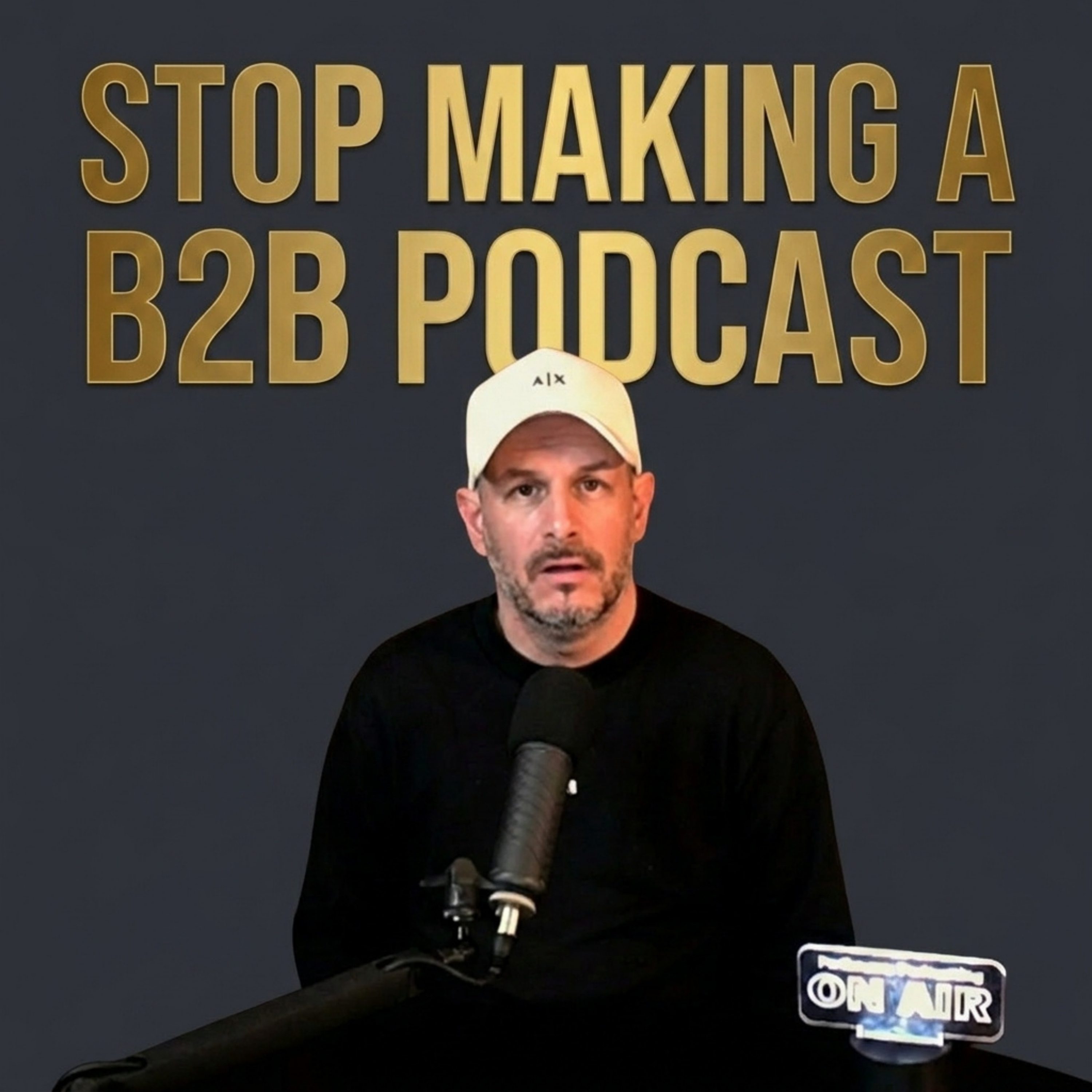
Stop Making a B2B Podcast! Start Making a SALES Podcast.

B2B Podcasting Insights - business strategy podcast for founders and brands

If your B2B podcast sounds "fine" but nothing ever really seems to come off the back of it, the problem probably isn't the content. It's the label. You need to stop making a B2B Podcast and start proactively designing your sales podcast.

"B2B podcast" has slowly come to mean a very specific thing. And the moment a show accepts that label, it's off the hook commercially. It doesn't have to do a job. It just has to exist.

I'm Neal Veglio, and in this episode of B2B Podcasting Insights, I'm making the case for a completely different framing: the sales podcast.

Not a salesy podcast.

Not a weekly advert with a theme tune.

A show deliberately designed to accelerate a buying decision your ideal customer is already edging toward.

Useful links

Podknows Website

https://podknows.co.uk

Sales Podcast Self-Audit (one-page PDF)

https://podknows.co.uk/sales-podcast-test

B2B Podcast Growth Diagnostic

https://podknows.co.uk/diagnostic

Podcast Audits

https://podknows.co.uk/audits

Timestamped summary

00:00 A B2B podcast parody

01:32 Why "B2B podcast" has become the wrong label

02:38 A LinkedIn company page with a microphone

03:24 What a sales podcast actually is (and isn't)

04:09 Why marketers flinch at the word "sales"

05:51 The B2B dodge and its commercial cost

08:14 The three-question sales podcast test

11:23 What changes when your podcast earns its keep

13:38 Pre-sold prospects and a shorter pipeline

15:00 Why most B2B podcasts were built to fail

16:08 Founder FAQ — Gareth on first-episode nerves

17:54 Quick tip — your cover art isn't a logo

19:13 The Sales Podcast Self-Audit and next steps

2026-04-18 19 min Transcript 12 chapters

Available Results

Generated results are saved to the knowledge database for reuse and search.

No generated results are available for this episode yet.

Extract Knowledge

Pick what you want extracted first. Model, scope, and chapter options appear after a template is selected.

Generated results for public episodes are saved to the knowledge database so they can be reused and searched later.
Speaker:
00:00:00
Welcome back to Business Talks with Business People for Business
Speaker:
00:00:03
People, where we talk business talks
Speaker:
00:00:07
about business people. This week we're taking a
Speaker:
00:00:11
deep dive into the digital transformation in
Speaker:
00:00:14
a post pandemic post SaaS landscape.
Speaker:
00:00:18
My next guest needs no introduction, but I'm going to spend the next four
Speaker:
00:00:22
minutes doing so anyway because that's what we do on
Speaker:
00:00:26
B2B podcasts. Cut.
Speaker:
00:00:29
Cut it. The whole thing. Cut, cut.
Speaker:
00:00:34
Nobody will buy from you with this podcast. You've just made
Speaker:
00:00:38
something tedious. Barely anyone will listen and watch.
Speaker:
00:00:43
Welcome along to B2B Podcasting Insights with me, Neal Veglio,
Speaker:
00:00:47
the founder of Podknows Podcasting, a podcast
Speaker:
00:00:50
agency which helps brands and
Speaker:
00:00:54
solo operators, solopreneurs, whatever you want to call them,
Speaker:
00:00:59
lonely old business folk so they can get better results from their
Speaker:
00:01:02
podcast. All right, let's have a grown up conversation
Speaker:
00:01:06
here about something I see people commonly
Speaker:
00:01:10
kind of approaching wrongly. It's something which sabotages
Speaker:
00:01:14
podcasts for many years. If you don't identify the
Speaker:
00:01:18
problem and get on top of it really quickly, it's
Speaker:
00:01:21
labeling your show a B2B podcast. I
Speaker:
00:01:25
know. Bit of a weird thing to pick a fight with, isn't it? Especially as
Speaker:
00:01:28
this show is called B2B Podcasting Insights.
Speaker:
00:01:32
Trust me, that's a search friendly
Speaker:
00:01:36
term only for this show. And I'm gonna get to
Speaker:
00:01:40
exactly why that is in a moment, so stay with me.
Speaker:
00:01:43
Now, somewhere along the way, B2B
Speaker:
00:01:47
podcast stopped, meaning a
Speaker:
00:01:51
podcast made by a B2B business for B2B buyers.
Speaker:
00:01:55
And it actually started meaning something a little bit more
Speaker:
00:01:58
specific. It started meaning a podcast
Speaker:
00:02:02
where someone, probably a founder, will sit down and either
Speaker:
00:02:06
share insights in a monologue or interview other
Speaker:
00:02:09
B2B founders and talking about industries in a
Speaker:
00:02:13
very polite way, not particularly meaningful, but
Speaker:
00:02:17
very balanced, very considered, very press,
Speaker:
00:02:21
sound bitey. And during those shows, under no
Speaker:
00:02:25
circumstances do we ever mention that
Speaker:
00:02:29
we'd like the listener to buy from us, because that would
Speaker:
00:02:33
be gauche. I love the word gauche. Wonder what
Speaker:
00:02:36
the color of gauche would be. Anyway, that's not a B2B
Speaker:
00:02:40
podcast. That's a LinkedIn company page with
Speaker:
00:02:44
a microphone. And that's what you're
Speaker:
00:02:47
probably making, whether you like it or not. The thing that you
Speaker:
00:02:51
should be making, and the thing I'm going to make the case for
Speaker:
00:02:55
over the next few minutes to you directly is a sales podcast.
Speaker:
00:02:59
Now note I said sales podcast,
Speaker:
00:03:02
not salesy podcast. Let me be clear here.
Speaker:
00:03:07
I'm not talking about a pitch fest. I'm not talking about a weekly
Speaker:
00:03:10
advert or fortnightly advert or monthly advert, depending on your
Speaker:
00:03:14
cadence, that mentions your
Speaker:
00:03:18
services and your brand and your business every two minutes
Speaker:
00:03:22
and ends with anyway. If any of that sounded good to you,
Speaker:
00:03:26
then blah, blah, blah, blah, blah. Buy my stuff. When
Speaker:
00:03:29
I say sales podcast, I mean it in the way
Speaker:
00:03:33
that it is a show where every
Speaker:
00:03:37
episode has been deliberately designed to accelerate
Speaker:
00:03:41
a particular decision to be made by
Speaker:
00:03:45
your ideal customer listener. It's a way to
Speaker:
00:03:49
amplify inbound conversion. But those people need
Speaker:
00:03:52
to already be circling you. We have the
Speaker:
00:03:56
capital ready for you right now. So every episode
Speaker:
00:04:00
has one job, one direction
Speaker:
00:04:03
and one ideal outcome. Every
Speaker:
00:04:07
single episode. Here's the bit that's
Speaker:
00:04:10
generally really funny to me.
Speaker:
00:04:13
Marketers, whose job it is to literally
Speaker:
00:04:17
market the thing that they use to generate
Speaker:
00:04:21
revenue. Marketers hate the word sales. They've been
Speaker:
00:04:24
conditioned to believe that the word sales
Speaker:
00:04:28
is aggressive, loud,
Speaker:
00:04:32
needy. Sales is the desperate cousin that turns up at the
Speaker:
00:04:36
family wedding and tries to sell everyone Ann Summers and
Speaker:
00:04:39
Betterware and Avon tries to get them on their
Speaker:
00:04:44
Amazon affiliate pyramid scheme. Whereas
Speaker:
00:04:47
marketing is the sophisticated one. Marketing
Speaker:
00:04:51
turns up wearing the nice suit and has the color coordinated
Speaker:
00:04:54
Filofax in their pocket just in case. So when someone like
Speaker:
00:04:58
me suggests that a branded podcast should play the part of
Speaker:
00:05:02
a sales asset, there's a visible twitch of nervousness,
Speaker:
00:05:06
of reluctance, of oh no,
Speaker:
00:05:09
gauche. We can't be seen to be selling. That would ruin
Speaker:
00:05:13
our brand. That would alienate our audience. It would be
Speaker:
00:05:17
awful. Stop for a minute, would you? Just listen to yourself.
Speaker:
00:05:20
The business you work for exists to sell something, whether that's
Speaker:
00:05:24
your business or you're a decision maker in
Speaker:
00:05:28
somebody else's business. The whole point of that business
Speaker:
00:05:32
is to sell to generate revenue,
Speaker:
00:05:36
to build profits so that you can survive
Speaker:
00:05:40
and the people that you have within your business
Speaker:
00:05:43
can also survive. Pay the rent, pay the mortgage, pay the
Speaker:
00:05:47
bills, enjoy themselves now and again, go to the cinema.
Speaker:
00:05:51
None of that happens if you don't sell. And every piece of content
Speaker:
00:05:55
that you produce within that business, whether it's this podcast
Speaker:
00:05:58
or a YouTube or social media or your
Speaker:
00:06:02
newsletter, all of that is produced
Speaker:
00:06:06
ultimately in service of that end. And pretending
Speaker:
00:06:09
otherwise is not being high minded. It's just
Speaker:
00:06:13
expensive. It's costing you a fortune. So the dodge has become
Speaker:
00:06:17
this, oh no, no, no, no, no, we're not making a sales podcast.
Speaker:
00:06:21
No, we're making a B2B podcast. We're making a
Speaker:
00:06:24
branded podcast with a B2B intent.
Speaker:
00:06:28
And the B2 to be gives people
Speaker:
00:06:32
permission to ignore the commercial job
Speaker:
00:06:35
that the thing has. It's kind of a get out clause.
Speaker:
00:06:40
It says, look, we don't have to justify any of
Speaker:
00:06:43
this that we're making here with results because it's a
Speaker:
00:06:47
B2B podcast and B2B podcasts are content
Speaker:
00:06:51
and they're about the industry and about us being thought
Speaker:
00:06:55
leaders and brand awareness. Yeah,
Speaker:
00:06:59
about that. Let me be really clear about what I'm saying here.
Speaker:
00:07:03
Let's leave no waters muddy. I'm not saying that
Speaker:
00:07:06
every episode should end with a five minute sales pitch.
Speaker:
00:07:11
I'm not saying you should hard sell any cold open. I'm not saying you should
Speaker:
00:07:14
name drop your products and services every 40
Speaker:
00:07:18
seconds like some cursed corporate
Speaker:
00:07:22
idiot. A sales podcast, in the way that I'm defining
Speaker:
00:07:26
it, is kind of the conversation
Speaker:
00:07:29
that a genuinely brilliant person at your company who
Speaker:
00:07:33
knows a lot, is great at talking to customers. A
Speaker:
00:07:37
conversation they'd be having if they were sitting down
Speaker:
00:07:40
in a room with a prospect who was pretty much 70%
Speaker:
00:07:44
sure that they wanted to buy your products or your services. The kind
Speaker:
00:07:48
of conversation where the prospect walks away, heads back home or
Speaker:
00:07:52
to their office, and thinks to themselves, yeah,
Speaker:
00:07:56
these are the people I want to work with. I don't really need to shop
Speaker:
00:07:59
around anymore. It doesn't sell at them.
Speaker:
00:08:03
It just removes any friction they might still have
Speaker:
00:08:07
from signing an agreement with you. Think about that
Speaker:
00:08:10
distinction, because that's exactly what we're talking about here.
Speaker:
00:08:14
It's the whole game. The traditional B2B podcast
Speaker:
00:08:18
tries to convince strangers. The sales
Speaker:
00:08:21
podcast removes any remaining lingering doubt
Speaker:
00:08:25
from the almost ready to buy that are lingering in
Speaker:
00:08:29
the podcast apps or on your YouTube channel, loving the
Speaker:
00:08:32
content you're putting out. One of those methods is a
Speaker:
00:08:36
license to print money, sustain your business, grow
Speaker:
00:08:40
and become the brilliant, brilliant company that you
Speaker:
00:08:44
know you need to be. The other is a conveyor belt of hope.
Speaker:
00:08:48
Let's talk about the three question test that I put every
Speaker:
00:08:51
B2B podcast through to figure out whether or not they
Speaker:
00:08:55
are genuinely making their podcast have a job. Go
Speaker:
00:08:59
back to my episode about what job does your podcast do? To
Speaker:
00:09:02
find out more about that. Here's how you tell the difference. Take
Speaker:
00:09:06
your last three episodes, your most recent three episodes. Not what
Speaker:
00:09:10
you plan to record, but what's already out there in the RSS feed
Speaker:
00:09:14
on Apple podcasts on Spotify, and ask yourself these three
Speaker:
00:09:18
questions. 1. Does this episode
Speaker:
00:09:21
serve a specific buying trigger? Not a topic, not
Speaker:
00:09:25
a theme, a buying trigger. A moment where prospect has
Speaker:
00:09:29
thought to themselves, oh God, yeah, what
Speaker:
00:09:33
I was doing isn't working. I really need some help? If the
Speaker:
00:09:36
answer is eh, kinda maybe
Speaker:
00:09:40
in a general way, then it's a no.
Speaker:
00:09:44
Question 2 could a prospect comfortably
Speaker:
00:09:48
bring an episode of yours into
Speaker:
00:09:52
an internal conversation within their own business where they're talking about
Speaker:
00:09:56
buying something? Could they present that to their boss
Speaker:
00:09:59
and say this is why I want to hire these people,
Speaker:
00:10:03
or would that feel embarrassing for them because
Speaker:
00:10:07
the episode is too generic, doesn't get to the point, it's kind of
Speaker:
00:10:10
meandering and it's too light and too safe to be
Speaker:
00:10:14
quoted by any decision maker as evidence of a
Speaker:
00:10:18
reason to buy. Question 3 By the end of the
Speaker:
00:10:22
episode, is the next step obvious for them to take?
Speaker:
00:10:26
Is it clear? Is it singular? You know, not check us out on
Speaker:
00:10:30
our website, not follow us on LinkedIn.
Speaker:
00:10:34
Just one clear place they need to go to to find out more.
Speaker:
00:10:38
Take that next step in their relationship from
Speaker:
00:10:41
being an anonymous listener or consumer of your content to someone
Speaker:
00:10:45
that could be in a position to reach out and buy. And
Speaker:
00:10:49
does it give them a reason why why they need to take that next step
Speaker:
00:10:52
with you? Now, if you've answered with yes three times, you got a
Speaker:
00:10:56
sales podcast. Well done. Two or fewer and you've got a pretty
Speaker:
00:11:00
wishy washy industry podcast, a B2B podcast in the
Speaker:
00:11:03
truest sense of the word, that's just operating very
Speaker:
00:11:07
politely and doing not very much at all for your business. By the way, if
Speaker:
00:11:10
you want to run this test for yourself properly, across
Speaker:
00:11:15
all the questions I've shared and more, I built a one page
Speaker:
00:11:18
self audit for you. I'll give you more on that in a minute.
Speaker:
00:11:22
Here's the thing. When you start building episodes with this in mind, with
Speaker:
00:11:26
this outcome designed in the process, when you accept that
Speaker:
00:11:30
your podcast's job is to accelerate inbound
Speaker:
00:11:33
conversions for those people who are already in your
Speaker:
00:11:36
circle, then the whole thing changes for you. And
Speaker:
00:11:40
I don't just mean the content, I mean what
Speaker:
00:11:44
happens with and around your podcast. Your
Speaker:
00:11:47
sales team starts using it confidently, adding it to email
Speaker:
00:11:51
signatures, sharing episodes with would be
Speaker:
00:11:54
prospects they want to get on the phone or in email. It becomes
Speaker:
00:11:58
a specific sales asset, a weapon.
Speaker:
00:12:02
You know you mentioned on our call last week that you are
Speaker:
00:12:05
struggling with X
Speaker:
00:12:10
and episode 11 of our podcast actually covers this off. That's the
Speaker:
00:12:14
sales podcast earning its keep. When you know that your podcast
Speaker:
00:12:17
is working, your prospects start quoting it back to you.
Speaker:
00:12:21
I listened to your episode about why and that's
Speaker:
00:12:25
exactly what we're dealing with. When can we sit down and have a chat about
Speaker:
00:12:28
this? When can we start? That's a sales podcast doing the
Speaker:
00:12:32
job. And it's the same as essentially doing the job of
Speaker:
00:12:36
having three discovery calls in one hit. Just one
Speaker:
00:12:40
download, just one listen. If this is working, then your
Speaker:
00:12:43
marketing team stops panicking about reach and starts paying attention
Speaker:
00:12:47
to the behavior of customers that are getting in touch.
Speaker:
00:12:51
Who's binge listening? Which episodes are being shared, you
Speaker:
00:12:55
know, inside the prospect's own company? Which ones are being
Speaker:
00:12:58
quoted back on our sales calls? That's a signal. We talk
Speaker:
00:13:02
about signals all the time in marketing. It's a
Speaker:
00:13:06
real signal. It's not a download. It's not even a listen. It's a signal.
Speaker:
00:13:10
It's evidence of customers wanting to buy from you.
Speaker:
00:13:14
And here's the thing that really matters that nobody considers
Speaker:
00:13:18
when they're just churning out content that they're calling a B2B podcast,
Speaker:
00:13:22
your close rates change. Not because the
Speaker:
00:13:26
podcast is converting cold strangers. No, it isn't.
Speaker:
00:13:29
It's not meant to. If your podcast is doing its job,
Speaker:
00:13:33
it's nurturing people from the top all the way down to that
Speaker:
00:13:37
sales conversation. But if it's working, by the time that
Speaker:
00:13:41
a prospect gets in front of your salesperson,
Speaker:
00:13:44
a huge chunk of the heavy lifting is already done. They've heard you think
Speaker:
00:13:48
they've heard what you got to say about matters. They've heard you disagree with
Speaker:
00:13:52
industry consensus. It's a big part of why my show
Speaker:
00:13:55
works, the one you're listening to right now. Because I don't go along with
Speaker:
00:13:59
the industry norms, I challenge them. Doesn't make me popular.
Speaker:
00:14:03
But it does mean my prospects totally trust that I know what I'm
Speaker:
00:14:07
talking about. If they've heard you be specific about a problem that
Speaker:
00:14:10
they're currently in, they're arriving pre sold. That's
Speaker:
00:14:14
what inbound conversions actually look like when your
Speaker:
00:14:18
sales podcast is doing its job and working properly.
Speaker:
00:14:22
Not a flood of cold leads. A steadier, shorter,
Speaker:
00:14:25
high quality pipeline where everyone who's showing
Speaker:
00:14:29
up is already sold or at least halfway to signing with
Speaker:
00:14:33
you. Here's the awkward bit that nobody wants to admit. Most
Speaker:
00:14:36
B2B podcasters aren't accidentally failing to do
Speaker:
00:14:40
this. They've been built on purpose in a way
Speaker:
00:14:44
that makes it impossible. They've been built to avoid
Speaker:
00:14:47
looking too commercial, to avoid upsetting anyone,
Speaker:
00:14:51
to avoid having a point of view strong enough to stand for something
Speaker:
00:14:54
and actually move anyone off of a fence. And the result is exactly
Speaker:
00:14:58
what you'd expect in that scenario. A show that nobody hates,
Speaker:
00:15:02
which is also a show that nobody buys from. If your podcast wouldn't
Speaker:
00:15:06
make anyone in your industry slightly uncomfortable, it's not
Speaker:
00:15:10
doing its job. Here's the way to look at it. If it couldn't
Speaker:
00:15:13
possibly ever cost you any deal, then is definitely
Speaker:
00:15:17
also not winning you one. A sales podcast has a spine.
Speaker:
00:15:21
It takes a position on things. It names a problem
Speaker:
00:15:24
specifically enough that the right listener feels seen and
Speaker:
00:15:28
heard and the wrong listener moves on, blocks you
Speaker:
00:15:31
and ignores you for life. Great. We didn't want them
Speaker:
00:15:35
anyway. Still a bug in the matrix. It's the whole
Speaker:
00:15:38
damn point. I hate your
Speaker:
00:15:43
podcast. Whoa.
Speaker:
00:15:49
Each episode I answer a question that's landed in my inbox from someone
Speaker:
00:15:52
running or launching a B2B podcast. You can send yours to
Speaker:
00:15:56
neal@podknows.co.uk, that's n e a l at p
Speaker:
00:16:00
o d k n o w s dot co dot uk. this one's
Speaker:
00:16:04
from Gareth, who runs operations at a B2B services firm in Cardiff.
Speaker:
00:16:08
He says, neil, I'm recording my first episode next week and I'm already losing sleep
Speaker:
00:16:11
about it. Every time I do a practice take, I freeze the second
Speaker:
00:16:15
the red light comes on. Any advice before I completely embarrass myself on
Speaker:
00:16:19
my own podcast? Gareth? First of all, breathe. Secondly,
Speaker:
00:16:23
the nerves aren't the problem here. The cause of them is you're
Speaker:
00:16:26
nervous because you're trying to sound like a podcaster. And
Speaker:
00:16:30
we can tell, everyone starts out doing this.
Speaker:
00:16:34
You got a voice in your head that's this, like, weird hybrid of
Speaker:
00:16:38
every presenter, every podcast you've ever heard, and you're trying to merge them all together
Speaker:
00:16:42
and make your own version of that. Don't impersonate people.
Speaker:
00:16:46
You're not Stephen Bartlett or Joe Rogan. Thank God
Speaker:
00:16:50
you're Gareth from Cardiff, who knows his industry inside
Speaker:
00:16:53
out. And that is the person that people are going to press play to hear,
Speaker:
00:16:58
not an imitation. Two practical things for you. Number one,
Speaker:
00:17:02
before you record, pick someone real, like a colleague, a
Speaker:
00:17:05
mate, a client that you actually like and pretend you're
Speaker:
00:17:09
explaining the thing to them, not to a general audience.
Speaker:
00:17:13
The audience is a collective, made up noun that makes you go
Speaker:
00:17:16
weird on a microphone. A specific person in mind doesn't.
Speaker:
00:17:20
Number two, stop listening back to the first 30 seconds of your
Speaker:
00:17:24
takes, then the worst 30 seconds. I'm serious, that's
Speaker:
00:17:28
where everyone sounds awful, including me, more than 20 years
Speaker:
00:17:32
in. that point, you're still getting into your stride, getting into
Speaker:
00:17:35
your flow. Start your listening back from about minute two, you'll
Speaker:
00:17:39
realize you sound better than you think. Oh, and the final thing,
Speaker:
00:17:43
the red light doesn't know anything about you. It's a
Speaker:
00:17:46
diode. It can't judge you. You're allowed to ignore it.
Speaker:
00:17:51
Quick tip for this episode and it's about your cover art. Your
Speaker:
00:17:54
podcast cover art is not a logo. I see this constantly. A
Speaker:
00:17:58
B2B company shoves their logo on a podcast
Speaker:
00:18:01
Canva slide and calls it the podcast cover.
Speaker:
00:18:06
They even put a microphone next to it. That's not cover art. That's
Speaker:
00:18:09
company stationery. Cover art has two jobs. Neither of them are
Speaker:
00:18:13
corporate. Job one Tell a human being in a
Speaker:
00:18:17
thumbnail the size of a postage stamp what the show's about and who it's
Speaker:
00:18:20
for. Job number two Be legible enough to
Speaker:
00:18:24
match the Apple podcasts and Spotify search indexing
Speaker:
00:18:28
and show somebody that's scrolling for a particular
Speaker:
00:18:31
search term that this is the show for them. Your company logo
Speaker:
00:18:35
tells them neither of these things, right? If any of this has landed
Speaker:
00:18:39
if you've been listening to this episode, realizing that your show is a well
Speaker:
00:18:42
produced industry podcast and not a sales podcast,
Speaker:
00:18:46
I built you something for it. It's called the Sales Podcast Self
Speaker:
00:18:50
Audit. It's a one page PDF with seven yes or no
Speaker:
00:18:54
questions. You run your last three episodes through it. You score it honestly,
Speaker:
00:18:57
and by the end you'll know exactly where your show sits on the
Speaker:
00:19:01
scale between inbound conversion machine and expensive
Speaker:
00:19:05
LinkedIn content filler. You'll find it at
Speaker:
00:19:07
podknows.co.uk/sales-podcast
Speaker:
00:19:11
test. That's P
Speaker:
00:19:14
O D K N O
Speaker:
00:19:17
W S dot co dot uk slash sales dash podcast dash test.
Speaker:
00:19:21
The link is in the episode description. Until next time, stop
Speaker:
00:19:25
making an industry podcast that hides behind the word
Speaker:
00:19:28
B2B. Start creating a sales asset
Speaker:
00:19:32
that earns its place in your overall company pipeline. Talk
Speaker:
00:19:36
to you on the next episode.